
July 14, 2023 / 2 Comments

While in Egypt…

Okay, so…

I’ve been fascinated with ancient Egypt since I was very little. Not sure what sparked it, but by the time I was ten I could rattle off the names of a dozen Egyptian gods and their relationship to one another. My fifth grade science fair project was a model pyramid with numerous “reconstructed” tools and a chart of heiroglyphs.

Many years back I was dating a woman and maybe a month into our relationship she mentioned she was going to Egypt in a few months. Would I want to come along? Spend a few weeks traveling Egypt with her?

I tried not to seem too desperate when I said yes.

As someone who grew up in New England, I was used to the idea of having history around you. Not just grandpa’s history or old family history, but serious history. Lots of buildings and landmarks in my hometown in Maine date back to the early 1700s, and the town’s history goes back even further.

But wow… getting to Egypt? There is HISTORY there. Thousands of years of it. I wasn’t ready for the crushing awe of it. And the scale of it. It’s one thing to read about how big some of these monuments are, to see them on television, but you honestly can’t grasp the size of them until you’re right there. Or in some cases, until you realize what you’re seeing in the distance.

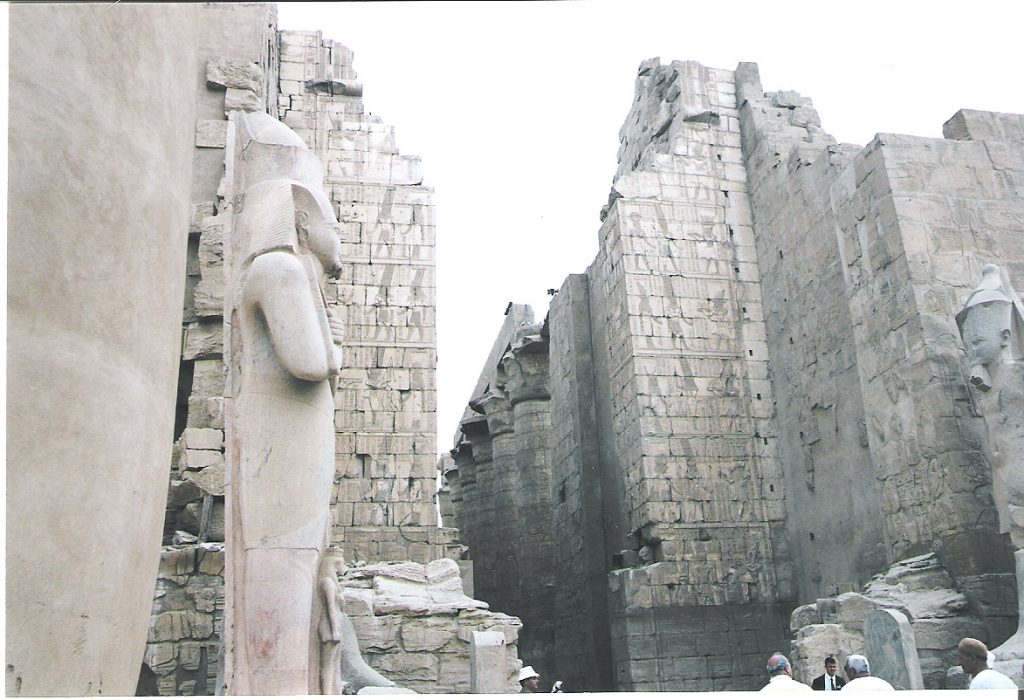
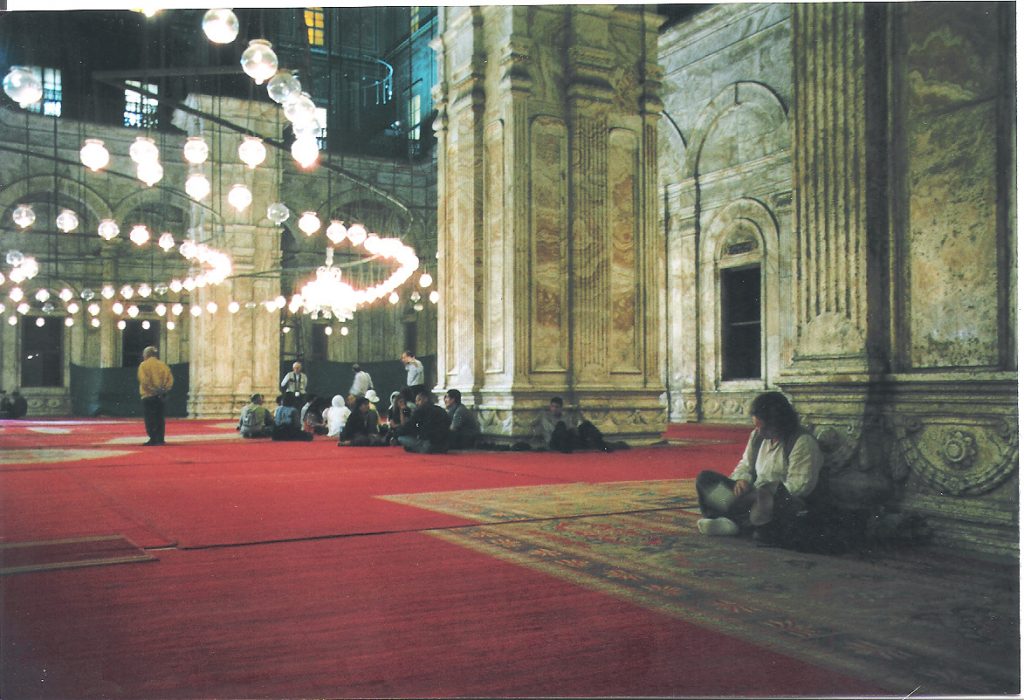
I was very lucky that we had no set schedule, so we could go somewhere and just… spend the day. We traveled from Cairo down to Aswan. Stopped for several days in Luxor. I’d just stare at temple walls, statues, and sometimes tombs. One time I just sat for an hour or so on a small cliff above the Valley of Kings and watched boats on the Nile.

Anyway, another thing I saw a lot of in Egypt was folks who spent a lot of time… well, today we’d probably say “taking selfies.” They’d pose in front of this or that, stand with this guide or that guard or hey, look, a camel! And then they’d race off to find the next thing to take a picture with.

It took me a while to realize these folks weren’t really interested in seeing Egypt. They were more interested in telling people they’d been to Egypt. They wanted to show off the photos and tell stories. For them, it was more about the secondary aspects of taking the trip. The after-effects, if you were.

So, while I’m sure this is incredibly fascinating to some of you, I’m sure far more are wondering what all this has to do with writing?

When we talk about writing, I think one thing that gets skimmed over a lot is what our actual goals are. What do we want out of this? Our endgame, so to speak. And this is important because if I don’t know what my real objective is—or I’m not being honest with myself about it—it’s going to be tough to find the right path to reach it.

Like, I’m willing to bet at least one of you reading this has thought “the goal is to get published.” Okay, cool. But what does that actually mean? Do I just want to be able to say someone paid me for a story and it saw print? That’s cool. I think for some folks there’s a degree of validation that comes with getting published, and maybe that’s all they need.

Maybe I just want to tell stories. That’s all that matters. Getting these ideas and situations and conversations out of my head and down on paper (down on electromagnetic bubble? Down on flash drive?) and sharing it with the world somehow. Or not sharing it. Maybe I just write because it’s what I do and it’s therapeutic on some level. Maybe I write a ton of stuff that nobody will ever see, and I’m totally cool with that. Nothing wrong with that.

Or am I hoping to maybe make money? Nothing wrong with that, either. More than a few folks write as a sort of side job. They’ve got their full-time career and writing’s what they do on weekends or the occasional late night, selling a short story or novella or even a full book. Or maybe the goal is to make writing itself the full-time career. To make enough money stringing words together that I can pay my bills, live in semi-comfort, and don’t need to do anything else.

But maybe the money’s irrelevant, and so’s publication. What I really want is for people to recognize that I’m good at this. Very good. Masterclass good. Maybe I want the accolades and the starred reviews and the numerous awards where I get to stand in front of people who understand how talented I am.

Or look, maybe I just want to be a writer because I want to be part of the club. That group gathered at the bar at the con. Those people online making clever comments to each other. I want to be in with them, and maybe I want people to look at me the way they look at those folks. It might sound a little silly but there are clearly people who only want to be writers for this… the same way those folks only wanted to say they’d been in Egypt. The want the destination, not the journey.

(yes, this may be me talking about a current hot topic)

Y’see, Timmy, there’s a ton of different reasons I may want to write. And whichever one is my reason… that’s fantastic. But I think it’s important to be aware of why I’m doing this. Because there are a lot of paths open to writers these days, and I don’t want to spend time and energy on a path that’s taking me away from what I really want.

So be honest. With other folks and yourself. What do you want?

Next time…

Actually, before I talk about next time, I wanted to bounce something off you. How many of you use the “categories” there on the side (also sometimes called tag or labels or…)? I was thinking of paring the list down a bit to make it easier to use. None of the tags will actually go away, they just won’t be in that list anymore. I was thinking I’d snip out all the proper names—nice easy way to lose twenty or thirty lines, and it’ s probably one of the least-used ways to search for things, yes?

Anyway…next time I’d like to talk a little bit about the devil. Specifically, the one in the details.

Until then, go write.

July 6, 2023 / 5 Comments

My Left Foot

Sorry I missed last week. Was up against a deadline (which I ended up sort of hockey-stopping past anyway). Plus, I feel like… I mean, is it just me, or in a way does it feel like we’re all relearning the internet right now? One of the biggest social media site in the world’s collapsing and people are trying to figure out what to do now. Run to a new social media site? Focus on the personal site? Abandon the internet and start training carrier pigeons on the roof of your apartment building?

That’s how it feels to me, anyway.

But it’s given me time to think about a few things…

I want to bounce an idea off you. Another way to think about plot and story. I’ve talked about these things once or thrice before. To go back to my oft-referenced Shane Black-ism, plot is what happens outside my characters, story is what happens inside my characters.

Today, I’d like to frame this in a different way, though. This idea crossed my mind, and the more I think about it, the more right it sounds and feels. To me, anyway.

Allow me to explain. And we’ll do it the best way possible. With a little story.

Let’s say I decide to lose thirty pounds. As of tomorrow, I exercise more, eat better, maybe cut back on the booze a bit. I do this for five or six months and wow—thirty pounds, gone.

So what’s happened here, from a storytelling point of view?

Well, simply put, I set out to do something and… I did it. It’s technically a plot, but not much of a plot. Not much story either. With no real conflicts or hangups, there isn’t a lot of room for self-discovery. So no real character arc.

Plot is conflict. It’s forcing my characters out of their comfort zones, into these fish-out-of-water sort of situations. And these are the situations where story happens.

So what’s story?

Well, if story’s what goes on inside my character, that would mean a character arc is a change in my character. An alteration of their views. Cowards become brave. The miserly become generous. The self-centered become sympathetic to others. Or vice versa—nobody said character arcs have to be positive. Lots of heroes have become villains, lots of good folks have been pushed to do horrible things.

Put another way, story is why I decided to lose 30 pounds. Did I do it for health reasons? For image reasons?

It’s very easy to have plot without story. Hollywood’s shown us that again and again. Hell, life shows us that all the time. I bet all of us here personally know one or two people who simply will not change their views—they won’t grow or advance in any way—no matter what they see, what they experience, what they do.

I’ve also talked once or thrice about “character-based” books and films, the ones that scoff at the idea of plot in favor of beautiful tales where… well, nothing happens. People sit around and have long talks and then… don’t change. Or they go through some very artificial, forced “growth.”

Thing is, nobody decides to change their views on their own. None of us ever wake up one morning and think “hey, maybe I should completely reverse my views on student loan forgiveness.” Nobody randomly decides to become a serial killer in the shower. We’re influenced by things outside of us. Around us. The people and events we’re exposed to, the things we endure, are what make us see the world in a different light. The external events motivate the internal changes.

Going back to my initial example. So I lost 30 pounds. Why? And why now? Obviously I’d been okay with my physical condition until now, so what made me suddenly decide to drastically cut my weight? Maybe someone died and made me realize I’ve got a lot of unhealthy habits that need to change? Perhaps I finally get to meet that online crush and worried what are they going to think of the real me? Maybe someone died and I realized I needed to become a rooftop-dwelling vigilante who haunts the night. What was it that got me thinking about losing weight?

I think plot tends to be active, but story tends to be a bit more reactive. We actively participate in the plot, but story kinda just… happens to us. We don’t have as much control over it. The reason so many of those artsy tales have poor stories is specifically because they don’t have a plot. There’s nothing new or different happening to encourage that internal change.

Y’see, Timmy, plot is the effect my characters have on the events, but story is the effect the events have on my characters. They push each other along. Like when I walk—pushing off the right foot lets the left foot move forward, pushing off the left foot lets the right foot move forward, and so on. if I try to move with just one foot it can get a little… erratic. And there’s a decent chance I’ll just faceplant.

Anyway, that’s what I’d like you to think about as you poke at your own manuscript. If I’m going to skimp on plot, what’s going to cause those inner changes? Do I have a real story, or is it just a forced, false change of view? And if all I’ve got is plot… why is anyone doing anything? What kind of arc do they have?

Next time…

Look, I’ll be honest. I feel like I’ve been rambling a bit and there hasn’t been a ton of feedback since pulling the ranty blog over here. Is everyone just happy with the rambling? Is no one reading this? Is it more of that online ennui I was talking about up top? Let me know something. Anything. A topic you might like or even one you’re sick of hearing about all the time. And if nobody says anything… maybe I’ll just talk about my trip to Egypt.

Until then, go write.

July 3, 2023

June Newsletter

(which I should’ve posted last week, but wow, so much stuff going on–more on that next time)

And here we are, halfway through the month again. I know it sounds a bit odd, but even just doing this once a month I’m a little worried some of you are feeling spammed. I know this newsletter is just bare-bones updates, and padded ones at that, but I’m trying hard not to make this content for the sake of content, if that makes sense? Let me know if you think this is coming too often for what you’re actually getting out of it..

This may also be some sort of gut/defensive reaction. Some folks manage to put out one or two newsletters a week. It sometimes makes me feel like I’m not writing fast enough. Or not enough happens in my life worth talking about. Or maybe the ever popular “why not both.”

Anyway… let’s get to it.

I finished up the last tweaks on GJD just the other day. Many thanks to Stephen, Kristi, Rob, Autumn, Robyn, and Colleen for early thoughts and notes. Final word count, after this quasi-final round of edits and rewrites, was just shy of 168K.

As you’re reading this, it’s very likely my agent is kicking back with his copy of said manuscript. We talked about it a while back and he’s seen my early outline, but other than that it’s all new for him. In a perfect world, he has minimal thoughts or comments and maybe he’ll be shopping it around before the end of summer.

Meanwhile, I’m finally going to get to that short story I’ve mentioned once or thrice which is now pushing up against a deadline (sorry, Henry!!). And then back to TOS, the other project I’ve mentioned before. My big hope is I can get the first draft of TOS done by the end of July which… isn’t impossible? I’ve got a solid outline, but it’s a story that lends itself to a sort of rambly, campfire-tale sort of tone. In the best possible way. So I guess we’ll see how that goes.

Also probably worth mentioning… okay, because of my time working in Hollywood (and then my time reporting on Hollywood) I’m very aware of what different terms mean and I know how rare it is for things to move forward. It’s why I don’t talk about any of it much unless I know there’s actually something to talk about. I’ve had maybe half a dozen film options at this point. None of them went anywhere. You heard about some of them after the fact.

I bring this up because there’s currently an option out there and, because of the WGA strike (which I support 110%), the producers have exercised certain clauses in the contract that allow them to stop the clock, so to speak. See, options have built in time limits. Think of them like a one-year rental contract. When the year’s up, that’s it. You don’t get to say “well, I went on vacation for two weeks, so I shouldn’t have to pay rent for those weeks I wasn’t living there.” These folks are very interested in what they’ve got (and so am I) so they’re putting everything on hold and will restart that clock once they can, y’know, hire some screenwriters again.

What is it? Who are these mysterious “producers” of which I speak? Like I said above… I’d like to wait until I can tell you something really solid. For now, you’ve absolutely heard of the producer/ director/ studio and you’ll probably be happy about what they’re trying to adapt.

Once the WGA strike is over.

Anyway…

Cool Stuff I’ve Been Watching— A lot of movies. Into The Spider-Verse was simply magnificent, as was Guardians of the Galaxy vol. 3. I held off sending this out just so I can say, honestly, that the second season of Strange New Worlds is off to a friggin’ fantastic start.

Cool Stuff I’ve Been ReadingWalking the Dusk by Mike Robinson, Lower Decks by Ryan North and Chris Fenoglio.

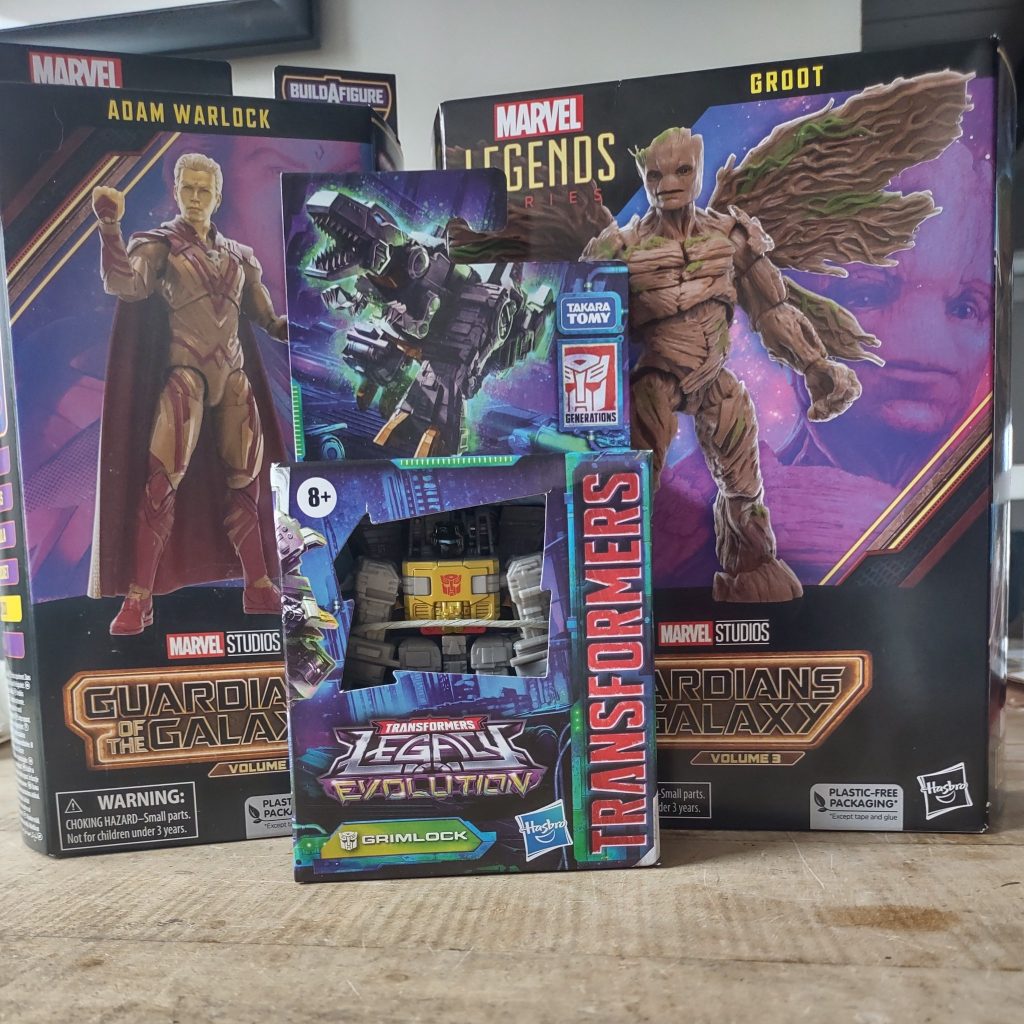
Cool New Toys – My wonderful partner gave me a Grimlock and the Deluxe “Buff Groot” figure for my birthday, and my best friend gave me Adam Warlock. That gives me a full set of Guardians. Also got a small pile of Spider-Verse figures. Now I just need to figure out how to display them all…

Last week I ended up finishing the editing/feedback draft of my new project (as mentioned in the newsletter), which meant I woke up Thursday morning and said “crap, I need to write a ranty blog post!” But as I started hammering away at it I quickly realized this topic wasn’t quite as quick and easy as it was in my head. So it didn’t get done Thursday. And Friday is errands. And now it’s the weekend again and okay look, I missed a week.

Anyway, I’ve talked about worldbuilding here once or thrice before, but I thought it’d be worth revisiting a certain facet of it that I talked about on Twitter a month or four back.

And that facet involves my time machine.

Well, okay, let’s back up a bit.

We’ve all read stories that revolve around some shiny-new technology. Supercomputers. Self-aware androids. Teleportation machines. Dimensional gateways. They’re the basis of so many books, comics, television shows, movies, games, and probably some other storytelling format I can’t think of. Oral tradition? Probably lots of androids in those eastern European folk tales that are verbally passed down through the generations.

I think we can all agree that having some kind of future/super technology as the basis my story is a kind of worldbuilding. If I’ve got a machine that’s going to change the world, I need to understand the machine, the world, and what kind of changes it’s going to make. So, like any type of worldbuilding, I need to have a lot of it planned out from the start. I have to be able to answer basic questions about it, because my readers will ask these questions. And they’ll ask because, by it’s very nature, we expect technology to operate in specific, predictable ways. That’s one of the things that makes it different from magic (hold your Clarke’s law responses).

And that brings us to my time machine.

If I tell you I’ve got a time machine, there’s a bunch of things we can expect people are going to want to know. For example, is the time machine real? Did you build it or just find it? No, seriously, is it real? How did you build a time machine when you can’t figure out custom ringtones on your phone?

Past those, though, there’s a bunch of things people might ask. Can you travel in time both ways, forward and back? Does the machine travel through time or does it just send you through time? If the machine travels with you, does it need some kind of energy or fuel? If it needs fuel, is there a limit to how far back/forward it can go in one trip?

And that’s before we even get into all the other bigger, standard time travel questions. What happens to the present if I change something in the past? If I know the future, can I change the future? Does the time machine compensate somehow for planetary motion?

This is a standard part of any worldbuilding. If I want to alter the world in my story somehow with a new element—for example, with a piece of technology that doesn’t exist—I need to stop and think about all the ramifications this new element is going to have. How will it change things? How will it interact with the existing world? To paraphrase Fredrick Pohl (who I think was paraphrasing someone else when he said it), a good sci-fi story doesn’t predict the car, it predicts the traffic jam.

If I, the writer, don’t know the answer to any of these basic questions, I think it tends to create problems somewhere down the road. There are two big ones, I think…

The first is general inconsistency. People use the time machine this way in chapter four, but then use it this way in chapter twelve. And, yes, we killed Hitler in 1938 but we’re… uhhhh… we’re just not going to talk about it. It’s a huge, major, historical event, but let’s, y’know, just pretend it didn’t happen. Everything turned out exactly the same anyway. Because the time machine ran out of the, uhhh, chronoline that it runs on.

See, if I don’t know the rules it’s hard for me—or my reader—to know if I’m breaking them. Which kind of means I’m cheating. It’s something I’ve talked about before—trying to world build in the third act.

The second issue is that if I don’t set any rules for how my technology works, I’m going to be trying to create tension/ conflict/ drama out of nothing. If I have no context for how the tech works, it’s hard to tell if something is difficult or dangerous or even impossible.

For example, if I say I’m using the time machine to send Wakko a million years into the past for two hours. Okay, so is that… risky? Supposed to be impossible? A normal Friday? Is there a reason it’s two hours and not three? If I don’t have any ground rules for how the tech works, I can’t tell if my characters are doing something amazing with it or not. And I can’t tell if their reactions are rational, irrational, or completely melodramatic.

Really, both of these boil down to needing context. My readers aren’t going to know how to feel about something if I don’t know how I want them to feel about it. And I can’t know unless I’ve established some sort of norm.

Look at it this way. If I tell you I’m taking a plane to Boston, you’d say “Oh, okay.” If I tell you I’m taking a plane to Cairo, Egypt, you might raise an eyebrow and say “Really?” And if I tell you I’m taking a plane to Jupiter, you might think I was nuts. Or drunk. And if I told you I was taking a plane to heaven, because heaven is up in the clouds and that’s where planes go, you might be tempted to call someone for my own safety.

Let me give you one more. There’s an old WWII Bugs Bunny cartoon where he’s fighting a little gremlin on a plane. And after several go-rounds between them, the plane ends up in a nosedive, hurtling towards the ground as both of them scream. Fortunately, the plane runs out of gas at the last minute and ends up stopping a few feet from the ground. Laughter ensues.

All of these different statements and examples make sense because we know how planes work and how they’re generally used. It’ s pretty standard to fly cross-country, but a little unusual to fly halfway around the world. We know planes can’t fly to other planets and definitely not to the afterlife. And we absolutely know a plane isn’t going to stop moving in mid-air because it ran out of gas.

If I’m creating a new tech, I need my readers and characters to have this sort of understanding of it. Because maybe my time machine would stop in mid-air if it runs out of fuel. Or maybe it slingshots back to wherever it started. Maybe it just goes to the last destination date we gave it. Or it might just sit there until we can figure out how to channel 1.21 gigawatts into the flux capacitor.

Now, let me toss out four conditionals.

One is that I don’t need to explain everything about my time machine and how it works. Within my story, a lot of people are going to know how X works, and people usually don’t sit around talking about things they already know. Especially if they’re well-established in my world. People don’t need to have conversations about how cars work every time they go for a drive. But people in our world all understand cars well enough to know something’s wrong when the engine makes a grinding noise or fluid gushes out from beneath the hood. And something’s very unusual if the car takes off vertically and flies away. My characters should be acting and reacting in such a way that readers can tell if something’s normal or very odd or horribly wrong with how this piece of tech is working.

Two is that in my story there might be a very good reason people don’t know how my tech works, or won’t talk about how it works. Maybe they accidentally invented it just last week and are still figuring parts of it out. Maybe they’re hiding that it runs on the life-energy of kittens. Maybe it’s got some side effects they’d rather not talk about. But even then—as the writer, I should know how it works. Which means it should still act consistently.

Three is that maybe my tech isn’t doing the thing we think it’s doing. It’s not uncommon to have stories where we find out thing X is actually thing Y. My characters thought they found a time machine that projected people into the past within their lifespan, but really it just creates incredibly lifelike holograms of their own memories. Absolutely nothing wrong with this. But my characters should still have their own ideas of what the tech is doing, and there should be an understandable reason why they think this. And it should be consistent when I reveal what the tech is really doing. That’s just how a twist works.

Fourth and finally, I know somebody’s frothing at the bit to bring up Clarke’s Law, so let’s talk about it real quick. Any sufficiently advanced technology would be indistinguishable from magic. I seriously love this one (and it’s inverse, if you’re a Seventh Doctor fan). But by it’s very nature, this also excludes any such devices from this discussion. Clarke’s law literally says we can’t recognize X as technology. So we shouldn’t expect to follow tech rules while we’re writing about it.

Anyway, I’ve been blabbing on about this for a while now and I think you’ve got the idea. If I want to make a time machine– or a teleporter, a psychokinesis drug, cybernetic eyes, bio-booster armor, whatever– I need to have consistent, thought-out rules for how this technology works. And these rules need to be in place on page one. If I’m not going to even think about how time travel in the past affects the present until I’m 2/3 done with my book… I’m probably going to hit some snags.

Next time, I want to talk about Neil Armstrong’s left foot.

No, wait. Your left foot! That’s what we’re going to talk about!

Until then, go write.

Categories