Okay, not so much rant.
Well, no more than usual, I guess.
I try to have a running list of seven or eight topics for future blog posts. That way if nobody asks a question or something doesn’t leap out at me, I’ve got something to fall back on. One of the ways things end up on the list is that I’ll be dropping links into a post, pointing back at when I previously talked about this or that, and I’ll suddenly realize I haven’t talked about whatever it is for six or seven years.
At which point I’ll usually let out this tired sigh and think something like holy crap I’ve been doing the ranty writing blog for a long time.
Which brings us to me ranting.
No, wait. That brings us to dialogue.
Hopefully we all understand how important dialogue is, yes? It’s how we bring characters to life, making them sound and speak like real people (sort of—more on that in a moment). It’s also the absolute best way to communicate information to my readers (or any audience) about the characters, their world, or the situation they find themselves in.
Likewise, dialogue is one of the easiest, quickest ways to alienate a reader. If my characters sound forced or stilted or just… well, unnatural, it’s going to push my readers away. So it’s something I’ve got to get right.
I know! There’s so many friggin’ things I need to get right for this to all work. But this is why so many people give up and you’ve stuck with it.
Anyway, I’ve talked once or thrice recently about different aspects of dialogue—vocabulary, subtext, arguments—but it’s been a while since I did a big “here’s a dozen or so tips” rants. So what I’d like to do is toss out a bunch of general “hey, think about this” things I’ve picked up from years of screenplay reading and manuscript reading. Just little things I should to keep an eye on in my dialogue. If it’s something I’ve ranted about in a bigger way at some point, I’ll link back to it.
And, as always, not every one of these is going to apply to every situation in every book. Nobody knows your book better than you. No one. That’s why it’s up to each of us to figure out exactly how this character sounds and speaks to move my plot along, to develop their story, to keep my narrative going, and so on.
Here we go.
Grammar – As you’ve probably noticed in your own life, very few people speak in perfect, grammatically correct English. Our tenses don’t always match. Verbs don’t always line up with our nouns. A lot of “spoken” English can look awful on the page. And this makes some folks choke, because they can’t reconcile those words with the voice in their head. When I lean into grammar I lose that natural aspect of language in favor of the strict rules of grammar, and I end up with a lot of characters speaking in a precise, regulated manner that just doesn’t flow.
This doesn’t mean toss grammar out the window and write however you want. People still need to understand what my characters are saying and that I’ve chosen to have them speak this way. But dialogue does give us a little more freedom in how we say stuff. See?
Contractions– This is kind of a loosely-connected, kissing-cousins issue with the grammar thing I just mentioned. Some folks avoid contractions because they’re trying to write correctly! But most of us use contractions in our everyday speech—even scientists, politicians, professors, soldiers, everyone. It’s just human nature to make things quick and simple. Without contractions, dialogue sounds stilted and wooden. If there’s a reason for one of my characters to speak that way, then by all means do it. If my characters are regular, native English-speaking mortals, though…
As a bonus, using contractions also drops my word count and page count. Win-win.
Transcription– Okay, some of you know I used to be a journalist and did lots and lots of interviews. One thing it taught me is, with very few exceptions, people trip over themselves a lot when they talk. We have false starts. We repeat phrases. We trail off. We make odd noises while we try to remember words. It’s really common and normal
BUT… anyone who’s ever read a strict word-for-word transcription of a conversation (or typed up a lot of them) will tell you it’s awkward, hard to follow, and a lot gets lost without the exact inflection of certain words. This kind of ultra-realistic dialogue will drive readers (and editors) nuts. Plus it wastes my word count on dozens of unnecessary lines. This sort of rambling can work well in actual spoken dialogue, but it’s almost always horrible on the page.
Similarity– People are individuals, and we’ve all got our own unique way of speaking. People from Maine don’t talk like people from California, people living in poverty don’t talk like billionaires, and fantasy elven princesses don’t speak like futuristic bio-engineered soldiers. My characters should be individuals, with their own tics and habits that make them distinct from the people around them. If a reader can never tell who’s speaking without seeing the dialogue headers… I might need to get back to work.
On The Nose—If you’ve ever heard someone call dialogue “on the nose,” they mean the characters are saying exactly what they’re thinking without any subtlety or subtext whatsoever. It’s the difference between “Would you like to come up for a cup of coffee?” and “Would you like to come up and have sex in my living room right now?” There’s no inference or implications, no innuendos or layered meanings. And the truth is, we’re always layering meaning into what we say.
Pro tip—I’d guess nine times out of ten, if a character’s talking to themselves out loud, it’s on the nose dialogue. It just works out that way. I’d guess half the time it’s just exposition (more on that in a minute).
Humor—Here’s another human nature thing. A lot of us tend to make jokes at the worst possible times. Breakups. Office reviews. Funerals. It’s just the way we’re wired. The more serious the situation, the more imperative that release valve is for us. In fact, be honest… people who never crack jokes make us a little suspicious or uneasy. Not everyone and not at every moment, but when there’s no joking at all, ever, it just feels wrong.
Plus, how a character jokes says something about them. Do they make non-stop raunchy jokes? Do they have a dry sense of humor? A completely awful sense of humor. Do they have any sense of when it is and isn’t appropriate to tell a certain joke?
Flirting—Flirting’s like humor in that it’s almost universal. People show affection for one another. They flirt with friends and lovers and potential lovers. Sometimes—like with humor—at extremely poor times. It’s not always serious, it can take different forms, but that little bit of playfulness and innuendo is present in a lot of casual dialogue exchanges.
Flirting is also like joking because it’s impossible to flirt with on the nose dialogue. Flirting requires subtlety and implied meanings. If nobody in my story ever flirts with anyone on any level, I might want to take a second look at things.
Profanity—Yet another ugly fact of human nature. We make emphatic, near-automatic statements sometimes. We react verbally. We throw out insults. How we swear and respond to things says something about us. Phoebe doesn’t swear like Wakko, and Phoebe doesn’t swear in front of Wakko the same way she swears in front of her mother. Or maybe she does. Either way, again, that’s telling us something about her and making her more of an individual.
Fun fact—some profanity is regional. The way we swear and insult people here is not how they do it there. So this can let me give a little more depth to characters and make them a bit more unique. I mean, I had a character who often shouted “tarnation” or “pissbucket!”
Accents– Speaking of regional dialogue… Writing characters with accents. There are a handful of pros out there who can do truly amazing accented dialogue, yeah, but keep that in mind—a handful. The vast majority of the time, writing out accents and odd “language” tics will drive readers and editors nuts.
I usually show accents by picking out just one or two key words or sentence structures and making these the only words I show it with. Just a bare minimum. Like most character traits, my readers will fill in the rest.
Dialogue Tags—I just talked about this a few months ago, so we won’t spend long on this. I don’t always need to put Yakko said, Dot replied, Wakko said, because after a point it should be apparent who’s talking. Plus with less words, dialogue gets leaner and faster. Tension builds in the exchanges because the reader isn’t getting slowed down by ongoing reminders of who’s talking.
Names—Related to those dialogue tags, if I don’t need names around the dialogue, I need them even less in the dialogue. Pay attention the next time you’re on the phone with someone. How often do they use your name? How often do you use theirs? Heck, if my friends call my cell phone I know who it is before I even answer—and they know I know—so I usually just say “Hey, what’s up?” We don’t use our names, and we definitely don’t use them again and again in the same conversation. If I’ve got two established characters, it’s really rare that they’ll need to keep using each other’s names. Especially if they’re the only ones there.
Monologues – Here’s another observation. Most of us don’t talk for long. We don’t give lectures or monologues. We tend to talk in bursts—two or three sentences at best. When I have big blocks of dialogue, I usually think about breaking them up. Is this person just talking to themselves (see above)? Is nobody there to interrupt them with a counterpoint or question or a random snarky comment? Is this monologue even necessary? Does it flow? Could I get all this across another way? Is this a time or situation where Yakko should be giving a four-paragraph speech? Especially if it’s the fifth or sixth four-paragraph speech…?
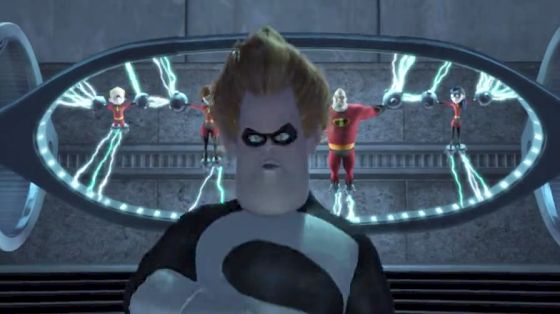
Cool lines— Our latest ugly truth (so much truth in this rant)—everything becomes mundane when there’s too much of it. If everybody can sink a basket with a hook shot from the three point line… sinking a basket isn’t that impressive, is it? If everyone can fly, being able to fly doesn’t seem like such a big thing, does it? As a wise supervillain once said, when everyone’s super… no one is.
The same holds for dialogue. We all want to have a memorable line or three that stands out and sticks in the reader’s mind forever, but that’s the catch. They’re memorable because they stand out. They’re rare. If I try to make every line a cool line, or even most of them, none of them are going to stand out. When everything’s turned up to eleven… well, it’s all at eleven. It’s monotone.
Exposition—Remember being a kid in school and that one teacher who just read right out of the textbook? Just raw, boring facts poured out in front of you, often without a lot of context? That’s what exposition is like to my readers.
Simple test. If a character ever gives an explanation of something the other characters in the room should already know (or my reader should know)… cut it. Seriously, just slice it out and see if it really makes that much difference. If nothing gets tripped up and things move faster…
“As you know…” – Closely related to exposition. I’ve mentioned this once or thrice before. I need to find every sentence or paragraph in my writing that starts with “As you know” or one of its cousins. “As you may recall…” “You all know…” Once I’ve found these, I need to delete them.
Think about it. A character saying “As you know” is openly acknowledging the people they’re talking to already know what’s about to be said. I’m wasting time, I’m wasting space on the page, and I’m wasting my reader’s patience. If I’ve got a rock-solid, lean-and-mean manuscript, I might be able to get away with doing this once. Just once. Past that, I need to get out my editorial knife and start cutting.
Listen to It—You may have seen the suggestion to read your manuscript out loud to help you see how things flow. Personally, I think this works great for catching errors, but not as good for catching dialogue issues. Since I wrote these lines, so I know how they’re supposed to sound and what they’re supposed to convey. When I read them aloud, there’s a chance I’ll be reading things that aren’t on the page, if that makes sense.
So if you’re worried about dialogue… get somebody else to read it out loud. A real person, not a text-to-voice program. Just a few pages. Let a friend or family member who doesn’t know it read it out loud and see what they do with it.
And there you have it. A big pile of tips which should help your fictional dialogue seem a little more real. Fictional-real, anyway. Not real-real.
Next time…
Holy crap! WonderCon is this week! Like, tomorrow! If you’re going to be there, I’m doing a Friday night panel called Neighborhood Nightmares, a Sunday afternoon session of The Writers Coffeehouse, and a later-Sunday autograph session. Plus I’ll probably be wandering the floor before/after those. If you’re going to be there, please stop by, say hello, ask a question or two!
Anyway… next time here, because it came up on Bluesky… I’d like to talk about twists.
Until then, go write.