
April 29, 2021 / 3 Comments

The Best Pace

I know I said I was going to try to do two posts this week but Tuesday was second shot day which ate up a bit of time but I’m now fully vaccinated! With no real side effects. So go get your second shot so we can all hang out together and things can get back to normal. Well, normal but with some major social reforms that this pandemic has really highlighted as necessary changes.

Anyway…

Look! More questions, more answers! And this takes so much pressure off me, because I don’t have to think of topics…

So, last week, after I prattled on about prologues, JD asked…

“I’m wondering if you have any suggestions on how to judge my pacing? I know every story is different, but in general, are there any tricks or tools to better know when I’m “running out of time” to get back to action before I lose the interest of my (hypothetical future) readers? Not just during the world build, but throughout?”

This takes even more pressure off because this question already contains part of the answer. Not all of it, but, y’know… maybe 20-25%.

When we talk about pacing, the first important thing, as JD said, is to recognize that every author (and every story) is going to approach things differently. Some need to dive right in with the fist fights and explosions. Others may take the slow burn, ramping tension approach. Right off, we need to recognize that pacing isn’t something that’s going to hit a bunch of universal guidelines. I think I’ve mentioned once or thrice before (here and at the Writers Coffeehouse) that I’m verrrrrrrry leery whenever folks set down rules like “introduce your love interest on page 16, inciting incident on page 23,  your first conflict by page 42.” Following blanket rules like this either creates cookie-cutter, formula stories… or it just turns good stories into bad stories. Because they’re being forced to hit benchmarks that don’t apply to them.

I mean, my new book doesn’t even have a love interest. So does that mean everything else bumps up by one page, or…?

The second important thing is to always remember Lee Pace is the best pace. I mean, seriously, look at the range this guy has. Pushing Daisies to Guardians of the Galaxy? I don’t know about you, but I freaked out when I realized that was the same guy.

But, seriously, let’s look at a few rules of thumb. Things we could probably consider as loose guidelines if nothing else. Because again, every book’s going to be different.

I think the best thing to remember is that pacing is a structure issue. Specifically, dramatic structure. I’ve talked about dramatic structure a few times before, so I won’t bore you with it again now. The important thing to remember for this discussion is that it’s always a slope. Sometimes that slope goes up, sometimes it goes down. But what it should never do is amble along on a flat line. Because a flat line means… well, you know. Dead.

Any chapter (or broad swath of my book, if I’m being clever and not doing chapters) should have a clear up or down on that slope. It doesn’t have to be a huge slope, but if I’m starting and ending at the same level of character growth, of overall tension, it probably means I’m doing something wrong. A chapter (I’m just going to keep using chapter as our nice, simple, unit-of-book-construction) should lean things one way or another, whether it’s holy crap you found the lost sword Dyrnwyn or just no, Jules, I’m not just going to give you some of my Doritos. Things need to move higher or slip downwards.

Probably worth mentioning… sometimes in our stories we plant things that don’t pay off until later. Character details. Worldbuilding. Set-ups for twists or other cool reveals. Such things are fantastic, of course, but they still need to work within my overall dramatic structure. It can’t be a situation where a chapter will be interesting in retrospect—it has to be interesting now, on the reader’s first time through.

Granted, this doesn’t mean it has to be interesting for the same reasons. It’s a wonderful skill to be able to pull that sort of sleight of hand, to make my readers look at this and be totally enjoying it, only to later realize that was the thing they should’ve been watching. But it still needs to be a chapter that moves things one way or another on that slope.

Because, again… the worst thing my chapter can do is flatline.

The sort of parallel to this—should be obvious but I’ll say it anyway—is that something needs to happen in every chapter (just to be clear, still using chapter as our basic, large-scale building block). In the same way we want to start with someone’s life changing, on some level or another, we want to keep having things happen. That’s what a good story is—the plot driving someone’s arc and their arc, in turn, is driving the plot. And driving implies we’re going somewhere, not sitting in a parking lot with the engine running.

Again, this doesn’t need to be huge movement. Every chapter doesn’t need huge leaps forward from the plot or broad swaths of character development that completely changes how we look at someone (that’ll usually ring a bit false anyway). Because every story is different and they’re going to move at a different pace depending on where we are in said story.

But they should always be moving. At some speed. In some direction.

How about this. Remember back in the A2Q when I made up a rough outline for a werewolf novel? Let’s take a look at those first few chapters I planned out and how they’re paced.

–Start with Phoebe and  Luna at home.  Both getting ready to go out for the evening, but Luna’s heading out to another party and Phoebe’s going hunting. So they’re looking for things, asking who borrowed what, warning each other to be safe, and so on.

(You can see a more fleshed out version of this here)

This is a slow opening, yeah, but there’s stuff happening. Both characters are doing things, I’m establishing relationships, doing some worldbuilding, which will should build some interest. And things are actually progressing. Both of them are getting closer to their goal of being ready to head out for the night.

–Phoebe’s out hunting and encounters the super-werewolf (although she doesn’t know it’s super yet). She puts a silver crossbow bolt in it and it’s going to ignore it and run off. This will also give her a chance to grumble about losing a silver bolt because they’re expensive. She can track it for a while, find the bolt… but no body.

Now we’re moving at a faster pace. A lot more action, and it’s action moving the story forward as it introduces a bit of an unexpected mystery and what looks to be a greater challenge. The first part got my reader intrigued, so now hopefully this gets them a bit more hooked with a sample of what’s to come.

–The next morning Phoebe goes to the lodge and we meet Luc and talk about hunting last night, if he saw anything noteworthy. Maybe some one-sided flirting?

Intro. Andrea, the Warden of the lodge. She’s willing to entertain the ‘super-werewolf” idea, and will pay an extra $2500 bounty for proof.

Things slow down here, but logically so—it’s daylight, the hunt’s over. Also, structure-wise, we can’t keep things ramped up to nine for the entire book or it’ll make getting to ten seem a lot less interesting. And when everything hits ten on the tension-ometer, I want it to mean something.

Plus, there’s some more worldbuilding, a possible love interest/rival/both, and a new goal for my heroine. It’s a lot of talking, but there’s some physical action taking place and it’s all nudging things along in the plot. Creeping forward, inching the tension up a bit with this new goal (and the implied possibility of not achieving it).

See where I’m going here? The pacing speeds up and slows down, but the big thing is that there’s always a pace. The story’s always moving. I mentioned something a while back that’s very true here–stories are like sharks. If they stop moving they’ll die.

(the shark thing’s not entirely true? Depends on the type of shark? Huh. Learn something every day…)

Again, every story is going to be different, so please don’t look at this as me saying “go slow, then fast, then slow again.” Your story is your story. It’s going to have its own pacing requirements that need to line up with what you want your story to do.

But hopefully this has given you a few things to look for.

Next time, I might finally get to clowns. Or maybe I’ll talk about plotting. That was a question I got a while back that’s still owed an answer. And questions get answers.

Until then, go write.

April 22, 2021 / 4 Comments

License to Prologue

I know I said I was going to talk about creepy clowns this week, but I couldn’t get the idea to gel quite right in my head. Plus then I got the social media question and had to deal with some other stuff. Anyway, I figured I’d backburner the clowns for now and talk about something more exciting for a minute.

Prologues.

Sorry, not prologues. Everyone knows prologues are awful and you should never, ever use them. Except, y’know, when they work. What I meant to say was Bond.

James Bond.

Let’s talk about James Bond and prologues.

If you think about it, prologues are kind of baked into the Bond film formula, especially the classic films. We’d always begin with James off on some little side mission, or maybe just finishing up a larger one, and then the opening credits would roll and we’d begin the actual movie. You know what I’m talking about, yes? It was the standard structure for decades, and even the new films kind of hold to it (although not quite as rigidly).

So why were these prologues so amazing that they were used through over twenty movies?

Three reasons…

First, it’s starting with action. By dropping us into the story right as a mission’s being brought to a close, it’s a perfect time for face-punching, explosions, gunfire, and bigger explosions. So not only are we starting with action, it’s action that has a clear purpose, a reason for its existence.

Second, the prologues always directly involve Bond. We don’t get long prologues about what other agents are doing, it’s about what our hero is doing. Right now. He’s part of the action, and usually the driving force behind it.

Third, and maybe most importantly, the Bond prologues always end up tying back to the main plot. Often directly to it. We get far enough in and learn that guy’s not dead after all, she was related to that other guy, or that other person got away with the goober that’ll let them do the thing in act three. So the prologues also serve as a bit of worldbuilding for the overall story and maybe some character introductions, too.

Three solid reasons the Bond prologues always worked.

And it’s not just Bond. This structure became so popular dozens of other action movies followed it. Hell, they’re still following it. Look at Thor: Ragnarok. Drops us right into the action with Thor winding up a mission to get Surtur’s crown, which ultimately ties back and becomes a key part of resolving the movie’s main plot.

So don’t be scared of doing prologues. Just make sure they follow Bond’s three simple rules. And if they don’t, well…

I was going to make some sort of “licensed to kill” joke here but everything I came up with was pathetic. Just pretend I said something fantastic. And accept there’s a good chance I’ll need to get rid of a prologue that doesn’t follow these guidelines.

Next time… I may double-post again next week. So there could be multiple topics.

Until then, go write.

April 20, 2021 / 3 Comments

A Social Media Question

 Hey, remember when I said if you post questions in the comments I’d try to answer them?

Well, last week, Tantilloon asked,..

“Do you think it’s still possible to get a book published without any social media presence? Asking because I finished a manuscript. I’m just opposed to social media in general, so I’m sort of wondering if my book is DOA just because the idea of using something like Facebook is a deal breaker.”

Not word for word, but that was the thrust of their question. And questions get answers!

Okay, I’ve seen variations of this floating around the interwebs for a few years now, and it’s come up once or thrice at the Writers Coffeehouse. Y’know, back in the before-time. When we all met in person.

I’m getting my second shot next week. How about you?

Anyway…

This isn’t an easy yes or no question, but I’ll try my best. As always, this is based off my own experience, but I’m also considering what I know/have seen from other authors, things I’ve bounced off a few agents I know (including my own), and talking with some editors.

First, the answer depends a lot on if we’re talking about fiction or non-fiction. Overall, it definitely helps a non-fictionbook if I’ve got a good-sized social media presence. Simple reason why—if I’m writing a non-fiction book, the implication is I’m an expert in some field, and a strong social media following shows that people are interested in my expertise. Yes, it’s possible people are just following me because they’re interested in my novels even though I’m an expert in all behind-the-scenes, non-fiction things related to Rom Spaceknight, but the overall assumption is still going to be that a strong social media presence is a very big plus for a non-fiction book.

So a big following on Facebook, Twitter, Instagram, TikTok, or… I don’t know, is Tumblr even still a thing? A big social media following isn’t strictly necessary for a non-fiction book, but it’s definitely going to help if I’ve got one. And what counts as “big” is going to depend a lot on how niche my book is. If I’m writing a political book intended to reach half the country, I probably want a larger following than if I’ve written a book on, say, the psychology of Rom embodying the sci-fi trope of paranoia vs. trust.

If we’re talking about fiction, this is kind of flipped. Most agents and editors neither require nor expect a big social media following. They don’t. Honest. Because, realistically… why would I have one? I mean, sure, I’ve got family and friends, and maybe a dozen or so people follow me for my insightful takes on Rom, but that’s still only going to add up to what… fifty or sixty people? Those publishing folks are aware that one aspect of being an unknown author is being, well, unknown. Seriously, think about it. If I’m not a known entity, why would I possibly have an online following of a size that could notably affect book sales?

Plus, sad truth is… social media doesn’t sell a lot of books. Either partaking in it or advertising on it. It sells one or two, sure, and it lets the fans I already have know I’ve got a book coming out. But let’s be honest—you and I both get hit with promoted tweets and Facebook adsevery day. Well, okay, I deleted my Facebook account over a year ago. Instagram ads, then. Point is… we ignore them most of the time, don’t we? And we ignore that guy who’s always going “Hey, buy my book! Buy my book! Buy MYbook! Buy my BOOK! HEY! MY BOOK! BUY IT!”

It’s just not what most of us are on social media for, and publishers know this. Because they’re people too. And their business is selling books.

True story—almost exactly ten years ago Nathan Fillion tweeted a few times how much he loved the Ex-Heroes books. Seriously, he did. I think he had a little under two million followers at the time. So let’s just say a million people saw him say how much he loved the books. One million potential readers.

We barely saw a ripple in sales. The book sold a little more that quarter, but it was selling a little more every quarter. Even with a million sets of eyes, there wasn’t a big spike we could call “the Fillion Effect” or anything like that.

Now, in all fairness—a publisher usually wouldn’t be upset if I did have a few hundred thousand followers and I liked hanging out on social media. It does make getting the word out there a bit easier. But again, it’s not going to affect if they pick up my book or not, because it’s not really going to sell a lot of books.

And if it does affect how a publisher’s looking at my book… that’s a little bit of a red flag, in my opinion. If they’re that concerned with my social media, it might be a sign they’re expecting me to do all the marketing and publicity. And since social media doesn’t sell books (see above), that’s not really a winning strategy.

So, no. Absolute not necessary to have a social media account.

Now, let me toss out one last bit of advice that kind of applies either way…

Social media is about, well, being social. Honest interaction. When people interact with me on Twitter or Instagram or whatever’s coming next, they’re expecting to interact with me. Not my assistant. Not my sales plan (as mentioned above). Not my month of pre-scheduled posts. They just want a sense of… me. That’s why most of my Twitter and Instagram is about interacting with friends, toys, cats, and B-movies. Occasionally some tabletop games or politics (if I’m especially frustrated by something). And most people seem to like it. That’s just who I am, and I enjoy sharing the stuff I’m interested in and/or love. I’ve got friends who put up pet pics, some who play random games, some who like taking weird photos of the world or themselves. It’s whatever you enjoy doing, because that honest enjoyment shines through.

If someone’s not really into social media, if they don’t want to deal with that interaction or whatever level of responsibility they think it needs to be… fine. Don’t do it. Seriously. People will sense that insincerity, that I see this more as an obligation than an honest interaction. And they won’t be that into it. Better to honestly not be on social media than be on it in a dishonest, disinterested way.

One last thing, which ties back to that insincerity. Let’s say I decide I don’t want to leave anything to chance. If a big follower count only increases my odds of getting picked up by 0.83%, I’ll still take what I can get! In this scenario, it might be tempting to do a lot of things in an attempt to artificially boost my follower count. Following back everyone who follows me, for example, trying to jump on whatever trend I can, or maybe even paying for likes and followers.

Editors and agents can spot this stuff just like you and I can. Again, they’re people. A lot of them have social media accounts of their own. And if they see I’ve got 50,000 followers but I’m following 49,892 people… well, they’re going to have a good sense of how wide my reach really is.

But again… it doesn’t really matter for a fiction book.

Anyway… regular post on Thursday. Clowns and true love. See you then.

April 15, 2021 / 3 Comments

Let’s Talk About Sax

Yes, I went there.

So, more than a few times here, I’ve talked about the need to pare away non-essential things. Characters. Names. Descriptions. Maybe whole chapters. These are all things that start to weigh my manuscript down like concrete blocks as it tries to tread water in my reader’s consciousness. Or something like that.

Maybe a better way to think of them is speed bumps. I might not notice one or two, but hitting four or five in a row is going to get annoying really quick. And hitting one once I get going fast… well, it either means slamming on my brakes or possibly crashing. It’s definitely going to be jarring.

But, as I’ve also tried to say once or thrice before, that doesn’t mean I need to strip everything down to a bare skeleton. There’s nothing wrong with elements that don’t tie directly—or even indirectly—to the plot or story of my manuscript. It’s more about being very careful how and when I deploy them.

And to illustrate this point, I’d like to tell you about Tim Cappello.

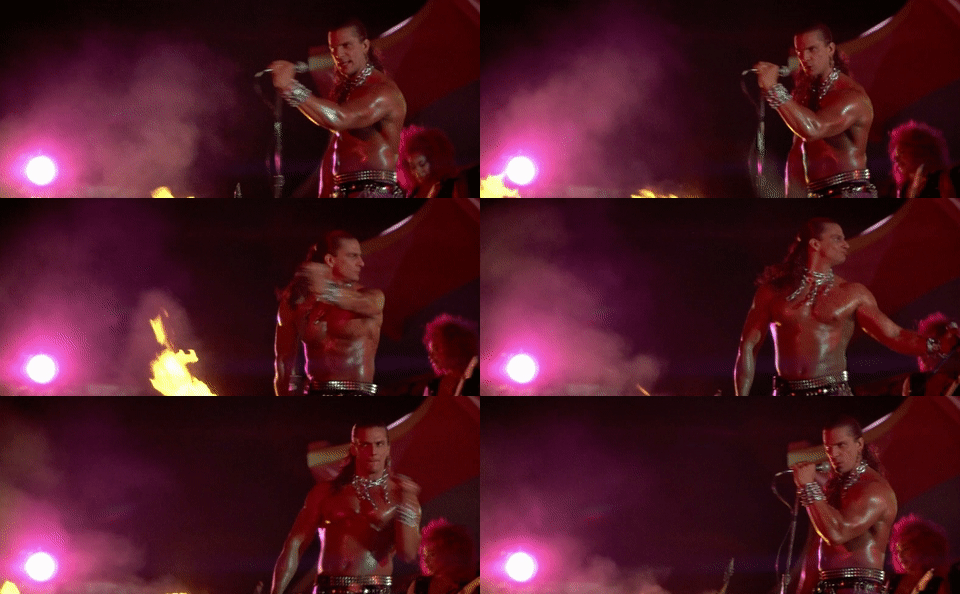
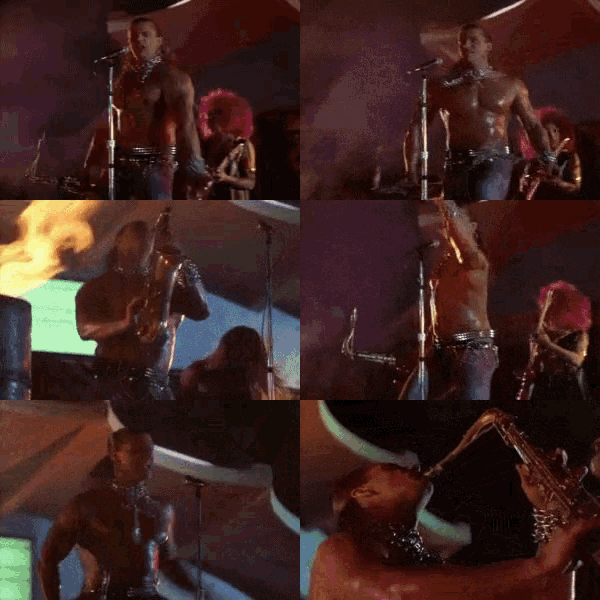
Tim Cappello’s a well-known-in-the-industry singer and saxophonist who had regular gigs with Ringo Star, Peter Gabriel, and spent over a decade touring with Tina Turner (he’s in the video for “We Don’t Need Another Hero”). But most of you probably know him for an incredibly tiny background part he had in an ‘80s vampire movie. And just putting those clues together, I bet most of you’ve already figured out who he is. He’s the legendary “Sax Man” from The Lost Boys.

Think about how weird that is, you immediately knowing who I was talking about. The entire concert scene’s maybe two minutes, and it’s super-generous to say he’s on-screen for twenty seconds of that. So running the math real quick (granted, not my strong suit) he’s maybe… one third of one percent of the movie?

And let’s be honest. The Sax Man doesn’t even do anything, plot-wise. He’s just window dressing that makes the beach concert feel a little more ‘80s. The whole scene’s pretty much just an excuse for Michael to gaze across the crowd at Star.

So… why is Cappello such an excellent background character in The Lost Boys? One that we all remember thirty years later? More than we tend to remember one of the members of the vampire gang was Bill from the Bill & Ted movies. No, seriously. Alex Winter is one of the vampires. He’s the one with the denim vest who gets staked in their cave.

Anyway, back on track…

First off, the Sax Man’s not excessive. I mean, okay, yeah he’s an oiled-up bodybuilder singing and doing hard rock saxophone riffs next to a flaming barrel. No denying that. But he’s the lead performer at a nighttime California beach concert in the late ‘80s. He’s not exactly over-the-top in that context. Plus, like I said, not even half a minute of screen time, and that’s broken into five or six shots. We hear him more than we see him, which also helps hint that he’s much more about the background and the setting than the actual story. He doesn’t even have a name. I mean, we all call him “Sax Man,” but apparently the actual credits at the end of the movie call him “Beach Concert Star” and Wikipedia just lists him as “Saxophone Player.”

Also, we kind of get him out of the way early. The beach concert’s just eleven minutes into the movie. We’ve still got 90% of the story to go, and we haven’t even introduced half the characters yet. It’s not like the movie’s bringing things to a halt so we can cut away to the singer at the concert.

Finally… I mean, he’s cool. He’s good-looking guy singing a high-energy song in front of a crowd. He’s having fun, they’re having fun. If I’m going to cut away from my leads and the plot, I want it to be to someone (or something) interesting. And Sax Man is definitely interesting.

So let’s break this down into some rough rules of thumb.

1) I don’t want to spend a lot of time on things that are just colorful set dressing (even if they’re people). As I’ve mentioned before, pages are precious and I only get so many of them. I can spend time on things not related to my plot… but I probably shouldn’t spend a lot of time.

2) I probably want to do it early. Sci-fi and fantasy editors will usually allow a little extra space for worldbuilding, and everyone expects me to set the tone with a few extra descriptions. But by their very nature, these additional details show up early in my story. If I’m doing a lot of worldbuilding in my third act, there’s a good chance something’s gone wrong.

3) If I’m going to use up a paragraph or three describing something… it should probably be something worth describing. Not something mundane, not something we see every day, not the kind of person we see every day. If it’s not something my characters would pay much attention to, why would I force my readers to examine it in detail?

Easy, yes? Three quick rules. They won’t hold in every instance, but they’re probably worth considering in every instance. If I’ve got a random colorful page describing that bus driver or this door frame, and it only kinda-sorta hits one of those guidelines… maybe that page should be used for something else.

Y’know… maybe something related to the story I’m telling.

Next time, I think I’d like to talk with you about creepy clowns, true love, and one of those common geekery movie flaws I see all the time.

Until then, go write.

And hey… you could listen to The Lost Boys soundtrack while you do.

Categories