
February 27, 2014

The Ecchh Factor

Pop culture pun.  I don’t do puns, normally, but it works.  As you’ll see.

This is mostly going to be for screenwriters.  Writers of prose—please don’t feel left out.  There’s a couple of things in here for you, too.

Tis the season for screenplay contests.  A few of the big names have opened their mailboxes for submissions, and there’s a dozen more noteworthy ones past that.  It’s a great way to get your name out there and even win some decent money, too, if you plan accordingly.

However…

As some long-time readers know, I used to read for a couple of screenplay contests (four different ones, in fact). I have several friends who read for some of the same ones, and some others, too. This time of year used to be a time of great sadness for us. And also a time of great drinking. Usually for the same reasons.

For an average contest, I’d probably read about a hundred scripts per year. That means there were years I’d read over three hundred scripts, usually all in the space of three or four months. It was a fascinating (and sometimes horrifying) overview of amateur screenwriting. To be honest, it’s one of the big things that convinced me to start the ranty blog.

It also gave me a real sense of certain patterns. There were certain types of scripts that would show up again and again and again. And it got to the point that I (and most of my friends) would let out a groan—an Ecchh, if you will—when we opened the next script and realized it was another one of those stories. Usually we could tell within the first few pages. In rare cases, the story would go along fine for twenty or thirty pages and the big first act reveal was… it’s just another one of those stories.

I drank a lot during this period of my life.

Now, I’m not saying any of these are automatically bad scripts that no one would ever pay a dime for. We could probably check IMDb box office listings right now and find examples of more than half of them. But contests aren’t about the box office, they’re about the submissions pool. Unless it’s something truly, utterly spectacular, each of these all-too-common screenplays is going to get an automatic response from a contest reader. An Ecchh.  And that means my script is already starting in the negative. And even if the reader’s just subconsciously knocking off two or three points for being an Ecchh-inducing script, those points could mean the difference between making it to the next round or winning a contest.

So, a few types of screenplays you should think twice about before submitting.  I’ve mentioned some of these before, so if they sound familiar… well, I thought it was worth repeating.

The 50% Script
I’ve mentioned this idea here a few times. In any pool of submitted material, around half of the submissions can be usually be disqualified by page three. It’s when I submit my stoner sex comedy to a Christian values screenplay contest.  Or my romantic comedy to a horror contest. Or my five-act play to… well, any screenwriting contest. The same goes for short stories. Very few screenplay contests want to see short stories. Hard to believe, I know, but there it is.

The 50% scripts are also the result of me being incompetent and/or lazy. If I  don’t know how to spell, have only the faintest understanding of grammar, and no concept of story structure…  that’s a 50% script. Or if I send in a first draft with all its flat characters and wooden dialogue. Or if I don’t even bother to learn how to format a screenplay. Or if I wrote my screenplay under the assumption I’d be directing it from this draft.

If my script falls in that 50% group, the reader’s going to know very soon. And they’re going to Ecchh because a lot of contests require them to read the whole script… even if they know it’s not going to win. Most readers will toss a 50% script as soon as they can. Sometimes sooner, if they think they can get away with it.

The Writer Script
I’ve said this a dozen or so times. Do not write about writers. I did the math one year as a reader and it turned out almost 15% of the scripts I read had a writer as one of the main characters (yeah, I started keeping track of this stuff). When I was interviewing contest directors for Creative Screenwriting, one joked that if her contest banned scripts about writers they’d probably lose a quarter of their entries. More than a few professional editors have said they’ll toss a book manuscript if it opens with someone writing on their computer.

No one cares about the day-to-day struggles I go through as a writer. No one. Most of you don’t—you’re here to learn about the successes. Definitely not a bunch of script readers, many of whom are writers themselves. If I’m being sincere, I’m going to bore everyone (more on that in a bit). If I make up some idealized writing lifestyle, the readers will Ecchh over that because now I’m delving into fantasy.

Let’s assume they didn’t toss my script aside as soon as they saw the writer character. If they get to the end and said writer-character finally sells their book or screenplay and wins the Pulitzer/ Oscar/ whatever… the reader will crumple my script into a ball and burn it so nobody else will have  to read the damned thing. Then they will get my personal information from the contest director, hunt me down, and cram the ashes in my mouth.

And I probably won’t advance in the contest.

The Current Events Script

I’m going to go out on a limb here. If we could look at the pool of Nicholl submissions for this year, I’d bet we’d see a fair number of Olympic scripts.  Several of them would be about stray dogs in Sochi. Also a bunch of screenplays that tie somehow to health care laws. A few on government gridlock, too. And most of them were probably written in four weeks or less.

Y’see, Timmy, if I saw a news report about some fascinating nuance of the world and realized it’d make a great script… it’s a safe bet at least a thousand other aspiring screenwriters saw the same news story and had the same idea. Probably more with the way stories spread on the internet. Even if only half of those writers do anything with the idea, and even if only ten percent of those people are sending their script to the same contest as me… that’s still fifty people rushing out scripts about the exact same thing I am. Even if half of them are completely incompetent and the other half are just barely on par, it means the contest reader is going to be reading a dozen scripts just like mine. Ecchh. And that’s if we stick to a thousand as our base number.

Mine may be the best in the batch, of course, but it’s going to lose a lot of appeal because now it’s a tired, overdone idea. And none of us want to be thought of as the best take on a tired, overdone idea.

The Actor Script
When people are trying to be positive about this one, they’ll call it “a character script.” It means my screenplay is just a thin plot with a handful of over-detailed character sketches piled up in it. There’s usually lots of deep and meaningful multi-page conversations about mundane things, often held in a few basic locations, and very little action. Of any sort.

The thing is though, is there anything remotely interesting about a story that’s indistinguishable from the boring, everyday life we all lead? Is there anything impressive about me putting all that boring stuff down on paper? Is there any sort of challenge there, for me as a writer or you as a reader?

Ecchh.

As it happens, this leads nicely into…

The True Script
A kissing cousin of the character script is the true script. On the cover or either the first or last page (sometimes several of these) I assure the reader this tale is based on true events involving me/ my parents/ my best friend/ someone I read about in a magazine article. These true events are often stressed to give a certain validity to what the reader is about to take in. After all, they can’t call my story or characters or dialogue unbelievable if it really happened, right?

Thing is, no one cares if my story is true or not. Nobody. Ecchh. They just care that it’s a good story and it’s well-told.  So my tale of prepubescent paraplegic drug addicts in 1990s Los Angeles needs to be as enjoyable—on some level—as a story about Neanderthal superheroes battling prehistoric lizard men in 1990s Los Angeles. Whether or not one of them’s a true story is irrelevant. In the end, I’m telling a story, and it’s either going to be good or it isn’t. Reality doesn’t enter into the equation for the reader, so it can’t for me.

The Formula Rom-Com
The man pursuing his dream girl realizes his best friend has been his real dream girl all along. A woman’s engaged to a condescending, controlling executive and then meets a poor artist and discovers he’s the real love of her life. Aphrodite/ Cupid/ an angel comes down to Earth on an assignment and falls in love.

Do any of these sound familiar? They should. Pretty much every one of them has been made into a dozen movies and a few thousand screenplays. Yeah, flipping the genders doesn’t make them any more original, sorry. Once it’s clear on page three this is a rom-com… Ecchh.

My romantic comedy has to be really spectacular and original to impress a reader. Again, it’s that sheer numbers thing. In four years of contest reading—a hundred romcoms, easy—I read one that stood out. Just one.

The Holiday Script
If you add in straight-to-DVD, movies of the week, and pretty much everything Shane Black‘s done, there’s a good argument to be made that holiday films are one of the best selling genres out there. However, just because my script is very sellable does not mean my script is very good. Or original. And if my contest is looking for good (see above), well…

The trick is to come up with something a contest reader hasn’t already seen again and again, to the point that they go Ecchh as soon as they see the mention of Halloween decorations. And—speaking from experience—they’ve seen most of it. They’ve Santa Claus quit, get fired, and get replaced by a temp, an elf, Mrs. Clause, his son, his daughter, his evil twin, his evil other personality, a robot, an alien, another holiday figure, another supernatural figure, Jesus. It’s all been done. The Easter Bunny has learned the true meaning of Easter, Cupid has learned the true meaning of love (see above… again), and Gobbles the Turkey has learned the true meaning of Thanksgiving. The hard way. Many, many times and in many, many ways.

There you are.  Seven very common types of scripts that will make a contest reader Ecchh. Probably more like eight or nine if you read between the lines a bit.

Again, I’m not saying I could never, ever win with one of these scripts. But I am saying that if I’m going to go this path I absolutely must knock it out of the park. No questions, no conditions, no exceptions.

Speaking of movies, next week I’d like to talk about the lessons we can all learn from that fine classic film Satan Met A Lady and its slightly more well-known remake, The Maltese Falcon.

Until then, go write.
January 23, 2014 / 5 Comments

Noxious Phrasing

            As you probably noticed, there was no ranty blog last week.  All the publicity stuff for Ex-Purgatory ate up a ton of my time.  And this week is fallout from that plus a bunch of dental issues I won’t bore (or horrify) you with.
            Thankfully, Thom offered to dive in and make some helpful tips for editors, and for writers who might be suffering from poor editor-ship.

            And maybe next week I’ll be back on the ball and we can talk about Robocop or something…

—————————

            I’m still not Peter Clines, and even though it is something of a crippling disability, I will strive to fulfill your sense of… of… I don’t know, whatever it is you’re looking for when you stop by this here blog. My name, if you’re the type what needs one, is Thom Brannan. (O hai, Thom.) I’ve appeared in this blog a couple of times, filling space when Pete was super-busy with his writerly duties. If you’re reading this, this is one of those times.

            Usually, Pete tries to talk about the craft of writing, and the many, many pitfalls he’s seen as both a casual reader and as a judge for some hifalutin’ screenwriting business. One of the things he’s asked for is a continuance of this tradition, but this blog will be a little different. If you’re reading this, Pete wasn’t only busy, but has allowed it.
            I’m talking to the readers today. Not your everyday, run of the mill readers, but participants in writer’s circles and beta readers instead. If you take time out of your busy, busy schedule to read for content and to provide meaningful critiques, I’m talking to you. If you’re receiving these critiques, I might be talking to you, too.
            During the course of these readings and critting, there are some phrases which make the rounds I wish to all that everybody, everywhere holds holy I could remove. They’re next to useless, and sometimes, downright insulting. If you use these phrases, but not in the way I’m about to mention, relax. Down, Simba. I’m not talking to you.
            You may have to forgive me if I become… animated during the writing of this blog. These things tend to get my hackles up.
Show, Don’t Tell

            If this is the limit of your advice for any bit of a critique, you’re doing it wrong. Please, readers, if you feel the urge to spout this piece of… advice, attach an example of what you mean. Or at the very least, be specific about what it is you wish to see and not be told.

            For instance, if the writer has written “John felt nervous,” and your reply is SDT, throw your writer friend (or circle-mate) a bone and give some examples. Don’t you think if the author in question had thought of a way to show it, he or she would have?
            It’s so bad that in my capacity as editor, I find myself cringing when I come to an instance where I want the author to show something. Somehow I power through, but always, always leave an example.
This Would Work If You Were Author X
            Yes. This one kind of sets my blood aflame. That was in an early critique I’d gotten; I disremember the reason. It might have been opening with a dream sequence. But the least helpful thing I read that day was, “This would work if you were Harlan Ellison, but you’re not.” You know what, you silly bitch? Before Harlan Ellison was Harlan Ellison, he wasn’t. The same holds true for Stephen King, for Clive Barker, for Cormac McCarthy, for goddamn anybody else. We all start small.
            I guarantee you, the guy up the street who has a woodworking shop wasn’t… uh, insert famous carpenter who isn’t Jesus here… the first time he picked up a hammer and saw. He was clumsy with his tools, and maybe if you look close, you’ll see he’s missing part of one of his fingers where he learned a bloody lesson. But now he has his own place, doing what he loves for a living, and fashioning memories for other people using those same tools he was clumsy with on day one.
That’s Cliché/ Been Done Before
            You don’t say. Man has only been telling stories for thousands of years. I would never have thought the same thing might pop up in more than one story.
            Clichés exist for a reason. They work. The work involves taking a pile of clichés and using them in a way that turns them on their heads, if need be, or exactly as they were intended. What? Yes. Sometimes it is a dark and goddamn stormy night. Don’t tell me that doesn’t happen, I’ve lived in Seattle. There most definitely is a calm before the storm. People don’t realize they’re holding their breath until whatever they’re holding it for is over. This really happens. And while some of these things are over-represented in fiction, that’s no reason to shun them.
            The same holds for monsters. As I’ve said before, not every instance of a monster needs to be a stunning new breakthrough in horror technology. Dracula hasn’t lost a scary step in 116 years; the vampire was done right the first time. (Yes, I know Dracula wasn’t the first. If you have to keep telling people this, maybe it’s because he was the first done really well.) The same holds for zombies and werewolves and man-made creatures of doooooom.
            For my money, the last worthwhile advance in horror technology came with “The Call of Cthulhu” and the idea of an uncaring, inhuman universe where we’re not the apex predator.
            But I digress. Things have been done before. If that’s your beef, maybe suggest ways the author could keep his or her cliché but use it in a better way.
When Will This Pay Off?
            Not everything mentioned in a novel will be essential to the plot, or to the overall story, or to character development. While it’s true that a lot of the bestest books and movies tie everything together in a neat little bow, some of them do not.
            Look at The Blues Brothers. Everybody loves that movie. Don’t they? Well. I do, and that’s enough for me. Where was I?
            Right. Take The Blue Brothers, if you will. That movie is just full of so much win, and there are parts in the beginning that link to parts at the end, and little bits in-between that talk to you when you see them reappear. “They broke my watch,” I laugh and laugh every time I hear that.
            But there are unrelated things. “Did you get my Cheeze-Wiz, boy?” What the hell is that? Is it important? Does it shed some light on Elwood’s character that, yes, he did in fact bring the Cheez-Whiz? No. No, it doesn’t. “Orange whip?  Orange whip?  Three orange whips?”  Does it matter what he ordered? No, it only mattered that the VP of the company asked to be included, and John Candy is a funny, funny man.  “Fix the cigarette lighter.”  Did that ever come back to haunt them? Hells, no, it didn’t. “Breaks my heart to see a boy that young goin’ bad.” Did that kid come back and help out? Or hurt the cause? Or was he even in the sequel? It’s in this paragraph for a reason.
In Conclusion
            No, that’s not one of the phrases, that’s just me, trying to figure out how to bring this to a clean-ish close. There are plenty more noxious phrases, but Pete doesn’t like these to be too long. Hey, if there’s reason, and he says yes, I’ll do another one. But for now, let me leave you with this.
            Beat readers and critiquers, you fulfill a vital part of the writing process. All the acknowledgements you read include people just like you, and authors rely on you to be straight with them, and to do what you can to help. From my own experience, the few works I do have out in the world would have been poorer indeed without the input of my beta team and the Permuted Pit and Pendulum critique groups.
            So, yes, you’re needed. Try not to be dicks about it.
November 8, 2013

Ironclad Screenwriting

            Hope you all had a wonderful Halloween, Guy Fawkes Day, or respective eerie holiday.
            As some of you know, I’m a bit of a geek, and as such I’m very excited for the release of Thor: The Dark World tomorrow.  And since I’m always willing to be pop culture relevant—and I’m really slammed with other stuff right now—I thought I’d post a fun conversation I had with Justin Theroux, who wrote the third of the “Wave One” Marvel movies, Iron Man 2.  Justin was great to talk to, even when he had to bite his tongue about some still-secret plot points and reveals.  He also had a very positive and realistic view of working in Hollywood and working on a major tentpole movie (a sequel in a set of interlocking movies, at that).
            A few points, but you’ll probably figure it out as it goes.  I’m in bold, asking the questions.  Keep in mind a lot of these aren’t the exact, word-for-word questions I asked (which tended to be a bit more organic and conversational), so if the answer seems a bit off, don’t stress out over it.  If you see a long line of dashes (————) it means there was something there I didn’t transcribe, probably because it was just casual discussion or something I knew I wasn’t going to use in the final article for one reason or another (there are off the record discussions now and then).  Any links are entirely mine and aren’t meant to imply Justin was specifically endorsing any of the ideas I’ve brought up here on the ranty blog—it’s just me linking from something they’ve said to something similar I’ve said. 
            By the very nature of this, there will probably be a few small spoilers in here, though not many.  Check out the movie if you haven’t seen it yet.  It’s fun and you’ll get a bit more out of this.
            Material from this interview was originally used for an article that appeared in the May/June 2010 issue of Creative Screenwriting Magazine.
            So, anyway, here’s me battering Justin with questions about Iron Man 2.

————————————————–

So… how does someone go from being an actor to screenwriter on a huge comedy to the sole writer on Iron Man 2

(laughs)  Your guess is as good as mine.  I don’t know.  I’ve been in Hollywood for about twenty years now.  I don’t know if that’s overnight.  Everyone has a weird road in this town and mine’s no different, I guess.  Everyone has a weird little story to tell.
Have you been writing all along?
I have, yeah.  If I were to thank anyone or lay it at anyone’s feet, it would be Ben Stiller who’s always been a very big champion of mine and always convinced me to do something professionally.  So Tropic Thunder was the first thing we were able to do together.  He was the one who first looked at my pages, years and years ago, and said ‘These are really decent pages.  You should be doing this more.’  He was the one that gave me the confidence.  So much of anything in the entertainment industry is confidence, and he was the first one to inject me with that.
Are you two friends?
We met… I was doing a play that he came and saw here in New York.  We met after the show and he was very flattering and I was very flattering to him.  I adored some of his earlier MTV shows and sketch work and The Ben Stiller ShowI thought was an unbelievably good show.  So I was gushing about that.  We sort of became friends over that.  That was in… 94?  95?  Four, maybe?  Somewhere early ’90s.
Were you a comics fan as a kid?
Yeah.  I was and am a comic book fan.  I wasn’t one of those comic book fans who ran out every week and bought whatever new issue was out there.  I sort of came into it backwards.  I read a lot of underground comics–Heavy Metal, Art Spiegelman, that kind of thing– but I also was an avid Spider-Manand Iron Man fan when I was a kid.—So I was a fan.  Not as probably die-hard as you might think, but I am a fan of the genre.
How did you end up on board Iron Man 2?
I had worked with Robert on Tropic Thunder and we had worked very well together and got along.  So he was the one who brought me over to Marvel.  He said ‘You should meet with Marvel.  You guys should sit down and see if you have any common ground because I think it would be a good fit.’  So I did.  I went when they were first gearing up for the very, very first initial push into development for Iron Man 2.  I sat with them for a long time and had long discussions with them about the character and that world.  We just hit it off.  It was a good match.  Shortly thereafter they said they’d love to have me and I was completely  flattered and floored, and we started developing the script right away.
Jon Favreau and Robert Downey Jr. both said early on, if I remember, they didn’t want to be involved if there wasn’t going to be time to do a good script.  Were you already on board at that point?
Yeah.  I don’t know.  I don’t remember when they said that, but it sounds completely in line with the way those guys think and work.  They’re amazing quality control, both of them.  As is Marvel.  They were extremely hands on, even in the creation of the story.  It was enormously collaborative.  I never felt like I was abandoned to write the script by myself, even though I did the actual writing.  There was always someone to bounce ideas off of.  Kevin Feige, Jeremy Latcham, Jon Favreau, obviously, and Robert, they were always there to lob in their ideas and support.  It was a very socialist endeavor, the creation of the script.
I think the writing teams for the first film (Art Marcum & Matt Holloway and Mark Fergus and Hawk Ostby) had a couple of years working with Jon Faverau.  You came on and they already had a release date for the film and less than a year before they started filming, yes?
(laughs)  You try to forget.  While you’re doing it you really try not to realize the pressure you’re under.  You try not to focus on it, at least.  You have to fake it and pretend you have all the time in the world to create it, because if you put a calendar and start X-ing days off you’ll go crazy.  I sort of operated, as we all did, I think, where it’s like ‘Well, we’ll deal with that when we get to it.’  As we had to turn in pages to effects and the line producer, we did a lot of punting of things until we absolutely had to try to move the ball across the finish line.
What’s your method?  Are you an outline guy, do you use note cards, do you just like to shuffle it all around in your head, start on page one, and plow through?
I don’t know. I love discussing things with people, almost to a fault sometimes.  I’ll bug a bus driver if I really want someone’s opinion.  The way I love to work is with someone who I trust knows the material, like Favreau and Feige, and bounce ideas off them.  Those guys had the benefits of doing [the first Iron Man] and were well-versed in the pitfalls and problems of where certain ideas could take you.  They were great at helping me eliminate certain things.  They could dismiss things that otherwise I might waste time spinning my wheels in.  That being said, when it actually comes down to writing I prefer to just wake up in the morning, make a cup of coffee, and just sit down and start hammering pages.  I write fat, usually, and hope the director can help guide me.  In this particular case Jon was good at guiding me towards what ——– on the one hand you’re trying to create a script that matches what Favreau’s vision is and what he wants to do.  I’m a big believer in being in service to the director as much as possible.
So you don’t use any outlines?
No, no, we did plenty of notecards and outlines and all the rest of that.  I think at a certain point you just have to start trucking through the deep snow and shoveling your way into it.  Or out of it.
How much did Jon actually get to work with you on this?  Was there time for the two of you to sit down and work the story, play with characters, that sort of thing?
Yeah, we met every single day in pre-production.  He was doing Couples Retreat for portions of that.  So we met very often, these epic sessions where we’d all—me, him, Robert, Kevin, and Jeremy—we’d sit in that room and beat through it.  Then I’d go away and do pages, come back, we’d beat through it some more, and I’d go away and do pages.  It was a very unified effort. We were all pulling on the same rope.  It was the way this movie had to work just because of the time frame.
What about Robert Downey Jr.  Did he have thoughts of his own for the script?
Yeah, absolutely.  Many days we met up at his house and scribbled stuff on cards.
Was it all for him?  Was it overall ideas or ideas for Tony Stark action and dialogue?
It was everything.  He’ got such an insane–insane in a great way–of working.  He’s just an idea generator.  He’s like a firehose with a powerful stream.  He’s one of those guys who’s just constantly percolating with new ideas and pushing into different areas and places where you didn’t think it could go.  There were certian idea he would have and you’d think ‘That’s completely insane.  There’s no way we could get away with that.’  He’d stick to it, and we’d write it and rewrite it, and we’d show up on the day and he’d perform it and–Oh, I get it.  That totally makes sense.  He’s the one who has it in his head.  There’s a lot of lightning firing off that guy.
How long does it normally take you to get a draft?
I honestly couldn’t tell you.  Even though we had a production draft that we ended up working off of, we were still developing whole chunks of it as we were shooting it.  Once we had the schedule for what we were shooting, we then knew we could go back in and since this is towards the end of the shoot we can go back in and really start finessing it.  So I was working on stuff on set all the way up until the very last day of shooting.

Now, how much of this was laid out for you from the start?  There was some stuff hanging there from the first movie, of course, but did you come on and it was already “Okay, we want Whiplash, Justin Hammer, the Black Widow, War Machine, the briefcase armor… give us a story.” 

No, no, no. To their credit, they really do give everyone involved in the process a blank slate to start with.  And that’s a blessing and a curse.  I think in the end it always ends up being beneficial to them.  You go in knowing anything is a possibility and they don’t shut any doors or windows to what you want to do until it becomes either cost-prohibitive or just doesn’t make sense with the brand.
            They’re firm believers that the fans are the shareholders in this whole thing, so they go in with the attitude of what do people want to see.  It’s not necessarily about what we want to do, it’s what people are expecting and what they want of this character.  And that’s a wonderful way to work, especially in this genre.  Everything was on the table and then it was just a question of taking things off the table.
            We opened up all the characters.  We opened up Whiplash and all the famous villains of the past and started picking up each one, rolling it around in meetings, and going “What about this guy?  What about that girl?”  We ended up getting three new characters for this movie–Whiplash, Black Widow, and Justin Hammer–and realizing there was a very powerful dynamic between those three.
How did you end up with Whiplash?
Y’know, there was a bunch… I won’t bore you with who we were looking at—translate ‘bore you’ as ‘get in trouble’.  It was really Jon’s idea.  I think Jon, very early on, had the idea of using Mickey.  We have sort of an energy theme going on, sort of a confluence of many things.  One is, our Tony Stark is a public figure.  Two, we knew we wanted to have this energy element to it.  What is the thing that’s inside him?  Could this thing become public?  Could it get out there?  It’s an arms race, essentially.  Then when we were looking at the different characters, we were thinking where can we sort of plug that idea into a character, and Whiplash—through Jon’s vision of what that character could be or become–what we all gravitated toward.  Weall thought that’s the guy.  Once Jon had pitched the way he envisioned that character, which is very different from a guy with a big ponytail and a cape, we thought that’s very cool.  These big energized whips emenating from his center chest piece.  It all, organically, started to take shape.  With the back story we thought we could have some fun there.
Now, in the first film one of the main elements was that Tony Stark had the only viable mini-Arc Reactor fused into his chest, plus there was one other one that would work for twenty minutes or so.  In the trailers we’ve got Iron Man, War Machine, Whiplash, plus what looks like a whole squadron of armored soldiers fighting them at one point.
Again, it sort of followed that….  If we walked into the room with anything, when we first started to develop, the one thing that was obviously on the table that we could not ignore was that he was a public figure.  That was the first little piece of clay that hit the table that we knew we’d have to build off of.   We thought, well, what comes with that?  What comes with that is a strange kind of arrogance, especially in today’s world, that that’s definitely going to entail?  Some kind of a newfound celebrity, to have a guy who’s a public superhero.  So there’s sort of an arrogance to Tony at the beginning of the movie that he’s the only one who is in possession of this technology.  So then the next dramatic device is… what if he’s not?  What if someone else can create it as good as he makes it, or almost as good?  That’s where we went with that.  What if the genie got out of the bottle?
War Machine is a little unusual because he’s not part of the “classic” Iron Man stories.  Rhodey is, of course, but War Machine was a much later addition.  Was this a concern, for you or the studio, since most of the successful Marvel movies seem to deal with classic elements more than newer ones?
I don’t want to talk about other’s people’s movies but… War Machine is not a dark force.  Our thinking was Tony is out in the world and has perhaps bitten off more than he can chew.  One of the themes of the movie is can one man be an island?  Are men islands in themselves, especially if you’re Tony Stark?  Again, without giving away too much, the War Machine armor and who’s using it really complements that idea or that theme.  I found it a relief to have that character in the movie.  And obviously Don is wonderful.  Only in the fact that they’re such good friends does that work.
Were you worried about the Batman issue?  Or I guess, Daredevil, since we’re talking Marvel…  That there are just so many character and elements crammed in here that there wasn’t going to be room for a coherent film story?
I wouldn’t say I was worried.  There were times where I felt that we had a luxury of riches.  It was like putting a bunch of desserts out in front of you an wondering which one you wanted to taste first.  It never worried me in that way.  If anything, it just made me want to work harder at servicing every one of them.  But I think we’ve done a pretty good job of tempering that and making sure that it doesn’t just turn into a Jackson Pollack.  Everyone has a purpose in the film, and I think as long as each one of those characters is well-defined and as long as they’re purpose-driven, then at the end of the day it just feels like a great big fun movie as opposed to a big, y’know, clusterfuck. (laughs)
There’s been some talk lately that this movie takes place before the Incredible Hulk movie which came out… well, at the same time as the first Iron Man.
(laugh)  I feel like Marvel has a great tradition of screwing the next writer. (laughs)  I think initially, when they first started interweaving it, things were considered afterthoughts.  Now—I don’t want to give away things happening in other movies—they’re starting to put a lot more thought into it and seeing it as a larger scheme.  We have things in our movie that are doffing their hats or perhaps telegraphing things that are going to happen in other movies.  That’s probably a much as I can probably say.  It wasn’t like we had a big meeting with Kenneth Branaugh about Thor.  There’s just enough cross-pollination to make it interesting, but not enough to start eating into other people’s sandwiches.
Was this something you were trying to figure out, how it all fit together, or did someone in an office just say “oh, this is the order?”
No, we knew we were going to have Nick Fury.  He showed up, you just can’t ignore it. And then there’s much smaller clues and things that we seeded throughout that will play out in other movies.  Obviously once Avengers is up and running you’ll start to feel the cumulative effect of those little jigsaw puzzle pieces getting put together.
I know there was also a point no one was sure if Samuel Jackson was going to be in the film or not.  Was that affecting you and your story?
Yeah.  For me, I just acted as if he was doing it.  We were putting him in.  He was going to go in.  It was up to the powers that be to make that happen.  I just kept writing as if he was going to show up on the first day.
Did you get a lot of notes?  Were you under the microscope, because the first film had been so successful?
Yes, but not in a way…  Marvel is a very special place.  Kevin Feige is probably the biggest comic book fan I’ve ever met.  He’s the biggest fan of his material.  He is, without question, one of the best keepers of that torch.  There would be times when we’d be bumping our heads or going ‘I don’t know how to make this work,” and Kevin would bring a clarity to the situation.  I’ve never experienced it with any other studio or any other creative process, where–literally–the head of the studio would be the one to go ‘No, you know what the fans want?  The fans want this, and at this moment in the movie this is what needs to happen and this is what we’re forgetting.”  He– and Jon, too– was great at just refocusing it.  He knows his brand and he knows his charcters so well.  He’s one of those guys who can tell you the day and date he saw this character or that issue came out or that movie premiered.  He just knows everything.  He’s encyclopedic.  I was always eager for him to put his two cents in an I would eek out his counsel on a regular basis.
Did the internet have a big influence on this?  Either for you or the studio.  Since the first movie people have been going crazy on the web with ideas and speculation, even more so once images and footage started appearing.  Does it affect your writing?
For sure.  Websites like Superhero Hype and IGN.  I wouldn’t say it’s an internet-made movie or anything close to that– because a lot of time people have ideas that have no bearing on what’s ultimately possible– but definitely.  There were times… As I said, the modus operandi of Marvel is that the only shareholders are the fans.  There’d be times when they would say ‘Oh, I read this thing, they’d be stoked if this happened.’  So we know we’re not on the wrong track pursuing that idea.  That’s really interesting and fascinating because it sort of puts a ghost partner in the room with you.  A shadow voice in the room.
Last question for you… now that Iron Man looks to be a successful franchise, did you leave some threads and ideas dangling for another sequel?  I know a lot of folks saw the Ten Rings terrorist group in the first movie as a hint towards the Mandarin…
I’m not confirming or denying that remark. (laughs)  I think that’s still in the distant future.  I would say if people looked for it they would definitely find it.
September 7, 2013

Easter Eggs

            Months early for Easter, I know.  But, as some of you may have guessed, I’m not really talking about those Paas coloring kits.  Or the Cadbury Bunny.
            For those few of you who are still waiting to see if Betamax is going to win the format wars, an Easter egg is a hidden bonus on a DVD or Blu-ray.  As of late, the term’s been broadened to include any little onscreen reference or in-joke. 
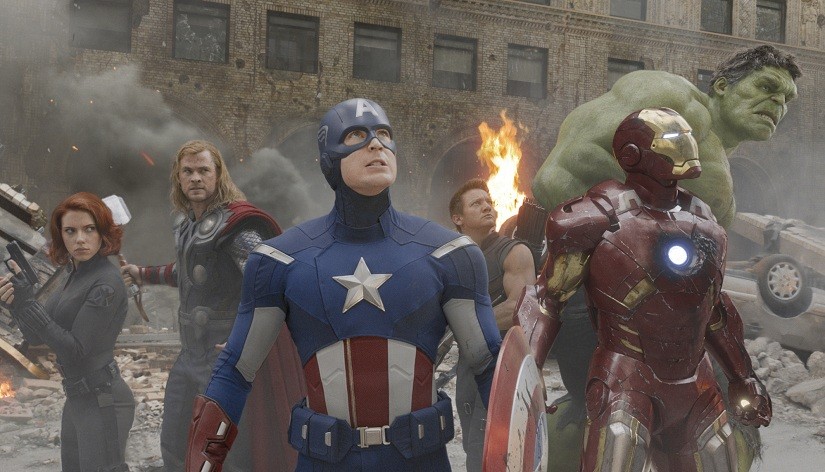
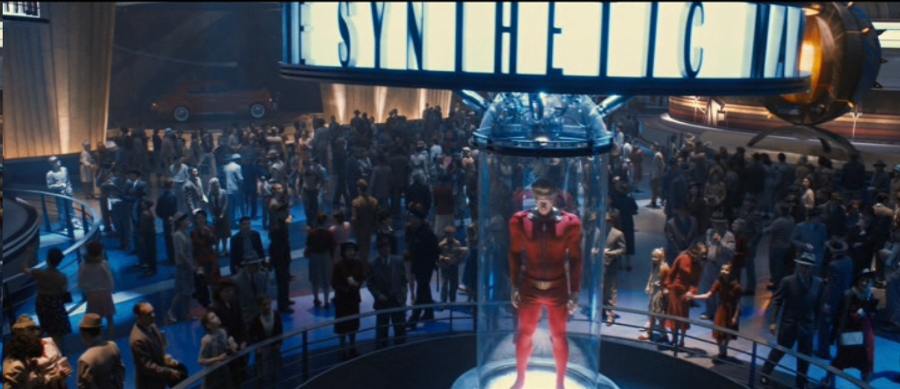
            A lot of superhero movies tend to have “Easter eggs,” in this broad sense.  Captain America’s shield (or a version of it) showing up in Tony Stark’s workshop.  Superman and General Zod crashing into a Wayne Industries satellite while they fight.  Agent Coulson stopping at a Roxxon gas station on the way out to New Mexico.  Professor Horton’s synthetic man at the WWII Stark Expo (a two-for-one Easter egg, really).  Heck, I remember giggling with geeky joy when Val Kilmer’s Bruce Wayne made an offhand comment about some people being “halfway to Metropolis by now.”
            I think most writers do this on one level or another.  We put in little in-jokes and references.  Sometimes they’re ten percenters, others they’re so small and private maybe only a dozen people in the world are going to get them.  I know I’ve done a bunch of them in different books and short stories.
            Now…a few weeks back I read an interview with Joss Whedon about the new Agents of SHIELD show.  The interviewer wanted to know if we’d be seeing lots of guest spots from some of the movie characters like Nick Fury or Cap or maybe Dr. Banner.  Whedon kind of shrugged it off and said while he wasn’t against it, the show wouldn’t last long if it was all about waiting for the next guest star or movie reference.  It needed to stand on its own feet, without support from the films.
            See, that’s the catch with these sort of in jokes and clever references.  My story needs to work despite these ten percenters, not because of them. If all I’ve got is a few clever nods to other things, I don’t have a real story—no matter how clever those nods are.
            This is also relates to a common prequel problem.  In prequel stories, there are often Easter eggs to all the stuff the audience knows is in the future.  Smallville would often dress teenage Clark Kent in blue t-shirts with a red jacket, or have numerous guest stars who would be important later in his life (like ace reporter Perry White).  Hannibal Rising had the titular character learning to cook and trying on samurai half-masks that hinted at the signature muzzle he’d wear later.  The Star Wars prequels showed us glimpses of the Death Star and hints of the Empire.  As I write this, there’s a pair of shows on the air, each about a famous fictional serial killer at an earlier part of their life.  And each show relies heavily on the fact that we, the audience, knows who this character is going to become.  There are constant winks and nods and references to things in their respective futures.
            In most of these cases, though, when you strip away all the references to “the future,” it becomes clear there’s very little going on in the now.
            There’s a similar problem you’ll see a lot in bad comedies.  It’s when the plot grinds to a halt to show us a painfully long setup for a joke that does nothing except get a quick laugh.  It’s not humor advancing the story, it’s just humor for the sake of humor.  And that gets old real quick, no matter how funny the gag might be on its own.
            I’ve mentioned seeing this in a fair number of genre stories.  A writer comes up with a really cool and new (or what they think is really cool and new) idea about zombie origins or time travel mechanics or vampire biology or cyborg implants or something.  But they don’t actually have a story.  They just have this one cool idea trying to carry everything. 
            All of these examples tie back to something I’ve brought up before.  One cool idea isn’t a story.  It’s just a story point.  And one story point—or even a dozen of them—does not make a book.  Or a movie.  Or even a short story.
            Easter eggs are cool and fun, no question about it.  But you can’t live off them. And a story can’t survive on nothing but sly winks.
            Next week, I think it’s time for that long overdue lecture on structure that I’ve been promising for months.
            Until then, go write.

Categories