
October 4, 2012 / 3 Comments

The First Thing That Comes to Mind

            I just wanted to do something quick this week, but hopefully you’ll all be impressed by the clever way I make this particular point.

            Grab a piece of paper and write these things down real quick.  Don’t think, don’t second-guess yourself, just scribble down the first things that come to mind, okay?  I want you to write down a television show about an island, a number from one to four, a Disney princess, and a vegetable.
            We’ll get back to that in a bit.
            Every now and then you’ll hear some guru talk about Jung or the zeitgeist or collective subconscious.  They’re pretty terms, but I’d guess four out of five times the people slinging them don’t really know what they mean.
            I think it’s much simpler than that.  Nowadays we’re all watching the same shows and movies and listening to the same music.  A lot of us are reading the same highly-recommended books.  Through the wonders of the internet, we can spend an hour each morning getting news updates from around the country and around the world.  Plus, all of us can discover the same Korean rap star within a week of each other.
            I’d guess at least ninety percent of you reading this had a basic Western education.  Most of us probably went to college for a few years, too.  We’ve compared banks and apartment-shopped and made budgets for either work or the home.  Maybe both. 
            We all share a lot of the same experiences, and we draw on those experiences to make the same decisions.  Because of this, we tend to be drawn to the same things—especially when you start dividing folks into fans of different genres and styles. 
            This is why you should never, ever go with the first idea you think of.  Because the odds are very good that at least a thousand other people just thought of it, too.  And half of those people are going to attempt something with that idea.
            I’ve talked about screenplay contests and some of the recurring concepts that made me and other readers cringe.  One of those was the Current Events script.  It’s a screenplay based off a recent, high-profile story that got a fair amount of news coverage.  They’re almost always rushed and, more to the point, there’s usually at least half-a-dozen of them about the same event.  And that’s just what one individual reader sees, so odds are there are a few hundred  of these scripts floating around each contest, all based off the same event. 
            A few months back I started toying with the idea of a new book, one that could possibly be the start of a new series.  Almost immediately, I came up with something that I thought was fairly clever and very open-ended.  I mentioned it to a friend over Labor Day weekend, though, and she said it sounded familiar.  She whipped out her Kindle, browsed Amazon for a minute, and came up with a name and title for me.
            Well, I got home and started checking it out.  It turns out the other author and I had both come up with the exact same premise.  Our main characters had the same background, the same life-changing event with the same results (and requiring the same medical breakthrough), and the same changes in their life because of it.  Different plots, but the story of our main character was almost identical.  The other author had just come up with it eighteen months earlier than me.
            We all get exposed to the same input and process it in similar ways.  That’s why the first thing that comes to mind is usually the thing that everyone else thought of, too.  Even if I think I’m a clever and exceedingly smart writer, I’m going to make the same first choices as everyone else.
            Don’t believe me?  Remember those things I asked you about up above?  I’m willing to bet that most of you wrote down LOST, three, Cinderella, and carrots. 
            What did I get?  Three out of four right?  I bet I got four out of four for some of you.
            When it comes to plot, try to avoid going with the first thing that comes to mind.  If you’re feeling gutsy, avoid the second and third, too.  That’s what makes a good writer—going beyond the obvious.
            Next time, unless I get another really cool request, I’m thinking I might talk a little bit about characters.
            Until then, go write.
September 27, 2012

Fleshing Things Out

            That’s right.  Taking requests and playing the hits you ask for.

            Probably one of the most common thing writers hear is people asking about turning ideas into stories.  “Oh, I’ve got a really great idea, I just need someone to help me turn it into a book.”  I get messages like this four or five times a year.  When it’s from friends, I try to be really polite and explain why it doesn’t make much sense for me to help with their idea when I’ve already got far too many of my own to work on.  When it’s someone I don’t even know…
          I usually just ignore those messages. 
          Still, the unspoken question there is a valid one.  How do you go from clever idea to full-fledged book or screenplay?  How does a writer go from “bugs in amber have dinosaur DNA in their bellies” to Jurassic Park?
            Let’s talk about that.
            Now, as usual, nothing I’m about to say is a hard-fast rule.  A lot of it comes from a talk I had a few Christmases back with writer/director Shane Black (best known for Lethal Weapon, The Long Kiss Goodnight, Kiss Kiss Bang Bang, the upcoming Iron Man 3, and a string of really awful dirty jokes in the movie Predator).  He had a few thoughts on how to assemble a story that I thought were very insightful, and I’m going to use his general framework to address this week’s topic.
            Having said that, just to make things less confusing, from here on in I’ll be referring to our collection of words as “a novel.”  It’ll be clear why as we move on.  Depending on what you want to write, feel free to swap “novel” out for screenplay, short story, epic poem, or whatever. 
            If I’ve got an idea for a novel, I want to look at it in terms of plot and story.  Can it expand into a full plot?  Does it lend itself to a strong story?
            Let’s go over each of these terms.
            Okay, first we need to understand what the plot is.  If I’m writing a book, the plot is what’s going to be on the back cover.  If I’m writing a screenplay, it’s going to be what they put on the back of the DVD.  Simply put, the plot is the chain of events that make up the novel.  It’s what makes readers need to turn the page so they can find out what happens next.
            It’s important to remember that one idea does not make a plot.  “There’s a haunted castle,” is not a plot.  “My partner is a robot,” is not a plot.  “I want to go to the prom with a cheerleader/ quarterback,” is not a plot.  A lone idea is just a plot point, and basic geometry tells us we need multiple points to make something worth looking at.  That something being a novel (or screenplay, epic poem, etc.).
            If I’m describing a plot, I’m going to use a lot of conjunctions.  I’ll be using and, but, and orto string all those plot points together.  Take a look at this example…
            Indiana Jones is an adventurer who finds ancient treasures and he’s a professor of archaeology at a university.  The government hires him to find the Ark of the Covenant before the Nazis, butthe Nazis have a head start.  Indy goes to find his old mentor, but finds out that Abner has died and his daughter has a grudge against Indy.  The Nazis show up and Indy and Marion fight them off.  They travel to Cairo and meet Indy’s old partner, Sallah, but learn the Nazis already have their excavation well under way.  The Nazis try to have Indy killed in the marketplace and he fights them off again, butMarion is killed when the getaway truck explodes.  Indy and Sallah get the medallion deciphered butit turns out there are two parts to the inscription and the Nazis only have half of it.
            See what I mean?  Lots of points, and I’ve barely written out half the movie.   It’s also worth re-noting then none of those ideas on its own is a novel.  It’s when they start joining up that we get something that interests us. 
            This is where a lot of people mess up the whole idea of “expanding an idea into a novel.”  Y’see, Timmy, an idea doesn’texpand.  The plot expands as more ideas are added into it.  It’s impossible to expand “Indy and Sallah get the medallion deciphered” without adding a new element to the mix.  Seriously, try it.  Any attempt is just going to be some artificial wordplay and padding until I bring “it turns out there are two parts to the inscription” into it.
            It’s also worth noting another key thing.   For most good novels, the plot is the attempt to do something.  Not necessarily succeeding at something, mind you, but attempting to do it.  Beat the Nazis, save the girl, beat the system, save the clock tower, and so on.  Plot is active.  In that little summary up above, ten of the eighteen points are characters physically doing things. 
            Listing these points out can also be a hint that my story is getting a little thin on plot.  If I’m really stretching to come up with individual points, or falling back on a lot of inactive, internal points, that could mean my novel is veering into more of an artsy-character range.  If a lot of my points don’t really tie back to the main thrust of the novel, that’s another good sign.  There’s nothing wrong with that, provided I knock the character stuff out of the park.  Which brings us to our next point.
            Now, if plot is what goes on around the characters, the story is what goes on inside the characters.  Plot is big and external.  Story is small and intimate and internal.  It’s the personal stuff that explains why the characters are interested in the plot.  And if it’s why the characters are interested, it’s also why the reader is interested.  Plot makes us need to turn the page, but story makes us want to turn the page because we’ve come to like these characters. 
            A great example of plot vs. story is Silence of the Lambs.  The plot is the search for a missing girl, and some of the desperate decisions and deals the FBI will make to find her.  The story is about Clarice Starling trying to make up for what she sees as an awful failure in her childhood, and how much of her life is shaped by the need to balance that failure.
            I’ve said a few times here that characters are key to a successful novel, and that’s because without good characters you can’t have a lot of story.  I can have a ton of plot, but not much else.
            Now, because of this, developing an idea into a novel is a little tougher from the story side, because it involves developing characters.  How the characters react to the idea depends on who they are and how this idea interacts with their personality and history.  Which means they need to have personalities and histories.  And a lot of this can just come down to asking and answering questions that relate back to that original idea.
            Let’s go with the one I mentioned up at the top—my partner is a robot.  Let’s say my character is Bob.  Did Bob know this partnership was coming or did it get sprung on him?  Does he like being partnered with a robot?  Does he like robots in general?  What kind of partnership do they have?  Is Bob the junior or senior partner?  Why?  Do they work well together?  Does Bob have weaknesses the robot will compensate for (or vice versa)?    
            The answers to all of these questions expand the story.  Odds are that some of the answers will lead to more questions, too.  And more questions means the plot is expanding.
            As above, this can also be a hint that my novel is a little weak on the story side of things.  If I just give quick, inconsistent answers to these sort of questions, my characters are going to end up pretty flat.  Character arcs are a big part of the story, so if my character never changes in any noticeable way, it probably means my novel is emphasizing plot over everything else.  There’s nothing wrong with that—there are plenty of fantastic plot-driven  books and movies—but it does mean I need to have a really solid, engaging plot.
            It’s important to notice that story is why so many novels can use the same plot but still be very different.  Alan Moore’s Watchmenhas the exact same plot as the classic Outer Limits episode “The Architects of Fear,” but they have different stories.  The same with Never Let Me Go and The Island.  While the basic idea is the same, the character tweaks make each of these into unique stories.
            Consider this—how much does the story of Raiders of the Lost Ark change if I just do a gender swap on Indy?  Start way back with her relationship with Ravenwood’s underage son.  Would this still cause a falling out between the two professors?  How would the son view this past relationship?  And in the late 1930s, what would it be like for a female professor?  The male students hitting on her in class is a very different image, and would the government men be as enthusiastic when they learn Dr. Jones is a woman?  Our basic plot wouldn’t need to change too much, but all these story elements become very different.
            So when you’re looking to take an idea all the way to a full blown novel—or screenplay, epic poem, opera, or whatever it is you write—start with the basics.  Consider your idea as part of a larger plot.  Think of how it could fit into a character’s story.
            This week was kind of long and rambling, so next week I might just do something quick.  Whatever pops into my head.
            Until then, go write.
February 17, 2012 / 10 Comments

I Long For a Bungalow…

            Long overdue pop culture reference.

            Every now and then I hear or read statements by people that there’s no real difference between writing a short story and writing a novel.  It’s all the same skills, they say, and it’s working toward the same goal, so working on one can only make you better at the other.
            I disagree with this, for the most part.  It’s a sloppy comparison, the kind that makes people say alligators and crocodiles are the same thing, or unemployment benefits and socialism.  There are some basic similarities, yes, but short stories and novels are two very different animals and they have to be dealt with in different ways.  Housecats and Bengal tigers have a lot of things in common, too, but if I find one in my living room when I wasn’t expecting it, it leads to one of two very different phone calls.  If I call the wrong person over to deal with it… well, one way or another, they’re going to be very annoyed.
            Here’s a better way to compare short stories and novels.  It’s not super-informative, but it should get your brain working on a few issues.  It came from a discussion between my lovely lady and I, and it’s such a solid analogy we then had some sharp words (well, not very sharp) about who actually came up with it after we’d been bouncing it back and forth for a while.  I shall split credit and say we came up with it, to be fair.
            What did we come up with?
            Carpentry.
            A good number of you reading this had to take some kind of shop class as kids, I bet.  You may have also belonged to Boy Scouts or Girl Scouts or some other group that did crafts at some point.  So I’m betting that a fair amount of you have held a hammer, driven a nail, and maybe even cut a board with a saw.
            A few of you may have even built a birdhouse.
            Birdhouses are pretty basic things.  Four sides, floor, perhaps a two-sided roof if you get fancy.  They generally have one entrance and not many features past that little peg for the birds use to land on or launch from.  I think I built two at different points in my childhood.  Although I think one was made out of a plastic milk jug, so it doesn’t count for our purposes today.
            So, all you scouts and shop students… is building a birdhouse the same thing as building a real house?
            Once I jump up in scale like that, there’s a huge design difference.  A five-inch square wall can hold itself up, but one that’s 9’ X 14’ needs a real framework.  That framework also needs to account for windows, interior doors, and possibly even supporting a second floor.  Heck, I’m probably going to depend on the framework even more—a birdhouse wall can just be a piece of wood, but for a house I’ll probably use two by fours covered with drywall or plaster.
            Plus there’s all sorts of extra details in a full-sized house.  I’ve got wiring, insulation, plumbing, and possibly cable to deal with.  Maybe tilework in the bathrooms and kitchen.  Central air if I’m feeling especially sinful.
            (Bonus points if you get that reference)
            Even my tools change.  A hammer and hand saw might work for a birdhouse, but for a full-size job I’m probably going to want a nail gun and some power tools because I need to be working at a different pace.  A table saw would be nice.  A level is very important.  Plus all the specialty tools for that drywall, wiring, and plumbing we were just talking about.
            The basic skills are the same, but what I do with them is completely different.
            This works both ways, too.  The blueprints for birdhouses are ridiculously basic things, assuming I even use any.  Half the time they’re not even drafted—just sketched out rough on a scrap of paper.  It’s not worth putting in any more planning than that because the actual construction takes so little time that the planning phase can completely overwhelm it.
            Past all that, what would you think of a birdhouse with drywall, plumbing, and cable?  It’d be a curiosity, yeah, but would you actually buy it?  I probably wouldn’t.  Hell, how would I hook it up once you hung it in the back yard?  And do you know how much it would weight if I framed the whole thing?  The whole support system for this thing just went from being a hook and eyebolt to a length of chain with a few bolts through it.
            Hopefully you all get where I’m going with this.
            Y’see, Timmy, I can’t approach writing a short story the same way I would a novel.  Each one has a very different structureElements that work on a small scale don’t work on a larger scale, and vice-versa.  While you can get away with less-detailed characters in one, they seem false in the other.
            How do you make it work?  Well… that’s still something each of us needs to figure out for ourselves.  This was just a reminder not to put a jacuzzi in your birdhouse.  And maybe to give your new home more than one hole in the front for a door.
            Next time, I’ll have something new for you to look at.  Or listen to.  Or something.
            Until then, go write.
August 4, 2011 / 4 Comments

Simpsons Did It!

A pop culture reference that’s so spot-on it’s not even funny.

Okay, it’s a little funny…

(General Disarray, go get the minions before they get lost…)

One of the big worries with creativity is wondering if you really are being creative. Is that clever new idea of yours something you came up with all on your own, or is it something you unwittingly borrowed from someone else? Maybe you skimmed over the back copy of a paperback in your local neighborhood bookstore or read a few spoiler-filled reviews on Amazon and your brain just filed it away. Worse yet, what if your clever story gets out there and then you discover five other people already had similar ideas. Now you just look like some hack plagiarist.

I’ve been involved in a bunch of discussions about stuff like this in the past few weeks. Has anyone crossed X with Y before? Have you ever seen this element used in that genre? What about that plot but in this setting?

The answer to all of these, alas, is yes.

Some guru-types like to drawl on about how there are only seven stories (or nine, or thirteen, depending on who’s selling what this week). While I think this is an oversimplification, it does point out an obvious truth. Most stories have things in common with other stories. That’s just the way of it. The same type of characters show up. The same situations arise. The same relationships form.

Here’s a random observation for you. When was the last time you met someone who didn’t remind you of someone else? Think about it for a minute. When we were little everything was new and fresh but as we got older we started to see patterns and similarities. A guy I met at a birthday party last weekend reminded me of a guy who lived across the hall from me in college. When I first met her, I thought my girlfriend looked a lot like one of my next-door neighbors. A production assistant I used to work with looks kind of like a sound mixer I know in San Diego. Another one reminded me of my cousin Chrissie crossed with a bit of Angelina Jolie (a very good mix, I have to say).

But those are all first impressions. As I delve deeper, I start to see the uniqueness of each person. The better I got to know them, the more Leo, Colleen, Russ, and Sarah became individuals and those superficial similarities dropped away.

Still, those initial generalities can be a bit bothersome. If there’s something else out there that’s similar to your work, should you worry about it?

Probably not.

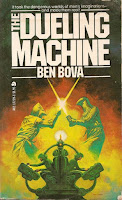
Submitted for your approval is The Dueling Machine. It’s a 1969 sci-fi novel by multiple-Hugo-award winner Ben Bova. In the far, far future, a brilliant scientist has created a machine to help reduce hostility. It’s “a combination of electroencephalograph and autocomputer” which lets two or more people connect their minds through the machine and interact in an imaginary dream world that they create inside the machine. The story comes about when someone is killed during one of these “simulated” duels—is it possible that dying in the imaginary world could make someone die in the real world?

Hopefully this premise sounds a bit familiar to you. It should because it’s a big chunk of the plot to The Matrix movies. And The 13th Floor. Also the Lawnmower Man films. Plus there’s a few books like Cybernetic Samurai and Snow Crash and Giant’s Star. And that television show VR5 that was on for a while. And about a hundred Star Trek episodes where people get trapped on the now-deadly holodeck, because the holodeck safety systems are apparently made of cobwebs and wet tissue paper. Heck, you’ve all probably got a dozen more at your fingertips, don’t you?

For the record, there are also dozens of books and movies and television shows featuring vampires in space (one’s actually called The Space Vampires—it was the basis for the movie LifeForce). And zombies in the old west. And new takes on time travel, space travel, politics, Jekyll and Hyde, all that stuff.

Now, this doesn’t mean that most stories copy other stories. We all draw from a lot of the same sources, so our thoughts are going to follow a lot of the same paths. But even on those paths we’re all going to march to the beat of our own drummer, so to speak. We’re also going to dress differently, bring different things with us, ask different people to come along, and we’re all probably heading down that given path for different reasons.

Y’see, Timmy, we put our own stamp on everything we do. If I did a modern version of Dracula and you did a modern version of Dracula, neither of us would end up writing Salem’s Lot, which was Stephen King’s modern version of Dracula. You might stick with Europe, but I’m probably going to set mine in southern California. We’d have our own ideas and notions and way of looking at it, just like Mr. King did.

Now, there’s a downside to this apprehension, too, and it’s kind of similar to the people who won’t write anything because they’re too busy learning how to write. Sometimes we—yes we—get so caught up in worrying if something is original that we grind to a halt trying to prove it isn’t. This desperate need to avoid being a copycat brings things to a dead halt.

True story —I was working on a book a few years back (right before I was inspired to start Ex-Heroes, in fact) called Mouth. As I was typing away, I suddenly came up with the coolest way to explain teleportation ever. I mean, this was Stephen Hawking-level brilliant. It was, if you’ll pardon the phrase, sheer elegance in its simplicity. I typed up a quick scene where Character A explained it this way to Character B, read through it, and realized it was even cleverer than that.

Too clever, in fact, for a guy like me to come up with it. It was too clean. Too perfect.

In a panic, I wracked my brain trying to figure out where I’d heard it before. Because I must’ve seen this somewhere. Online? In a comic book? All I was reading at the time was Amazing Spider-Man and that was all packed full of “Civil War” nonsense. Maybe a television show? What had we gotten from Netflix in the past few months?

I asked my girlfriend to read it. I figured she might recall whatever this source was, because I kept drawing a blank. She went through the chapter, got to the questionable explanation, and loved it. When I asked her where she’d seen it before, she couldn’t remember ever seeing it. After I pressed her for a bit and she re-read it again, she admitted it was vaguely like the explanation of “tessering” in Madeline L’Engle’s classic A Wrinkle In Time, but only in that it took what was plainly a very complex idea and boiled it down to an extremely simple explanation.

In other words, it was all mine. But I wasted a week worrying over whether or not I’d copied it.

Do a quick look at your chosen field. Make sure no one’s done something exactly like your idea. Then just write. Your own style and vocabulary and characters will give it a flavor all its own.

Like the Buddha says, don’t sweat the small stuff.

Next time, if I don’t get any suggestions, I may have to fall back on spelling.

Until then, like I just said, go write.

Categories