
October 18, 2013

The Tin Dog

            Pop culture reference, long overdue.  Hopefully you get it.  If not… you’re missing out.
            If you’ve followed this collection of ramblings for a while, you know that I worked in the film industry for a number of years before I stepped away to start writing about it.  In that time I worked on a lot of television, but also did some low budget movies.  And as time went on, something became very clear to me, and once I realized this it changed my attitude a lot.  And I came to realize you could always spot inexperienced (or plain ignorant) people on set by this lack of clarity.
            Y’see, every member of the crew—for at least for one moment every day—is the most important person on set.  Not just the actors and the director and the assistant directors—everyone.  The makeup artists, the dolly grip, the on-set dresser, the clapper-loader, the assistant prop master, and even the production assistants.  At some point during a given day, they will be the most important person on set for one reason or another.
            What’s the proof of this, you ask?
            Well, the film industry is focused on money.  For all the stories you hear about Hollywood wasting money on things, the truth is most producers squeeze every penny they can out of a film shoot.  If someone doesn’t need to be on set—and drawing a paycheck—they just wouldn’t be there.  Their job would’ve been eliminated or rolled into someone else’s.  Or sometimes just handed off to a production assistant, or even an intern.  It’s a regular thing on film sets to have temporary crew members who work a day or two, then vanish until they’re needed again. 
            If they don’t need to be there… they’re not there.
            Now, I gave you that little insight so I could tell you this story.
            Back in the early ‘90s the X-Men were taking off and mutant characters were the flavor of the decade at Marvel.  Every new character was a mutant.  Any old character who’d never had a specific origin became a mutant.  Needless to say, most of these new creations were tissue-thin with nothing interesting about them except their random power or ability.
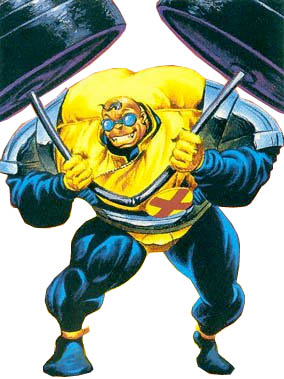
            One of those characters was a guy named Guido.  He was a very over-muscled, bespectacled guy with super-strength who’d originally been created as a bodyguard (mutant, of course) for another character (mutant, of course).  Guido ended up on the new, government-sponsored X-Force team (in the same-titled comic written by Peter David) and he was there when the team was introduced at a press conference.
            Problem was, Guido never picked a code-name.  Their NSA liaison couldn’t exactly introduce Havok, Polaris, Quicksilver, Wolfsbane, Multiple Man, and… Guido.  Confusion ensued for a moment, during which Guido wandered out on stage in his uniform, seven feet tall and about eight feet wide.  And one of the reporters at the press conference said..
            “Wow!  He must be the strong guy.  Every group’s got a strong guy, it must be him.”
            To which Guido grinned and proudly announced, “Yes, that’s me.  I’m Strong Guy!”
            Much giggling ensued.  For about two years.
            Anyway, there’s a keen little observation there, and it’s why I used this comic book as my example.  Almost every superhero team doeshave a strong guy because, at some point or another, every team needs a strong guy.  X-Force needed Guido.  The Avengers needed the Hulk.  The crew of Serenity needed Jane.  SG-1 needed Tylk.  You can trace this all the way back to Grimms’ Fairy Tales, when a wandering man would gather a group of friends who were fast, keen-eyed, sharp-hearing… or extremely strong.
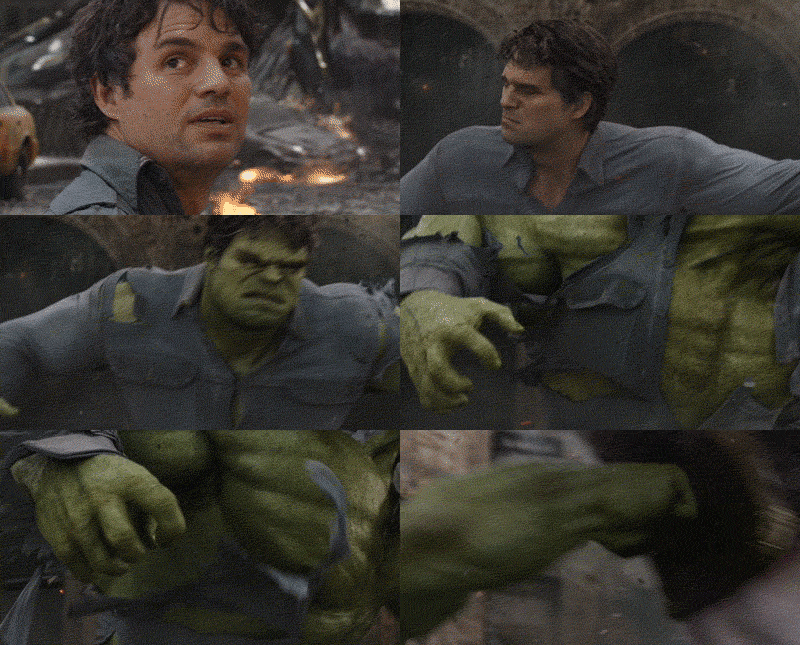
            And, much like the film crews, these groups have a strong guy because at some point they’re going  to need a strong guy.  The whole point of having someone like the Hulk on your team is that eventually there’s going to be some kind of giant space war-snake that needs to be taken out with one punch.  If I wasn’t going to have going to have a key moment like that, I wouldn’t bother to include a strong guy.  

            This doesn’t just hold for the strong guy, of course.  It holds for all the characters.  If I’m going to have a super-smart, deductive character in my story, there needs to be an intellectual problem for him or her to solve.  If I’m going to write in the greatest sniper in the world, at some point something’s going to need to get shot with pinpoint accuracy. 
            Is this all starting to make sense now?
            Simply put, characters need a reason to be in my story.  Sure, there’s always going to be those nameless folks there to bulk up the mob, fill in the ranks, or just serve as cannon fodder. Thing is, though, I shouldn’t be putting a lot of effort into someone who isn’t actually going to be doing anything.  All my characters should be propelling the plot and/or story forward.  If they’re just standing around not affecting anything… why am do I have them there?
            If Yakko’s just standing around not taking part in anything, odds are he’s going to get in the way.  We’ve all dealt with people like that, right?  The ones who just stop moving in the middle of a walkway or stand in front of a door.  They’re just hindering everyone else from getting things done, and the common response to them is anger or frustration.
            I’ve mentioned a bad habit before, the tendency to name every single character in a story or screenplay.  That idea has a lot of ties with this one.  Naming someone is a clue that this person is going to be important one way or another and that the reader might want to keep track of them.  So when I’m giving names to the waitress, the security guard, the cab driver, the homeless guy in the alley, and the woman jogging by the diner… well, it’s going to cause chaos in the reader’s head because they’re going to assume all these people are important somehow.  It’s the character equivalent of Chekhov’s phaser on the mantle.
           Then it’s going to cause frustration because none of them are doing anything.  They’re just standing around (or sitting, or jogging by outside), getting in the way of the story.  They’re wasting time and space that could be spent on the plot or on developing the characters who are actually doing something. And my readers are going to resent them for that.  And resent me.
            One last example.  The title one, in fact.
            When Russell Davies relaunched Doctor Who for the 21st Century, fans were almost instantly united on one point.  Mickey Smith was the most useless recurring character ever.  He was introduced as the on-again-off-again (mostly off) boyfriend of Rose, the Doctor’s companion, and for a year and a half that’s all he was.  He showed up, moped, grumbled, and then got left behind again as Rose and the Doctor took off for new adventures.  He had no personality and no real purpose.
            But in the second season, something happened.  Mickey realized he had no purpose.  He decided to stop standing around and to become part of the story.  In fact, after a few episodes Mickey even decided he needed to have his own story, one that didn’t involve Rose and the Doctor.  The next time we saw him, Mickey had become a confident, dimension-hopping resistance fighter.  And at that point, we couldn’t wait until the next time we saw him.
            Mickey went from annoyance to cool, just like that.  He was so cool that he turned down an offer from Torchwood and became a freelance alien hunter.  Hell, in the end Mickey hooked up with one of the Doctor’s other companions, Martha Jones, and we all knew she was way cooler that Rose.
            No, come on.  Admit it.  Martha was cooler than Rose.
            Anyway…
            Y’see, Timmy, there needs to be a reason for a character to be in my story.  At some point, just for a moment, they need to be the most important person in the story, the one who’s making things happen.  If they don’t do that—if they don’t advance things somehow—they shouldn’t be there.
            Next time… well, I’m taking Halloween off, so next time I’ll get to the scary stuff a little early.
            Until then, go write.
May 16, 2013 / 4 Comments

Character Assassination

            My lovely lady came up with the title.  She’s kind of fantastic that way…

            Eventually it all comes down to this, doesn’t it?  I’ve crafted a character with a detailed backstory, some wonderful nuances and habits, and even believable speech patternsthat stand out in a crowd scene.  It’s a character every reader can picture in their minds and relate to on a personal level.
            And it’s time to put a bullet in their head.
            Killing people in a story is a delicate thing.  I don’t mean this in some artsy, poetic way.  I mean it more in a “cutting the wires without disturbing the mercury detonator” way.  It’s something that has to work precisely on several levels for it to be effective.  And just like that detonator, if I’m going to do a half-assed job with it… well, I’m really wasting everyone’s time.
            But probably not for long.
            Here’s a couple of loose guidelines for killing someone… and getting away with it.
            Firstoff, if I’m going to kill a character… well, it means I need a character, right?  A real character.  I can’t expect there to be a lot of emotional impact from the death of a tissue-thin stereotype.  Killing cardboard cutouts is fine to drive a body count, but it’s not going to drive a plot and it’s not going to motivate anyone on a personal level.  It’s not going to affect the reader, either.  If I say Joe, Tom, or Mary just died in a car crash, that really doesn’t mean anything to any of us.  I can’t create Wakko on page fifty, kill him on page fifty-one, and think it’s going to have any emotional weight—either with the other characters or with my readers.
            Second, this character’s death needs to drive the plot forward.  That’s what good story elements do, right?  They keep the narrative moving—not necessarily upward or into positive place, but forward.  Killing a character who’s well-developed but has no connection at all to the plot doesn’t accomplish anything.
            I’ve seen a couple writers fall back on this sort of thing in an attempt to build tension.  The plot will be rolling on and then we’ll pause to meet Phoebe.  She’s thirty-one, blonde, likes to wear combat boots with everything from jeans to her little black dress to her bikini on the way to the beach.  She’s been seeing a great guy for a couple of months now and she thinks on this upcoming ski trip he might even get down on one knee—OH, she’s dead.  The bad guy got her.  Or the zombies.  Or the giant spiders.  Now let’s go back to the plot for a few chapters before I take a moment to introduce you to Yakko.  He’s a college dropout who went to work for the park service.  He’s also been seeing a great guy for a couple of months now (not the same one as Phoebe) and he thinks on this upcoming ski trip he might even get down on one knee—OH, the spiders got Yakko, too.
            This kind of thing works once.  Maybe twice.  But it gets old quick because it doesn’t really build any tension.  When my story is about Wakko and Dot hunting the spider queen in Brazil, telling the reader that two unconnected strangers were killed by giant spiders in San Diego doesn’t have much effect on my plot .
            If I’m going to kill a character, I want it to inspire my other characters.  It needs to motivate them one way or another to strive for their goals.  Alternately, this death needs to become a major challenge in reaching those goals.  If my partner Wakko is one of the only people who knows the spider queen’s vulnerable point and he just took a talon to the head… well, crap.  Where does that leave me?
            Thirdis that this death needs to fit structurally within my story.  As I’ve mentioned before, the dramatic structure of a story needs to be a series of ups and downs.  There need to be slowly increasing challenges, which require greater efforts for my characters to overcome, and help build tension.  If I’m going to kill someone off, their death needs to fit within this general structure.
            To go back to the example I just gave, if Wakko’s one of the only people who knows the spider queen’s weak point and he’s killed by the guards just outside her nest… that’s awful.  In a very good way.  I’ve just created a major stumbling block, because I’m out in the middle of the Amazon, at the center of the web with no one around for miles, and I’ve got no idea how to stop the queen before she fills her egg sac with ten thousand giant spider eggs.
            If my partner Wakko dies in the first fifty pages, though…  Well, it’s a big spike at the start of the story, which means everything after it is either going to be lower, or it’s all going to be just as high and my story’s going to stay at the same level for ages.  Plus, there’s no real tension here.  If Wakko dies on page forty-eight but there’s four hundred pages left in the book… well, odds are my characters have time to find someone else who knows those weak spots.
            Now, all that being said…
            Some writers push a school of thought that says killing characters is no big deal.  These folks almost brag about it, that they end lives randomly.  This is more artistic, after all, more like real life.  Absolutely no one is safe in their books.
            I find this to be a rather stupid approach.  For a few reasons.
            One is that we’re not talking about real life, we’re talking about fiction. Real life is chaotic and structureless and people often die for no reasons at extremely inconvenient times.  In my stories, though, I’m God.  Nothing happens without a reason.  Everything in the world of my story is part of my master plan, and if it isn’t… well, why is it in my story?
            Which brings me to reason two.  If my characters are dying at random in ways that don’t advance any element of the story, then it means my story has no structure.  A death is a big setback (especially for the person who died), and odds are if there’s no spot for that big setback in the narrative structure I’m going to mess up my flow.  Plus, if I’m a hundred pages in and Phoebe, my main character, has an unknown aneurism burst in her forebrain so she dies instantly… well, what happens now?  Is the story over?  Does Wakko take over as the main character?  If I was going to have him as the main character (in this world, I am God, after all), why did I spend a hundred pages on Phoebe?
            And that’s the third reason this view isn’t too smart.  Odds are a random death means failure.  One way or another, Phoebe has dropped the ball big time—even if it’s not her fault.  She stepped off a curb without looking, ate an egg without cooking it all the way, or just stood up a little too tall while on that away mission.   She’s failed to reach her goals (she had goals because she was a real character, right…?), and that means we just spent a hundred pages identifying with and investing in someone who didn’t win.  On any level.  We’ve been identifying with a loser with crap luck (she must have crap luck—she just died randomly, yes?).  I don’t know about any of you, but that isn’t going to make me happy.
            So, a good death (if there is such a thing) is going to have real characters.  Their death is going to help drive the plot (one way or another).  And it’s going to happen at a point in the narrative that makes structural sense.  If I’ve got two out of three of those, I’m probably in good shape.  One out of three… maybe not so much.
            And if I honestly don’t know if I’ve hit two or three of those points… well, maybe we should stay the execution.  Just until we can confirm what the governor said in that last phone call…
            This time next week I’ll be up in Seattle for Crypticon, so I’m going to try to get this post up Wednesday night before I leave (assuming I don’t cut things too close). 
            And if you’re in the north-west neighborhood next weekend, please stop by and say hullo.
            Until then, go write.
            Ahhh, Valentine’s Day.  A day when love and romance should be the first thing on everyone’s mind.  Even when we’re not dating anyone,  we can’t help but brood over such things today.  Okay, love, romance, and maybe massacres.

            Anyway…
            I’ve got plans, so I won’t be here for long, but I wanted to take a moment to address a common issue I see with love stories, whether they’re the main thrust of the story or just a subplot. 
            The weak triangle.
            I’ve mentioned triangles here before.  They’re an easy form of conflict where a character (A) has to choose between two options (B and C).  They come in a variety of flavors, but for today’s little rant I’m going to talk about one of the most common ones—the romantic triangle.
            We’ve all seen romantic triangles before.  Wakko (A) has been lusting after the head cheerleader (B), but then comes to realize that his best friend Phoebe (C) is really the person he should be with.  Dot (A) is all set for her reliable-and-boring boyfriend (B) to propose on their trip to Europe…until she meets the bohemian artist (C) who just moved in across the hall.
            Sounds familiar, yes?
            Here’s something else that may sound familiar.  In how many versions of this story is that head cheerleader (and please pardon me for being blunt) a cruel, wretched bitch?  Not just in a “mean girls” sense, but an honestly reprehensible human being?  She isn’t just someone you wouldn’t want to date, she’s someone you wouldn’t even want to talk to.
            And yet… Wakko’s infatuated with her.  He’s totally blind to her faults, no matter how many times he’s smacked in the face with them.
            Now, granted, in this scenario Wakko’s a high school boy.  High school boys are notorious for overlooking things, especially when it comes to high school girls.  It’s a hormone thing.
            But we’ve seen this situation reversed, too, haven’t we?  Where Dot is smitten with the quarterback—an arrogant jock whose dream is to start up a Hitler Youth program at their school because he thinks it will look good on his college applications.  And we all know girls mature faster than boys soooo… what’s her excuse?
            Really, there’s a dozen versions of my B character (B referring to the point of the triangle, not the sophistication of my writing).  The Bridezilla.  The condescending executive.  The fixer.  The person who’s nice to you but rude to the waiter.  The all-too plain Jane.  The Mister-so-Right-it’s-kind-of-creepy.  Everyone reading this can probably name a dozen examples from a dozen different stories, yes?
            Now, in this particular triangle scenario (and all the variations of it), the big problem is the actual integrity of the A-B line of the triangle.  When B is such an overall undesirable person, we can’t understand why that relationship even exists in the first place.  Why would Wakko be involved with someone like her?  What does Dot possibly see in him?  Surely either of them could do better, right?
            See the problem here?  If it’s that obvious to all of you that my character is with the wrong person, then said character looks kind of stupid, don’t they?  Maybe really stupid, depending on how much of an ass I’ve made B look like.
            More to the point, going with C isn’t much of a surprise in this scenario, is it?  It’s the only sane choice.  If they don’t go with C, they look even dumber than they do for being with B.  To paraphrase Eddie Izzard, when the choice is cake or death, we’re not really surprised that most people choose the cake.
            If I’m using a triangle for conflict, especially a romantic triangle, B and C both have to be valid choices.  If they’re not, then my triangle doesn’t have any strength to it.  It’s weak, and that means my conflict is weak.  And if my plot or subplot is based on that conflict… well…
            Mind you, B doesn’t need to be perfect.  He or she should have pros and cons, like any good characters.  But there need to be enough pros—even if they’re shallow ones—that they somehow outweigh the cons.  As I mentioned above, there are times that a pretty face or really great sex can override a lot of negative qualities in a person.  So can a lot of money or material goods.  But these things can only make up for so much.  At the end of the day, the relationship between A and B has to be a solid one.  Not rock solid, but it has to take some weight.
            Making this decision between B and C needs to cause some turmoil for A.  Not gut-wrenching, years-of-therapy turmoil, but it should require a bit of effort.  It has to be a challenge.
            At least, more of a challenge than picking cake or death off the dessert menu.
            Next time… well, it’s that time of year again.  It’s contest season, and I wanted to offer a few tips to the screenplay-centric folks so you can make sure that your script goes down screaming in a ball of flames and never has a chance.
            Until then… well, okay, tonight your mind shouldn’t be on writing.
            But tomorrow, go write.
December 13, 2012 / 7 Comments

I Win. I Always Win.

             Minor pop-culture reference for those of you who are good with movie quotes.  And if you are, you’ll see the conflict with today’s little rant…

            Also, a shameless plug.  My book 14 was chosen as best sci-fi novel of the year by Audible.com, and the publisher’s got the Kindle version on sale right now for just $2.99.  Please check it out and then come back to tell me I’m a talentless hack.
            Speaking of which…
            This is going to be one of those divisive posts, but I think it fits the nature of what I try to do here.  This is one of those perhaps painfully obvious tips a writer needs to follow if they want any measure of success.  And when I say “success” I refer to the age-old definitions of selling your stuff and making money.
            If you want that kind of success, your hero has to win.
           I’m using heroin the gender-blind sense.  If it makes you feel better, feel free to substitute in heroine or protagonist.  I’m not against any of these terms or the characters they attach to, I just think hero is short, quick, and to the point.
            And the hero wins.
            Pretty much always.
            A couple spoilerscoming up, too.  Nature of the beast for this kind of rant, sorry.  You may want to stop here if you’re way behind in your required reading or viewing.
            Anyway…
           There’s a belief in some circles that having the hero of the story fail and diesomehow improves the story.  This usually ties back to the twin ideas of art and realism which… well, which I mock here on a regular basis.  It’s the belief that inserting something random and depressing into my story is more “honest” because life is often random and depressing. 
            And as we all know, art imitates life.  Therefore, if I’m imitating life, I must be making art, right?  That’s just simple math.
            Right?
            As I’ve mentioned once or thrice before, this ending sucks.  It sucks because we all inherently know the hero is supposed to win.  The hero is supposed to win because we identify with the hero.  If the hero loses, it means welost.  We’re losers. 
            Believe it or not, this sort of statement doesn’t go over well with most people.
            Now, before people start scribbling the angry comments (although I’m sure at least one person already has), let me finish.  I’m not saying that every book has to end with happy smiles and people rolling around on piles of money in their new castle.  My hero does not need to defeat the lizard men ninjas, save the world, and end up with nymphomaniac/ heiress Reiko Aylesworth in a flying car.
            Keep in mind, the hero doesn’t necessarily need to enjoy winning.  I just said they need to win.  They may be crippled or scarred—physically, emotionally, or both.  If the hero ends up wounded or broken after all they’ve done, really that just makes us identify with them a little more, doesn’t it?  I know if I had to fight a dozen terrorists in the Nakatomi Building in my bare feet, I’d get the crap kicked out of me.
            But I’d still win, of course…

            Heck, it may only be a moral or spiritual victory.  Atticus Finch loses his court case in To Kill A Mockingbird.  At the end of Rocky, our title hero’s battered, bruised, and can barely stand.  And Rocky loses the fight.  The refs rule for Apollo Creed.

            And yet, we all understand that he’s won in the way that really matters.  He’s proven he’s not a loser.  He’s shown that he can go the distance.
            The hero doesn’t even need to survive the story.  There are plenty of characters in books and film who didn’t live to enjoy their victories.  Let me give a few quick examples… 
            If you’ve seen The Professional, you know the end is a fiery bloodbath.  Only one person walks away, and it definitely isn’t Leon.  Stephen King has killed off his heroes in The Dead Zone, The Stand, IT, Desperation, and more.  Reese dies at the end of Terminator, and when Arnold plays a good Terminator in the next two movies he always gets destroyed.  J.K. Rowling has a lot of bodies at her feet by the end of the Harry Potter series, enough so that she almost seems as kill-happy as Joss Whedon, and he’s just legendary for killing his heroes in brutal ways—in comics, television, and film.
            And yet, in all of these examples, the hero wins.  No question about it.  Anyone who’s read or seen any of these stories will tell you the good guys won and the bad guys lost.
            So if I’m going to kill off my hero or if my plot resolves with a massive failure… maybe it’s worth rethinking that.
            Especially if I want to win.
            Next time, I’d like to discuss a common writing problem and the wisdom of Obi-Wan Kenobi.
            Until then, go write.

Categories