September 21, 2018 / 4 Comments

One and Done

            Okay, book edits have been turned in, but I never made it to IKEA.  One of our cats is sick and has been getting daily trips to the vet for fluids.  So the library and game room are still stuck in transition.
            Plus, I managed to squeeze a ranty blog post into all of this, only to realize at the last moment (just as I was inserting links and pictures) that I’d talked about this exact topic just a few months ago.  I mean, I used some of the same examples and everything.  I may be a hack, but I’m not that much of a hack.
            So let me skip ahead in my list of topics and talk briefly about killing people.
            A while back I mentioned a bad habit people have that I named “describe and die.”  It’s when an author (or screenwriter) gives us tons of details about a character in an attempt to make them likeable and relatable.  As a way to get us quickly invested. 
            And then kills them.
            Today I wanted to mention a little offshoot of this that I ended up talking about with my editor recently.  Call it a connected bad habit.  One I think grew out of necessity…
            This is going to seem rambling, but stick with me.
            One of the ugly truths about screenwriting is that so many things come back to budget.  I can write the most elaborate script with a broad palette of characters, but at the end of the day it’s going to come down what we can afford to do—especially in television.  I may have written dozens of little characters here and there to help bring the world to life, but the reality is they’re going to be cut and trimmed down to the bare minimum we need to move the plot along.
            Of course, most of us don’t see this.  We just see the final version.  And we tend to absorb some storytelling lessons from it.  Even the bad, unnatural ones.
            In screenwriting it makes sense that we’ll never, ever have a speaking role that isn’t important.  It costs almost a thousand dollars just for someone to have one line.  Seriously.  That actress saying “Your drink, sir”—she just paid rent for the month.  And she’ll get a sliver of the residuals, because she’s a speaking actor.  So Hollywood is reeeeeeeeeaaally conservative when it comes to handing out random lines to random people.  I’ve personally watched those parts get whittled away as new script revisions came out.
            Of course, that’s Hollywood.  Books have no budget.  We can have casts of thousands and dinosaurs and spaceships and all sorts of stuff.  If someone needs to speak, they can speak.
            But…
            Some folks still follow that minimal-character idea, not understanding it’s an element of budgeting, not storytelling.  And when I combine this with describe-and-die, it creates a really weird mechanic in my story.  Not only do I “create” real characters just to kill them off… they’re the only other characters I’m creating.  Nobody else gets a line of description or a few words of dialogue.
            Y’see, Timmy, now my story only has three types of people in it.  Protagonists, antagonists, and… victims.  Heck, depending on my story, I may not even have an actual antagonist.  Now all I’ve got is protagonists and victims.
            Which doesn’t feel like a very well-rounded world, does it?
            I’ve talked here a few times about the need to keep things tight, but—like so many things in life—this goes horribly wrong once it’s taken to extremes.  I don’t want to trim away every single interaction or description in the name of brevity.  A non-stop, breakneck paceis going to get exhausting really fast.
            I shouldn’t be afraid to have a little more in my story.  I don’t want my world to be cluttered, but I also don’t want it to be a stark, utilitarian framework.  Because the truth is… sometimes people are just there.
            Usually blocking an aisle in IKEA.
            Next time…
            Okay, look, my schedule for topics is a mess now, so if you’ve got something you really want to hear me blather on about, let me know down in the comments.  And if nobody does, I’ll just end up blabbing on about Sherlock Holmes or something…
            So until then—go write.
September 14, 2018

A Little Context

Wow. A wild week with Dragon Con. And then a just as wild but far less fun week on the floor of the game room when I threw my back out the day after getting home. Just flopped there between the boxes and the brand-new couch I couldn’t make it up on to…

But I’m okay now. Well, much better… 80-85%.

I’m still in the process of moving into my new place.  Yeah, I’m going to keep talking about this for ages. And milking it for useful analogies.

I’m guessing most of you have moved, and you know how it’s not just about that one day. It’s a whole ongoing process—packing up there and spreading back out here. I mean, we’re here now, but there are still maybe twenty or thirty boxes scattered through different rooms, and we’ve kinda developed unpacking fatigue. That’s not even counting the library.

We’re also discovering that some of our stuff is just… well, bad, now. Things are in new configurations and combinations and some of them just don’t work. They look kinda weird or ugly. Sometimes, they actually don’t function correctly anymore. This shelf was short enough to fit well below my old office window, but not this one. Which leaves me with nowhere to put the printer.

We’ve got a fair amount of stuff that worked there but doesn’t work here. So it’s probably getting replaced. Which means more weekends putting furniture together in my future…

Funny thing is, this related to something I wanted to talk about.

What a coincidence, right?

I read a lot of books and watch a lot of movies. I take in a lot of storytelling, just on a week-to-week basis. And a common thing I see is people copying a beat or a character moment or some kind of set-up.

To be clear, I’m not taking about plagiarism. While there are some blatant rip-offs out there, and books that try to capitalize off other books, that’s not what I want to talk about here. Those folks have much bigger issues to deal with than we have time and space to discuss…

What I’m talking about is when people are using a moment they saw in a previous story and trying to get the same emotional resonance with the reader (or audience) as it did in that other tale. A key reveal at just the right moment. A fervent declaration of love (or at least lust).

And they accomplish this by copying that original story beat as close as they can.

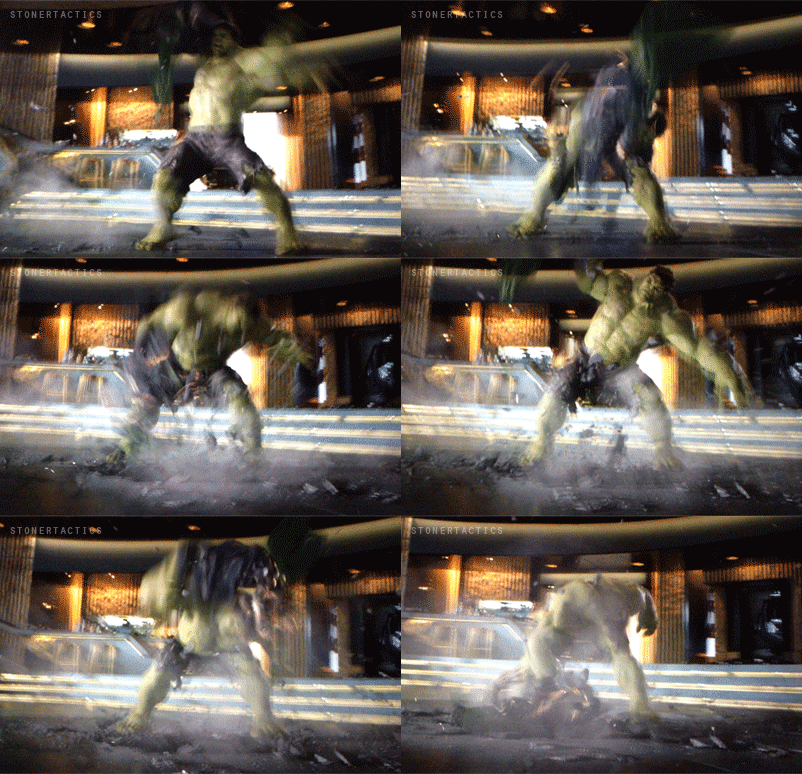
Remember when the Hulk beat the crap out of Loki in The Avengers?  nd then did the exact same thing to Thor in Ragnarok? Funny as hell both times, right? 

So now let’s picture an adult man doing that with a baby. Holding it by one leg, swinging it up over his shoulder, and slamming it face-first into the ground two or three times. That should be funny, too, right?

No, of course not. Hopefully you were all cringing a bit just at the thought of that. It’d be nightmarish to watch, and for someone to actually think that it’d be funny…?

Again these shelves worked in my old office, but not my new one. Everything around them is different. The windows.  The angles. The carpet. The colors.

How about this one– watching someone undress can be sexy as all hell. Unbuttoning shirts. Sliding out of pants. Maybe just tearing open a coat if you’re both impatient.

But in a different context, those very same actions can be mundane, annoying, or depressing. Heck, even kinda creepy.

Yeah, someone doing that exact same little striptease can be creepy as hell. Because if I’m seeing it from outside the bedroom window, maybe with some leaves in the way, while I hear that rough breathing… Hey, we all know what that handheld POV shot means. We’ve seen horror movies. There’s a psychopath out there in the bushes watching that person strip! They’re probably wearing a weird mask and everything.

I mean, assuming the director’s not just copying this shot and doesn’t understand what it meant in other films…

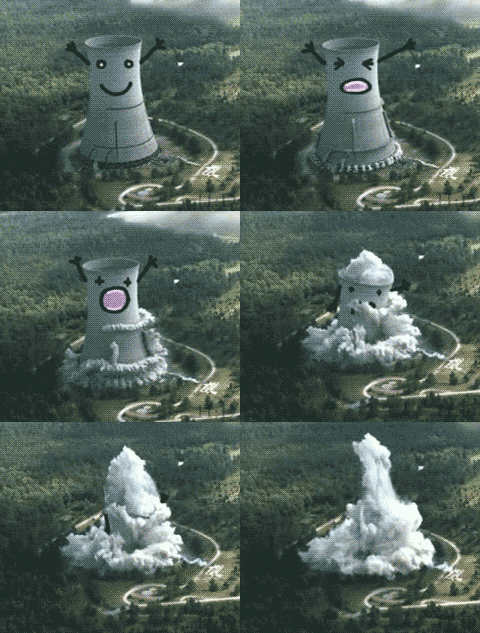
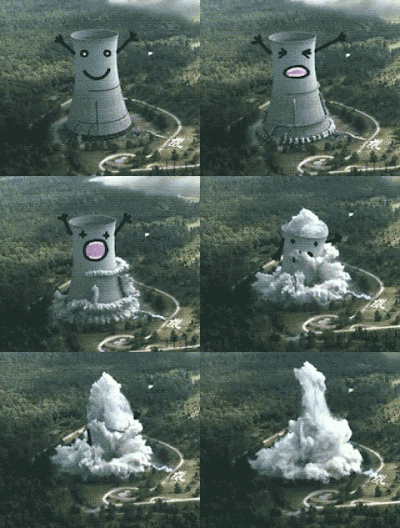
And this may sound like extreme examples—talking about killing babies and stripteases—but it holds for pretty much anything. Seeing a building collapse can be terrifying.  Or exciting. Or frustrating. Heck, if I do demolition for a living it could be boring.

Y’see, Timmy, the problem with all of these examples is that sometimes people try to copy something they’ve seen in other stories without understanding why it worked in those stories. Yes it was exciting/scary/titillating/romantic over there, but that was over there in a certain context. The reaction it created isn’t something inherent to the elements themselves. It was a result of the combining narrative voice and character development and plot structure that led up to them.

Think about that striptease again. Think of all the different ways it could be interpreted by someone. It depends on when they see it. Where they’re seeing it from. How they know the other person. How that person knows them.

Think of all the different ways it could be interpreted by an audience.

And if I can’t think of any other ways… that might be part of the problem, too.

Next time, I’d like to bounce an idea off you.

Until then… go write.

            I’m going to IKEA again.  This time for bookshelves.

August 30, 2018 / 4 Comments

If I’m Being Honest With Myself…

            Okay, look… there’s a good chance this post will piss you off.
            Two things I ask you to keep in mind, going in.
            First is that this comes from a place of kindness.  If you’re reading this, I want you to succeed.  All of you.  Well, okay, not him, but the rest of you, absolutely.  So I’m saying these things because… well, they need to be said.  And you need to hear them.
            Some of you really need to hear them.
            Second is that everything I’m going to be talking about is something I’ve personally experienced.  Not that I’ve seen another writer doing it—I’ve done it.  I’ve believed it.  I’ve been the person needing that smack in the face.
            And I learned from it.  And got better because of it.
            Writing’s tough.  It’s hard work.  I know this, because I’ve been doing it for a living for over a decade now.  When someone tells me how easy and wonderful and fun writing is, I’m often tempted to point out…
            Well, look.  There was a point when I thought writing was easy and fun.  It was back when I wasn’t taking it seriously.
            My writing ability started making huge leaps when I was finally able to admit a few things to myself.  I think that’s true of most people in most fields—if we can’t be honest about where we are, it’s hard to improve.
            That being said…

My first attempts at writing will suck—This sounds harsh, yeah, but… well…  Too often when we’re starting out, we just can’t get past the idea that something we wrote isn’t good.  I know I couldn’t.  My work was typed.  It was a full page long!  My mom liked it!  Of course it deserved to sell.  It deserved awards!  International awards!

            Seriously, there was soooooo much writing before my “first novel.”  There was Lizard Men from the Center of the Earth (two different versions).  A trope-filled sci-fi novel.  Some Boba Fett and Doctor Who fan fic.  A fantasy novel  fuelled by a sudden influx of hormones during my teen years (enough said about that).  The Werewolf Detective of Newbury Street, The Trinity, The Suffering Map, about half of a novel called Mouth.

            And then…Ex-Heroes. 
            It’s just against human nature to spend hours on something and then tell yourself you just wasted a bunch of time.  Why would I write something I couldn’t sell?  Obviously I wouldn’t, so my latest project must deserve a six-figure advance.
            The problem here is the learning curve.  None of us like to be the inexperienced rookie, but the fact is it’s where everyone starts.  Surgeons, chefs, pilots, astronomers, mechanics… and writers.  Oh, there are a few gifted amateurs out there, yeah—very, very few—but the vast majority of us have to work at something to get good at it.  And we can’t improve until we accept that we need improvement.
My first draft is going to suck—There was a point where I’d fret over my first draft.  I’d spend hours laboring over individual words, each sentence, every paragraph.  I’d get halfway down the page and then go back to try to fix things.  It meant my productivity was slowed to a crawl because I kept worrying about what had happened in my story instead of what was going to happen.
            The freeing moment was when I realized my first draft was always going to suck.  Always.  And that’s okay.  Everyone’s first draft sucks.  Everybody has to go back and rework stuff.  It’s the nature of the beast. 
            With those expectations gone, it became much easier for me to finish a first draft, which is essential if I ever wanted to get to a second draft.  And a third draft.  And maybe even a sale.
            No, needing another draft doesn’t make me a lesser writer in any way.  Every single professional writer I know (and I know a lot of them at this point) does a second draft.  And usually a third and fourth.
My writing needs editing.  Lots of editing—As I mentioned, I’ve been doing this for a while.  Surely by now I’ve hit the point where my stuff rolls onto the page (or screen) pretty much ready to go, yes?  I mean, at this point I must qualify as a good writer and I don’t need to obsess so much over those beginner-things, right?

            Alas, no.  Like I just said, my first draft is going to need work.  We all make the easy first choice now and then.  Things slip past us.  We misjudge how some things are going to be read. I’m fortunate to have a circle of friends and a really good editor at my publisher who all call me out when I make these mistakes or just take the easy route when I’m capable of doing something better.

            As I mentioned above, part of this is the ability to accept these notes and criticisms.  I’m not saying they’re all going to be right (and I’ve been given a few really idiotic notes over the years), but if my default position is that any criticism is wrong then my work is never going to improve past the first draft. 
            Which, as I mentioned above, sucks.
My writing needs cuts—Sticking to the theme, if I believe my writing is perfect, it stands to reason all of it is perfect.  It’s not 90% perfect with those two odd blocks that should be cut.  When I first started to edit, one of my big problems was that everythingneeded to be there.  It was all part of the story.  Each subplot, every action detail and character moment, all of the clever references and in-jokes.
            The Suffering Map was where I first started to realize things needed to be cut.  I’d overwritten—which is fine in a first draft as long as I can admit it in later drafts.  I had too many characters, too much detail, subplots that had grown too big, character arcs that became too complex.  It took a while, but I made huge cuts to the book.  It had to be done.  Heck, I just cut a whole subplot from the book I’m editing right now.  About 2500 words gone, snip-snip, in about five minutes.
            And the book it better for it.
My writing is going to be rejected –Know what I’ve got that most of you reading this will never have?  Rejection letters.  Paper letters that were mailed to me by editors.  I’ve got dozens of them.  Heck, I’ve probably got a dozen from Marvel Comics alone.  And since then I’ve got them from magazines, big publishers, journals, magazines, ezines…
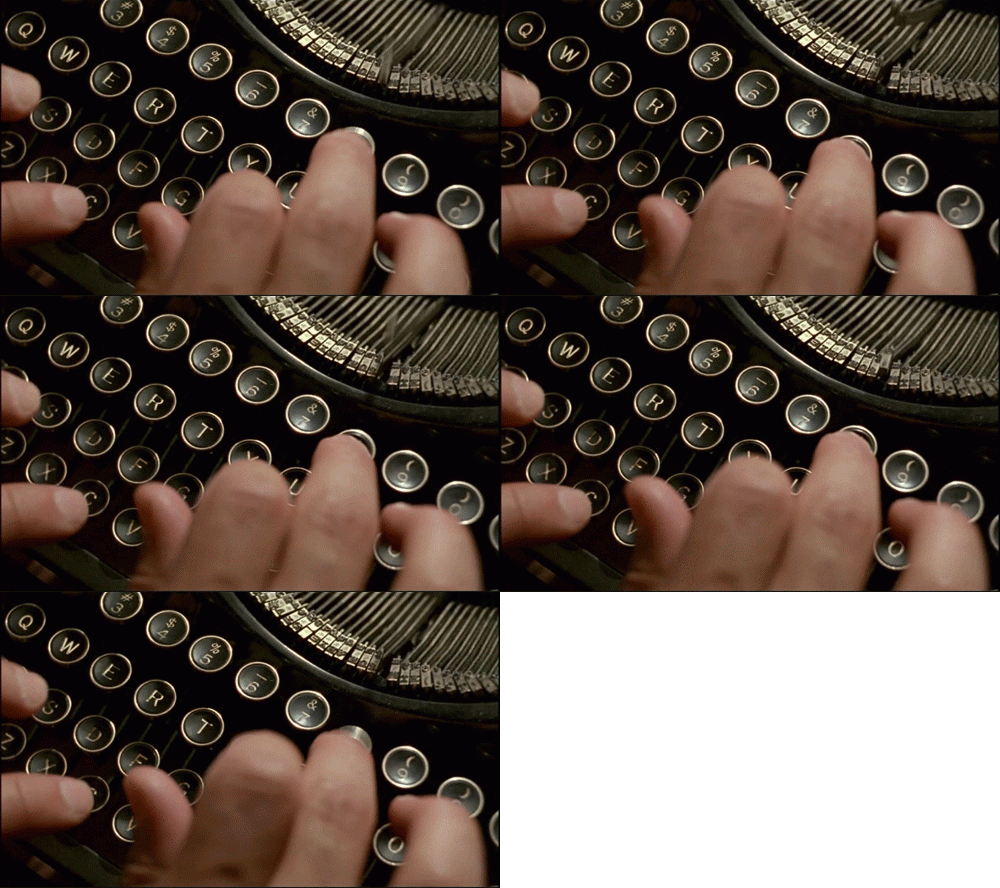
            But when that first rejection from Marvel came… I was crushed.  Devastated.  How could they not like my story?  It was a full page!  I included a colored pencil rendering of what the cover should look like.  Did I mention it was typed?!
            It took me weeks—whole weeks, plural—to work up my courage to try again, and then they shot that one down, too.
            Granted, I was eleven, and those stories were awful.  I mean… really awful.
            Rejection is part of the process.  I still get rejections today.  I expect I’ll be getting then for the foreseeable future.
            Which is a good time to mention…
Rejection does not automatically mean my writing is bad—Getting that email is tough, like a punch to the gut.  It’s easy to let it get under the skin and fester.  Self-doubt feeds on rejections, so it’s important to think of it as “still looking for the right home.”
            Like I said, I’m still getting rejections today, even with the fairly solid list of credits and accolades after my name.  Editors and publishers are people too, and nothing is going to appeal to everyone.  Getting rejected became a lot easier for me when I realized it didn’t show up on my permanent record and it wasn’t a personal attack  It was just a person who didn’t connect with that particular story for some reason.
            Now, there’s a flipside worth mentioning here…
Rejection also doesn’t automatically mean my writing is good—There’s a lot of memes and recurring stories and a few general mindsets that push the idea that if my work gets rejected by an agent or editor it mustbe good, because all those people are idiots.  And it can be a comforting thought.
            It’s also kinda close to conspiracy-theory reasoning, if you think about it.
            Going right back to the beginning of this little rant, there’s a decent chance my work just isn’t good.  No big deal.  Like I said, I had dozens and dozens of rejections before I started to get some sales.
            But if I refuse to back away from the idea that it might be me—if I take dozens of rejections as proof the system is stupid rather than admit the possibility my manuscript wasn’t ready to go out—then I’m never going to improve.
           
            If I can admit these things to myself, it can only make me a better, stronger writer.  It’s not a flaw or a weakness.  In fact, if I look at the above statements and immediately think “Well, yeah, but none of that applies to me…” it’s probably a good sign I’m in denial about some things.
            And that’s not going to help me get anywhere.
            Speaking of getting anywhere, if you’re in the Atlantaarea I’m at Dragon Con this weekend.  Come find me and we can talk about books and writing and is Clark Gregg coming back to Agents of SHIELD or what?
            Next time, I’d like to put a few things in context.
            Until then, go write.

Categories