
Sorry this is running a bit late.  Ending up lost in a great book earlier this week and put me behind on a lot of things.
            Okay, I’ve said a few times that I don’t want to use this blog to go over the basics.  If you’ve found your way here, I’d like to pretend that you’ve got a loose grasp of your chosen writing format.  But I’ve seen a few screenplays recently that… well, it’s apparent the basics of screenwriting aren’t as well-known or understood as they should be.
            Now, to be clear, I’m talking about if I want to do this professionally.  I want a studio to hire me and give me a pile of money so they can turn my script into… y’know, garbage. But, hey, they’re giving me a pile of money. 
            If I’m trying to do indie/YouTube things with my close circle of friends… format doesn’t really matter as much.  No one else out of that circle’s going to see it, right?  But if I’m thinking of Hollywood, of screenplay contests, of those big brass rings people have been thinking of for decades…
            Well, I need to have some idea how a screenplay works.
            So, here’s a  dozen basic rules I should have down before I show my screenplay to someone. 
            And especially before I submit it to someone.

            1) Basic FormatScripts are always in single space Courier 12.  Always.  If you heard a story about a professional screenwriter who only works in Times Roman and turns in his or her work that way, I can tell you two things—that person’s already got the leeway you only get with a well-established career, and as soon as they handed the script in the whole thing was reformatted into Courier 12.  It’s the industry standard for a number of reasons, including timing and scheduling.  Every other department needs that script in Courier 12.
            Ahhh, says clever wanna-be #8… if they can convert it anyway, then what difference does it make if I want to write in Times or Arial or Wingdings? 
            It doesn’t make any difference how I write it.  But when I submit it to a contest, an agent, or a production company, it has to be in Courier 12.  Because scripts are always in Courier 12.  Always.  And I’m trying to convince people that I’m a professional. 
            One other thing—I don’t use scene numbers in a spec script.  That’s something that comes up much later during the actual pre-production for a film.  They’re a tool for the assistant directors and department heads, not the screenwriter.  Putting them in now will just get me tagged as an amateur.
            2) Basic StyleAlways use third person, present tense.  Always.  The script is what’s happening on screen right now.  Characters can have dialogue where they talk about things in past tense, but all my action blocks and descriptions must be in third person, present tense.
            A screenplay that switches person or dips back and forth between past and present tense is always a good tip-off for readers that this is someone’s short story or novel they sloppily adapted into screenplay format.  There’s also usually a reason no one bought their short story or novel, and it’s related to the fact that they didn’t bother to learn how to format a screenplay…
            3) Capitals— This isn’t that tough.  I use capitals the first time we see a character so the reader knows this is someone new.  I’ll go into this a bit more in a minute.
            I also use capitals for emphasis when something important happens.  When YAKKO IS SHOT or Dot’s exploring the graveyard and finds A SEVERED HAND ON THE GROUND.  Keep in mind, though, that in this sense capitals are just like exclamation points.  The more often I use them, the less power they have, and eventually they’ll tip the scale and just start frustrating or annoying the reader.
            Also, noneof this applies to dialogue.  Again, for clarity, I should never apply the above rules to dialogue.  If dialogue is in capitals it means someone is shouting–nothing else.  To be clear, there is no other way to interpret capitals in dialogue.  Capitals in dialogue=shouting.  So even if my sister has never been mentioned in the script before, I don’t say “Have you met my sister CAROLYN?”  I also don’t say “Hey, over there on the ground, is that A SEVERED HAND!?!!?” 
            Okay, I might shout if I see a severed hand.  But am I supposed to shout?
            4) Names– As I mentioned above, whenever I introduce a character, I put them in all caps in the action blocks.  The very first time I see YAKKO WARNER I need to know he’s someone new. After that he’s just Yakko.  For example…
Another man cut from the 50’s action cloth, ZACK “ZAP” MARSHALL is standing by another panel, a few feet down the wall from Lance’s.   This one has three large buttons on it, marked “laser,” “missile,” and “x-ray”. Zap also wears a wide, high-tech belt buckle with a large button in the middle of it.
REX
Ready, Zap?
ZAP
Just give the command, Captain.  I’m ready to blow it out of space.
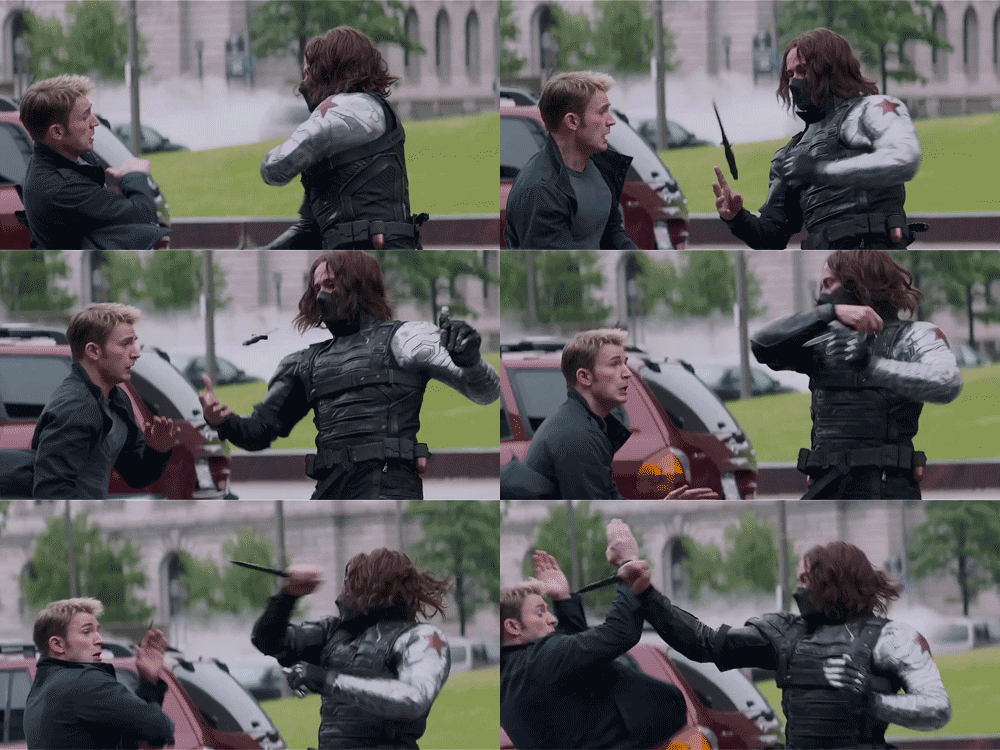
            Dialogue headers are always all caps, using the most common version of the character’s name, and I never change dialogue headers for a character.  Wakko’s dialogue is always headed with  WAKKO, Dot’s is always headed with DOT.  The only time they would change is if the character has completely changed identities on screen.  For example, in Captain America: The Winter Soldier we find out the title assassin is actually Cap’s supposedly-dead friend Bucky.  He’s WINTER SOLDIER in headers until he’s revealed as BUCKY in either the action block (because you’re introducing a new character) or dialogue (where it still isn’t capitalized unless it’s shouted).  Then his next dialogue header should be WINTER/BUCKY.  Use that double-header once, and then he’s BUCKY from there on in.

            5) Don’t Name every Character—In the abbreviated, concise format of a screenplay, names are an important tool.  They tell the reader that this character is someone we need to pay attention to.  They’re important enough to the story that they rate a name and not just a title like MAN #2 or WAITRESS or OFFICER.
            Alas, some idiot somewhere started pushing the idea of naming everyone in a screenplay.  The logic is that this gives more detail, nuance, or some such nonsense.  Do not do this.  If my screenplay is littered with extra names, the reader’s going to be tripping over themselves trying to keep all those names straight because the logical assumption is that they need to be kept straight.  I made the effort to name them, after all.  So rather than focusing on the story, the reader’s trying to figure out how the woman in the mall and the taxi driver figure into the story.  That’s breaking the flow and it’s going to piss them off when they realize they wasted time and effort juggling twenty-seven names for no reason.
            Never name someone just to give them a name.  No one—not even the actor—is going to be upset with just MAN #2.  A friend of mine has made a good career out of being MAN #2.  Trust me, MAN #2 is going to make a nice chunk of money, even for just one day on set.
            6) Actually Describe Things—A few years back I got to interview screenwriter-director David Goyer (The Dark Knight, Man of Steel, the Blade trilogy) and he told me a funny story about getting smacked down by Guillermo del Toro.  It seems Goyer had described a character in a script as “a living nightmare.”  del Toro looked at this and said “What does that even mean?  That is boolshit!”
            There is a time and a place for pretty, evocative imagery and language.  That time and place is not while writing a screenplay.  As I mentioned above, the script is about what’s on screen right now, which means it has to be something we can actually see.  A reader needs to be able to visualize what’s on the page, and it’s very important that multiple readers visualize the same thing.  I can tell you Jack is a dead ringer for my old work friend Scott, but that doesn’t mean a damned thing if you don’t know what Scott looked like.  “It’s a hundred times cooler than Armageddon” sounds really cool, but it’s really hard to do concept sketches and storyboards off that.
            During our interview, Goyer actually admitted this issue bit him in the ass when he directed one of his own scripts.  He’d given a vague, roundabout description of a sequence, but once he was on set he actually had to figure out how to film it.  Now he needed a real description.  So production came to a halt while Goyer and his assistant director tried to block out the mess that writer-Goyer had left them to deal with.
            That leads nicely into…
            7) Don’t write what we can’t see – A solid corollary to the last point.  I’ve lost track of how many times I’ve seen stuff like this in amateur screenplays (and a few professional ones).
            Tight on a man sitting in a restaurant, not eating.  This is WAKKO, an advertising executive who just scored a multi-million dollar contract with Pepsi.  He’s freaking out, though, because he also just found out his fiancé has been cheating on him with someone from her office.  Another WOMAN!  And now he’s questioning their whole relationship, himself, how did he miss this, how could he be so blind? And how is he going to explain this to his friends and family?  No, Mom, Jane’s not coming to Thanksgiving–her bird’s getting stuffed by one of the girls from legal? Wakko keeps going back and forth between blaming her for cheating and blaming himself for not realizing why things felt strained between them.
            What’s wrong with that paragraph?  Well except for the first sentence… how is the audience expected to know any of this?  All we’re going to see is a guy in a restaurant.  Again, the script is what’s on screen right now.  Not what’s in someone’s head.  That’s the stuff that comes out through dialogue, action, and maybe some clever set dressing or wardrobe choices.  But definitely not in a block of exposition in the action blocks.
            8) Don’t Over-Describe Characters—This sounds a little contrary to some of the stuff I’ve just said, but trust me–it isn’t.  A bad habit some writers develop—especially prose writers—is to go mad with character description.  Hair color, eye color, ethnic background, education, music preferences, drink preferences, underwear preferences, etc…  They take their entire character sketch and drop it into the screenplay.
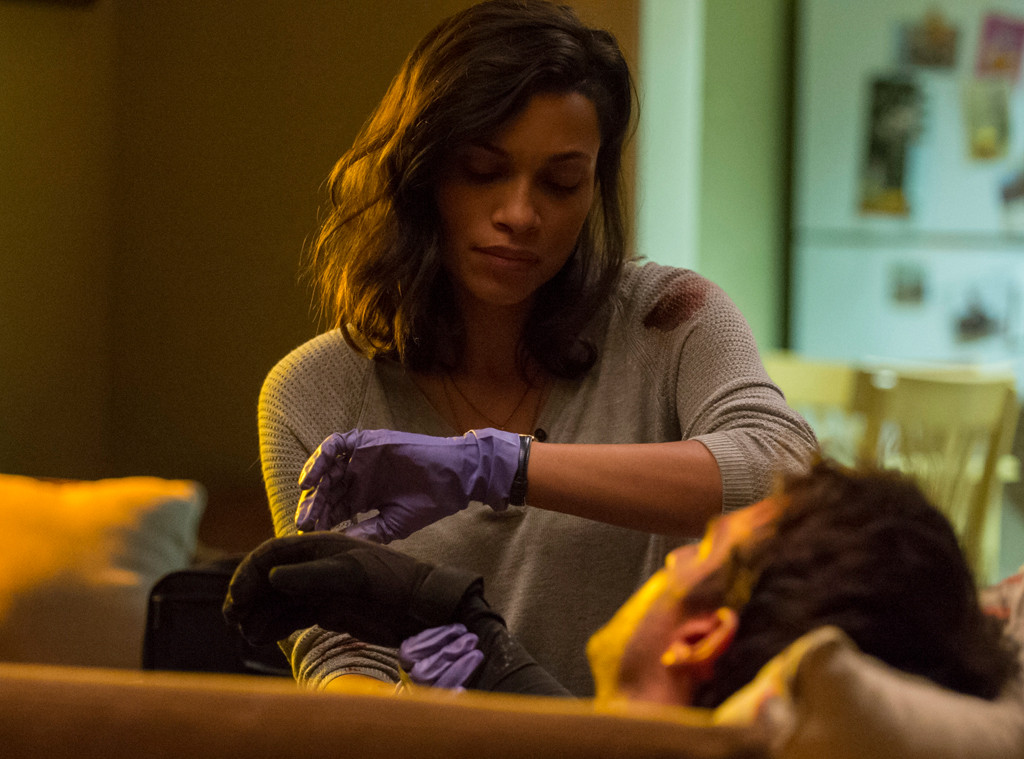
            I don’t go nuts describing characters in scripts for a few reasons.  One is that I always want to be tight and lean in a screenplay.  Two is, as I just said above, I don’t want to describe anything the audience can’t see.  Three is the one none of us like to think about—there’s a good chance this character will change.  I can spend half a page describing Rosario Dawson and then they decide to cast Jennifer Lawrence.  It happens. 
            Just give enough description so the character stands out from any other character.  Really, if I’ve got more that two sentences of character description I’ve got too much.  Yeah, I may have tons more, but remember—the script is about right now.  Everything else about my character will come out in the course of the story through their dialogue and actions.  If it doesn’t, my problem is not that I only got two sentences of character description.
            9) Don’t act – Okay, you know those little descriptions under the dialogue header, usually in parentheses?  These are called parentheticals.  Sometimes, as a joke, they’re called wrylies.  It’s a quick set of instructions to the actor about how the line’s supposed to be delivered.
            Actors loatheparentheticals.  Actors hate parentheticals the same way screenwriters hate  producers who want us to change the ending so everyone was dead the whole time and to make Natalie Dormer’s part a lot bigger because she’s become kind of a hot item since we finished principal photography.  It’s someone who has no idea how to do my job telling me how to do my job.  Let’s look at a quick scene from one of my own scripts…
WENDY
(excited)
You did it!
TED
(proud)
Yeah, great shot, Zap!
LANCE
(relieved)
All clear again, Captain.
REX
(serious)
Yes.  But for how long? 
WENDY
(confused)
What do you mean, Rex?
REX
(thoughtful)
If it wasn’t for brave crewmen like Lance, Zap, Ted, and the rest of you, the galactispiders would make the starways far too dangerous. 
            Are those parentheticals really telling you anything useful?  Most actors would be able to figure this stuff out just from context.  So would any reader. 
            Which, for the record, is why none of these parentheticals are actually in my script—I just added them for this example. 
            Y’see, Timmy, there are only two times to use a parenthetical.  One is if it’s life or death important to the story that this line is delivered a certain way.  If the whole film is going to fall apart if Yakko doesn’t whisper in this scene, then add a (whispered) to that line of dialogue.  Two is if I think there’s a very real chance this line could be misunderstood, even with all the context and lines before it, and the resulting misreading will destroy the entire film.
            If I’ve got a parenthetical in my screenplay, I need to think long and hard about if it meets one of these two criteria.  And then probably remove it anyway.  They’re the adverbs of screenwriting.
            10) Don’t direct—Okay, what I just said about actors hating it when you tell them how to act?  Directors loathewriters who fill up a script with directing notes.  When I fill pages with stuff like “Pan over to reveal…” or “rack to see Yakko’s expression,” directors shake their heads, cross that out, and plan how they’re going to shoot the scene.
            Like the parenthetical above, only put in direction if it’s life or death important to the film.  If the story hinges on this being a crane shot, then put in—if the story really hinges on it.  Me thinking this scene would be really cool with a crane does not make it a pivotal shot. 
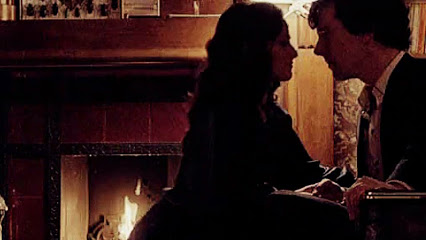
            Plus, a lot of time adding direction honestly detracts from the story.  Here’s a great example—how many of you have seen Sherlock?  Remember the last moment he has alone with Irene Adler at 221B Baker Street, when they’re sitting at the fireplace and she’s trying to convince him to run away with her?  It’s pretty important that we don’t focus on what Sherlock’s doing with his hands, right?  Except if I point this out in my script, readers are going to spend the next ten pages trying to figure out what Sherlock’s doing with his hands, and that’s going to override a lot of what’s going on now.  If I hadn’t mentioned it, they wouldn’t’ve thought about it, but now it’s essentially a low-level spoiler in my own script that his hands are doing something that will matter later.  Don’t worry about that sort of thing.  By the time the readers get to the flashback and figure it out, they’ll understand that when the movie is filmed we can’t focus on his hands at that point.
            By the way, just to clarify—it doesn’t matter if I plan on directing the script myself.  The script I submit to a contest, an agent, or a producer, has to be a script for anyone.  If I’m actually going to be the director, I’ll have plenty of time later to add that stuff.  Plus I’ll have my own notebook and schedule.  For now, all those things are just taking up space on the page.
            11) VO vs. OC—Okay there’s a huge difference between voice-over and off-camera.  This is one of those little things that can get me tagged instantly as an amateur if I get them wrong.
            Voice-over(V.O.) is when someone’s talking that no one else can hear.  Announcers and narrators are usually voice-over.  Train of thought is voice-over.  “Little did he know…” tends to be voice-over.  Another good tip—I will never, ever see lips moving for a voice-over.
            Now off-camera(OC) is when someone’s talking that other characters can hear but the audience can’t see.  For example, if Phoebe’s on her phone talking to Wakko, and we hear his voice, he’s off-camera, notvoice over.  That old bit when everyone hears a voice, turns, and sees that Dot has come into the room—that’s off-camera.
            I want to use OC carefully, because too much makes it look like I’m trying to direct again (see above).  I’m not going to put it during an intercut phone call.  I don’t use it when we know Dot’s on the other side of the room but we’re not seeing her at this moment.
            12) Don’t use archaic terminology – Forsooth, whenst thou uses scrivening of yesteryore, thy words appearst equally of yesteryore. And few and far between liest those who show interest in the dry, dusty bones of a mouldering anecdote.
            Or, as we say today, no one’s interested in an old script.
            It used to be common to end every scene with CUT TO or FADE, or to end every page with (CONTINUED).  It also used to be common for the US military to have a lot of horses and bayonets.  In both instances, that hasn’t been the way it works for years.  When I started working in the film industry back in 1993, CUT TO was already dead.  (CONTINUED) was on life support, and only cropped up in very limited use. Usually for ongoing dialogue.
            If I’ve been using an old script from The Maltese Falcon, The Godfatheror Rocky to learn this terminology and formatting—I need to toss it.  The film industry grows and changes like any other industry.  If my reference script wasn’t written in the past ten years, it’s probably going to give me more bad habits than good ones.
            This is also one of the big reasons I wanted to go over all of this again. At this point, it’s been about nine and a half years since I worked in the film industry full-time. My experience is getting old, and I’m smart enough to admit that.
            Some people are not.
            Or  just don’t care as long as you’re going to pay them…
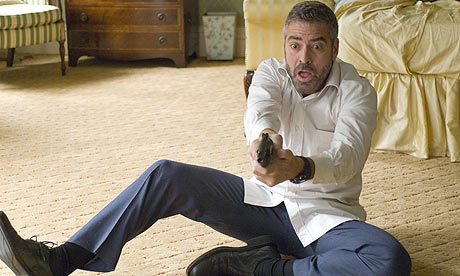
  
            13) Don’t use real celebrities as charactersA bonus point I’ve mentioned before.  I’ve read screenplays where one character ended up at a resort with Johnny Depp, another one where someone dated Carmen Electra, and a really, really creepy one about George Clooney getting involved with a producer… who happened to have the same name as the screenwriter.  Unless your movie is already in production and Helen Mirren happens to be your best friend in the world who would do anything for you, do not use her as a character in your screenplay.
            Yeah, I’m sure some of you are already calling foul.  After all, haven’t I littered the Ex-Heroes series with mentions of celebrity zombies?  Well, yes I did.  But that’s the difference between a book and a screenplay—you can still read the book if Nathan Fillion, Jessica Alba, or Alex Trebek don’t show up.  Now if someone ever decides to make a movie out of the book… well, then there’ll probably be issues. 
            Although I feel relatively safe saying Fillion would show up.
            So, thirteen tips to a more coherent, professional-looking screenplay.  I’m betting the majority of you knew most of them.  But a few of you… well, now you know.
            And knowing is half the battle.
            Next week… I wanted to talk about some very bad people and how to make them good.
            Until then, go write.
March 17, 2016 / 5 Comments

All Purpose

            I’m sorry this is a bit late.  Well, four  weeks late.  That’s not a bit, that’s crazy-late.  I’m in the final weeks for this manuscript and I’m really trying to make it fantastic.  That’s pretty much been my main focus the past month or so, for what I hope are obvious reasons.
            Hey, speaking of which…
            One of the most common things that makes a character unbelievable is when they have no purpose for their actions.  We’ve all seen it.  The guy who decides to pick a fight over something petty in the middle of a crisis.  The person in charge who continues to ignore someone with key information.  The spouse who’s just a jerk.  The ninja who attacks for no reason.
            Nothing knocks a reader out of a story faster than people just randomly doing stuff.  There’s a simple reason for this.  In the real world, when people do things for no reason, they’re usually considered to be insane.  Not an interesting insane, either, but the “lame motivational excuse” insane.  If I run into a  burning house to save a baby or a dog, I’m going to be considered a hero whether I make it out or not.  If I run into the flaming house just because it’s there, I’m going to be considered an idiot.

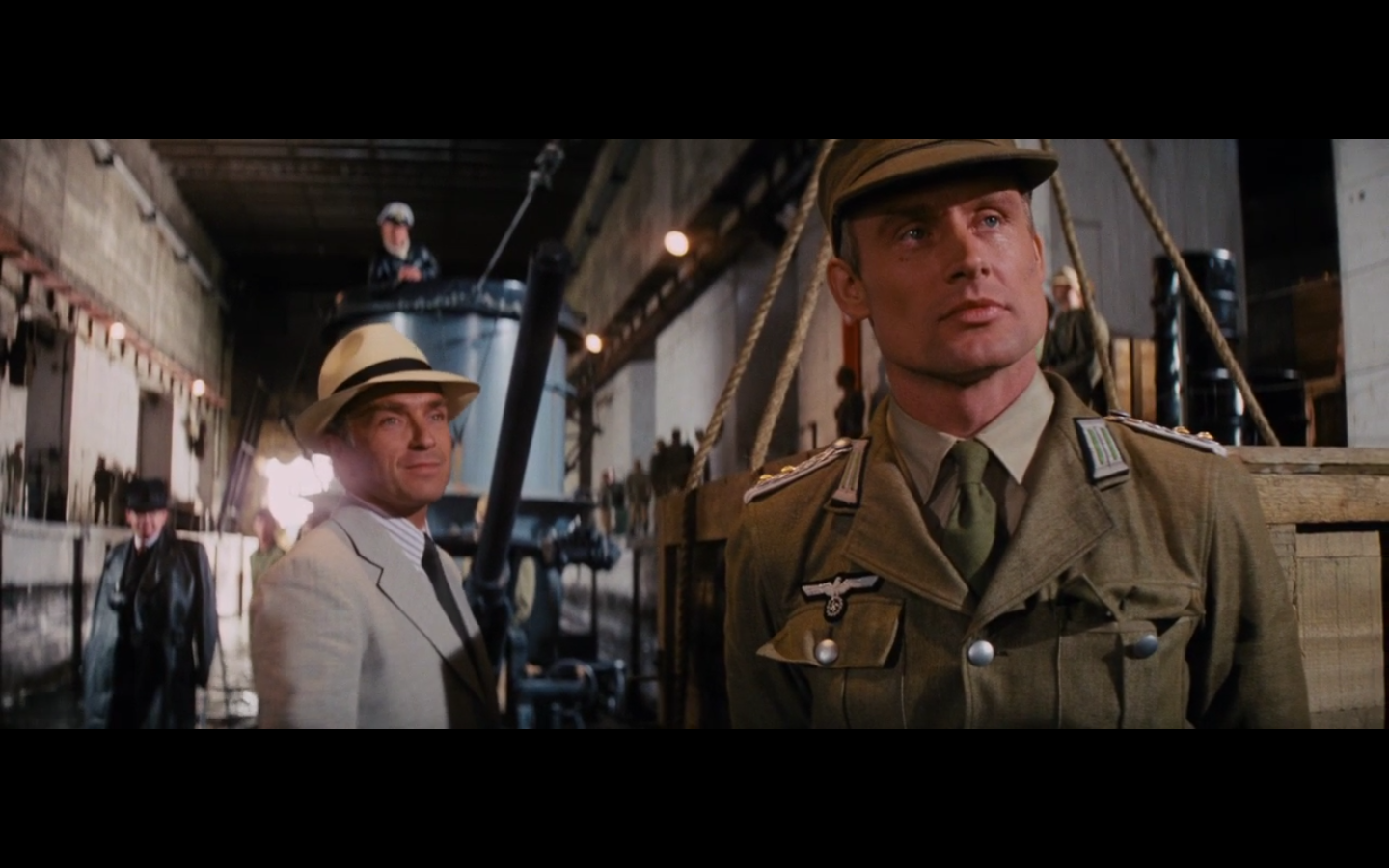
           People need a reason to do things.  Real reasons.  Reasons that jibe with their background and their personality and with basic rules of behavior.  That’s why you’ve heard of people motivating horses with a carrot on a stick but not with a t-bone steak on a stick—horses like veggies, not meat.  In Raiders of the Lost Ark, it’s completely understandable that Belloq wants to open the Ark before taking it to Germany, and believable that the Nazi officers would feel uncomfortable about performing a “Jewish ceremony.”  This fits with Belloq’s smarmy background and it makes sense—historically, even—that the officers would be a bit by disturbed by what needs to be done to open the Ark.

            So here’s a challenge for you—try to picture that scene reversed.  Imagine if, at that point in the film, the Nazi colonel was insistent on performing the ceremony and Belloq said “no, no, I really think we should just take it to der Fuhrer and let him deal with it…”  It wouldn’t make any sense, would it?
            In the big scheme of things, most people’s motivations tend to be simple.  If you’ve ever seen a procedural show, they often talk about the common motives for murder.  Love, money, revenge—they’re very basic ideas.  The unspoken motive for the investigators on these shows is justice, or perhaps closure.  In Raiders, Belloq is looking for glory and maybe a bit of power (I think it’s safe to say he was secretly hoping he’d get all the benefits of that “hotline to God”).  Indy wants to stop the Nazis and save the Ark for a museum.  The Nazis want to obey the orders from their commander.
            In the book I’m working on right now, a major motive for the main character is infatuation.  It’s why he takes the actions he does that kick off the story.  But not very far in, fear and survival become big motivators for him.  His actions might not always be rational, mind you, but his actions fit who he is and what he thinks he can accomplish.
            Now, sometimes the story needs people to act a certain way.  It’s been plotted out and the characters need to do this now so that can happen later.  What some writers don’t seem to get is that this need doesn’t make a character’s actions more believable or forgivable.
            The reader has to be able to relate to my character’s purpose for doing things.  While characters might have very true and proper motivations within the context of their tale, those motivations still need to be interpreted by the chosen audience.  This is especially important for stories set in different cultures (Japan, for example, or India under the caste system) or perhaps in entirely fictitious ones (Barsoom, Diagon Alley, or the grim darkness of the future).  It’s common to hit this wall when the writer knows their chosen setting too well, or maybe had to build it from the ground up.  To me, it’s completely clear and understandable why a Thark warrior would act this way—why waste time going over it, right?  To you, though… this may not be so clear.
            Let me toss out one other thought about motivations.  Up top I gave a list of situations that many of us have probably dealt with.  The random aggressive person.  The jerk spouse/boyfriend/girlfriend.  The willfully ignorant boss.   These people really exist.  Hell, I had that higher-up boss for two years at one point.
            But…
            As I’ve said here many times, reality is not a story point.  It’s not part of a character sketch, either.  Once I put that boss into a story, my readers are going to expect there’s a purpose to him being there.  That there’s an actual reason for his behavior.  And if there isn’t… that’s on me as the writer.
            Look at the characters in your story.  Follow them for a few pages.  Can you explain their actions with one or two simple words?  Are they words most people will know?  Do these words relate to the character and not my outline?
            Then you’ve probably got some very driven characters.
            I’m not sure I’ll be able to post anything next week because I’m a “special guest” at WonderCon here in Los Angeles.  And I’ll be in the last two weeks before this new book is due.
            Or maybe I’ll just stop making excuses and write something.
            Until then… well, hopefully you feel motivated to go write.
January 30, 2016

Annnnnnd… ACTION!

            Hey!  Wanted to thank all of you who came out last weekend to the Writers Coffeehouse. Hopefully hearing me talk about writing in the real world was at least as semi-useful as all of this.
            Also—shameful capitalist plug—my new book, Ex-Isle comes out next week from Broadway Paperbacks.  Check out that fantastic cover over there on the right.  It’s book five in the ongoing Ex-Heroes series, and I happen to think it’s pretty cool.  Granted, I might be a bit biased…
            (the audiobook’s still three weeks out but it is coming, I promise)
            Anyway, enough about that. Now… story time.
            About fourteen years ago some friends and I were in a pretty serious car crash.  Someone sideswiped us as we were pulling onto the freeway and then sped off.  My friend’s SUV was slammed into the concrete wall, bounced off, then slammed into the wall again because the wheels had twisted around to send us right back into it.  We skidded ten or twenty feet scraping against the wall.  The first impact was so hard that the passenger side door crumpled in, hit me, and fractured my ribs on that side.  I also caught half the windshield with my face.  I remember clenching my eyes shut on instinct, what felt like gravel hitting my cheeks and mouth and forehead. While part of me knew (in the greater sense) that we were in the middle of a collision of some kind, another part of me was still trying to figure out what the hell was going on.  And there was so much noise.  Screams and hollering from friends, metal on concrete, metal bending, glass breaking, highway noise because the windows were gone.  It wasn’t until everything stopped that I realized how loud it had been.
            Now, I took a while to write that out, and a while for you to read it, but the truth is, it took seconds.  Six or seven seconds, tops. Really, at the moment, it was just a blur of sensations. I didn’t piece together what had happened—and what I’d experienced—until afterwards.
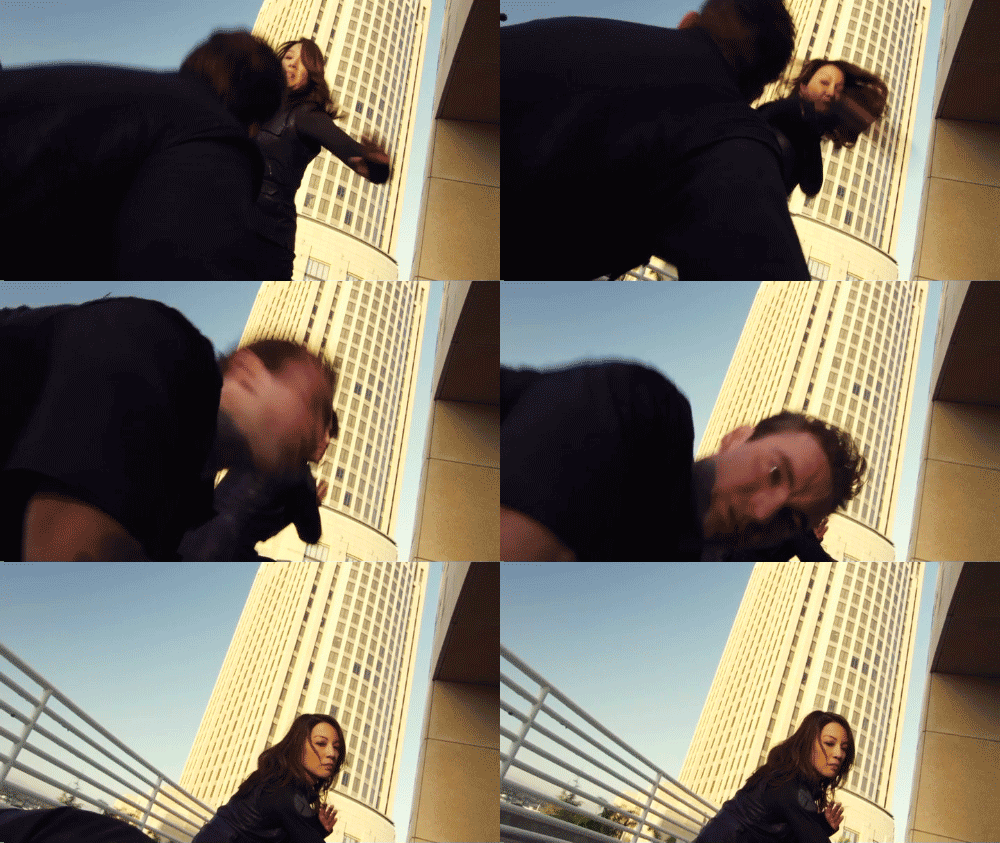
            Action, by its very nature, is fast.  It’s a blur.  If you’ve ever been part of an accident of some kind, a fight, a collision, or any other kind of really dynamic moment, you know what I’m talking about.  A huge amount of action is stuff we figure out after the fact.  In the moment, I’m not quite sure how my shirt got ripped or why my arm’s bleeding or… oh, geez, I think I whacked my head a lot harder that I thought.
            Here are a couple of tips on how I try to make my action scenes seem fun and cool.
            Keep it fast–Action can’t drag. If it takes a full page for someone to throw a punch and connect, things are happening in slow motion.  Even a paragraph can seem like a long time, especially once multiple punches are thrown.
            My personal preference is to try to not have action take much longer to read then it would to experience.  I trim fight scenes and action moments down to the bare minimum to give them (pardon the phrase) a lot of punch. One way I do this is to clump some actions together and let the reader figure out what happened on their own
            He slammed three fast punches into the other man’s kidney.
            Karen did something quick with her hands, and now she held the pistol while the mugger wailed and held his wrist.
            Keep it simple—I practiced martial arts for a while and I also have a lot of experience with  weapons thanks to my time in the film industry.  Even though I know lots and lots of terminology, I try not to use it.  That kind of thing can clutter up an action scene, especially when I’m using a lot of foreign languages or obscure terms.  I want this to move fast, and if my reader has to stop to sound out words and parse meanings from context… that’s breaking the flow.  If they need to figure out if a P-90 TR is a rifle, a pistol, or a fitness program… well, maybe they’ll come back to it after lunch.
            Remember, there’s nothing wrong with terminology, but there’s a time and a place for everything.  That time is rarely when someone’s swinging a baseball bat at your head.

            Keep it sensory—Kind of related to the above, and something I touched on in my story.  Action is instinctive, with a certain subtlety to it. There isn’t a lot of thought involved, definitely not a lot of analysis or pretty imagery.  Keeping in mind the fast, simple nature I’ve been talking about, I try to keep action to sounds, sights, and physical sensations.  I can talk to you about a knife going deep into someone’s arm, severing arteries and veins as it goes… or I can just tell you about the hot, wet smell of blood and the scrape of metal on bone.  Which gets a faster reaction?
            Granted, writing this way does make it hard to describe some things, but a lot of that gets figured out after the fact anyway.  My characters will have a chance to sort things out once things cool down.

            Keep it real—Like so many things in fiction, it all comes down to characters.  There’s a reason we can zone out dozens of attacks on the news but be gripped by a single one in a book.  Action needs to be based in real characters because my readers need to care about the people involved.  A stranger in a car crash is kind of sad in an abstract way, but Wakko in a car crash is a tragedy and we want constant updates.
            This also kind of works against the idea of “always start with action,” which is something I’ve talked about before.  It’s tough for readers to be invested in action when we don’t know the people involved.  If I start with an action scene it has to be twice as big to compensate for the fact that we don’t know the characters, and once it’s that big it’s going to effect the level of everything that comes after it.
            Now, as always, it’s pretty easy to find exceptions to these.  As I said, these are more tips than rules.  But there’s one particular exception I want to talk about.
            A pretty common character is, for lack of a better term, the fighting savant.  Batman, Jack Reacher, Melinda May, Ethan Hunt, Sarah Walker, Joe Ledger, Stealth—characters who’ve taken physical action to an art form through years of study and experience.  For these people to not use precise terminology for weapons or moves could seem a little odd.  It makes sense they’d be able to dissect action, picking out the beats and planning out responses like a painter reviewing their palette.
            But…
            Keep in mind, these characters by their very nature should be rare.  If I have a dozen utterly badass characters who all have badass moves with badass weapons… that’s going to get boring real quick.  It’s monotone.
            Also, keep the point of view in mind while writing.  Stealth may be a trained master of unarmed combat, but St. George gets by with his invulnerability and raw strength.  Whose narrative this is will affect how her actions are seen by the reader.
            And that’s that.  A handful of tips for writing killer action.
            Next time, I’d like to talk about, arguably, one of the finest episodes of Star Trek: The Next Generation that was ever produced.
            Oh, and  next Thursday I’ll be at Mysterious Galaxy in San Diego, blabbing away and signing copies of Ex-Isle.  If you’re in the area, please stop by and say “hullo.”
            Until then… go write.
December 11, 2015

Protagonist #3

            I can’t believe the year’s almost over.  Where did the past few months go?
            I wanted to get much more done this year.  But we’ll talk about that in a few weeks…
            While posting my last few little rants and adding in links, I realized there’s a lot of basic stuff I haven’t revisited in two or three years now.  I think part of it is because I’ve been doing more conventions and talking about these topics there, so it feels like I’m going over them all the time.
            Anyway, over the next month or two I want to go over some things like dialogue, stakes, action, and a few other random tips and tricks I’ve stumbled across during the many years of mistakes that make up my career.
            Right now, I wanted to talk about some character basics.  Three of them, to be precise.  Put this rant near the top of the advice column.  I’m really, really tempted to call it a rule, but I think that would spark too many comments about various exceptions and distract from the point I’m trying to make.
            Pretty much across the board, my characters need to be believable, relatable, andlikeable.  If my protagonist doesn’t have these three traits, I’m pretty much screwed.  It’s not impossible to have a story where my characters don’t have these traits, but it’s going to be an uphill battle.  Like, rolling-a-boulder-up-a-mountain level uphill battle.
            Allow me to explain by going over each of these. We’ll do that with my frequently-used volunteer character, Dot.  Also, there’s a lot of back and forth between them, so I apologize now if this gets a bit confusing or jumbled at points. 
            First up, Dot has to be believable.  Almost nothing is more important than this.  If my reader can’t believe in the character within the established setting, if they don’t feel like a real person, my story’s got an uphill battle going right from the start.  It doesn’t matter who (or what) Dot is, she must be believable.
           How do I do that?

           Dot’s dialogue should sound natural.  Her words have to flow naturally and they have to be the kind of words Dot would use.  I’ve seen countless stories where four year olds talk like they’re forty and forty year olds talk like robots.  When Dot speaks, it can’t be stilted or forced, and it shouldn’t feel like she’s just spouting out my opinions or political views or whatever.

            The same goes for Dot’s actions, reactions, and motives.  There has to be a believable reason she does the things she does.  A reason that makes sense with everything we know about her or will come to know.  If her motivations are erratic and just there to push the plot along, my readers are going to pick up on that really quick.  If I find myself thinking (or shouting) “What are you doing?!” at a character, it’s a good sign their motivation isn’t believable
            Also, please keep in mind that just because Dot is based on a real person who went through true events doesn’t automatically make her believable.  Sometimes, believe it or not, it can make her seem even more contrived.  I’ve talked here several times about the difference between reality and fiction, and it’s where many aspiring writers stumble.  Don’t forget, there’s no such thing as an “unbelievable true story”—only an unbelievable story.
            Speaking of which, this first trait can be an immediate challenge for genre writers, yes?  Werewolves aren’t believable  because they’re not real.  Neither are leprechauns.  Nanotech cyborgs, aliens, ghosts, hive minds, demons, Santa Claus, Elder Gods, barbarians from the Ninth Realm of Shokar—we’ve pretty much proven all of these things are fictional, much as we might want some of them to be real.  But, as I just mentioned, part of this trait is making them believable within the setting of the story.
            Next, Dot needs to be relatable.  As readers, we enjoy seeing similarities between ourselves and the characters we’re reading about. It lets us make extended parallels with what happens in their lives and what we’d like to happen (or be able to happen) in our own lives.  It’s not a coincidence that most stories deal with ordinary people in extraordinary situations.  It’s hard for readers (or an audience) to enjoy a story when they can’t identify with the character on some level.
            Part of this is me being aware how my readers are going to view and react to Dot.  There needs to be something they can connect with. Almost all of us can relate to blue collar, middle class folks easier than multi-millionaire celebrities.  I feel safe saying everyone reading this—or writing it—has been the victim of an awful break up or two.  Very few of us have hunted down said ex for a prolonged revenge-torture sequence in a backwoods cabin.  Hopefully none of us.
            This is also going to tie back to the idea of being believable.  Dot’s actions and reactions, her motives and experiences, are a big part of what’s going to make her relatable.  This is how the readers come to understand her.  By the same token, the less believable or common a character element is, the less likely it is my readers will be able to relate to it.  If I make Dot a reincarnated, retro-futurist one-percenter who eats nothing but snake hearts, speaks only in Babylonian metaphors, and firmly believes the lizard men are going to be returning to claim the world (and welcomes her new reptilian overlords)… well, it’s going to be a real challenge for my readers to identify with that.  And if readers can’t identify with Dot, why will they care what happens to her?
            When Dot doesn’t have any character traits we can relate to, we’re no longer understanding her—we’re observing her.  It’s an immediate wedge between the readers and the character, keeping them at arm’s length.  And that separation is going to keep readers from getting caught up in my story.
            Again, this isn’t to say characters can’t have amazing traits or abilities, but  those can’t be my focus.  The most successful takes on Superman haven’t been the ones that focus on his godlike powers, they’ve been the ones that emphasize he’s still basically a guy who grew up in all-American, small-town Kansas.  Jessica Jones may be able to punch through a wall, but her story is really about how she chooses to deal with her past—therapy groups, lots of drinking, and random sex with guys she barely knows.  Jonathan Maberry’s Joe Ledger is a trained and lethal warrior who still prefers to spend his time playing with his dog, wearing Hawaiian shirts, and enjoying burgers and beer. In my own book, The Fold, Mike may have one of the most amazing minds on the planet but he really just wants to fit in and be like everyone else.
            Finally, and perhaps most importantly, Dot has to be likeable.  There has to be a reason we, as readers, want to follow her story and not his or hers or theirs.  We have to like her.  There should be elements to her we admire and maybe even envy a bit. We have to be somewhat invested in her accomplishing her goals and making it to the end of the story.
            Keep in mind, likable can mean a lot of things.  It can mean adorkable klutz but also fantastic work ethic.  Maybe Dot has impeachable integrity.  Maybe she takes care of every stray she finds.  She could be really funny or perhaps she’s just always there when her friends need her.  Or maybe she’s the one who just says what needs to be said and stands up for the little people, no matter the cost to her.
            On the flipside, if she’s morally reprehensible, a drunken jackass, or just plain boring… well, what’s going to keep people reading?  Nobody likes the person who kills babies or pets.  We’re rarely interested in boring people (because none of us think we’re boring) and we don’t like stupid people(because none of us think we’re stupid).  If this is how I’m characterizing Dot, nobody’s going to read through a few hundred pages of her exploits.  Or lack of exploits.
            Again, this doesn’t mean my character has to be a saint, or even a good person.   In Doctor Sleep, we find out that Danny Torrance grew up to be a major, life-ruining alcoholic. Cat Grant on Supergirl is a ruthless, often cruel boss who can’t even be bothered to get her assistant’s name right.  Sherlock Holmes has often been portrayed as curt and with very little patience for those he thinks are inferior to him (which is most people).  Raymond Reddington is a ruthless “concierge of crime” who doesn’t hesitate to pull a trigger or stab someone in the back (figuratively or literally).  We’re still interested in them as characters, though, either because of underlying codes of honor or because they’re doing things we wish we could get away with.  And because of this, we’re willing to follow them through their stories.
            Now, I’m sure many of you reading this can list off a dozen or so examples from books and movies of characters that only have one or two of these traits (someone probably skipped down to the comments after the first few paragraphs and started typing them up). It’d be silly for me to deny this.  Overall, though, I think you’ll find the people that don’t have all three of these traits are usually supporting characters.  They don’t need all three of these traits because they aren’t the focus of our attention.  If I’m a halfway decent writer, I’m not going to waste my word count or screen time on a minor character—I’m going to save them for Dot.
            So, to sum up, a good character should be someone we’d like to be, at least for a little while.  That’s what great fiction is, after all.  It’s when we let ourselves get immersed in someone else’s life.  So it has to be a person–and a life– we wantto sink into.  One we understand on some level or another.  One we can believe in.
            One we want to read about.
            Next time, it being the season, I’d like to talk about Santa Claus.
            Until then, go write.

Categories