


April 11, 2019
POV
Well, it was fun taking March off, but now I’m back to work on a new project. Working on a new outline. And buffing a few rough edges off the thing I turned in back in February.





Of course, I’m still making time for the ranty blog. And for drunken movie critiques on Saturdays. It’s all an important part of the process. Trust me.
Speaking of seeing things my way, I realized I haven’t talked about points of view in a while. I’ve mentioned it here and there, but I don’t think I’ve focused on it in… a couple of years? It’s about time to bring it up again.
Point of view is one of those things we all learned about in seventh or eighth grade and kind of memory-dumped once we passed that test. It’s really important if you’re a writer (or a high school English teacher), but for everyone else it’s…
Well, it’s kinda irrelevant, to be honest. I think most non-writer/schoolteacher folks have only the barest idea of how point of view works. And there’s a pile of evidence that says they don’t really care if it doesn’t. Yeah, sad but true. All too many people won’t notice if my book has some major POV issues.
BUT…

That doesn’t mean we, as professional and aspiring writers, shouldn’t care about getting it right. I mean, most people can’t tell you the difference between an alligator and a crocodile. Doesn’t mean the difference isn’t there. And if I want to be taken seriously as a herpetologist—especially in the overall herpetology industry and community—I should probably learn what that difference is. And what using them means for my story.
Points of view. Not crocodiles. Using crocodiles in my story… well, okay, it really depends on the context and the genre.
Anyway…
If I’m going to take this whole being-a-writer thing seriously, I need to understand how the different points of view work so I can use them without confusing (or frustrating) my readers. A lot of otherwise good stories I see get derailed by an irregular point of view… or by a complete lack of one. They’ll just jump from character X to character Y to an omniscient point of view to Z’s journal. Which means, as a reader, I’m constantly getting knocked out of the story as I try to figure out what angle I’m seeing things from.
So let’s talk about these a bit…
First person is when the narrator is a character in the story. Usually (but not always) they’re the main character. Everything I see or read in the story is filtered through this character. I see what she sees, hear what she hears, feel what she feels, know what she knows.
On the plus side, first person can feel very easy and freeing to write. I just get myself in character and go. It’s great for lots of little train-of-thought sidebars and segues. It’s also easier to build a connection with the reader, because I’m speaking directly to them with/through this character.
On the downside… well, it’s all filtered through my character. I don’t know what’s going on in that other room or Meanwhile, back in Washington or any of that. Everything rests on this one character. They’re our window into the story, and if they’re not a very clear or open window… well…
That makes me think of another point that’s probably worth mentioning. In a first person story I’m getting access to all the narrator’s thoughts. I know what they know, realize what they realize, and so on. I mention it because this means I have to be very careful with any sort of reveal or twist. About how I structure a lot of stuff in my story, really. If I’m going to bring readers inside my character’s head, my character can’t suddenly decide notto think about something just because it makes things more dramatic. Sure, if you ask me a question I can give you a vague answer out loud, but I guarantee you that in my head I’m thinking of the exact, precise answer. When I see a giant crocodile in a clown suit, I don’t think “but then I saw something far beyond my wildest nightmares, which I will detail after the chapter break.” I just think “oh holy $@#% crocodile clown!! RUN!!”
First person’s become fairly popular over the past decade or so, especially in YA fiction. I’m just pulling numbers out of the air here, but I’d guess anywhere from a third to maybe even half of the books you’ll stumble across these days use a first person POV.
Second person is very rarely used, but I’ve seen it done once or thrice so I think it’s worth touching on. This point of view makes you, the reader, the main character and the writer projects all the action and emotion onto you. “You walk across the parking lot and a feeling of unease begins to creep up your spine. You hear a sudden noise and bolt for the shop door!”
Plus side, second person is immediately personal for the reader. I’ve dragged the reader into the story and made them part of it. These things are happening to you, which makes it a bit easier to get invested.

Down side is that I’ve dragged the reader into the story and made them part of it. I’m taking control of them, which means I’ve robbed my protagonist of their agency. You’re going to do these things and feel like this and react like this. If you’ve ever played D&D (or any RPG) where the dungeon master just takes control of the whole game, it’s a lot like that.
Second person requires an incredible level of empathy. I need to know exactly how my readers are going to react as the story progresses so it will feel natural for them. If I can pull it off, though, it can make for a truly amazing experience. I highly recommend the Welcome to Night Vale episode “A Story About You” if you want a great example.
And this brings us to third person. It’s an independent, non-involved telling of the events of the story. In a third person story, the reader (and the narrator) are just spectators. Think of a television show or movie—we’re “there” but we’re also outside of the events, looking in at them.
Now, third person breaks down a couple different ways. You may have heard of third person omniscient. This is when I, as the writer, give the readers access to everything. We see everyone’s actions. We hear everyone’s thoughts. We get everyone’s reactions, even the hidden, internal ones. We can start here in the diner booth, going back and forth between the young couple on their first date, then leap into the server’s head to see his horrified reaction to their awkward displays of affection, and then drift over to the short order cook who’s secretly a serial killer and is debating which one of them he’s going to murder first.
Hey, these things happen.
Third person omniscient is great because it lets me dump everything. I get to show every action, reaction, motivation, reflective character moment, all of it. It lets me cover every base and round out every character.

The downside to third person omniscient is… well, I’m showing everything to my readers. And one of the major aspects of storytelling is concealing things from them. Deciding exactly when this gets revealed, that gets seen, this gets realized. If I’m inherently showing everything, then it’s going to be clear—maybe awkwardly clear—when I’m deciding not to show something. It’s like trying to do a striptease when you’re already naked. It can still be fun and sexy, but it’s also going to be painfully apparent what your hands are blocking.
Now, there’s also third person limited. This is when my story keeps the reader as a spectator but I’m much more selective about what they see. I may decide we’re only going to focus on Yakko and his thoughts. Think of it as seeing over his shoulder. Or perhaps I’ll only let the reader see actions but not get access to what any of the characters are thinking.
Third person limited can strike a nice balance between getting my readers invested, because I can get very close to a character, but still restricting what I’m showing them. It works well for almost any kind of story or genre. To the best of my knowledge, it’s still the most common point of view for fiction, even with the rise of first person stories that I mentioned up above.
The trick with third person limited is I can see these certain things very clearly, but not other things. It’s a little bit like first person in that sense. I’ve chosen to limit things to this one character, whether I’m inside their head or outside of it. So my story needs to depend a lot on what they experience, not what’s happening to other people in other places.
Hopefully it’s clear that point of view is a big part of storytelling. It’s going to affect how my narrative unfolds. It’ll also determine which things I can tell you or explain during the course of the story. If I have an inconsistent point of view, it’s going to be jarring and break the flow of my story. If I’ve chosen the wrong point of view, things may come crashing down around me right from the start.
 Whoa, whoa, WHOA! The wrong point of view, you say. How can there be a wrongpoint of view? Sure, it may change the story a bit one way or another, but how can the point of view be wrong? It’s just an arbitrary decision I make about how I’m going to tell my story, right?
Well… consider this.
Let’s say I’ve decided to write a mystery novel in third person omniscient. In fact, let’s say it’s that little diner scene I mentioned up above. So here’s our first chapter with Dot and Phoebe out on their date. Dot’s thinking about first kisses, Phoebe’s thinking of morning-afters. Here’s their server who was raised a bit too conservative and can’t stop himself from inwardly cringing at two women clearly out on a date, even though he’s trying to be more open and accepting. And over there, looking out from the kitchen, is Wakko the short order cook, who’s thinking about Phoebe and Dot and—
No, wait. Hang on. We can’t see what he’s thinking. That’ll kinda kill the mystery aspect of this, won’t it?
Okay, so we’ll just never peek inside Wakko’s head. Of course, any mystery fan is going to wonder why we’re seeing inside everyone’s head except his, and they’re probably going to assume (pretty quickly) it’s because he’s the killer. And they’ll be right. In which case my mystery has faceplanted pretty early on.
Of course, I could just decide to see inside Wakko’s head from the start, but now this isn’t a mystery. If we know he’s the killer from the start, this is more of a thriller. And it’s a tricky one, because now the investigators searching for Dot’s killer (yeah, sorry, he went after Dot) are going to be playing catch-up with the readers for the whole book. We’ve know it’s Wakko since chapter one, after all.
So, choosing the right point of view is important in a story. At best, the wrong one can mean a lot of extra work. At worst… it means I might do a lot of work and then discover I’ve written myself into a corner.
Another important thing to remember is that my point of view needs to be consistent. If ninety-five percent of my book is focused on Phoebe and her thoughts and her actions and what she sees, it’s going to be very jarring on page 324 when the narrative suddenly jumps into Wakko’s head for a few paragraphs. If I switch viewpoints five or six times in the same chapter, it can get confusing real fast. Likewise, we can’t start over Wakko’s shoulder and then driiiiiiiiiiiiiift over so we’re suddenly looking over Dot’s.
Now, this isn’t to say we can’t change point of view in a story. It’s cool to switch POV and there’s nothing wrong with it. My Ex-Heroesseries regularly switches between third person points of view in the present, and goes into first person for flashback chapters. But I’m also very, very clear when I’m doing this.
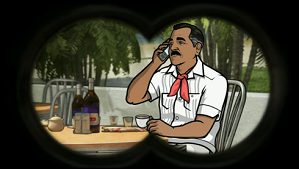
Think of it this way. Whatever POV I choose, it’s kinda like looking through a pair of binoculars. I can see this. But if I suddenly whip the binoculars over to look at that… well, it takes a couple of minutes. I need to find that, focus on it. And if I didn’t know that shift was coming—or that it even happened—imagine how disorienting it would be. What am I looking at now? Am I seeing it from a different angle? Is this even the same pair of binoculars? I need to make it clear to my readers this shift has happened. If they abruptly start seeing things from new angles or hearing new pronouns, they’re going to go back to figure out when things changed. Which means they’re not moving forward with the story anymore.
And that’s never a good thing.
And this concludes my not-so-quick overview of different viewpoints.
Next time, I’d like to talk about Guido a bit. No, not downtown Guido. The guy from X-Factor.
Until then, go write.
April 4, 2019
Shadow Agency
This week—requests are granted! Also, as you may have noticed, the majority of responses I got in comments/ tweets/ DMs/ etc were in favor of the new layout, so I’m going to stick with it for now.
A few weeks back someone asked about characters. How do I get a sense of who they are. How do I make sure when they do something it’s what they’d do instead of just what the plot (and by extension—I ) want them to do?
Okay, these are two related-but-different questions. Let’s look at each of them on their own, then figure out that relationship-overlap. Which I think is what we’re aiming for with this request.
Also, because there’s a lot to unpack here, expect a lot of links to previous posts. I don’t want to bury you in too much rehashed stuff. You’re here for exciting hot takes on the art of writing, yes?
First off, how do I get a sense of who my characters are as individuals? What makes them unique? What makes them stand out?
 One thing would be their general backstory and personal preferences. If I’ve got a character—especially one of my main characters or important supporting ones—I should know a lot about them. And I’m talking about me, the author. For almost all of my characters, there are things I know about them that never make it into the books. Maybe it’s about their relationship with their parents, their worst class in school, or their favorite bands. It can be games they play, people they’ve slept with, or their first car. A lot of this sounds like weird stuff, yeah, but all of this says a little something about who someone is, which means it’s going to affect how they react to the world around them.
There’s also their voice. The way people phrase things and the words they choose. Their background will have an effect on how they act, and it’s also going to effect how they talk. This is one of the easiest ways to make characters distinct on the page (or in an audiobook).
Also, I could think about how people react to this character. Do folks wince at the sound of Dot’s voice? Do they instinctively lean away from Wakko? Do they lean toward Phoebe? And are people right to react this way, or is it because they know something else that we don’t?
All of this should give me a really good sense of who my character is. Again—I probably won’t use all of it. I may never see Yakko stumbling through a date or listening to music or reminiscing about his old VW Bug. But these are all the little elements that help move a character from a basic stereotype and into actual, memorable person-hood.
Okay, the second part of all this is about these characters making decisions.

There’s a term you may have heard around the interwebs called agency. It first appeared back in the 1700s, when people were having Enlightening discussions about philosophy and sociology. At its simplest, agency refers to free will. Can a person make their own choices and affect the world around them? How much does the world they exist in restrict that ability to make choices? If I can’t travel alone, vote, or choose who to love… do I have free will, or just the appearance of free will? Do people in prison have free will? Free will may have gotten them there—or maybe the conditions forced on them by society did—but now they have almost no freedom to make choices at all, so…? Is there a point where I no longer have free will?
Anyway, that’s all heavy stuff. It’s a little different (and easier) for us when we’re talking about agency in a literary sense. Fictional entities don’t have free will because they’re… well, they don’t actually exist. But as a writer, I need to make my readers believe these characters are real people who are having an actual affect on the world around them. They need to do things, and these things need to matter. If cowards are suddenly going to leap forward and be brave, there should be a clear reason. If a cold person falls madly in love, we should understand why and how. If someone decides to open the spooky mystery box after it’s killed half their friends… well, we should be with them on this, even if we don’t like it.
 Yeah, sure, it’s possible to make inconsistent decisions or choices that move the plot forward. We’ve all seen it happen. The wonderful A. Lee Martinez(he of the Constance Verity books and the Save The Movies podcast) came up with plot zombie a little while ago to explain this. It’s when characters are only acting in service of the plot, not out of any actual developed or established character traits.
This is, just to be clear, a bad thing. Y’see, Timmy, my characters need to face challenges and need to respond to them. They need to make choices—ones that are consistent with who they are. And the results of these choices should have a real affect on how the story plays out. Because if they’re not… Well, then they’re not really doing anything. They’re just empty puppets. Not even the good kind of puppets. They’re just sock puppets that I’m using to try to convince my readers this is a real story.
So make your characters do things. In character.
Next time, I’d like to look at some things from a different angle.
Until then, go write.
March 28, 2019
The Most Basic of Basics
I don’t have a lot of time this week because tomorrow is the start of (cue cheering) WonderCon in Anaheim . I’m going to be there hanging out for parts, signing some books, and Sunday I’ll be holding a two hour version of the Writer’s Coffeehouse. Please feel free to stop by, say hi, and listen to me talk about this crazy business of writing stuff.
Speaking of which…
Keeping in mind our limited time, I wanted to take a quirk moment to chat with you about one of the most important thing to learn in storytelling. This can easily be a make-or-break thing. I’ve heard contest directors talk about it, agents talk about it, editors talk about it. They all see it constantly and it makes all of them roll their eyes.
Spelling and vocabulary.
I’ve got to know how to spell if I want to make it as a writer.
 Now I’m sure a couple folks have already rolled there own eyes and moved on to watching some cool YouTube videos. I mean, I said this was going to be about basics, but nobody thought we’d go thisbasic, right? We don’t need a grade school refresher. Besides, its the 21st century. People have spellcheckers on their phones! Technology’s made knowing how to sell pointless.
Right?
Well… As I’ve talked about once or thrice before, spellcheckers are pretty much idiots. They can tell me if a word’s spelled right, but they can’t tell me if it’s the right word. It’s the classic there, their, or they’re argument.
And that’s the vocabulary half of this. Some of the greatest computers out there are pretty bad when it comes to understanding grammar, which means it’s doubtful they’re always going to know which word I’m trying to use. Which means there’s a good chance it doesn’t’ actually know if this word is spelled right or not. Did I want thereor their? Only one of them’s correct, and if I don’t know which it’s supposed to be…
F’r example, check out this list. I’ve done this sort of thing before. These are all words people used in articles on fairly popular, journalistic websites (some news, some entertainment) pared up with the word they meant to use. I’m willing to bet all those articles were spellchecked and given a good thumbs up from the computer, but the writer didn’t know the difference. Or maybe their editor. Or maybe both of them
lede and lead
poles and polls
borders and boarders
allude and elude
right and rite
peek and peak
serfs and surfs
reign and rein
reign and rein
Yeah, a couple of those are laughable, I know, but I swear I didn’t make any of these up. They meant to use X, but they printed Y. A couple of these I’ve seen multiple tines, even.
 And I’m sure you know what they all mean, right? You wouldn’t be laughing if you didn’t know bothof the words. If I only know one of them, well… that’s not entirely helpful, is it? Especially as a writer. Words are supposed to be my thing, the raw material of my trade, but I don’t know what they mean? Would you want surgery from a doctor who knew what some of your organs did?
Now, a common defense I see for this a lot is that I don’t need to know. Spelling’s not that important, and it’s all just an arbitrary constrict, anyway. Readers will get my meaning from context. If I meant polls and I wrote poles, when it’s actually in a sentence people will still understand what I’m trying to say
Yeah. Yeah, they will. That’s why most readers and agents and editors will excuse a mistake or two. We’re all human. We make typos. We get a little tired and bleary-eyed during that
But, y’see, Timmy, if I don’t know how to spell, if I don’t know my vocabulary, if I’m just depending on the computer too do it all for me… I’m going to make more of these mistakes. More and more, the longer my manuscript is. Dozens, maybe hundreds of them.
And, yeah, we’ll all gloss over one or two points where we just need to get it from context. Maybe even three or four. But there hits a point—and it really isn’t that high—where we start to wonder if this person really knows what they’re doing. Again, how many times do you really want to here your doctor joke “Wow, what do you think thatdoes?”
Want proof?
 Well, I’ve littered half a dozen or so of these mistakes all through this little rant. You probably noticed some and chuckled. Hopefully all of them. I’m tempted to say someone might even leap down halfway through reading this to comment on the irony of my post on spelling having such blatant spelling errors. And they’d be kinda justified. Here I am, trying to say I understand the craft, that my words are worth your time, worth reading, and yet…
I’m making a lot of really blatant, basic mistakes in just three or four pages.
It’s understandable that they’d shake their head, scoff, and say “oh, no, good sir. Not you. Not today.”
To put it another way, we’d understand if I got rejected over that kind of thing.
And I don’t want to see anybody here rejected over that kind of thing.
This weekend—WonderCon!
Next time, I want to talk about what you can do. Or, really, what your characters can do.
Until then, go write.