

August 26, 2010

It’s A Trap!!

I would like to thank Admiral Ackbar for pointing out the obvious.

Alas, sometimes things aren’t as apparent as we think they should be. Like the horror story where the absolute last thing someone should do is open the door to the study, so of course Yakko is reaching for the knob…

Lots of aspiring writers fall into traps. Sometimes it happens when they follow bad advice. Other times it’s because they insist on using a method or writing in a style which really doesn’t work for them. And sometimes… sometimes that trap’s just sitting there in the field kids play kickball in, hidden by some leaves, waiting to snap…

So, with all that being said, here are some common–and dangerous– misconceptions people have about writing. Beware them, and beware the people who set these traps for themselves and others.

Writing is easy Probably the most common misconception there is. I mean, most of us learned how to put words on paper when we were ten, right? We could write passable essays by ninth grade. So writing for a living, for an audience greater than your immediate friends and loved ones, how hard could it be? Anyone can do it once you’ve got a clever idea. Heck, I’d bet 90% of Americans have immediate access to a word processor of some sort.

Truth is, writing—not basic, grade-school literacy, mind you, but the ability to write— is a skill which needs to be learned like any other. All you need to do is browse the comment sections of any news feed or message board to see how few people know how to express their ideas through words. Yeah, I took English and reading classes in school. I also took music classes, so maybe I should expect to get a recording contract sometime soon? Twelve years of gym classes, too, but for some reason I haven’t made it onto any Olympic teams.

Writers need to train and practice for months–maybe even years–before they’re ready to show off their writing. I don’t need to look it up to tell you Wolfgang Puck didn’t get any praise for the first hundred meals he cooked, Mark McGuire did not get paid big money the first thousand times he swung a baseball bat, and Stephen King didn’t make a single cent off the first 100,000 words he wrote. Writing is work. Hard work. It requires skill, a great deal of practice, some actual talent, and a heck of a lot of dedication. This is why so many people can’t succeed at it.

This is probably the best trap because it doesn’t just catch the writer, it tends to kill them 2/3 of the time. Most of the wanna-be writers who believe this have never actually written anything. Once they do, they come up with an excuse why they’ll never be completing their manuscript (see below), then slink away to become musicians. Or writing gurus.

Writing doesn’t require any writing A few decades back there was a huge spec script boom in Hollywood. It was one of those rare periods when studios acknowledged the importance of the writer and were paying top dollar for screenplays, or even just the idea for one. A popular story is how established screenwriter Joe Eszterhas scribbled the bare idea (no pun intended) for Jade on a cocktail napkin and ended up with a multi-million dollar contract for it.

As I said, however, this was over twenty years ago. These days producers and publishers are much more cautious and they’re not interested in ideas. They’re interested in complete, finished works. Not two-thirds of a manuscript. Not most of a script. Just to save time, knowing the right people won’t change this. No, it won’t. I don’t care what you read on the special snowflake website.

Not to sound too harsh but… well, no, this is harsh because people can only end up in this trap by choice. If someone can’t write and complete something, they can’t be a writer. That’s really all there is to it. Stop now and go back to those criminal justice classes you signed up for.

For the record, some folks argue they don’t want to write until they get paid. These people should give up on any sort of fiction– because that’s not going to happen there–and go into journalism. Then they need to find a staff job on a website, magazine, or newspaper.

Good luck with that, by the way, not having a writing resume and all…

First person is easy A lot of prose writers start off with first person stories. It’s quick, it’s not hard to get into, it’s easy to find a voice. It’s also very personable, so a reader can relate to the characters immediately. Plus there are tons of formats ready and waiting; journals, diaries, letter, memoirs, and so on.

Truth is, first person is a very difficult, very limiting tense to write in. There’s a reason so many professional writers avoid it. Beginning writers rarely develop their first-person characters past their voice. I could go on about this one for a while, and as it happens I did earlier this year.

Writers who get caught in this trap start their first novel and pound out 20,000 words worth of journal entries over the weekend. There’s always that chance they may be brimming with so much raw talent they’re the next Hemingway or Steinbeck. There’s a far better chance, though, they’ve just wasted a long weekend.

Writers don’t need to read – Somewhere along the line, someone started promoting the silly idea writers shouldn’t waste time reading, they should spend all their time writing. This is kind of like saying you don’t want to waste time stopping for gas while you’re driving. Every professional writer I’ve ever met, interviewed, or even just read about (myself included) reads voraciously. A writer should be devouring works in their chosen field to stay current and snacking heavily on everything else to stay fresh.

Sad but true, the people who fall into this trap tend to write plain awful stuff. They go for every easy idea, hit every cliché plot point, and tend to follow the textbook formulas they were taught in some creative writing class somewhere. What else can they do? They try to mimic one or two famous examples of what they aspire to and usually end up looking just like the worst of the worst (because they have no idea what the worst looks like)

Research everything – Alas, this is one of the two deadliest traps out there, which is why I saved it for one of the last. We all want to get the facts right in our stories. We check research books, make phone calls, visit important locations, or maybe some of us just spend a lot of time on Wikipedia. The point is, how can I be expected to move forward with my story if I don’t know the name of George Washington’s barber and what size shirt he wore? It’ll ruin everything if I just call him John Smith, neck 16.

This is an awful trap because getting stuck in it means a writer was trying to do the right thing. Research is important, but never forget it’s not writing. There’s a time for putting noses in books but there’s also a time for putting pens to paper (or binary code to electromagnetic bubble memory, as it may be)

Some people get caught in an even deeper layer of this trap. They get stuck researching how to write. We’ve all known someone like this, the one who buys book after book, takes class after class, but never does any actual writing. For some people this becomes a defense mechanism of sorts, sometimes subconsciously and sometimes… not so subconsciously. If they never start, they won’t have to put the work in and their work stays in that wonderful hypothetical stage where it’s the greatest thing (almost) ever committed to paper. It’s a tragedy, really, they never had time to write it down…

Rewrite until it’s perfect – The last and deadliest of the traps in our showroom. For some people, rewriting turns into an endless loop. There’s always another opinion to listen to, more feedback to get, and revisions which need to be done because of them. Just thought of a new way to do those action scenes? That calls for another draft. Maybe last night’s Chuck inspired a new opening? Perhaps Aunt Betty is visiting and she thought the ending was a little violent, and a good writer knows changing the end means changing everything which leads up to the end.

There are two ways people fall into this trap. One is a combination of bad advice and bad judgment. So many gurus tell people to rewrite and rewrite and rewrite. How many times have you heard “writing is rewriting” parroted in classes or on message boards? There’s some truth to that, but there’s also a lot of truth in the phrase “poop or get off the pot” (cleaned up for work computers). Eventually, a writer just needs to call it done and move on or they’re going to be trapped in one manuscript forever.

The other way people fall into this trap is by purpose. A bit like with research, constant rewrites are an excuse not to actually produce anything. You don’t expect me to show you an incomplete or old draft, do you? I was going to send it to some agents or publishers, but I think it needs one more polish to make it perfect. Maybe one more after I go through and clean up a few loose threads. Rewrites are a way wanna-be writers–again, consciously or not– can avoid possible failure yet still keep up the illusion of forward motion.

Are all of these traps deadly? No, but getting snagged in one can definitely cost you some time. I’d be lying if I said I hadn’t fallen victim to one or three of them over the years. Fortunately, one of those things only has to slam on your leg once and you’ll rarely let it happen again.

Assuming, of course, that you get out of it the first time.

Next time, I’m going to throw around some big words relating to the throwing about of big words.

Until then, go write. And watch your step.
Think of Bruce Campbell and you’ll have an idea what the title–and this week’s rant–refers to.

So, imagine flipping open a book or a script and reading that Ognaron took his airepulsor carriage out for a twenty wobosa drive along the neerwoks of Qin’nixxia on the Crossing of Terafils.
Does that even mean anything? I mean, you could probably sit down, diagram the sentence, and get some very rough ideas of what one or two of these words refer to. Maybe. More or less. How often do you want to do that, though? Can you imagine weeding through a whole paragraph like that? Or multiple pages?
Of course not. How could you keep track of any of it? You’d probably go mad. I know a few script readers who have. Heck, there’s a reason most professional readers will tell you their least favorite kind of screenplay is the dreaded sci-fi/ fantasy script (well, maybe tied with the “based on a true story” script). A large percentage of them take hours to slog through for reasons just like this.
No, we’d all rather just read that Ognaron took his hover car out for a twenty minute drive along the ocean cliffs on Father’s Day. The fact that the writer isn’t wasting time with silly or pretentious words tells us they’re more interested in getting to the story. As I’ve mentioned once or thrice before, what every reader wants to see is forward motion. It doesn’t matter if it’s a short story, a script, or a novel, the last thing the reader wants is to get hung up on something that just doesn’t matter.
Here’s a helpful hint. Try to sum up your story in two pages. You don’t need to do it on paper or anything, just get the whole thing organized in your head so you could jot it down or explain all of it to someone in five or ten minutes.
Got it?
Okay, if at any point you find yourself simplifying some of your terms for the summary– referring to your character’s airepulsor carriage as a hovercraft, for example–then just use that simpler term in the actual story. Don’t use interlobal trans-psion pulse communication when you can just say telepathy. There’s no need to overcomplicate a term people are already familiar with. Let’s just call a pistol a pistol and be done with it. You’ve got better things for your readers to spend their time on, right?
Likewise, if at any point you find yourself saying or thinking something like “In this dimension, X is called Y,” then just use X. Why force the reader to remember an awkward name for something common? Like using said, it’s more likely they’ll skim past something common than ponder its use on an alien/ alternate world.
I’ve mentioned this little tidbit before. In the preface to his novel Nightfall, Isaac Asimov explains that he uses miles, hours, and years not because the planet his story is set on is somehow related to Earth, but because he didn’t want to overcomplicate things. Sure, he could’ve made up new names for everything but, seriously, what would be the point?
Another related problem in fantasy or future worlds is when the writer attempts to create their own slang or idioms. I read one book that decided a few hundred years in the future no one would say God and Jesus–everyone used Yahweh and Kristo instead. The problem with this is that I went through the first 50 pages of the book thinking Kristo was the name of one of the main characters (who would sometimes refer to herself in the third person).
Y’see, Timmy, if I don’t know the name you’re using, or the ideas behind it, I have to assume it’s the name of a character. Let’s take a look at a few simple sentences.

–“Christ, what are you doing here?”
–“We’re going to have another child, if God is willing.”
–“Jesus, it’s good to see you.”
–“God knows what Marc’s up to this time!”
These all make sense, right? No confusion about what any of these sentences mean. However, what if I switch the names like this?

–“Sarah, what are you doing here?”
–“We’re going to have another child, if Catherine is willing.”
–“Tim, it’s good to see you.”
–“Gillian knows what Marc’s up to this time!”
See what happens? The sentences are conveying different information. With these more “casual” names, the bits of dialogue shift from expletives or figures of speech to people being directly addressed or referenced. And if you don’t know which category the names fall into…

–“Tokar, what are you doing here?”
–“We’re going to have another child, if Neeva is willing.”
–“Grothlaxia, it’s good to see you.”
–“Ostarix knows what Marc’s up to this time!”
Do you have any idea what these sentences are saying now? They’re almost impossible to decipher without a frame of reference for those names. Is Neeva someone’s wife, husband, or deity? Heck, Tokar and Ostarix might not even be names at all. What if they’re alien curses or swear words that are only capitalized because they start the sentence?
So, as readers, when we come across something like this it usually does one of two things. It either brings us to a grinding halt as we try to figure out what this word means, or we make assumptions about what the word means and the story comes to a grinding halt later when we figure out we’re wrong. On very rare occasions, we make the assumption, guess right, and the story flows on without incident.
Really, though… Why would you risk drawing attention to yourself like that? As a writer, do you want your story to hinge on the reader possibly making a correct guess? Are you so certain the reader will keep going afterward that you’ll risk bringing the narrative to a dead stop?
I didn’t think so.
Don’t overcomplicate your story with details that are just going to slow it down and drive readers away. If you don’t need to make up a word or a phrase or a term… then don’t. Just keep it simple and they’ll love you for it.
Next time, I think I’ll either prattle on about something funny or try to shock you all somehow. Not sure which yet.
Until then, go write.
May 27, 2010 / 7 Comments

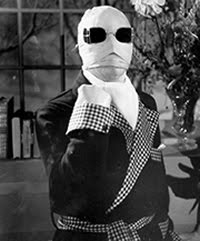
To See The Invisible Man

Either my latest rants have been pure gold no one can argue with or a lot of you really hated me using LOST as an extended example. Haven’t seen any comments in weeks.

Speaking of things you don’t see, this rant’s title is another one of those clever pop culture references. Anyone remember it?

Okay, fine, I’ll explain.

“To See The Invisible Man” is the title of a Twilight Zone episode adapted by Stephen Barnes from an old Robert Silverberg short story. It’s not one of the classic Zones, but one of the newer ones when the show was revived in the mid-‘80s. It’s the tale of a man in a somewhat-utopian society who is sentenced to a year of “public invisibility” because of his selfish, antisocial behavior. He isn’t actually turned invisible, however. He just gets a small brand on his forehead which tells everyone to ignore him. That’s the curse of it. They really can see and hear and feel him–and he knows they can– but no one will react to him. Even when he desperately wants and needs to be acknowledged (there’s an eerie scene in a hospital emergency room), people pretend he’s not there. As we find out later in the story, seeing an invisible person is a major crime.

In a way, this serves as a clever little metaphor for being a writer. The reader knows the writer is there, that you’ve crafted and shaped these words on the page, but they don’t want to admit you’re leaning over their shoulder. They just want to go on their merry way and pretend they’re alone with the book. As such, the worst thing the writer can do is draw attention to themselves.

For many would be writers, the temptation is to embellish the pixilated page with an exuberant flourish of verbiage which exhibits not only the vocabulary we’re capable of as proficient anecdotists (far above any paltry amanuensis), but also how we can bend grammar to our will; the elaborate and subtle metaphors we can craft; and the clever intricacies we can interweave betwixt the threads of character, plot, and theme.

For the record, it took me almost fifteen minutes to craft that impenetrable sentence. Yes, it looks like a paragraph but it’s just one sentence. A long, sprawling sentence that really tempted you to skim, didn’t it? Heck, let’s be honest. I bet after tripping over your second or third obscure word, at least half of you started skimming, didn’t you?

Y’see, Timmy, every time we make the reader hesitate or pause just for a second, we’re breaking the flow of the story. We’re encouraging them to skim at best, put the manuscript down at worst. The reader should forget they’re paging through the latest Wakko Warner novel or screenplay, perhaps even forget they’re reading a written work altogether. This happens, odd as it sounds, when they forget they’re reading. And the easiest way to make that happen is for them not to see the writing. It’s tempting to wave our arms and shout and try to get the reader to admit they can see us, but all this does is ruin things for everyone. It’s like Sherlock Holmes showing how he came to his amazing deductions or a magician explaining their greatest illusion. That moment is when the whole thing falls apart.

As writers, we need to be invisible. Oh, we want our characters to be seen. We want our dialogue to be heard. We want our action and passion and suspense to leave people breathless. But we are just distractions. If you think about it, who’s the more impressive tough guy– the one who commits unimaginable acts of violence, or the one who doesn’t have to commit those acts? Being able to restrain yourself is just as impressive as how excessive you can be. Less of us is more of the story.

Here’s a few simple ways to keep your literary head down.

Vocabulary We all know what bright means, but effulgent can make us pause for a moment. That guy can be bald or he can be glabrous. Some sneakers are black with a bit of red and some are atrementous tinged with titian.

A huge problem I see is writers with ego problems. They think they’re cleverer than anyone else, and they’re determined to prove it. More often than not, the writer latches onto (or looks up) obscure and flowery words because they didn’t want to use something “common” in their literary masterpiece. These folks write sprawling, impenetrable prose that makes it sound like they spend their free time wanking off to a thesaurus. All too often they’ll try to defend this wheelbarrow of wordplay by saying it’s the reader’s fault for having such a limited vocabulary. After all, everyone knows what it means if I say I’m going to cast a bantam gallet towards an embrasure, right?

Any word a writer chooses just to draw attention, to prove they don’t need to use a common word, is the wrong word. Any word that makes the reader stop reading and start analyzing is the wrong word. Period. You can try to justify your word choice any way you like, but absolutely no one is picking up your book or looking at your screenplay hoping for a vocabulary lesson. When the reader can’t figure out what’s being said for the fourth or fifth time and decides to toss that manuscript in the big pile on the left… there’s only one person to blame.

(It’s not them, in case you had any lingering thoughts on the matter)

(By the way, it just means I’m going to throw a small stone at a window)

Structure— Like obscure vocabulary, convoluted sentence structure is often the sign of a writer’s ego. One of the most common ways this manifests is to insist on grammatical and structural perfection. This often mean a rigid, formal text and very stiff dialogue. These writers are so insistent on proving they know the correct way to write that their words come across as forced and artificial.

The second most common is needless complication. If something can be described in five words, these writers will manage to do it in thirty, and I guarantee at least half a dozen of those words you’ll have to stop and look up (see above). This is where you find folks that use phrases like “seemed to be” or “appeared to be.” Some of these storytellers also go the non-linear route, even though nothing in their story gets improved by this pointless scrambling.

All of this can be an instant killer in screenplays, because most professional readers won’t put up with it. Your writing needs to be clean, simple, and natural. If there isn’t an in-story reason for it to be overcomplicated, it shouldn’t be.

Said— People will never notice if you use said. Said is invisible. What they notice is when your characters respond, retort, exclaim, pontificate, depose, demand, muse, mutter, sneer, shout, snarl, growl, whimper, whisper, hiss, yelp, exclaim, or ejaculate. Yes, stop giggling, it was a common dialogue descriptor for many years. Once you’ve got three or four characters doing all this (instead of just saying things) you shouldn’t be surprised if your audience stops reading to shrug or snicker. Usually while they’re pointing at you.

Granted, there are times where characters are shouting or whispering or hissing. Overall, though, they’re just going to be saying things. So don’t overcomplicate things and draw attention to yourself.

Names. If used in moderation, names are invisible. They’re just shorthand for the mental image of a character. It’s also worth mentioning that simpler, more common names blend into your writing easier than rare or unnatural ones. A reader can glide past Tony but might stumble a bit on Antonio. Edward is easier on the frontal lobe than Ezekiel, and they’re all nothing compared to Bannakaffalatta.

It’s worth mentioning a little note there for the genre folks. When writing sci-fi or fantasy, many fledgling writers feel the need to rename everything. The characters have all-new, created-for-this-world names. So do their pets. And their gods. And their elements. And their system of weights and measures. Off the top of my head, I would say 90% or this is a waste of time and a distraction. Your elaborate fantasy world will not collapse if the giant, fire-breathing lizards are called dragons, but it might if you insist on calling them pyroreptillicans.

A good rule of thumb–when you’ve made up a name like Grothnixyettiq for one of your characters (or their mode of transport, or their homeland, or the way they measure distance), take a moment and try to say it out loud. Note how long it takes you to figure out how to say it. Now email or text it to a friend, give them a call, and ask them to say it out loud. No hints or clues. Just ask them to say that word you wrote. If their pronunciation doesn’t match yours, you should really use a simpler word.

Always remember that moderation is key. If any name repeats too often, it begins to get cumbersome. Even a simple name like Dot can stack up. When I see a paragraph about Dot reading Dot’s book out by Dot’s pool shortly before Dot decided it was too hot outside and Dot went in where it was air conditioned… well, personally at that point I start counting them. Which means I’m not reading the story, I’m auditing it.

This is why we have…

Pronouns. When proper names start to stack up, we switch to the pronoun. Just like names are shorthand for story elements, pronouns are shorthand for those names. When nouns start to clutter up your writing, they’re there to leap in and shoulder the weight. It’s how Yakko becomes he, that mysterious island becomes there, and the Cerberus Battle Armor System becomes it.

The catch here is to make sure your pronouns are clear, because the moment someone gets confused about which it you’re referring to, they’ve just stopped reading your story and started studying the page. A good rule of thumb—after you’ve referred to Dot as she half a dozen or so times, drop her name back in once. It’s been long enough it won’t look repetitive, and it’s a gentle reminder of who she is.

And there they are. A few simple ways to stay invisible.

Next week, just for whatever budding screenwriters happen to stumble across this site on a regular basis, a few notes on drafting. In the construction sense.

Until then, don’t let me see you writing.

December 11, 2009 / 4 Comments

I Put The Poison In Both Cups

Easy geek reference up there for you.

So, this week’s little rant is sliding in under the wire. To be honest, I’ve been buried under a ton of last-minute stuff for work. Plus the holidays. Plus some family stuff. I can’t be expected to keep up on all of it.

Well, that’s not true. It’s a bit of a cop-out, really. If I’d managed my time a bit better a lot of this would’ve been done on time. There were even two or three times this week I remember thinking “I need to start working on this week’s ranty blog post.”

Cop-outs suck, don’t they? You’ve made an investment in some piece of writing and then wham! Out of nowhere the writer just does something lame. They’ll change the rules or deliberately ignore continuity and just try to bluff their way through. Epic stories that don’t deliver. Mysteries that aren’t explained. Ominous foreshadowing that never pays off. All of these are cop-outs.

The very first story I can ever remember telling had a cop-out ending. I was about eight years old, it was summer, and Mom had taken us to the beach even though I wasn’t feeling well. Somehow I ended up sitting with the father of my friend Todd, while everyone else played in the water, and I spent the time regaling him with the epic tale of G.I. Joe fighting off the Intruders.

For those of you born after 1980, G.I. Joe used to be just shy of a foot tall and had fuzzy hair. You could even shave him. He was also firmly grounded in the real-world military. When Star Wars shifted the toy paradigm to science fiction, GI Joe suddenly gained a bunch of new friends, like the superhero Bulletman and the cyborg Mike Power. And enemies called the Intruders which were a race of alien bodybuilder midgets who wore metal leotards… sort of…

Anyway, on with the story.

You see, the Intruders came down in asteroids. And they all crash-landed at GI Joe’s secret base. There were lots and lots and lots of them. In fact, there were a million of them. So GI Joe was shooting at them with his gun and he shot ten of them, and Mike Power was kicking with his bionic leg–

(Mike Power had one bionic leg. Just one. Even at the age of eight, I could see the gigantic flaws in this bit of cybernetic engineering.)

–and Bulletman used his ray to lift a bunch of them into the air and send them away. This pattern of violence was repeated enthusiastically twice or thrice before I declared all the Intruders defeated.

Not so, Todd’s father told me. A million is a lot.

I conceded this, and explained that the above mentioned pattern of gun-kick-ray happened again. So now they were all gone.

No, he said with a smile and a shake of his head, a million means there’s a lot more left.

I nodded, then said that Bulletman had used his ray to scoop up everyone who was left and send them away.

It seemed like a very solid ending at the time.

Granted, it’s easy to excuse an ending like that from an eight year old, but far too many adults use them, too. Except for poor spelling, there isn’t a much more glaring sign of poor writing than a plot thread that winds up with a cop-out. It shows the writer didn’t think things out, or just couldn’t be bothered to.

A few common types of cop-outs.

Changing the rules–While it completely fits the story it’s told in, the title reference of this little rant is a perfect example of changing the rules. In the midst of this serious contest of life and death, we find out it wasn’t a fair contest. We’ve been told within the story that X + Y = Z, but the writer suddenly announces X + Y can also equal Q. This usually comes about because the story has been written into a corner and the writer won’t take the time to go back and change things (when the ancient Greeks did this, they called their cop-out deus ex machina). As Billy Wilder once observed, a problem in your third act is really a problem in your first act.

Changing the rules is inconsistent and it breaks the flow. William Goldman used it for comedic effect in The Princess Bride, but it’s doomed to almost certain failure in anything except a comedy. Heck, thanks to Goldman it’s going to look pretty tired in a comedy, too…

The so-called twist–This is a more specific type of changing the rules. I’ve set out the rules for a good twist before, and they’re pretty simple for anyone to figure out. That’s why it’s so frustrating when a writer has Debbie pull off her wig and announce “Hah!! I’m really Larry’s second-cousin!!!” This is often followed by flipping through pages to figure out who Larry is and why his second cousin would have it in for everybody.

Usually a poor twist tries to solve one problem in the story at the expense of the story itself. A weak twist isn’t just a cop-out for a plot thread, it’s almost a guarantee the manuscript will end up in the large pile on the left.

No payoff –Few things are as annoying then to go through a story waiting to see the two enemies clash or to learn the answer to the mysterious puzzle that’s plagued out heroes… only to not get it. The enemy gets away. The mystery gets skirted over. It just leaves the reader feeling cheated.

Sometimes it’s not even a question that’s not answered, it’s just a payoff that never happens. When the climactic, world-altering final battle occurs off-camera and we just see the characters talking afterward about how amazing it was, that’s a cop-out.

Just plain weak– Sometimes when a writer uses a cop-out, they’re just choosing the path of least resistance. It’s quick and easy and wraps stuff up. Oh, he was dreaming and she was insane. Sometimes an ending can seem solid, but it’s still weak because of the promise of something bigger. A worldwide alien invasion is awesome. A worldwide invasion where the aliens can be defeated by tap water… not so much. Remember, a story can be weak by inclusion just as much as by omission.

And there you have it. I’d put more, but, as I mentioned before, I have a lot of work to do still.

Plus, I’m really Larry’s third cousin.

Still open to suggestions as we head into the holidays. If not, next time I’ll end up blathering about women I’ve dated or something.

Until then, go write. At least your Christmas cards.

Categories