July 10, 2014 / 3 Comments

Reverse Engineering

            A quick tip for this week.
            When I was still a scrabbling writer looking for my first real success, I was sure there was some sort of trick to writing.  That it wasn’t about putting in years of work and getting experience, it was just about finding the right topic or the right genre.   I wrote lots of stories that focused on all the wrong things, because I was convinced it wasn’t how I wrote, it was what I wrote about.
            Needless to say, this wasn’t true.
            It wasn’t just me, though.  Lots of writers think this at some point in their learning curve.  They think success is some wave that all those other people are riding.  They figured out what was going to be hot this year and jumped on that wave.  Young adult stories.  Werewolf stories.  Space opera stories.  Western stories.  All I need to do is aim my story at the next wave and then I’ll be successful, too.
            Again… this isn’t true.
            A while back I saw Joss Whedon’s fun and super-low budget Much Ado About Nothing.  Some of the actors were there and did a little Q & A afterwards.  Someone asked Alexis Deinsof about the wisdom of deciding to do a slightly-updated Shakespeare play as a movie.  He smiled and said “You can’t start at ‘success’ and work backward to ‘What should I write about?’
            When a story finds a home with an editor or a producer or a reader, it’s not because of trickery.  It’s because that writer knew how to tell a story and that story appealed to said reader or editor at that particular time.  That’s all.  So copying a theme or a genre from something successful isn’t going to help me.  Rushing to copy the current “hot thing” isn’t going to help me. 
            The only thing I can do to improve my odds at success is be the best writer possible.
            Next time, because it’s always good to have your website noticed by lots of people in the NSA, let’s talk about nuclear weapons and blowing up cities.  We can watch the hit counter go crazy together.
            Until then, go write.
            2014!  Welcome to the world of tomorrow!  Just with no flying cars.  Or jetpacks.  And far less moonbases than Space: 1999, Inherit the Stars, or 2001: A Space Odyssey led us to expect.
            Wow.  We’re only two days in and 2014 is kind of a letdown so far.
            Anyway, as I often do at the start of the year, I’d like to take a minute or three to talk about this page and the kind of stuff I babble on about.  And touch on a few of the things I don’t.
            And to do this, I’m going to dip my toe into a potentially controversial subject.  So hopefully I won’t offend anyone too much
            Maybe it’s just the circles I travel in, but I tend to see a lot of “after the fact” material.  It’s on pages I get links to or I get spammed with messages about it.  People with blogs about how to self-publish and why traditional publishers are dinosaurs.  About how to get past those evil “gatekeepers” and why they’re pointless.  Which ebook platform is best.  How to format for said platform.  Where to find a good agent. Where to find a good artist for my cover.  How to network.  Good places for self-promotion.  How much I should self-promote.  How much I should pay for that promotion.
            The reason I call this “after the fact” material is because it skips a major step.  Every one of those issues is about getting my book in front of readers.  None of it addresses the important question…
            Shouldmy book be in front of readers?
            Is my book ready to be published, by me or anyone else?  Does it deserve to make it past those gatekeepers?  Do I have something worth promoting?
            And that’s what I don’t see a lot of out there—help to get past that first step.  Because the best chef in the world can’t do anything with no tools and an empty kitchen.  If I don’t have a full, polished manuscript, all those other tips are kind of useless.
            This is why, in my opinion, self-publishing still has—and probably always will have—a stigma hanging over it.  There are some absolutely phenomenal self published books out there, and some authors who are making great money as self-publishers.  But the ugly truth is that, statistically, most self-published material is bad.  Now that it’s so easy and cheap to self-publish, I’d even say that these days the vast majority of self-published stuff is awful.  There’s a lot more good stuff than a decade ago, absolutely, but by the same token  there’s tons and tons more bad stuff.
            So, that’s what I want to do here.  I try to help with that first step. Every week I toss out some advice, tips, and observations on how to improve a manuscript and turn it into something people want to buy and read.  Things I was told or stumbled across (or learned the hard way) in the thirty or so years that I’ve been stringing words together.
            Now, the two main things you’ll find here is advice on writing and ruleson writing.  Yes, there are rules.  No, I don’t care what he said.  No, I don’t care what she said either.  There are rules that have to be followed.  Bear with me.
            Adviceis optional.  When to write.  Where to write.  What to write.  How to develop characters.  How to edit.  How many drafts I need to go through.  What kind of structure a particular story should have.  What point of view to use.  I’d say the ranty blog is about 60-65% advice.
            This is the kind of stuff that’s going to be individual to each writer.  I like to write in the afternoon, but you might be more productive in the morning, and she’s more productive after midnight.  I tend to plan a rough outline in my head, but you might need three really detailed pages before you begin, and he might be fine with a dozen notecards taped to the wall.  I might need music to write but you need absolute silence and she can’t write unless she’s outside and wearing a Ren Faire outfit.  The thing about advice is that it’s rarely wrong, it just might not be advice that works for me or you.  That’s one of the main tenets here, my golden rule.
            It drives me nuts when I come across someone insisting advice must be strictly followed.  I think a lot of would-be writers get messed up by this, and these are the folks who end up staring at a blank page every morning in a silent room, wondering why they can’t write the opening of the goth-witch-lit novel they have no interest in but were told is going to be the new big thing.  They often get stuck wearing an itchy corset, too.
            Y’see, Timmy, rules are the real non-optional stuff.  Spelling.  Grammar.  Structure (you have to have some kind of it).  Likable characters (not necessarily good characters, but someone my readers won’t mind following) with believable arcs.  Flow.  Coherency.  This page is maybe 35-40% rules, at any given time.
            Most of us had at least five or six teachers during our lives who tried to teach us the rules of writing—the basic mechanics of how words go together to express ideas.  If I want to make a living at this, I need to know those mechanics.  If I don’t know how to spell, if I don’t understand structure, if commas and apostrophes are baffling to me, if I can’t sense how my readers will react to something… well, it’s going to be very hard for me to have any success as a writer.
            The flipside of what I mentioned above, it’s also very damaging when some folks try to insist that rules are just loose guidelines, that it doesn’t matter if I follow them or not.  I think a lot of that comes out of folks who see the rules broken by an experienced professional and assume they can be ignored from the start.  They point to the exception and use that as their reason to not learn the rules.  This kind of deliberate ignorance leads to poor writing and bad habits, and it means a lot of potentially good writers never improve. 
            Y’see, Timmy, if I don’t understand the rules, I’m not going to know how to break them.  A good writer can break some of the rules, but it’s like playing Jenga.  I can’t pull out all the blocks holding up the stack, and if I’m going to pull out this one I need to make sure that one is rock-solid.  If I don’t understand the basic rules of how the tower stands, I’m going to bring it crashing down on my second turn.  Maybe even my first.

            Actually, that’s an even better analogy.  Breaking rules is like demolishing buildings.  It looks simple, but the folks who do it actually need to know more than the people who built it.  They need to understand which walls are load bearing and which beams are supporting, but they also need to know how the material’s going to break or crumble or shatter and how much explosive is needed for each result without there being so much that the building collapses out rather than in.

            Because it might look really cool and fun when the building collapses out across the city, but it doesn’t get a lot of repeat customers.
            What else, what else, what else…
            Do I repeat myself here?  Well… yeah.  Especially if you’ve been following along for two or three years.  I try to come up with new ways to approach the same problem.  Sometimes I’ll hear something new and clever that I’ll try to share, or maybe even expand on.  At the end of the day, though, this page is more like a mid-level class on writing.  You can take the same class twice and get more out of it, but by the third of fourth time there’s a serious case of diminishing returns.  I’m not saying any of you long-time followers should leave, but don’t be too surprised if I end up talking about dialogue or character voices or something like that.
            Speaking of which, next time I wanted to talk about dialogue and character voices.
            Until then, go write.
November 22, 2013 / 3 Comments

The Four Step Program

            Probably not the one you think of when you think of professional writers…
            I’m a bit pressed for time this week, so I wanted to revisit an idea from a few weeks ago.  Hopefully in a way that may resonate with a few of you.
            There are, in my experience, four stages of being a professional.
1) Not knowing what you’re doing
2) Thinking you know what you’re doing 
3) Realizing you don’t know what you’re doing
4) Knowing what you’re doing
           I first came up with this rule set after about eight or nine years in the film industry.  I can’t remember how I came to it, but when I did I realized it mirrored my career.  As I looked around, I realized it was possible to place almost everyone on set in one of these categories.
            To explain…
            I ended up in the film industry by chance.  A guy I knew needed grunt labor and I was thrilled with the idea of working on a movie.  There was an immediate culture shock, believe me.  Different terms, different hierarchies, different expectations.  I spent my first month on set trying to soak up everything I could, because it was clear I didn’t know anything.
            Of course, by a week or two into my third project, I felt like I had it down.  I knew all this stuff, and I made sure that everyone knew I knew how to do it.  There was no doubt in my mind that I could do my boss’s job at least as well as him, if not better.   
            It was another year or so before I had the chance to be the boss… and learned how unprepared I was.  There were tons of basic things I didn’t know.  My assistant (a friend of a friend who’d offered to help) knew far more than me, and it was a minor miracle she didn’t smack me three or four times a week.  And I deserved to be smacked, believe me.  Then my next job went the same way (although I still hold that one was a 40-60 share with very unrealistic producers).
            So in the end, I sat down and decided to see what I had to do to be better at my job.  I took a good look at the tools and equipment I was going to need.  I paid attention to everything, not just the stuff that interested me.  I planned ahead.  I was more careful with the projects I chose, and the people I chose to work with.
            At which point I noticed other people were telling me I was good at my job.  I didn’t need to tell them.  It was apparent in the work I was doing.
            A while after this, I noticed this pattern applied to almost everything.  Almost any job you could name.  I saw it in many other jobs on film sets past mine.  I had a friend who was a cop, and he agreed a lot of police officers followed the same pattern.  So do programmers.  Watch a show like Kitchen Nightmaresand you’ll get to see some restaurateurs go from step two to step three and head toward four.
            Because that was the other thing I noticed.  There were some folks who weren’t that good at their job but were convinced they were.  They were stuck at step two because they never had (or never acknowledged) that slap down moment.  So they never bothered to improve.  They just stayed at those early, flawed levels.
            So why am I bringing up the film industry and cooking shows here?
            As I’m sure many of you have realized, being a writer follows this path, too.  Not knowing what you’re doing. Thinking you know what you’re doing.  Realizing you don’t know what you’re doing.  And then knowing what you’re doing.
            When I first sat down to write a story, every aspect of it was a mystery to me.  How to structure my plot, how to reveal character, how to describe action.  Hell, I barely understood what plot, character, and action meant.  But I waded in and tried to put my own twist on other stories.  And at some point I decided I was at least as good as half of these people writing for Marvel or DC or Del Rey.  And my mom agreed that I was very talented for an eleven year old.  So I started submitting stuff.  And I got rejected for some reason.  And I submitted other stuff.  And that got rejected, too.
            After many years and even more rejections, I was struck with the wild idea that maybe the problem wasn’t all those editors.  Maybe it was me.  Maybe my stories just weren’t good enough yet. 
            I went back over some of the things I’d sent out in earlier years and realized they were… well, pretty awful.  Some of the basic ideas were neat, but the stories were clumsy, my dialogue was awful, and my vocabulary was grade school level at best.
            So I decided to improve.  To write stronger stories, better characters, more believable dialogue.  I read everything I could in several genres and tried to figure out what worked and what didn’t.  And did it really not work, or did it just not work for me?
            And, well, years after that… here I am today.
            Some people never get past that second step.  Most people don’t, to be honest.  Especially these days when its easier to skip past possible rejection and claim almost anything as “success.”  These folks don’t need—or don’t want—to admit they need to improve, so they never do.
            How many steps are you down the path?
            Next week…. well, next week’s Thanksgiving, so I’ll be watching The Day The Earth Stood Still, Casablanca, and The Maltese Falcon while I make eggplant parmigiana from scratch for the vegetarians in the home, and some turkey for the rest of us. 
            But the week after that, I’d like to talk about that fantasy world you’re living in.
            Until then, go write.
October 12, 2013

But What About…

Yeah, this is a day late.  Lots going on this week, so I thought I could make an exception…

Which, by coincidence, is what I wanted to blabber on about this week.

If you hang out with enough writers (or musicians, or filmmakers, or other artists), either online or in the real world, you’ve probably heard a story about someone who broke the rules and got away with it.  And Wakko didn’t just break the rules, mind you… he shattered them.  Every one of them.  They had to write new rules for him to break.  All those people who tell you do this, don’t do that—he ignored them all.  And that’s how he got where he is today, with his fame and fortune and living the life we all dream about

People like these tend to get sort of a mythology around them in their respective circles.  Which is kind of sad, because these folks—unintentionally or not—tend to make things a lot harder for the folks coming after them.  Once I buy into the idea of being the exception, my chances of success drop drastically.

Let me give you an example…

Most of you have probably heard of Cormac McCarthy.  He’s a brilliant writer who’s done some wonderful books like The Road and Blood Meridian, among others.  He’s also famous for using almost no punctuation, sometimes to the point that his books become difficult to read.  Seriously, you’d think the guy got beat up  by a pair of quotation marks every day after school when he was a kid.

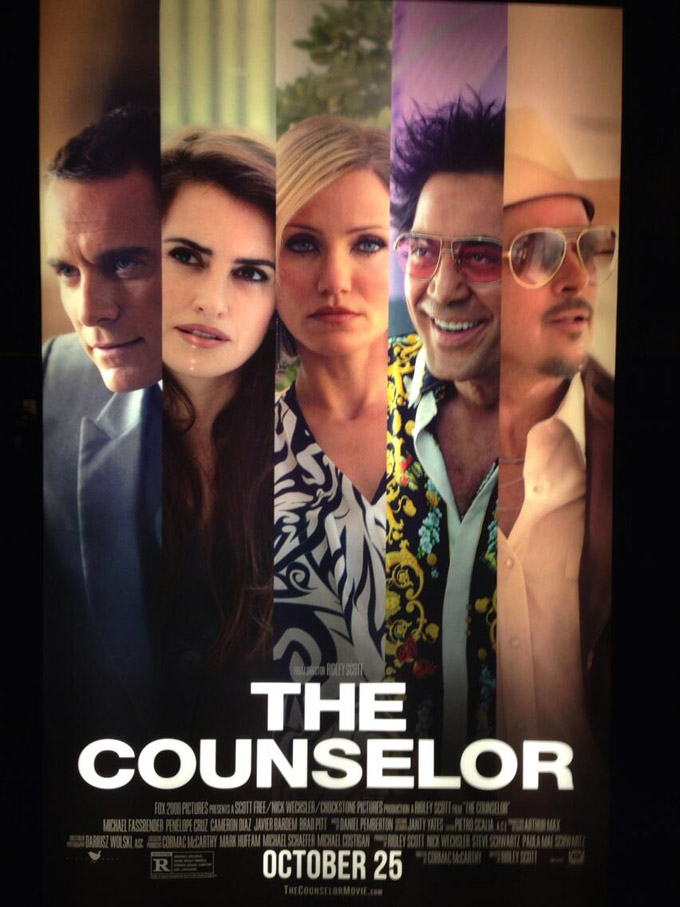
Now, McCarthy decided a while ago that he wanted to write a screenplay.  But, being Cormac McCarthy, he didn’t bother to learn how to write one.  He just started throwing dialogue and settings down on the page in whatever format looked right to him.  And several accounts say the script was…well, a complete mess.  Naturally, though, when word got out that he’d written a script, Hollywood went nuts.  The script was grabbed, Ridley Scott directed, and it’s coming out in just a few weeks ( The Counselor).

Now, a lot of would-be screenwriters who believe in ignoring the rules saw this as validation.  How can anyone say formatting matters after a format-free script sells and becomes a major motion picture?  It’s undeniable proof that sort of thing just isn’t important.

Except, well… not exactly.

Cormac McCarthy’s been a legend for twenty years, and was still famous for twenty before that. He could’ve turned in a script written on a used paper plate and the bidding would’ve started at fifty thousand. His status as a novelist made him the exception to the rules of screenwriting. Just because he can do it doesn’t mean I can. Or you can.  Or she can.

Here’s the thing…

Exceptions to the rule tend to be rare.  Exceptionally rare, you could say. That’s why they’re the exception and not the rule.  McCarthy’s script was snatched up by Hollywood despite its poor formatting, but dozens of them are tossed aside every single day for that very reason.  Because that’s the rule.  Formatting does matter.

And it’s not just screenwriting.  For every person who sold the first draft of the first novel they wrote to the first publisher they showed it to, there are millions of people who did not.  Yes, E.L. James, Diablo Cody, J.L. Bourne, and a triple-handful of other writers started out by giving their work away for free and then spun that into successful, paying careers as writers.  And that sounds fantastic until you stop to consider there are over two billion people on the internet these days.  Even if only one percent of them are trying to make money by writing on a blog or website, that puts the odds of success somewhere in the neighborhood of  20,000 to 1 (about 0.0005 % if my math is right).  And that’s with a very generous estimate of how many successful writers have followed this path.

I can’t use an exception to the rule as a basis for how things should be done.  By it’s very nature, the exception is the freak chance, the aberrant behavior—it’s just not the way things work.  Think of the stories you’ve heard about people who survive falling out of airplanes or getting shot in the head.  They’re amazing and true and took almost no effort, yes, but they shouldn’t make anyone rethink using parachutes or gun safety.

If I want to succeed, the best thing I can do—whether I’m jumping out of a plane, getting shot at, or writing a story—is to follow the established rules.  The absolute worst thing I can do is scoff at those rules—rules like spelling, grammar, or wearing body armor—and  decide they don’t apply to me.  No matter how amazing my writing is, I need to follow the basic guidelines for my craft.

The reason I should follow them, before you ask, is because the person reading my work is expecting me to follow them.  The publishers, editors, and producers who see it before my chosen audience definitely will, and those readers or viewers will assume I’m going to, too.  They all have certain expectations they’ve built up, and these expectations all tend to fall in line with the rules.

Now, does that mean amazing, rule-bending things won’t happen or can’t be done?  Not at all.  My writing may be so spectacular that no one notices the abundant typos.  The basic idea could be so clever that nobody will pick up on the fact that all of my characters have about as much depth as a puddle on the kitchen floor.  Heck, the structure of my story could be so rock-hard the reader will forgive and forget those incredibly boring opening chapters.

But you know what?  Let’s say on page one of my manuscript I introduce school newspaper reporter Tomm Truth and Joanie Justice, and show them straggling with staph editor Barry O’Bama who doesn’t want them running a article about the poor campus seckurity.  After a paragraph or two of that my editor’s going to groan out loud.  I know when I was a script reader seeing stuff like that made me roll my eyes and add more rum to my glass.

Y’see, Timmy, the minute I see a bunch of clichés, misused words, poor grammar, and misspellings, I’ve rendered a judgment on that writer.  Possibly two or three, depending on how many things I see that look wrong.  And they may not be wrong for this story—each one may be carefully chosen to set up certain things for later on.  But on page one or two or three, they look wrong, and that’s how they’ll be interpreted and that’s going to color my view of the manuscript from here on.

If I assume I’m the exception, that I don’t need to follow certain rules, I’m setting an obstacle between me and the people who are going to pay me to keep writing.  Maybe even multiple obstacles.  They’re not insurmountable and they don’t guarantee failure.  But it does mean I’ve just limited my potential audience.  Some readers will toss a manuscript in that big pile on the left after seeing two or three things that look like mistakes.  Others will read ten or fifteen pages before setting it aside.  And if I can’t prove I am the exception before that happens, I’m going to get a lot of rejections.  My story may be loaded with promise, but if my initial foundation looks weak and poorly designed, why would anyone risk the time to see if the rest of it’s structurally sound?

So try to be the exception.  Just don’t automatically assume you are.  You need to earn it.

Next time… I want to talk about Guido.

Until then, go write.
Categories