
October 29, 2014

The Man With No Name

             So very sorry for the long delay.  You’ve all been very patient.  Like, eligible-for-sainthood patient.  
            I could make a bunch of excuses but, well… I’m probably going to bombard you with self-promotional stuff next year.  Let’s just put it that way.
            Sorry.
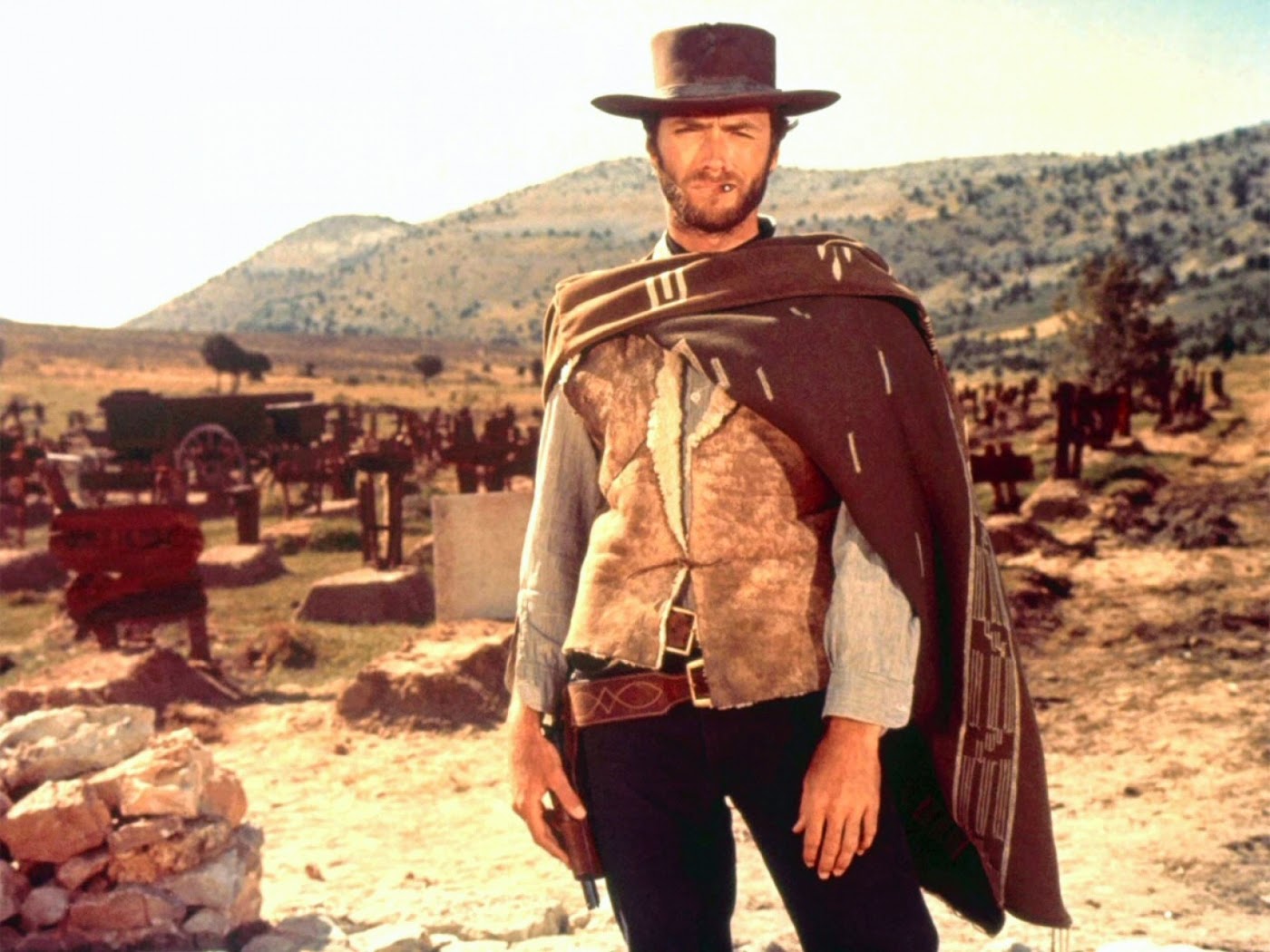
            Anyway… let’s talk about that title.  Pop culture reference from fifty years ago.  In the hit western A Fistful of Dollars (also known as “that old western they’re watching in Back to the Future II”) and its sequels, Clint Eastwood’s character is never named.  Never. 
            Why do I mention this?
            Let me go over a few things first.
            There are three types of characters in any story.  You may have heard a bunch of different literary terms for them, but for our purposes I’m going to break them down to main characters, supporting characters, and background characters.  Every character in my story can fit under one of these three umbrellas.  Or in one of these classes, if you prefer.
            My maincharacters are my heroes, and sometimes my villains, too.  These are the people making things happen in my story, and the ones my narrative will spend most of its time with.  If someone makes a movie out of my book or screenplay, the main characters are going to be the ones on the poster.  There could be six or seven main characters in a good-sized ensemble, but it starts getting hard to balance (or juggle) things when it goes much higher than that.  Not saying it’s impossible, but if my story has fourteen main characters, I might want to rethink some things.
           The supporting characters are the ones around my main characters, usually offering some kind of support (surprise) in either a physical or emotional way.  They appear and disappear from the story as they’re needed.  We don’t focus on them as much because they’re secondary in the story.  They help out, in a variety of ways, but they aren’t the ones who save the day or stop the bad guy.
            Finally, we have the background characters.  They’re just what they sound like.  These are the window dressing people.  The ones who fill tables at a restaurant, bring drinks to our heroes, and stand at the bus stop outside so they can be obstacles when said heroes come racing out at high speed.  In the film industry, they’re actually called “background” or just “extras” (and sometimes less flattering terms depending on who’s listening).  Background characters rarely get more than a line or two of description, and it’s almost always physical.  More than that’s a bad precedent, because I’m setting up the reader to think they’re more important than they are.  When my story’s focusing on the flight attendant, I don’t need tons of history and  psychological background about the rude woman in seat 4C.
            Now, before we get back to Clint Eastwood, let me mention something else that’s come up here once or thrice before.  Names.  Names are important for characters, because a name is great shorthand to my readers for how relevant a character’s going to be to my story.  If I introduce a character with a name, there’s a good chance they’re going to matter so the reader should pay attention to them. 
            (I mean, I’m not just going to name some random guy over at table three in the diner, right?   Can you imagine how much Guardians of the Galaxy would’ve dragged if it started by naming every single person in the hospital room with Peter Quill’s mom?  Or all of the prisoners and guards in the Kyln?  That’d just get silly and confusing, and there’d be no point to it…)
            So, what am I getting at?
            I need to keep track of what class of characters I’m writing about and balance things accordingly.  It’s hard for me to say Bob is one of my main characters if the bus driver gets more description than he does.  If everyone in my script is named, how’s the reader supposed to keep track of the important people?
            A while back I mentioned Theresa Cano, a character in early drafts of my many-times-rightfully-rejected novel The Suffering Map.  Except Theresa wasn’t even a character.  She was a rich and detailed transitional device that filled two pages.  When I cut her out (in the fourth or fifth draft, if memory serves) it didn’t change a single thing in the story.
            So, really, she was a two page distraction that broke the flow.
            In A Fistful of Dollars there’s so much focus on the main character that he doesn’t even need a name.  And it’s not like this complicates things  He’s almost always present  and people rarely use names when they talk to each other.  Cormac McCarthy does the same thing in his novel The Road.  We never learn the father’s name or the son’s.  Same with Ryan Gosling’s character in Drive.  We’re more than halfway through Fight Club before it’s pointed out that Ed Norton’s character has never been named.  Heck, Boba Fett’s name is never spoken in the Star Wars movies until about twenty seconds before he’s knocked to his doom in the third movie.
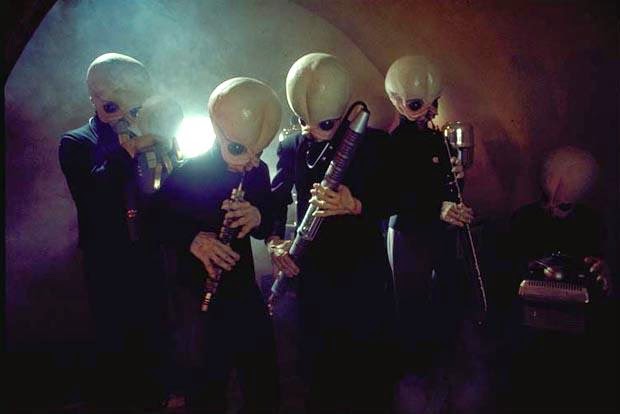
            Speaking of Star Wars… one of the biggest complaints about all the Special Editions and additional canon is how overcomplicated it’s made things.  The folks at Kenner and LucasArts were looking for more marketable material, but rather than making new things they just inflated what was there.  Think of that famous cantina scene with the band and the alien trying to rough up Luke.  Did you know the band has a name?  All the individual musicians do, actually.  So does the alien smacking Luke around (he’s called Ponda Baba).  And the bartender.  In fact, pretty much every single alien in that scene now has a proper name and a race and a back story.
            Good thing none of it’s actually in the movie.
            When I’m writing, I have to know what’s relevant.  I shouldn’t make extended detours to cover irrelevant characters because a detour, by definition, is off the path.  It’s breaking the flow.  People can argue about art or style or literature all they want, but if my heroine runs into the drugstore for first aid supplies after a vampire attack and I spend the next seven paragraphs talking about the twenty-two year old failed football jock who’s running the night shift register because he tore a ligament in his junior year of college and had nothing to fall back on when he didn’t go pro, and how he got his name from his grandfather and it caused a huge argument between his dad and his mom when he was little which was what drove him to be a super-successful athlete and why the torn ligament was such a dream-killer… wait, why was my heroine coming in here?  Does she know this guy?   Is he secretly a vampire hunter (doubtful, since we just heard his whole history)?  Is he the love interest?  Is he a potential—no, never mind.  Our heroine just ran back out to get on with the story.
            Once I start breaking the flow—going off the path—I risk losing my reader.  I need to stay focused on my main characters and the actions they’re taking, with some help from the supporting characters now and then.  The background characters, by and large, should stay in the background, with maybe an odd line of dialogue or description now and then–giving them a name and a page of description isn’t going to add anything because they’re not supposed to add anything.  And if I really feel compelled to put the best man in every scene of my wedding story, then maybe I need to rethink who the main characters are and restructure things accordingly.
            Because if I’m not sure where my characters belong in my story… well, who will be?
            And there you have it.  Clint Eastwood.  Hope it was worth the wait.
            Next time…
            Y’know what?  This is so ridiculously late, and it’s a holiday week, so in a day or two I might revisit the idea of how to horrify people.
            Until then, go write.
August 1, 2014

So Very Tired…

            Sorry for missing last week.  When I should’ve been posting this, I was at the San Diego Comic-Con, hanging out in the Geek & Sundry lounge and watching the Welcome to Night Vale panel (I even got to ask a question about writing).  And the G&S folks gave me a free copy of the Zombies: Keep Out! board game and a card game called Love Letters.   And Felicia Day smiled at me once as she walked past.
            Y’know, in retrospect, I’m not really sorry I missed last week.
            But I am finally caught up on my sleep. I was exhausted for a while there.
            Speaking of which…
            I write a series set in a post-apocalyptic world.  It was first put out by a small press that specializes in end-of-the-world fiction, and I’ve met a bunch of authors who work in that genre and related ones.  Needless to say, I’ve read a lot of these books and stories.  I’d have to guess close to a hundred in the past five years.
            I have seen a lot of people die on the page.
            I’ve characters die of disease or injury.  Seen them shot or stabbed.  Some have been crushed.  Many have been torn apart by zombies—both classic slow ones and the runners.  A few people have gone peacefully and with no pain… but not a lot of them. 
            On a semi-related note, for a long time there was a joke in comic circles that no one stayed dead except Bucky and Gwen Stacy (who’ve both been resurrected in recent years).  It’s one of the things that made some folks point to comics as low-brow, pulpy writing, because villains and heroes would always return with elaborate tales of how they’d avoided death… again.  The new term tossed about is death fatigue.  Readers are just plain bored with overhyped “deaths” that are reversed in twelve issues or less.
            What I’d like to blab on about this week is sympathy fatigue, also sometimes called compassion fatigue.  It’s a medical term that refers to when doctors, nurses, and caregivers have become so drained by the death and suffering they see that they just… well, can’t feel sympathetic anymore.  Constant exposure has desensitized them.  I had the (very awful) experience once of visiting the “death row” of an animal shelter, and the woman who mass-euthanised the cats and dogs admitted she didn’t even look at them anymore.
            Readers and audience members can feel sympathy fatigue, too.  After watching countless people die, the carnage just fades into a background hum.   It no longer carries any emotional weight.  How often have you watched a horror film with an audience and, after a certain point, people just start laughing? Characters on screen are stabbed, tortured, crushed, and decapitated, and you and your friends are giggling.  Maybe even cheering.
            How do I keep people from laughing?
            Let me get to that in a kind of roundabout way…
            A bad habit I’ve mentioned before is naming every character.  I think some time in the past an MFA professor or writing coach offered some advice about names and it went through a dozen iterations of the telephone game.  Now there’s a (thankfully small) school of thought that says every character should have a name.  That guy at the bus stop.  The cook behind the counter.  The woman in the leather jacket.
            When I give a character a name, I’m telling the reader that all these people are important.  There’s a reason she’s Phoebe and not “the blonde” or “the woman in the leather jacket.”  A name tells the reader to take note of this person because they’re going to affect the story.  If it turns out Phoebe has nothing whatsoever to do with the plot, it means I’ve distracted the reader.  And distractions kill the flow of my story.
            When this idea gets mixed with death, it creates a pattern you’ve probably seen before in stories.  We’ll get introduced to a random person, be told a bunch of character stuff about them, and then, eight or nine pages later… they’ll die.  Usually their death will be connected to the larger threat, if not the larger story.  Giant ants, Ebola, vampires, terrorists–whatever the actual protagonists are dealing with, these poor folks will stumble across it and be wiped out.  In some books, this can happen four or five times.  Introduce a character, kill ‘em.  Introduce a character, kill ‘em.  Introduce a character, kill ‘em.  Introduce a character… well, you get the point.
            The idea here is that I’m showing my readers the widespread nature of the threat, or perhaps the ruthlessness of the killers.  And it should carry emotional weight because I spent a couple of pages making Phoebe or Wakko or Dot feel like real people.  From a mathematical, by-the-numbers viewpoint, this is all good, right?
            Catch is, though, my readers are going to notice this pattern really quick.  Just like they’ll notice that I’m naming background characters who have nothing to do with the plot, most readers will realize I’m just introducing characters to kill them off.  So they’ll stop investing in these characters as a way to save time and effort.  It’s a defense mechanism.  They just stop caring.
            And once the reader stops caring, well…
            Perhaps the worst thing this means is that once my readers have been conditioned by all the meaningless deaths, they’re going to be numb to the important ones.  One of my leads will make a heroic sacrifice or that jerk supporting character will finally get what’s coming to her, and my readers will gloss over it the same way they barely registered the last six or seven deaths.  My whole story gets lessened because I’ve lessened the impact of death.
            Don’t get me wrong.  It’s okay to have people die.  I’m a big fan of it.  But I can’t use cheap tricks to give these deaths weight.  I need to be aware of who my characters are and what their deaths are accomplishing within my story structure.  If I just need someone to die gruesomely to set the mood or tone, I don’t need to make them a major character—or to convince my readers he or she is a major character.  And if I’m going to kill off one of my major characters, her death shouldn’t read just like the nineteen deaths that came before it.
            Because when I kill off someone important, I want you to care.
            Next time, I’d like to offer you all a simple choice.
            Until then, go write.
July 4, 2014 / 3 Comments

The Road to Redemption

            I went back and forth over the title for this week’s little rant.  It felt too easy to go this way.  Hopefully you’ll find it in your hearts to forgive me.
            I wanted to take a few moments to talk about redemption tales.  Someone asked about this a while back—a long ways back, I believe—and I thought it could make an interesting post.  Redemption is tough to qualify, though, and it took me a while to put my thoughts into some form that, well, anyone else would comprehend.
            That happens to me a lot.
            Which brings us to today.
            One key thing I’ll be bringing up a lot for this is empathy.  A good redemption story relies heavily on me knowing how my readers will respond to various incidents and actions.  If I don’t have a good idea how something will go over, it’ll be easy for either end of my redemption tale to seem pointless, confusing, melodramatic… or all of the above.
            A redemption tale can either be the main thrust of my whole story or it can just be part of a single character’s arc.  Either way my story has to hit a couple of points.  Not in the sense of “introduce the motivating incident by page 17,” but more in a general “let’s talk about the story and the characters” way.  If I don’t have these points in mind, there’s a good chance that my “redemption” story is going to earn some rolling eyes and a hearty laugh or three.
            So… with all that in mind.
1—Does my character need to be redeemed?
            This is one of those “obvious” things that far too many folks mess up.  If I’m going to tell a redemption story about Yakko, he needs to do something that requires redemption.  This is step one, and it’s kind of bothersome how often I see people who miss this point. 
            I’ve seen more than a few folks who try to structure big redemption moments around characters who haven’t done anything wrong.  It’s really great that Yakko wants to sacrifice himself to make up for his past sins, but if he doesn’t have any past sins… well..  That’s not redemption, it’s just a pointless sacrifice.  Yakko needs to have something in his past (or do something early in my story) for which he needs some form of honest redemption.  For most of this post, I’m going to call that the key event.
            That “past” aspect is important, but I’ll get to it in a few minutes…
            This is my first big empathy moment as a writer.  If I can’t predict what actions (or lack of actions) my audience will see as redemption-worthy, this story can get silly pretty quick.  Yakko should not be going on a ten year penitent crusade around the world to make up for feeding his cat tuna instead of chicken.  If he’s really guilt-ridden about that nickel he picked up off the sidewalk when he was six… again, I’d better be writing a comedy.
            What was Yakko’s key event?  Did he sneak a peek at his roommate in the shower?  Write a bad check?  Get someone fired?  Rape or murder someone?  Maybe lots of someones…?
            That brings us to…
2Can they be redeemed?
            Somewhat related to the first point.  There are certain acts that are unforgivable.  That’s true in any society, past, present, or future.  Sometimes people do things that are beyond redemption.  It’s really tough to imagine anything a serial child rapist could do to make up for what they’ve done in the past.
            Yeah, I’m sure some of you are thinking “they could die,” but that’s not redemption, is it? That’s vengeance, and that’s not what we’re talking about.  And I’m going to talk about death in a little bit.
            So when I’m writing Yakko’s redemption tale, I need to really think about what he’s done.  Again, some of this is going to be an empathy issue.  Will my readers think his key event is a redeemable act? 
3Do they want to be redeemed?
            Again, this may sound obvious, but I can’t force redemption on someone.  That’s not how it works.  Yakko needs to want it.
            And maybe he doesn’t.  Maybe Yakko doesn’t feel like he did anything wrong.  Perhaps he paid his fine or wrote his apology letter or served his time and considers the matter closed.  Or maybe he knows it was wrong and just doesn’t care.  Some people are like that.  If Yakko’s one of them, it’s going to be tough for me to write a redemption story about him.
4Why haven’t they done it before?
            Okay, in order to explain this point, I want to toss out what I think is a fairly firm rule of thumb…  Feel free to agree or disagree down below.
            In a good redemption story, a notable amount of time needs to pass between the key event and the redemption for that event. 
            Y’see, Timmy, in my opinion one of the main elements of redemption (from a story point of view) is guilt over the key event.   If I don’t feel guilt, then why would I want redemption (see above)?  And if I’m taking care of things immediately after the key event, this isn’t so much redemption as it is… well, cleaning up.  Yakko may feel horrible about having to do this clean up, but does he really feel guilty?  If I hit someone with my car, it’s the difference between calling 911 and sitting with them until the ambulance comes… or switching my headlights off and speeding away.  I may feel bad in both situations, but they’re two very different situations.
            That being said…  Why didn’t Yakko stop immediately? What made him run from his key event?  What’s kept him from admitting it or doing anything about it until now?  Denial?  Fear? 
            Which brings us to a two-part point…
5AWhy are they doing it now?
            If I accept that Yakko has tried to disavow or hide that key event for weeks or months or years… why is he looking for redemption now?  What’s changed for him as a character that he’s decided to acknowledge this and make amends somehow?
            This is another big empathy moment because this is a big decision for any character, and it goes against what they’ve done up until this point.  If this isn’t a believable change of heart, my whole story’s going to fall apart.
5BWhy are they doing it now?
            From a story structure point ofview, why is this happening now?  Odds are Yakko’s going to start looking for redemption in this story, because I write about active characters who actually do things.  So, as an author, why have I included this?
            Am I just looking to round out Yakko a bit as a person?  Is this the main plot of my whole novel?  Either way, this decision and the repercussions from it need to fit into the structure of my story and into Yakko’s arc as a character.
            Last but not least…
6Does it balance the scales?
            At the end of the day, every redemption story comes down to this.  Does what Yakko did now make up for what he did then?  Does he believe it does?  Do other character think things are even now?  Even more importantly, are my readers going to think this is a fair trade off, or is it going to come across a little thin or forced?
            It’s worth mentioning death.  All too often writers try to use death as the ultimate balancing agent.  It’s seen as the automatic “redemption now” act.  Sure, Yakko raped, killed, and pillaged his way across three continents, leaving thousands physically or emotionally scarred in his wake, but in the end he died saving those two campers from a grizzly bear.  And that makes it all okay, right?
            No, of course not.  In fact, if not handled just right, death can come across as a “he got off easy” situation, cowardice, or even a cop-out on my part.  I don’t have to deal with all these complex emotions and repercussions if Yakko takes a trio of bullets in the chest, but I can still be praised for my artistic handling of the situation.
            That’s the idea, anyway.
            On a related note, a redemption story where the character doesn’t redeem themselves in the end is just… well, kind of pointless.  It may have been very pretty from a vocabulary-metaphor-symbolism point of view, but it isn’t a redemption story.  Or much of any story, to be honest.  I may feel it’s beautifully tragic and ironic, but I think most readers are going to find themselves wondering why they just wasted the past few hours following a guy who doesn’t accomplish anything…
            And there you have it.  A few questions I need to ask myself if I’m trying to do a redemption story.  And if I don’t have some positive answers for most of them, well, maybe I need to look again at how I’ve set up my story.  Or my character. 
            Because there’s a good chance they’re not on the road to redemption.
            Next time I’d like to work backwards a little bit.

            Until then, go write.
June 26, 2014 / 3 Comments

Limited Discussion

           I wanted to revisit something I blabbed on about a few years back.  I’ve kind of touched on it a few times since then, but I thought it would be good to just babble on about it more specifically.  So if you’ve been reading this for a while and you have a phenomenal memory… sorry.
            I see a lot of television shows that are getting rolled out and cancelled just as fast.  One thing that amazes me is how many of them don’t really seem like television ideas.  They’re cool ideas, yes, but many of them are very A-to-B sort of stories.  My characters have been presented with a single, overriding problem or conflict, and once they resolve it… well, that’s it.  Which is a great thing for a feature film or a single season, but very rarely works well with a long-running series.
            And I’d say that long string of cancellations kind of backs me up on that.
            Some story ideas are, as I just mentioned, pretty much straight line affairs.  There may be a few steps, but in the end it comes down to achieving a single goal.  There are also the broad ideas, the ones you tell people and they say, wow, that could go on forever.  In the past, I’ve referred to these, respectively, as limited and unlimitedconcepts.
            What do I mean by that?
            An unlimited concept generally has a very broad scope.  Sherlock Holmes uses deductive reasoning to solve mysteries.  Spider-Man and Batman fight crime to make up for the death of their loved ones.  Captain America and Superman fight to protect rights and ideals that they believe in.  Joe Ledger is a soldier turned cop turned super-agent working for the mysterious Mr. Church (or is it Mr. Deacon?).  The crew of the starship Enterpriseexplores the distant reaches of the galaxy.  Jack Reacher just wants to wander and see the country, but he’ll stop to help folks out sometimes.  Detective Kennex and his android partner, Dorian, investigate homicides in the future.
            A key thing to note.  When we talk about unlimited concepts, nine times out of ten we end up talking about the characters over the plot.  Sometimes it’s the setting, but usually it’s the characters.  An unlimited concept isn’t about a specific set of events, which is why it’s also sometimes also called an open story.
            A limited concept, as the name implies, can only go so far.  As I mentioned above, it’s an idea that has an end inherently built into the concept.  A road trip story is a classic limited concept—as I mentioned above, it’s A-to-B.  We’re trying to get (physically or metaphorically) from here to there.  The passengers of Oceanic flight 815 want to be rescued from their weird tropical island and the residents of Chester’s Mill want to be rescued from the big invisible dome over their town. Tom Jackman wants to find a way to control his dark half.  Mark Watney wants to find a way to survive on Mars for the years until a rescue mission comes.  The crew of the starship Voyagerwants to make their way home from the other side of the galaxy.
            In all of these cases, the characters have very clear, straightforward goals.  Once that goal’s reached, the story is over.  It doesn’t mean everybody in Chester’s Mill lives happily ever after or the Voyager crew never goes into space again, but those are all different stories which don’t have to do with the premise I mentioned above.
            Why am I babbling about this?
            If I don’t understand what kind of an idea I have, it’s very easy for me to mess it up.  Trying to play one as the other almost never works.  By their very nature, these concepts are very true to themselves.
            For example…
            Several years back I was part of the staff for an online game.  One time while we were brainstorming new quests for the playerbase, someone suggested taking one of the old ruined castles at the fringes of the map and making it haunted.
            “Okay,” I said.  “And…?”
            “It’s a haunted castle.”
            “Right.  So what’s the quest?”
            “It’s.  Haunted.”
            An unlimited concept is almost never a story in and of itself.  It’s almost always lacking any sort of plot or narrative structure.  I need to add elements to make it work as a story (or a quest).  A fair number of “art” films tend to be unlimited concepts—they’ve got fantastic characters, beautifully rendered locations… but nothing else.  Nothing happens because unlimited concepts don’t contain a conflict or goal for the characters to strive for.
            On the other hand, a common thing I see people do with limited concepts is to keep pushing the goal away to extend the story (or series).  It’s an A-to-B, which means when I hit B the story is over.  So some folks will swerve around B for a while, maybe go back to A because they forgot a few things.  Somehow we end up at 4.2 (no idea how we got here), then we get close to B and veer off at the last minute…  If I’m doing a Los Angeles to Boston road trip, think how annoying it would be to start circling Boston but never actually get there.  Or I suddenly find out I need to be in San Diego instead.  That’s what it’s like when a limited concept artificially extends itself.
            It’s also cheap if I pile on the limited concepts, giving my characters a dozen or three goals that need to be achieved—either all at once or one after another (see above).  In my earlier days, before I had a better grasp of structure, I thought this was how you filled a book.  I still see lots of writers do it when they start out.
            The truth is, it’s very tough for either of these concepts to work alone.  An unlimited one almost never does, but that hasn’t cut down on the number of art films or “experimental” stories.  A limited one might squeak by as what’s often called a “plot driven” story.  Neither of these tends to be very satisfying.
            For a really great book or screenplay, I need both working together.  I need to put that fantastic character (the unlimited concept) and give them a solid goal they need to achieve (the limited concept).  As I’ve often said, my story won’t succeed without good characters, but they also need to do something and it needs to challenge them somehow
            If I don’t have good characters or I don’t have them doing anything… well…
            The math isn’t that hard.           
            Look through that document of story ideas.  Or the file folder.  Or the notebook.  If you’re reading this, odds are you’ve got at least one of those.  Figure out if your ideas are limited or unlimited.  Because then you can figure out what they need to become solid stories.
            Next time… well, there haven’t been many comments lately, so I’m guessing none of this stuff interests a lot of you.  So next week I’ll try to redeem myself

            Until then, go write.

Categories