
May 30, 2018 / 6 Comments

Back In the Olden Times

I warned you there won’t be a post on Thursday.  It’s my birthday, and there’s a good chance I’m going to be filthy drunk, playing with little toy soldiers, or maybe getting a new tattoo. Possibly some combination of these things.

But I figured, what the hell, I’d like to talk about something else. This’ll be one of those little rants that’s less about writing and more about being a writer.  And it’s a topic you may have heard of before.

There’s a concept that comes up now and then—the starving artist.  If you look at the history of writing throughout the 18th and 19th Century, and even the start of the 20th, you’ll see a common thread. Most writers were hungry.  Literally.  They often couldn’t afford food. They usually lived in crappy apartments. Even the ones living “glamorously” in the ’20s and ‘30s were usually… well, living like crap.

People point this out and use it for all sorts of excuses. They think this proves artists don’t need to get paid. If you were a real writer, you’d just be doing it for the joy and the excitement of creating stories. You need to starve if you want to be any good at this, so just stop your whining and suffer! It’s not like writing’s a real job anyway.

This is all nonsense, of course. Every bit of it. But, as I’ve brought up here before many times, it’s easy to just say “that’s wrong.”  The harder thing is to explain why something is wrong.

So let’s talk about the four basic flaws people make with the “starving artist” argument.
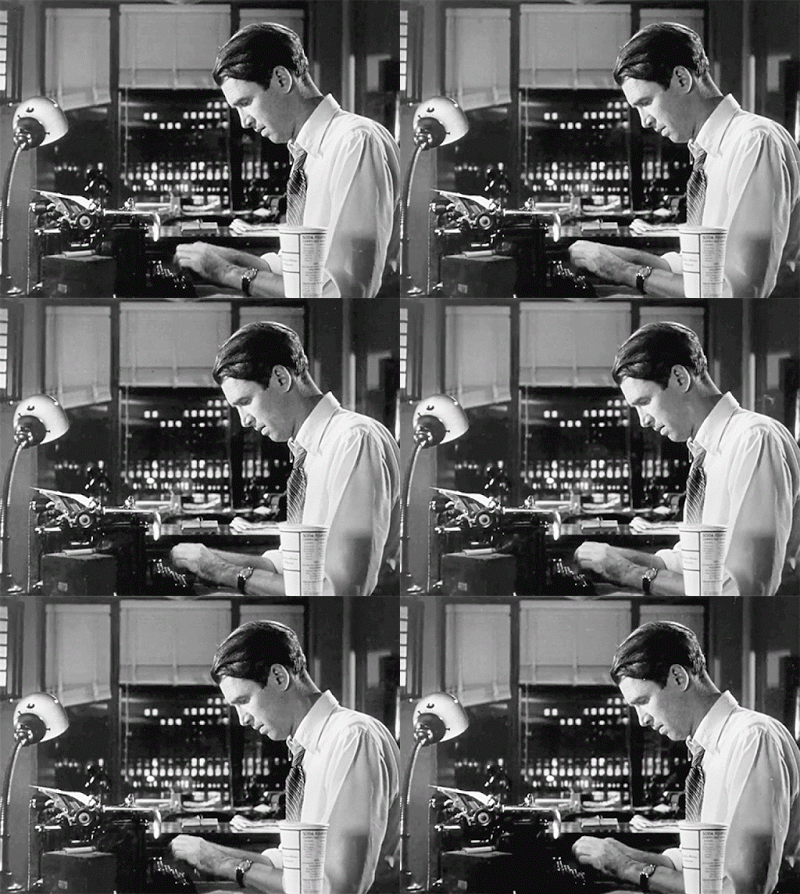
First, they think this is something “real” artists did. They decided to throw themselves into poverty and live on bread crusts and cheap wine while they perfected their craft. It’s what everyone did back then, and it worked for them.

Okay, let’s pick this apart.

Yes, back in the day… you had to starve for your art. Not because it built character, not so you’d understand suffering, none of that nonsense. I’d be a starving artist because… that’s how I’d learn. I’d work less or take time off altogether, and I’d just write. Write, write, write.  Because, again, that’s how I’d learn. There weren’t classes or programs or books or degrees.  No, seriously, there weren’t. That’s a really recent thing (and a rant all in itself). If you wanted to be a writer—a good writer–you learned by writing.

And that meant spending time writing. Which meant… not working on other things. Like maybe a high-paying job.  Or any kind of job.

Plus, keep in mind—being a writer back then also meant a serious investment in money.  How much do you think these folks wrote a week? 15,000 words? 20,000? That’s a ream of paper every month. Yes, paper.  How else do you think they wrote back then? If I had a typewriter—assuming I could fix it myself and didn’t need to pay for maintenance—I’d still need to buy a new ribbon every 200 pages or so (or re-ink the old one, which means buying ink). Plus there’s postage, too (have to submit my work somehow).

Of course, all this skips over the real issue. Does anyone really think those aspiring writers wanted to live in poverty?  If they could live in the modern world where everyone has a computer with a word processor, email submissions are the norm, and you can spend four or six or eight years at a university (with housing and a dining commons and medical services)… well, I feel pretty safe thinking very few of those writers of yesteryear would say “Nope—squalor and starvation for me, please.”
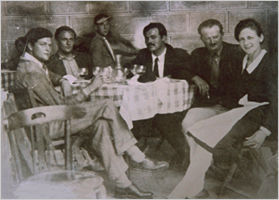
Second, when people talk about the starving writer, they romanticize it. We hear stories about Hemingway, Fitzgerald, Stein, and so many others hanging out in Paris and we think, oh, how lovely that must’ve been. All the creativity and support and free exchange of ideas.

Truth is… Hemingway was using alcoholism to deal with his PTSD after World War One. Fitzgerald had constant money problems. Hell, a bunch of them were skirting poverty at any given time. Oh, and let’s not forget the Nazis were gaining power in Europe at that point, so that may have caused a bit of tension among the progressive free-thinkers.

Things were really awful for those very notable starving writers at what’s considered a major point in their careers.  But we overlook a lot of the negatives because of those positives. We maybe even enhance the positives a bit more than we should.

F’r example, right after college I lived in a shabby, beetle-infested, un-insulated townhouse in Amherst with three friends. We roasted in the summer, froze in the winter, and fought over the single shower every morning. We had a pretty-much absentee landlord who never fixed anything and stole our security deposit in the end just because we were young and she could.

I have tons of happy memories about that year.  But I also know that’s my brain mercifully editing out all the horrible stuff. You’ve probably had points in your life like that, too—a job or a living arrangement or a relationship you can look back at fondly if you just ignore points A, B, C, and E. And we do ignore these things, because I think most of us like to focus on the positive. But it doesn’t mean the negative wasn’t there.

Third is that, like with so many things, people have flipped correlation and causation. Nobody’s ever been a great writer just because they lived in abject poverty. Nobody.

All those folks living in Paris who became legends in their field? Well guess what? There were thousands of people in Paris trying to be writers and poets and painters, and most of them were poor and starving (see point number one up above). Most of them never become successful. Critically or financially.

If poverty was such a deciding factor… well, shouldn’t most of them become household names, too? I mean, that’s how this works. If X causes Y, then in all cases of X we should see Y. In a bare majority of cases, at the very least.

But we don’t.

The ugly truth of history is we tend to talk about the rare successes and not so much about the abundant failures. When we only consider those exceptions to the rule, though, it gives us a really skewed view on things. It’s like only looking at Jennifer Lawrence’s career and then saying “Well, I guess every young girl who moves from Kentucky to Hollywood is going to end up being a major movie star.”

And we all know it just doesn’t work like that.

Fourth, and finally, is the Puritan thing.  And I’m saying this one as someone who has New England roots stretching back a hundred years before this whole “United States” idea.

Y’see, Timmy, there’s a kind of messed up idea in America that jobs should not be pleasant.  Nobody should like their job.  Jobs mean work, and work means long hours, sweat, and aching backs when you get home—and you need to go home.   If you’re working out of your home, it means you’ve either a housewife or got one of those cushy liberal-elite “jobs” that just involves taking money from real working people.  You’re in the arts?  Yeah, try a real job sometime…

Okay, sure, not everyone’s that bad, but that attitude is really pervasive.  It’s why some people think writers—all artists, really—should suffer.  It fits into a view we’ve all been conditioned to believe.  Well, all of us in the States, anyway.
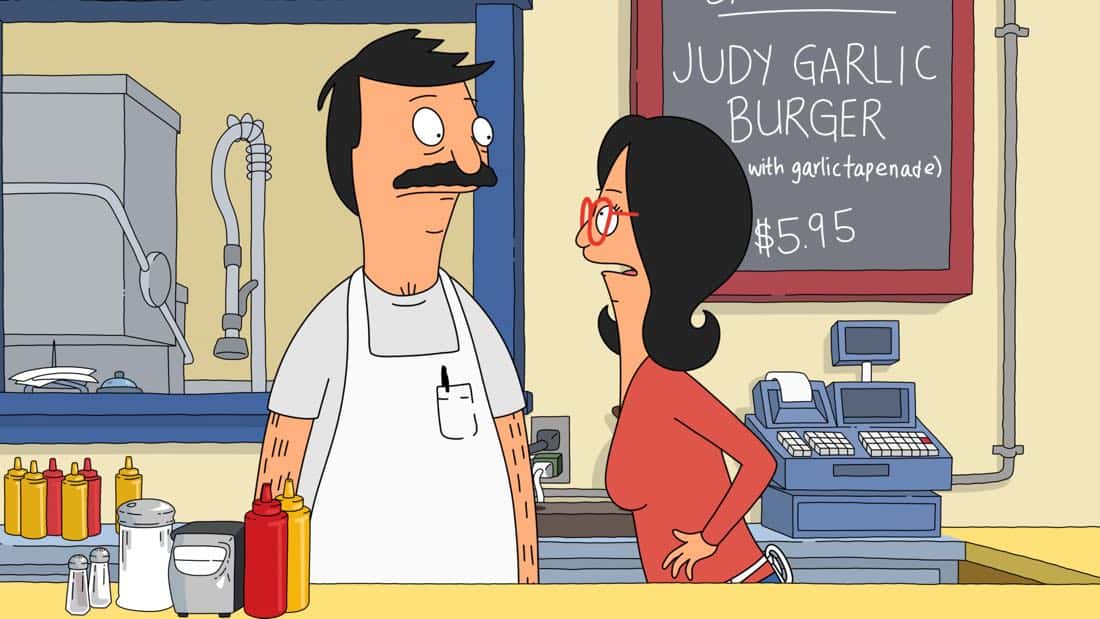
Don’t believe me?  What’s blue collar comedy?  It’s a whole subgenre of sitcoms about working-class folks who don’t like their jobs and get low wages.  This is a normal, relatable thing.  Because people are supposed to hate their jobs, right?

When I started writing full time, one thing I struggled with (for years) was people who didn’t understand that I was working.  No, seriously. I’m actually working. I still had to put in my forty hours a week like anyone else. Usually more.

So when people are pushing the starving writing idea… this is where it’s coming from. And this is why it’s wrong.

Now…

All that said…

This doesn’t mean writing is easy now.  It’s never been easy.  If I want to do this, I’ll still have to make tough decisions now and then.  I may have to prioritize things.  I will probably have to make some sacrifices.  If I want this to be my career, that means it’s my job. And that means it’s going to be work.

But unless I do something stupid… I shouldn’t have to starve.  And nobody should expect me to.

See you next week for that P-word talk.

Until then, go write.
May 24, 2018 / 4 Comments

Jammed

            First off, so very sorry post have been irregular here as of late. Believe I’ve mentioned I’m juggling a few things.  One of which is the con I’m at right now.
            But we’ll talk about that in a bit…
            This week I wanted to revisit an idea that I’ve brought up a couple of times over the past few months.  I’ve heard it called a few different things, but my preferred term has always been flow.  First heard it that way from a wonderful author and writing teacher named Drusilla Campbell, and it always stuck with me.
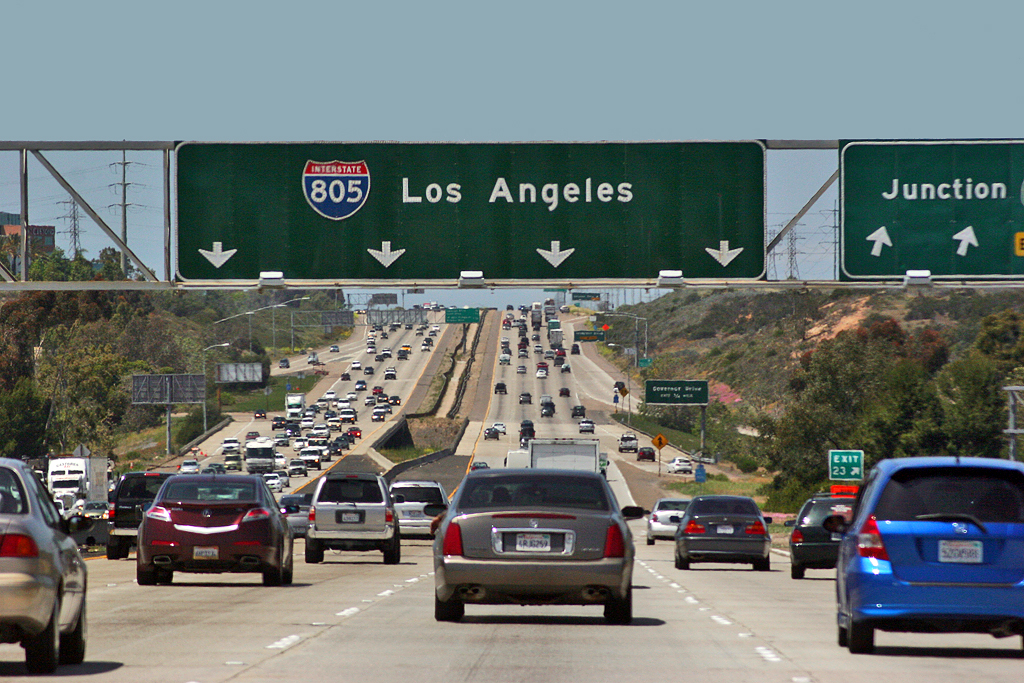
            The visual I’d like to put in your head for flow is traffic. Regular old automobile traffic.  I’m going to go out on a limb and guess most of you reading this can drive, and the few who don’t have still ridden in a car.  And hopefully most of you have been to a city, or at least on a highway of some kind.
            So… let’s talk about the flow of traffic.
            Living in Los Angeles (and before that San Diego, and before that the greater Boston area), I’m very used to highway traffic.  Sometimes, often late at night, the highway is clear and wide open.  There’s barely anyone on the road and you can pretty much fly.
            Of course, even if there aren’t many cars on the road, something big can still create a traffic jam.  Major construction or a big accident can condense things down to one lane, and suddenly that very open road is densely packed and moving at a crawl.
            During the day it can be even worse.  When there’s a million people on the road (no exaggeration here in LA) one small problem can slow everything down.  A large one can bring things to a crashing halt.  Hell, there’s a big hill on the 405 through the Sepulveda Pass and it always causes traffic slowdowns, both ways, up and down.  I’ve been in traffic jams so bad you could actually shut your car off, get out, and stretch your legs for a bit.
            There are places where the very structure and layout of the freeway just naturally causes traffic jams. There’s no way to avoid it the way things have been constructed.  I know a couple stretches where—for no reason—the road goes from six lanes to three.  And then back up to five.  That mile of three lanes… it’s almost always clogged.
            Traffic patterns can even get messed up when people just start looking at the wrong thing. We’ve all been in massive slowdowns that are simply caused by people staring at something on the side of the road. Or sometimes on the other side of the road.  A big accident in the northbound lane can make everybody in the southbound lane slow down to take a look.
            Sometimes it works great, though.  Those million people can be on the road and it’s fantastic.  Everything works.  I’ve had times when I’ve been looking at all the cars on the road, but then looked down to realize I’m almost doing sixty-five.  We’re all going at almost sixty-five, in perfect sync.  I was just caught up in everything and didn’t even realize what was actually going on.
            But that flow can get disrupted so easily.  Again, one car going really slow.  One closed lane.  One distraction over on the shoulder.
            What’s the point of this little visualization?
            Reading a story is a lot like traffic.  It has a flow.  When the flow’s great, we barely notice how fast things are going.  We just zoom along and suddenly realize we’ve read a hundred pages and it’s dark out and where the hell am I?  A book that you can’t put down has great flow.  A book that you should love but you just can’t get into… probably doesn’t.
            Here’s a few things that have the potential of causing a traffic jam in my story.
Switching Tenses/Formats/POVs
            A friend of mine has a book where the main character slips into sort of a fever dream.  She’s sick, she’s been medicated, and now she’s… a bit out of it.  And so the next two chapters of the book are in stage play format.  It becomes a bit more separated from reality for the reader and we understand it’s more surreal for the character as well.
            Compare this to another book I read recently when, for no reason, maybe 15-20% of a page would suddenly be in screenplay format.  Dialogue, prose, prose, slugline, dialogue, stage direction, prose, dialogue.  It jarred me out of an otherwise wonderful book every single time, and the author did it every four or five pages.  I looked for patterns and tried to figure out if there was a recurring motif, but couldn’t find anything.  I loved the story, but I kept getting knocked out if it.

            There’s nothing wrong with doing clever things.  It’s highly encouraged.  But I need to have a reason to do them, because my readers are going to assume there’s a reason I did it. That’s natural, isn’t it? I made the effort to put it in the book, so there must be a point to it.  Bruce Joel Rubin once mentioned that when we stop experiencing stories in our gut, we go into our head and start analyzing them.  That’s when the flow breaks.  When we stop reading and start drawing mental diagrams.

Names
            I was reading this big sprawling generational family saga recently.  Not normally my kind of thing, but I’ve been trying to expand my reading umbrella lately.  And I’m overall glad I read it.
            But…
            One issue it had was that, by nature of being multigenerational, there were lots of people who were called “Dad,” and quite a few who were “Mom.”  And they were all Dad and Mom.  No “Pops” or “Papa” or “Daddy Dearest.”  No “Mum” or “Ma” or “Mother.”  Which got confusing because the book also jumped POV and timeframes a lot.  We might be in Yakko’s head for a chapter, then hop over to his granddaughter’s.  Which meant “Dad and Mom” is now referring to different people.  Some of them even had the same name, so there was a Yakko Jr. and a Yakko the III (fortunately grandpa had died)
            Anyway, what it amounted to was me going back to analyze the book every ten or fifteen pages to make sure the person behind this POV was who I thought they were.
            This is closely related to something else I’ve mentioned before—when lots of people have very similar names, especially when they all begin with the same letter.  We naturally lock on to that first letter to help keep things straight in our heads. If my story has a large cast featuring John, Jerry, Jacob, Jared, Justin, Jean, Jon, Jeri, Juan, Jenn, and Jess, people are (again) going to spend just as much time going backward to figure out who’s who as they are going forward to, well… read my story.
Vocabulary
            We work with words.  That’s a simple fact of the job.  And nobody wants to use common words.  We want to work with amazing words.  Exciting, sexy, awe-inspiring words that people will remember years from now.  Decades from now, even.

            But here’s the thing to remember.  The words don’t really matter. The story matters. The characters matter.  The actual words are just a delivery device.  They’re how I’m telling you the story.  As a writer and a reader, I don’t want to be focused on the act of communication more than what’s being communicated.  The words should be almost invisible.

            And the truth is… the common words are going to be a lot less visible than the uncommon words. As readers—as people—we notice the uncommon. It stands out. And in many cases… it’s distracting. 
            This isn’t to say we can’t use uncommon or obscure words. There should be a reason for using them, though, and that reason shouldn’t just be me wanting to show off the obscure word I learned on Doctor Who a few months ago.  They shouldn’t be stumbling blocks for my reader.  Again, they should be adding to the story, not the delivery device.
            That’s just a few things.  I’ve mentioned some others before.  Flow is kind of tough to get too specific about because something that causes a small bump for me might be slamming you into a metaphorical wall.  Or vice versa.
            Y’see, Timmy, that’s the biggest lesson about flow.  It’s an empathy issue.  It’s about being able to put myself in someone else’s shoes—a lot of other people’s shoes—and make an honest assessment about things.  Will this reference trip people up?  Is this structure confusing?  Is it easy to keep all these characters straight?
            Because if I can’t be honest about my work, there’s a good chance I’m going to jam things up.
            And if that happens too often, to stick with our traffic metaphor… people will start looking for alternate routes.  
           Next time, I’d like to talk about that opening chapter.  You know what I mean.  The P word.  Although, fair warning, next time might not be for two weeks or so.
            Oh, and hey—I’m at Phoenix Comic Fest right now!  Are you reading this? You should come find me. I’m that guy typing on his phone. And also talking on panels and signing stuff and all that.  Come by and say hi.
            And then go write.
            Hey, all.
            A couple people have asked for this, and I figured I could put it up here and link to it anywhere else.  Centralized blog and all that.  I’m on the cutting edge of 2007 tech, I know…
            Anyway, this is a crazy week for me, and here’s my schedule for said week
WEDNESDAY
7:00pm—at the Poisoned Pen in Scottsdale AZ
Elevengeddon
            I am the 14th Geddon, one of a handful of surprise guests showing up here along with Eleven-plus really spectacular authors who are already on the list. Can’t make it to Phoenix Comic Fest?  Come meet me here and get things signed.
            And from here we move on to…
FRIDAY
10:30 am—North 126C
It’s the End of the World as We Know It – Apocalyptic Fiction
            A favorite topic of mine, and I’m moderating this one (as well as chiming in with my own thoughts)
12:00 pm—North 125 AB
Leaping Tall Tales in a Single Bound – Stories of Superhuman Abilities
            Clearly a topic I’ve been studying for many years.  I have many thoughts and strong opinions on this, some of which I’ve elaborated here in the past.  I will share them and more.
1:30 pm—North 124AB
Book Signing
            Scribbling, scribbling, scribbling.  I love to meet folks and deface their books.  This is your big chance to get me to sign all your Craig DiLouie novels. 
8:00 pm–North 120CD
Drinks with Creators
            Just follow the flow of writers and artists.  You’ll find us.  And then you can hang out and talk with us and be absorbed into out biomass.  Join us.  JOIN US…
SATURDAY
3:00 pm—North 126C
Writing Advice I Would Give My Best Friend
            I give writing advice sometimes.  Who knew?  Show up and see how good I am with on the spot questions. 
4:30 pm—North 124AB
Book Signing
            More scribbling, scribbling, scribbling.  Here’s your chance to get a copy of Ready Player One signed by me…
SUNDAY
10:30 am—North 126C
Bad to the Bone – Villains in Fiction
            Another topic on which I have many thoughts.
12:00 pm—Changing Hands signing area
Book Signing
            One final chance to have me scribble in books for you and bring down their resale value.
            And that’s this week.
            Plus, y’know, the usual post here on Thursday.
            Hope to meet some of you this week.  Until then… go write.
May 15, 2018 / 3 Comments

But First… Some Death

            I’m still feeling a bit guilty about missing the Writers Coffeehouse this weekend, so here’s a quick thought about something that’s come up more than a few times with Saturday geekery movies…
            Every now and then I come across a story— very often, but not always, a horror story—which begins by introducing us to a big cast of characters.  Four or five friends going on vacation up at the lake.  Or maybe some kids partying in that abandoned house on the edge of town.  Or a group sneaking off into the woods at night for some passionate funup in clearings and up against trees.  And then…
            They all die.
            Every one of them.
            Dead and gone. 
            Possibly even eaten. 
            All in the first ten minutes.
            At which point… we get introduced to our protagonists.
            If I had to guess, I think this kind of opening in stories has spun out of that oft-quoted, rarely understood rule “start with action.”  Writers want to dive in with a big opening.  And what’s bigger than killing people, right? 
            Now, I’m not against starting things with a bang.  Or against killing a character if it serves the story.  But there’s a two-fold issue when I fall back on this kind of opening…
            One is that I’m wasting perfectly good deaths.  No matter how funny or clever or nightmarish those deaths are, I’m pushing the audience into compassion fatigue.  And I’m not even doing it with people who matter.  I’m killing off all-but-nameless cutouts that my audience has no investment in and desensitizing them to the impact those other deaths could have.
            Two is that… well, this isn’t really a great narrative structure.  A key thing about every story is knowing where it begins. When I do something like this, it’s a false start.  It has almost no bearing on my actual plot or story. And that means my story probably begins sometime later.
            Yeah, there are always threads stretching before my first page.  Previous relationships, earlier jobs, a string of birthday parties, and, yes… even a few deaths.  But are they relevant to this story?  If I had to boil down what this story was about, to condense it into one page, would any of those early elements be on that page?
            Y’see, Timmy, if I hit a point where I’ve killed off every character I’ve introduced and my story’s not even close to over… there’s a good chance it means this is where my story actually starts.
            And I was just wasting everyone’s time before this.
            So stop wasting time.
            And go write.

Categories