
November 23, 2018 / 5 Comments

Black Friday VI— the Von Trappening Pt.2

            So, hey, at the risk of being a bit of a killjoy, let’s talk about Black Friday and the holidays and being poor for a couple of minutes.
            Actually, no.  Let’s talk about moving and forgetting your wallet.
            Well, about me moving and forgetting my wallet.
            Because it happened.  As some of you know, I bought a house this year.  But I was also trying to finish a book, which meant I didn’t really have time to move.  So for a few months my partner and I did this slow dance of packing up a few things and driving them down to the house whenever we could.
            I was doing this back in June and noticed about halfway through the drive that I was low on gas.  And quickly discovered I had forgotten my wallet.  I shouted in the car a lot, and then the dread creeped in.
            Dread I was, alas, all too familiar with.
            I spent the next hour watching the gas gauge creep down, hoping I was going to make it and just kinda knowing I wouldn’t.
            I ended up at the Arco gas station just off Via de le Valle.  No gas.  No money.  Just trapped and powerless.
            That’s what being poor is.  Pretty much a constant feeling of being trapped and powerless.  Of having no agency, as some might like to say.
            And, yeah, I’m speaking from experience. I grew up kinda poor at points in my childhood, but when I became a full time writer I was very poor for almost three years. Phone-shut-off-and-stealing-toilet-paper-from-the-library poor.  All-our-shopping-at-the-99-Cent-Store poor.  I had a chance to sit down with Shane Black for a coffee or two as part of a work assignment and I had to turn it down.  I didn’t have enough money to buy a coffee, and possibly not even enough to get me across the city to where he was.  Yeah, I didn’t have enough money to go work.
            Being poor is just a constant feeling of tension.  Of being painfully aware of what you don’t have and what you can’t do.  And in today’s climate… hell, for the past ten or fifteen years, a lot of people have made it painfully clear that they judge you because of that.  They find you lacking as a person because of your poverty.
            And it’s even worse at the holidays.  Because so much of the holidays is about giving, and when you’re poor you just… you’ve got nothing to give.  It doesn’t matter how much you care about that person, it doesn’t matter how much you want to.  It doesn’t matter because you’ve got nothing.
            And again… you can feel people judging you over it.  At every office party or gathering of friends or family dinner.  Judging you for being trapped and powerless.
            It sucks.
            At which point… I would like to tell you about the redheaded woman in the sundress who came to my rescue.  She parked across from me at the Arco, started pumping gas, I begged her to take pity on someone moving and if she could spare three dollars.  Three dollars of gas could get me home.  Or to the big empty house that would hopefully soon be home.
            And she smiled and said sure.  And offered me her credit card.
            Dead serious.  She just swiped her credit card on my pump and told me to pump whatever I needed so I could get where I was going.
            Thank you, mystery redhead.  You were—and are—fantastic.
            There are good people out there.  People who want to help.  Especially at this time of the year.
            So if I can help some of you avoid feeling that miserably low this season—the low I had to feel for those Christmases—I’d like to do it, as I have on Black Fridays past.
            If you’re feeling trapped and powerless because you can’t afford gifts for your family or friends, shoot me note at PeterClines101@yahoo.com.  I’ve got sixteen or seventeen random books that I’ll autograph to whoever you want and mail out to you—or to someone else, if you need it shipped.  I’ll even gift wrap if you need it.  I’ll send them out for as long as the books last (or until it gets too close to the holidays). You can request a specific book but I can’t promise anything on that end. 
            You know what?  I’ve got two or three audiobook sets, too.  Those big wallets of CDs.  If audiobooks work better,  just say so.  I still can’t promise which one you’ll get, but if it’d be better for the person you’re gifting, just say so.
            And look—every year people offer to chip in and help me out with this.  You don’t need me to do that.  You can go be fantastic people all on your own.  I guarantee, there’s a toy bank or gift bank or food bank or some kind of program within ten miles of you right now.  You could help out with that.
            Again, this is only for those of you who need some help getting gifts for others. The people who are pulling unemployment, cutting back on everything, and feeling like trapped because they can’t afford gifts for family or friends.  It’s not so you can recommend someone who might like a free book.  You could do that for them, too—go get them a book.
            Also… I’m also doing this on the honor system, so if you’re only trying to save yourself some money or score an autographed book, I won’t be able to stop you.  Just know that you’re a deplorable person and you’re taking a potential bright moment away from someone who needs it this holiday season.  And you’ll probably burn in the fiery pits before Krampus feeds your cajun-fried corpse to a squale.
            Happy Holidays.
November 20, 2018

Top Ten Rules for Writers

            Two posts a week is becoming a  kinda regular thing here, isn’t it…?
            So, hey, you may have seen that a certain set of writing “rules” was passed around Twitter recently.  Not so much rules, in this case, as a collection of trolling and rejected fortune cookie messages.  People made fun of it.  I was one of them.

            But a few people also put up serious, much more useful lists.  Things to help with being a writer and with the writing itself.  And I thought, hey, I’m not going to be posting on Thursday because of Thanksgiving (I’ve got a turkey to cook and classic movies to watch)… maybe I could do a top ten list, too!
            Because I always make sure to jump on every trend a good week after it’s dead.

            I did a whole post about it over on my MySpace page.
            Anyway, for your enjoyment and possible education—and with the Golden Rule firmly in mind—are my top ten rules for writers.
1 – Write Every Day
            Yeah, this is one that gets batted around a lot, pros and cons, all that.  I’ve talked about it at length before.  Here’s why it’s the first rule I’m going to toss out…

            If I want to do this for a living, I have to think of writing as a job.  That’s an ugly truth.  This is my job.  I do it full time.  Probably more than full time.  I’d guess at least once or twice a month I’ll have a week where I work hours close to my film crew years.
            Yeah, you may not be there yet.  I get that.  But the whole reason I got here is because I started treating my writing like something that had to happen every week.  It wasn’t a hobby, it was something that needed to get done.  Because if it didn’t need to get done… well, it usually didn’t.

2 – Read
            As I write this, I’ve just finished reading my 46th book of the year.  That’s not counting a ton of comics, research material, a bunch of gaming rule/ sourcebooks, and probably three or four Washington Post articles every day.  Like anything, writing is input-output.  I can’t get the engine to run of it doesn’t have fuel.
            No, alcohol isn’t fuel.  It’s just lubricant.  And too much lubricant eventually just makes you spin and place without accomplishing anything.
3 – Learn to Spell
            I’ve talked about this many, many, many times.  Learn words. Learn how to spell them.  Learn what they mean.  Words are the building blocks of writing.  The bare-bones foundation.  Wanting to be a writer when I can’t spell is like wanting to be a chef when I don’t know the difference between salt and sugar.
            Don’t be scared to grab a dictionary or type something into Google.  Nobody will judge you for it.  I do it all the time, even just to confirm I’m right about exactly what a word means.  Hell, I did it twice late last night as I was finishing up copyedits on a book.
4 – Exercise your mind
            I just talked about this a while ago, too.  I’m a big believer that the mind is like any other muscle group.  You can’t just do one thing with it.  Don’t be scared to experiment with other creative things.  Build a bookshelf.  Play with LEGO bricks.  Cook a meal.  Sketch something.  Paint something.  Sing something.  Hell, balance your checkbook.  Do your taxes.  Let your brain flex in different ways.
5 – Exercise your body
            Another sad truth about writing.  It generally involves sitting on your butt and well, not doing much.  From a physical point of view.
            Cool science fact.  The brain needs oxygen to work.  Oxygen comes from blood.  Blood flow increases with exercise and decreases when we… well, sit on out butts.  So exercise actually makes it easier to write.
            And I don’t mean go buy a punching bag or get a gym membership.  If you can do these things, great, but just stand up from your desk or kitchen table and move around a bit.  Go for a walk.  Play with your dogs.  Just get that blood flowing.  Khorne cares not from where the blood flows, as long as it flows!  Skulls for the skull throne!
            Wait, sorry, ignore those last bits…
6 – Learn the Rules
            I know nobody likes to hear this part but… there are rules to writing.  Like spelling (see # 3 up above). They aren’t ironclad things, but they do exist and they exist for a reason.  Rules are the common ground we interact on as authors and readers.  You know why I can’t read Chinese?  Because I don’t know the basic language rules of Chinese.  Those writers are communicating in a way I can’t understand.  And the same holds for writing in English if I don’t know the basic rules of English.
            Likewise, there are rules to storytelling.  Again, not unbreakable ones, but they’re real and. on one level or another, we’re all aware of them.  Certain universal expectations, and also some that are more tailored for different genres or styles.  I need to have a good sense of how these rules work if I want to tweak or openly subvert them.
7 – Have Fun
            I know, I know… After some of the other things I’ve said, this sounds impossible, right?
            Whatever reason I have for writing, I should be having fun with it.  Don’t listen to those weirdoes who talk about starving artists or suffering for their art or any of that nonsense.  All that approach does is make you… well, not like writing.  Why would I want to spend all my time doing something I inherently don’t like?  Believe it or not, you can be a real writer without ever once feel tortured, anguished, or misunderstood.  Like so many things in life, if writing makes me feel miserable and frustrated… maybe I’m doing it wrong.
            Again, be really cautions about listening to those “artistic” folks who insist writing has to be  a traumatic experience.  Write about stuff you love, about ideas you’re enthusiastic about.  Let writing be the high point of your day, and let that joy carry through onto the page.
           
8 – Write
            Yeah, again.  It’s important.
            At the end of the day, the only real yardstick we have for progress is making words appear on the screen (or in the legal pad or on that parchment you make yourself at that secluded cabin out in the hills).  I can attend all the conferences and seminars I want, read every instructional book or blog post with a list of rules, but if I’m not actually writing… it doesn’t really matter. 
            I was that guy for a while.  I could tell you a lot about writing, what it meant to be a writer, what I planned to write… but I never wrote anything.  I never made any headway.  And if I don’t write—if I never produce a finished manuscript—it means I can never write a second manuscript.  I can never have a better draft. 
            The only way to move forward is… writing.
           
9 – Don’t be Scared to Break the Rules
            So there are rules.  No question, no discussion.  Rules exist.

            But I don’t need to be trapped by them.  I shouldn’t feel like rules are the end-all, be-all of writing.  Just because someone can quote a rule that my story breaks doesn’t necessarily mean I’m doing anything wrong.  It doesn’t mean I’m doing anything right, either, but it doesn’t mean automatic failure.

            This is why I always get a bit leery about gurus and books that say things like “by page twenty-three, you should have…” or “heroic quests follow this pattern…”  A side-effect of saying “do this” is people get the idea things always need to be done that way.  If the worksheet’s telling me I mustknow the answer to these seventeen questions about my character, the implication is that if I only know twelve I must be a bad writer who made a bad character.  Even if I know the answer to seventeen different questions, or twenty-nine other questions, the book said those were the important ones.
            Yeah, screw all that.  Ignore it. 
            I read these books sometimes, but I don’t worry about ignoring half of what they say and just pulling out what works for me and the story I’m telling.  Or using none of it and just tossing the whole thing.  Writing is an art.  Even if I’m writing for commercial purposes, it’s still an art.  And art is unique to every artist.  I can use creative misspellings and odd story structures and characters who don’t fit perfectly in that heroic mold.  Or the heroic tights.  Or the heroic top… which seems to have shrunk a little in the mid-section since I became a full-time writer.
            For example, if everybody’s doing lists of ten, you could just stop at nine.  That’s okay.  It doesn’t mean your list is wrong

            And that’s that.

            I’ll see you all at the end of the week for the usual Black Friday talk, and next Thursday we’ll talk about, well… next time.
            Until then, go write.
            Once you nap off all that turkey.

November 15, 2018 / 2 Comments

The Telephone Game

Hey, here we are.  Exactly halfway through NaNoWriMo.  How are things going?  Hopefully you’re about halfway through your goals.  Don’t freak out if you’re not.  There’s still plenty of time to get caught up.  You’re going to nail this.

Anyway, I had an interesting back-and-forth with my editor last month, and I thought it would be worth sharing with you.

I’ve talked a bit in the past about dialogue descriptors.  They’re one of those things that can be a bit tricky at first.  I don’t want to use too many different descriptors, to the point that I’m distracting from what’s actually being said.  I also don’t want to fall into a habit of using too many proper names, but… I don’t want to overuse pronouns to the point of being confusing.  And really, if I can trim away excess descriptors altogether, that can really pick up the pace.  Unless they’re there deliberately for pacing reasons.

 Not confusing at all so far, right?

So here’s a wild theory of mine I’d like you to consider.

And it’s a bit rambly.  Sorry.

I think, on an instinctive level, we tend to view—or hear, I guess—dialogue as a binary thing.  A back and forth between two people.  Wakko speaks to Dot, Dot replies to Wakko, Wakko replies to Dot, and so on. 

Because this is such a normal and natural thing for us, it’s how we interpret most conversations.  If I show you a page of nothing but dialogue, the automatic assumption is going to be that it’s between two people.  A to B to A to B.  It’s just how things tend to line up in our minds.

This gives us a lot of stuff to play with as writers.  If Wakko speaks to Dot, the inherent understanding is that Dot’s reply is going to be to Wakko.  Which means we don’t need to point out she’s talking to him.  Sure, I might need something  if there are five people in the conversation, but when it’s just one on one dialogue, constantly pointing out who’s talking and who they’re talking to this can be… excessive.  I mean, who else could Dot be talking to?  Does she think out loud a lot?

Likewise, I don’t need to explain that Wakko’s responding to Dot.  I probably don’t even need to say who’s responding.  Again, my reader’s already thinking in a binary mode, so they’ll figure it out on their own.  They’ll probably be glad I’m not spoon-feeding it to them, to be honest.  Again, A-B-A-B-A-B… this isn’t tough for a reader to understand.  I don’t need to label each element of it.

Now here’s something to keep in mind.

Have you ever had to do something that’s very repetitive?  Maybe something at work, maybe something for fun.  Stapling forms, ping-pong, folding laundry, even just one of those toys where you hit the rubber ball with a paddle?  Anything where it’s just one-two -done, one-two -done, one-two-done, and so on?

Personally, I’ve found that the real killer in these situations is stopping to think about what I’m doing.  The moment I consider howI’m whacking that rubber ball again and again and again is the moment I lose my rhythm.  It’s when I stumble and mess up and have to go back to square one.

I think the same holds for dialogue.  I can keep that back and forth and back and forth going for pages if my rhythm’s good.  It’ll be fast and smooth and just amazing.

But…

The moment I give the reader a reason to think about that back and forth of dialogue—any reason—is the moment they’re going to stumble.  And when they stumble, they’re going to stop and have to backtrack.  I’ve knocked them out of the story, and now they’ve gone from reading and enjoying it to… examining and measuring it.

So during these long stretches of back and forth dialogue, it’s not a bad thing to remind the reader who’s speaking at points.  Especially if there might be something going on with my actionor my structure that might make them question who’s speaking.  Again, I don’t want to risk a stumble.

Now, going off something I brushed up against above…

I think things get chaotic in dialogue when there are multiple speakers and the writer isn’t clear about it.  If I suddenly introduce Phoebe into the conversation between Wakko and Dot, this isn’t A-B-A-B anymore.  There’s a random C in there somewhere.  And if I don’t make it clear where it is, it’s going to make my reader stumble and break the flow.  Again, I want people reading my story, not analyzing it.

So introducing that third element into the conversation is a great place for dialogue descriptors. In fact… I might go so far as to say it’s almost a necessary place for them.  I want to be very clear if it’s A, B, or C talking.

Y’see, Timmy, we’re always going to keep defaulting back to that instinctive. binary, back-and-forth view of dialogue,.  A-B-A-B.  Unless I’m told otherwise, I’m going to assume the person speaking afterPhoebe is the person who spoke before Phoebe.  So once I’ve got three or four people in the mix, I need to be a lot more careful with where I do (and don’t!) use dialogue descriptors.  I don’t want my writing to get bogged down with them, but I need to be sure it’s always clear who’s speaking.

Because I don’t want my dialogue to be C-A-C-A.

Get it?  Poop joke.

Hey, next week is Thanksgiving.  Which means no post on Thursday and, well… if you’ve been reading this blog for a while, you know what I’m going to talk about on Black Friday.

But maybe I’ll do something unrelated and semi-interesting on Monday or Tuesday.

Until then… go write.

November 13, 2018

My Brush with Greatness

             I’ve been thinking about this all day.  Well, a dozen different versions of this…
            About nine and a half years ago I entered an awful phase.  The small-press, first time author looking for blurbs phase.  It’s when you have no credits to fall back on, no industry clout behind you, but you have to somehow get people with both of these things to read your book and say nice things about it.
            Needless to say, it’s tough.
            Near-impossible.
            I, however, had a plan.
            Since I’d worked in the film industry, and was still writing about it at the time, it occurred to me that rather than go after recognizable authors, I could go after recognizable actors.  Hunt down some of the cult icons that would mesh with a superheroes-fighting-zombies story.  Their names might not carry a ton of weight in the literary world, but they would with the fans I wanted to reach.
            So I called in some favors with people I knew and ended up with a short list of email addresses and phone numbers for certain managers, agents, and small offices.
            Alas, it did not go well.
            I got no response from most of the emails.  My phone calls were stonewalled.  The best response I got was from Bruce Campbell’s manager, who let me give my spiel and then—very pleasantly and politely, without a hint of malice or snark—told me that Bruce was just too busy to be reading anything at the time.
            (Damn you, Burn Notice!  Damn you!!!!!)
            I hit the bottom of my list pretty quick.  And it was my biggest long shot.  A comic legend who had an office in LA… an office I’d managed to get the phone number for.
            I dialed and ran through the spiel one more time in my head.  The friendly-but-casual-but-confident approach that would get me past the person answering the office phone to the person I needed to speak to, who would then get me to the person I wanted to speak to. Well, I had no illusions about actually speaking to him, but hopefully I could convince that second person to hand off my manuscript to–
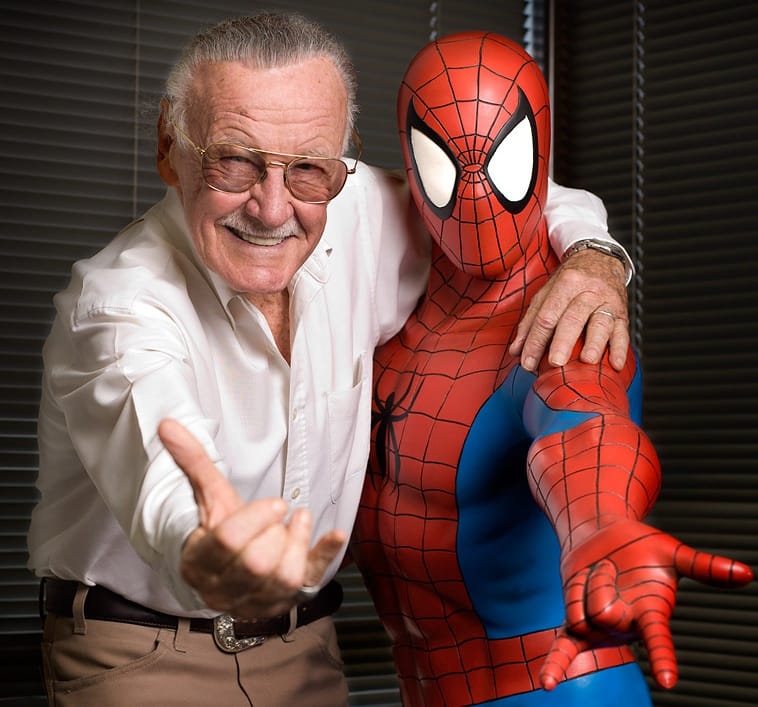
            “Hey, it’s Stan.”
            To be fair, true believers, I’m not 100% sure that’s what he said.  By the time he’d reached the second word I’d recognized the voice.  The voice I’d heard in hundreds of interviews.  The voice that had narrated all those episodes of Spider-Man and his Amazing Friends when I was a kid.
            That voice on the phone knocked pretty much every coherent thought I had out of my head.  He was on the phone!  With me!  Right NOW!  I WAS ON THE PHONE WITH STAN LEE!!!
            “Hello?”
            I was still kind of in shock, but I realized I needed to say something or he was going to hang up.  I still couldn’t get my thoughts in gear, though.  Couldn’t adapt, couldn’t stay professional, couldn’t…
            I blurted out my spiel, probably at double time, all in one breath, and ended up asking Stan Lee if I could speak to whoever could get me in touch with Stan Lee.
            There was a pause at the other end of the line, then a little laugh, and then “Yeah, just hang on.”  At which point I heard the phone get muffled, handed off, and found myself speaking to someone else who brusquely assured me Stan was far too busy for whatever my request was and clickthe call was over.
            I’m sure he’d forgotten about it five minutes later, but I’ll never forget the brief moments I found myself talking with one of the most influential people in my life.
            Well, okay…  babbling at him.  And him taking it good naturedly.
            Rest In Peace, Stan.  You were inspirational in so many ways, to so many millions of creators, and I wouldn’t be here today without you.
            Excelsior!

Categories