
February 5, 2021 / 2 Comments

Let’s Talk Terms

I had a conversation with an acquaintance of mine just after the New Year. They’d been offered a contract for their manuscript but were getting some iffy vibes from the  publisher. I talked with them about it for a bit and pointed out, yeah, there were a few good reasons for those iffy vibes.

What surprised me is that this acquaintance is a smart person, and I’ve talked with them a few times about writing and publishing. But combining the excitement of getting accepted with some potentially confusing terminology and, well… I can see where it’d be easy to get caught up in things. And maybe a little confused.

So I figured, hey, let’s take a minute or three and just talk publishing terms. These are things you may have heard or seen tossed about, but nobody ever explained them in any sort of depth. And they’re good things to understand if I want writing to be some level of career. Especially a full-time one.

Also, before anyone rushes to make angry points below, this is about definitions, not “which one is better.” If you want to have that argument, I’m sure there’s someone else out there who’d be pleased to go at it with you, no matter what view you take.

Let’s start with the basics. Traditional publishing is when somebody offers me money for certain rights to my story, often for a set period of time. By rights we generally mean the print rights, ebook right, and nowadays audiobook rights are very common, too. Anything more than that may be getting a bit sketchy (why does a book publisher need movie rights?). Again, publisher’s getting certain rights, and the author’s getting money for those rights—that’s textbook traditional publishing right there.

Because they’re getting these rights, the publisher’s taking on all the responsibilities. They’re going to take care of editing, copyediting, layouts, cover art, the actual production and distribution, marketing, publicity, and so on. A good publisher is probably going to involve me in all this, but it is theirs at this point (they paid for it) and it’s ultimately all up to them. We could talk for hours about different people’s experiences—good and bad—past that, but I think for now that’s a good basic way to look at it.

Let’s talk about that payment. This is something I think some people get confused about a lot, and there are some folks who take advantage of that confusion. For the purposes of this discussion, all the money I make off a traditional publishing deal is going to be in the form of royalties. They’re a percentage of the money the book makes. Usually not a very large percentage, true, but as I just mentioned, I have no responsibility here. Someone else is doing all the work and paying for everything. So don’t be shocked or angry when you hear that percentage is usually going to be a single-digit number.

Some quick math. Let’s say I’m getting a 5% royalty rate. My book sells for $20. The publisher sells 5000 copies to bookstores and other retailers across the country. That’s 5000 x $20 = $100,000, and my cut of that would be $5000. Make sense?

”But hang on,” says Wakko, “I thought they bought the rights. Where’s that money? Where’s my advance?”

Now… here’s where it might get a bit confusing.

If you’ve ever worked for a small company, you may have been able to ask your boss for an advance on your paycheck. Give me a hundred bucks now, take it out of my check then. When we talk about an advance in publishing, it’s the same thing. The publisher’s giving me some of my royalties before the book’s actually sold any copies. It’s kind of a show of faith—they think the book will sell XXX copies, so they’re giving me X right up front.
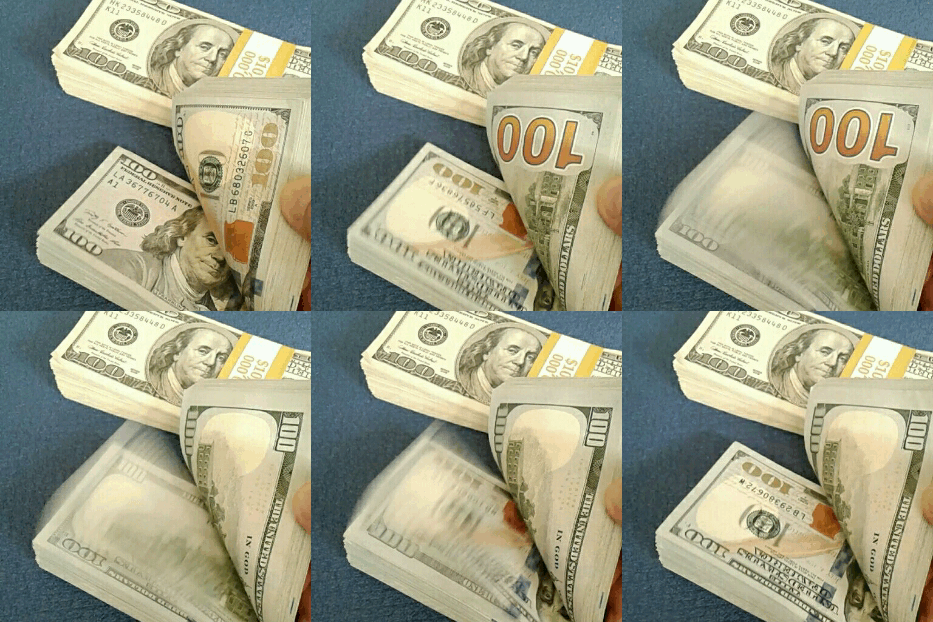
To build off the above example, let’s say the publisher gave me an $8000 dollar advance. When that first wave of royalties come around, I’d get nothing—but only because they already gave it to me. I got that $5000 in the advance (plus another $3000). When the book’s made me that full $8000, we say it’s earned out its advance, and from this point on the royalty checks will go straight to me.

Also, no matter what you may have heard… publishers don’t demand the advance back if my book doesn’t earn out. Seriously, it’s a non issue. If we dug into the very, very rare cases where this happened, we’d find something else had happened to make the publisher ask for their money back. The contract had been broken somehow or something had happened to make publishing the book a business/ethics problem. So it’s not so much asking for the advance back as it is canceling the whole deal.

One other thing worth keeping in mind. I’ve seen a few publishers be a bit… let’s politely say disingenuous by suggesting not giving advances is better for me, the author, because I’ll start getting royalties immediately! But here’s the thing to remember—advances are royalties. They’re royalties I’m getting before the book earns any money. How could anything be more immediate than that? If I gave you the choice of eating cake now or waiting until we decide to bake a cake… what’s the quickest way for you to get cake?

Wow, said a lot more there than I planned to. Anyway, moving on…

The next thing you’ve probably heard of is self-publishing. Sometimes this gets referred to as independent/ indie publishing, but I’ve got to admit that always feels like a bit of sleight of hand to me. Usually when people talk about indie publishing, they’re talking about smaller publishing houses that aren’t connected to the Big Five (I think it’s still the Big Five for a few more weeks, yes?). So when people lean into this… I mean, they’re technically correct, but it feels like they’re just trying to avoid saying they’re self-published.
As the name implies, self-publishing means I’m doing everything myself. I’m writing the book, but I’m also editing and copyediting the text. And I’m in charge of layouts, cover design, cover art, distribution, marketing, publicity, all of it. Because, well, I’m the publisher. This also means I’m sinking more time and money into the publishing side, since I either need to learn how to do all these things or pay somebody to do them. Also means no advances because, y’know, who’d pay them? But it does mean a more sizable chunk of the profits, and successful self-pubbers can make some serious cash. If they’re successful.

Now, this brings me to a slightly newer term (relatively speaking). Over the past few years you may have heard of hybrid authors. This is when an author has some books that are traditionally published and other books that are self-published. Doing both things = hybrid. Get it?

The idea of a hybrid author was pretty much unheard of for ages. You were solidly one or the other and that was it. But times have changed, openings and opportunities have appeared, and lots of authors do this now. Some do it with new material. Some (like me) do it with older works that have reverted back to them. Yes, I too am one of these hybrids we’re speaking of.

Please note this doesn’t change anything I’ve mentioned above. The hybrid author tag is cool, but that’s all it is—a cool label. I’m still traditionally publishing just as it’s described above, and I’m also self publishing just as it’s described above.

Okay, two more things I want to mention…

First is a vanity press. You may have heard this one before. A vanity press isn’t so much a publisher as a printer that overpromises. Or, y’know, a scam that takes advantage of aspiring authors. They offer “publication,” but the author pays for the editing, copyediting, layout, cover design, cover art. distribution, marketing… hey, this list sounds familiar, doesn’t it? It’s all that stuff I’d have to pay for if I was self-publishing. But by going through a vanity press I get to… share the money with them? So, I pay for everything and they still take a cut of the profits. Sometimes as their percentage of the royalties, sometimes as payment for actually producing the book… which, again, I’m paying for. So sure, you can have a hardcover edition—they’re only $11.23 apiece and we need you to make a minimum order of 500 copies.

Here’s a much better deal. Self-publish your book and just send me a cut of the profits. I mean, if you’re going to give money to somebody for no reason, why not? I promise to spend it all on rum and toy robots. See? Don’t you feel better about that already?

Anyway…

One giveaway is that vanity presses will take pretty much any manuscript they get. Sci-fi romance? Accepted. Historical fantasy? Accepted. Deranged conspiracy theories written in crayon on a placemat? So accepted! They’re not making any actual investment, so there’s no risk for them. If my book fails, it fails. Nothing to them. They already got paid. Again… by me.

Now, I thought those last two were worth mentioning because my acquaintance up above told me they’d recently heard the term hybrid publisher, which was new to me. And after they explained the contract to me, I did a little more digging and educated myself a bit. Which is tough, though, since hybrid publishing doesn’t really have any set yardsticks. And this is where it gets a bit tricky…

One thing most accounts agree on is that hybrid publishers charge the author. Depending on which press I’m looking at, they might charge for editing, copyediting, layout, cover design, cover art, distribution, marketing, and HEY! This is that same list of publishing requirements. Again. So again, I have to ask why am I paying someone else to do this if I’m not getting all the profits? If I’m paying, I’m the publisher, right?

Now, a defense I saw of a few hybrid presses is that they’re different from a vanity press in that they don’t take everyone. They curate their list just like a traditional publisher would. And I think that’s cool and generally good business, but… well, I mean, if you think about it, vanity presses don’t accept a lot of people. My dad’s never been accepted by a vanity press. Neither has my niece. A vanity press only takes advantage of the people it accepts, so if my main defense is that I don’t accept everyone… I mean, isn’t that like saying there are lots of people the Golden State Killer didn’t murder?

To be clear, I’m not saying that all hybrid publishers are a scam. I can’t because, as I mentioned, there’s no yardsticks. They all have different practices and guidelines. But I get very leery any time a publisher starts asking for money. Because the minute I’m paying for things or I’m doing a large share of the work, that sounds a lot like self publishing to me. And if I’m self publishing… why is someone else getting a cut?

Unless of course, it’s me. And you’re sending me money for rum and toy robots. 

So anyway… there’s some terms for you. Some of you may have known a lot of this already, but if you’re somebody who didn’t I hope this might help a bit next time you’re making decisions. Or just considering things.

Next time… I think we really need to talk about Cloverfield. Specifically, about this journal I was keeping while the monster attacked the city.

Until then, go write.

January 28, 2021 / 2 Comments

Keeping Our Heads Down

This is something I’ve talked about several times here on the ol’ ranty writing blog, but I realized I haven’t talked specifically about it in, well, many years. Too many years, really. Definitely not since I’ve tried to lean away from the more ranty, accusatory tone I tended to write in back at the start of this.

Look, reading all those movie scripts made me pull out a lot of hair.

I talked a month or so back about the idea of a contract between author and reader. There’s one other aspect to that contract, a sub clause, and I think it’s one of those “so obvious we don’t think about it” sort of things. To be blunt, nobody’s picking up one of my books to hear from me. Or to see me.

I mean, sure, they like a lot of the characters and worlds I’ve created. Some folks probably (hopefully!) like my style enough that they’re willing to try something new from me. But they still don’t want to see me. They want the story, and they definitely don’t want me getting between them and it.

Now, this doesn’t mean I’m going to follow you home from the bookstore and stick my hand between you and the page or sing nonsense in your ear. It’s just that nobody wants me distracting them from the fact they’re reading my story. They just want to sink into that world and get lost.

Yeah, of course, on one level you know I crafted each of those sentences and paragraphs, chose where all

the breaks

should go, but we have this quiet understanding that I won’t be leaning over your shoulder asking “Did you like that? Did you see what I did there? Wasn’t that clever?” You just want to immerse yourself and forget about the world for a little bit. Or at least get to look at it from a neater angle.

That was jarring, wasn’t it? That weird paragraph break? It was only two lines, but it broke the flow for a second, and you stopped hearing my voice and started hearing your own instead. Probably saying something like “was that a mistake? Is he doing beat poetry? Was he trying to do something funny there?”

And this is the worst thing that can happen to a writer. I don’t want you thinking about me. I want you to be thinking about Hector and Natalie and the people they’re running away from. If you’re noticing me, thinking about what I’m doing… it means I’ve done something wrong.

Think of it this way. It’s the difference between the tough guy in a story who commits unimaginable acts of excessive violence to look tough… and the tough guy who doesn’t need to commit those acts. The one we understand is more impressive without seeing a blatant demonstration. Being able to restrain myself is usually more impressive than how excessive I can be. Less of us is more of the story.

So here’s four easy ways I can keep my literary head down.

Vocabulary— When I started out, I know I desperately wanted to show I had a better vocabulary than the average person. Because that’s a hallmark of a good writer, yes? I didn’t want to use common, pedestrian words, the words just anyone would use. I was a skilled anecdotist, after all, not some mere amanuensis.

And let’s be honest—I wasn’t alone. This is a phase a lot of us go through as we’re starting out. We latch onto (or more often, look up) obscure and flowery words for our literary masterpiece, as if we’re going to get a quarter every time the reader has to look something up. And if the reader doesn’t enjoy going to the Miriam-Webster site every three paragraphs? Well that sounds like their problem, doesn’t it? Not my fault you’ve got such a limited vocabulary.

Truth is, any word I choose just to get attention—to prove I don’t need to use a common word—is the wrong word. Any word that makes my reader stop reading and start analyzing from context is the wrong word. I can try to justify my word choice any way I like, but nobody’s picking up my book hoping for a vocabulary lesson. When a reader can’t figure out what’s being said for the fourth or fifth time and just decides to toss my manuscript in the big pile on the left… there’s only one person to blame.

(It’s not them, in case you had any lingering thoughts on the matter)

Structure— Just like obscure vocabulary, convoluted structure’s another common sign of writer ego. One of the most common forms of this is insisting on grammatical perfection. This usually mean a lot of rigid, formal text and very stiff dialogue. It’s when I get so insistent on proving I know the correct way to structure a sentence my words end up sounding forced and artificial. Also worth noting the flipside of this which is insisting I don’t need to follow any grammar or spelling conventions. Punctuation? Capitalization? Those are tired tropes for losers.

The second most common sign is needless complication. I can admit I used to write—or try to write—sprawling, impenetrable prose. Sentences that went on and on. Descriptions that never ended. It took someone two pages to step through a doorway because we had to know what kind of socks and underwear they were wearing and what flavor toothpaste they preferred. If they were mentioned in the text, I had to remind you of these facts and how they were posed at the exact moment they spoke. Believe me, if something could be explained or described in less than ten words, I’d find a way to do it in at least fifty.

And while I never got quite that bad, there are also some writers who choose arcane story structures or points of view or tenses. Just because they can. Things will go from non-linear first person musings to omniscient third person flashbacks to second person song lyrics and then to a telepathic gestalt mind that only speaks in one of those single, three page sentences I was just talking about. There’s nothing wrong with any of these things, in a general sense, but so often they’re not there to serve the story. It’s just an attempt to look cool and do cool things. If I want to do something like this, I should be able to explain why I’m doing it. And the explanation needs to better than “y’know… reasons,” or I’m just going to leave my readers confused and frustrated as they get knocked out of my story again and again.

Said—Sad admission, kind of going with the vocabulary point up above. For many, many years I didn’t use said. Said was, in my opinion, the lowest common denominator of dialogue descriptors. It’s the kind of word used by writers who weren’t going places, writers not destined for greatness, like I clearly was. Not only that, I’d try to never us the same descriptor on a page twice. So in my early work my characters would respond, retort, exclaim, demand, muse, mutter, sneer, snap, shout, snarl, grumble, growl, whimper, whisper, hiss, yelp, yell, exclaim, or ejaculate. 

Oh, grow up. It was a common dialogue descriptor for years. Really.

Of course, once I finally got to sit down and talk with a professional editor and show him a few pages, this was the very first thing he commented on. Truth is, nobody notices said on the page. It’s an invisible word. Yeah, of course there’s going to be times when my characters are hissing or shouting or gasping. But I should save those words for then so their impact hasn’t been used up and weakened. The vast majority of the  time… stick to said.

Names—If used in moderation, names are also invisible. If you think about it, they’re just a shorthand note for the mental image of my character or MacGuffin or whatever. And they help us keep things straight if I’ve got a bunch of people all talking together.

It’s worth mentioning many fledgling sci-fi or fantasy writers feel the need to rename a lot of things. Or everything. Characters have all-new, correct-for-this-world names and so do their pets. And their gods. And their elements. And their system of weights and measures, their money, their units of time…  It’s great worldbuilding, but I’d guess 83% of the time this is just wasted words.  My elaborate sci-fi empire won’t collapse if I call mind-to-mind communication telepathy, but it might if I keep calling it intralobeech, which, as we all know, is short for “intralobe speech.”

Which, as we all know, is telepathy.

Always remember that moderation is key. Even a simple name like Bob can stack up and get distracting really quick. Which is why the ancient ones created…

Pronouns–when those proper names start to stack up, we switch to pronouns.  Just like names are shorthand for story elements, pronouns are shorthand for those names. When nouns start to clutter up my writing, they’re there to leap in and shoulder the weight.  It’s how Hector becomes he, that mysterious island becomes there, and a Hudson Hornet becomes it.

The catch here is I need to make sure my pronouns are clear. No questions exceptionally clear, ‘cause the moment someone gets confused about which her I’m referring to, they’re going to stop reading my story and start studying the page. We’ve all had to do that, right? Feel our way though a paragraph so we’re clear who she is. Or work backwards through the dialogue, trying to figure out who’s speaking which lines. I’m always super-careful with pronouns, because I don’t want that happening to anyone in my books.

Again—pronouns good. Pronoun confusion—bad. And it’s a writing rule you can apply to real life.

So there they are.  Four simple ways to keep our collective heads down so readers don’t see us standing there. Staring at them. Waiting to be noticed.

Y’see, Timmy, every time I make my reader hesitate or pause just for a second, I’m breaking the flow of the story. I’m encouraging them to skim at best, put the book down at worst. My reader should forget they’re paging through the latest Peter Clines novel, hopefully forget they’re reading altogether. And the easiest way to make that happen is for them not to see the writing.

It’s tempting to wave our arms and shout and try to get the reader to admit they can see us, but all this does is ruin things for everyone. It’s like Sherlock Holmes showing how he came to his amazing deductions or a magician explaining their greatest illusion. That moment is when the whole thing falls apart.

As writers, we need to go unnoticed. We want our characters to be seen and our dialogue to be heard, yeah. We want our action and passion and suspense to leave people breathless, absolutely.

But we’re just distractions.

Next time… hmmmmm. Not sure. I’m open to requests or suggestions if anyone has any. If not, I might tell you about a conversation I recently had with someone about getting published.

Until then… don’t let me see you writing.

January 21, 2021 / 1 Comment

The Lesson of Flashdance

Oh, hey everyone. What’s new with you? Anything cool going on?

I’ve had this idea on the backburner for… well, a few years now, but now that I’ve got a handle on it, I’d like to talk to you about one of the most important creative-arts films of the 1980s.

You read the title, so I’m pretty sure you can guess where I’m going with this.

Quick sum up, for those of you who’ve never seen Flashdance. Alex is an eighteen-year-old welder who dreams of being a professional dancer and makes side money as a… what would we call it? Exotic dancer? A non-nude provocative dancer. She’s got a friend who wants to be a professional ice skater and another one who wants to be a comedian. Alex also has a boyfriend who’s twice her age and also her boss at the steel mill, and there’s a lot to unpack there.

Actually, there’s so much to unpack in that relationship  it’s what a lot of reviews will focus on. That and, weirdly enough, how unrealistic it is someone could be a professional welder at eighteen in a union town. Probably the same people who complain about how lightsabers work and about how the military sets look in zombie movies.

Getting off topic. Sorry. Anyway…

In my opinion, those issues distract from the actual story, which—if you think about it—is a much more ‘90s story about a trio of young, aspiring performers all looking to break into their chosen fields. We’ve seen a few versions of that, yes? If we look at Flashdance in that light, what’s the story about?

Well, we have our trio of aspiring artistic friends. Alex gets a chance to audition for an exclusive dance conservatory and gets nervous and leaves without auditioning. Her friend enters an ice skating competition and fails (kinda horribly). Her other friend gets a chance to do his comedy routine at an open night mic and bombs (also horribly), but then he decides to move to LA where there are more comedy clubs to try performing at. Meanwhile, Alex’s boyfriend gets her another chance to audition for the conservatory and… she comes up with another excuse to not audition.

Seeing the pattern here? One of these things is not like the other. In this trio of aspiring artists, the other two are failing, but it’s only because they’re actually trying. Alex is the one who won’t take any risks. She’d rather stay in her safe, small pond where she’s a superstar rather than find out she’s not good enough to go higher. That’s her story—working up the courage to try. Because until she does that, nothing else changes. She stays where she is.

This happens to a lot of us in the arts. We get nervous about if we’re good enough and talk ourselves out of doing more. We can’t get rejected—we can’t fail—if we never put ourselves out there, right? Heck, there are even some folks who’ll twist failure into some sort of victory. “Yeah, I got rejected, but that just proves my writing’s too good for the homogenized publishing industry!”

As I’ve mentioned before, though, rejection’s just part of the process. Failure is how we learn and sharpen our craft. And we can’t fail if we never try to do more, to push ourselves higher. So if I’ve never failed… maybe it means I’ve just been playing it safe and not doing enough. Maybe it means, on some level, I stopped.

Y’see, Timmy, we need to push ourselves. We need to keep at it. Even when we get rejected. Even when someone says our chosen genre sucks. Even when they say our writing sucks. Like any art, the only way to improve is to keep doing it. To keep challenging ourselves again and again and again.

Ray Bradbury once said the only way you fail is if you stop writing. Which is the short form of this. So yes, I could’ve called this “the lesson of Bradbury,” but half of you wouldn’t’ve paid attention.

Next time, I’d like to talk about why you rarely see a good writer.

Until then, go write.

January 14, 2021

So. Much. Winning!

This is one of those posts some folks may feel the need to argue with. It’s a writing tip that’s going to feel obvious to some of you, and ridiculous to others, but I truly think a writer needs to follow if they want any measure of success.  And when I say “success” I refer to the classic definition—“making money off your material.”

If I want that kind of success, my hero has to win.

Fair warning, there’s going to be a couple spoilers coming up. Kind of necessary if we’re going to talk about how things end for a character in a story. They’re for pretty big things I’m sure most everyone already knows the ending of, but there’s the warning just in case. If you’re way behind in your required reading or viewing, you may want to stop here.

Also, I’m using hero in the gender-blind sense. If it makes you feel better, feel free to swap in heroine or protagonist. I’m not against any of these terms or the characters they attach to, I’m just using hero because it’s short, and quick and I’m trying to stay focused on this instead of everything going on in the world. So for this post, I’m just talking about the hero.

And the hero wins.

Pretty much always.

Now, there’s a belief in some circles that having the hero of the story fail and die somehow improves the story. That it’s more dramatic. It’s the belief that having something depressing and random happen to my hero is more “honest” because life is often depressing and random. I think this ties back to the frequently-waved buzzwords realism and art. Art imitates life, so if I’m imitating life, I must be making art. That’s just logic. Right?

As I’ve mentioned once or thrice before, this kind of ending sucks. It sucks because we all inherently know the hero is supposed to win, since we identify with the hero. If the hero loses, it means we lost. We’re losers, identifying with another loser.

Believe it or not, this sort of statement doesn’t go over well with most people. I mean (as we’re currently seeing in the real world) people have a lot of trouble dealing with it when a character they’ve invested so much of themselves in doesn’t win.

Now, before people start scribbling down below (for any reason, although I’m sure at least one person already has), let me finish.

I’m not saying every book has to end with happy smiles and people rolling around on piles of money in their new twelve-bedroom mansion. My hero doesn’t need to defeat the cyborg werewolves, save the world, and fly off into the sunset with nymphomaniac heiress Margot Robbie in her private jet.

Truth is, the hero doesn’t necessarily need to enjoy winning. I just said they need to win. They may be damaged physically, emotionally, or both. In fact, if my hero ends up wounded or broken after all they’ve done, it just makes us identify with them a little more, doesn’t it?

When they win like this, we often call it a pyrrhic victory. Maybe our hero solves the murder mystery, but loses their best friends in the process. She got revenge, but her lover’s still dead and now she’s a wanted criminal herself. He won the contest, but now his family’s humiliated and wants nothing to do with him. The team tried to save all the hostages but only half of them got out alive. As I mentioned above, victory isn’t an all-or-nothing thing, and my hero can still have a pile of losses even though they’ve succeeded in their main goals. A partial win is still a win.

Hell, the hero doesn’t even need to survive the story in order to win.  There are plenty of characters in books and film who didn’t live to enjoy their victories. At the end of Rogue One (here’s that spoiler alert) our two surviving heroes are literally incinerated in the blast from the Death Star’s test firing. And note I say surviving heroes. The rest of their team has already suffered a series of brutal and violent ends. Nobody gets out of that movie. Same with Tony Stark in Avengers: Endgame, cooked from the inside with a single snap of his fingers.

And yet, in both of these examples, the heroes win. No question about it. Anyone who’s seen these stories will tell you the good guys won and the bad guys lost.

A key thing here is my character’s motive. What are they trying to do? Keep in mind, their stated goals and their actual goals might not always be the same. Phoebe may say she wants to date the head cheerleader, but what she’s really looking for is romantic love and companionship. Wakko may say he wants revenge, but what he really wants is justice. So they may fail at that obvious, stated goal (dating the cheerleader) or even a broader, more universal goal (keeping their left leg attached), but still succeed with their actual, motivating goal.

Now, I want to mention one other thing, because my friend Stephen Blackmoore brought it up when I mentioned this theory of winning at the Writers Coffeehouse once. There are some stories (a lot in the noir genre, for example) where the hero doesn’t win. In fact, in some cases they fail completely, on all levels, and end up much worse off than they began. This can absolutely happen in stories. Great stories, some of which get a lot of praise and awards.

But…

I think if we named some stories where the hero fails in this complete way, we’d probably realize… they’re not all that well-known. And they’re probably read even less. Again, not saying they’re bad, but it is a much smaller niche of potential readers who’ll enjoy a story where the hero, well, doesn’t really accomplish anything. Even if it’s beautifully written. So there’s nothing wrong if those are the stories I want to write, but I should have my eyes open about how wide an appeal they’re going to have.

Y’see, Timmy… we encounter enough failure and losing in real life that most folks aren’t going to also enjoy it as entertainment. We want to see victories and success and heroic sacrifice because these are the things we dream of in our own lives, and we relate to those people because they’re the kind of people we wish we could be. Even if just for a little while.

So if I’m my plot ends with a massive failure or my hero dies for no reason… maybe it’s worth rethinking that.

Especially if I want to win.

Next time, I’d like to talk about Flashdance.

Until then, go write.

Categories