February 20, 2014

Perfect

            I’m kind of on a roll right now with the new book, so—if you don’t mind—I’m just going to make a quick observation and get back to it.  Next week I’ll prattle on for far too long like I normally do.
            So… said with the golden rule firmly in mind
            Worrying if all the words are right in a first draft is a lot like worrying if I’m getting a band or a DJ for my wedding when I’m not dating anyone.  It just doesn’t matter at this stage.  If I keep obsessing over those later elements, I’m never going to take care of the earlier ones.
            Write a first draft.  Perfection will show up in the later ones.  Honest.
            Next time, we’re well into screenwriting contest season, so I thought I’d talk about the stories contest readers hate.
            Until then, go write.
February 14, 2014

Must Love Jaws

            Pop culture reference.  Very funny video.  Even Spielberg liked it.
            Well, in the way of my people, I’m spending the day before Valentine’s Day back at the dentist.  New teeth.  That’s weird.
            Which made me think about love. Mostly, how much I love painkillers…
            But you don’t want to hear me whining again
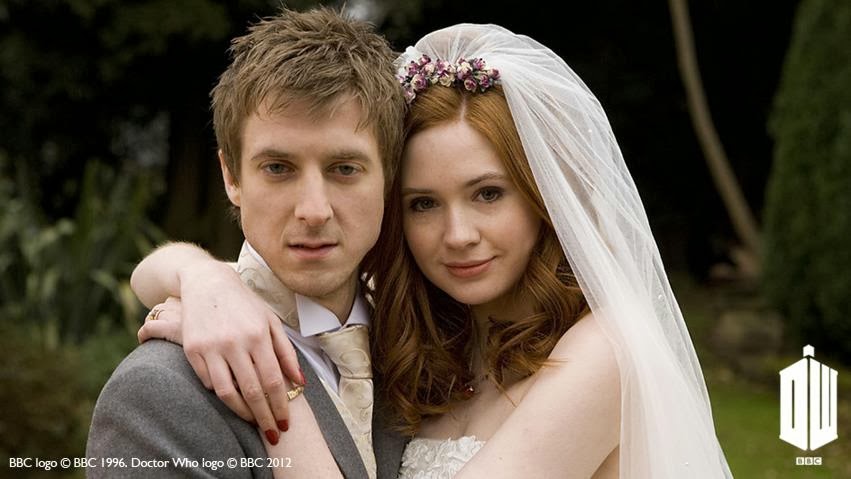
            A lot of folks were horrified or—depending on how your particular ship sails—vindicated a few weeks back when J.K. Rowling announced that she probably shouldn’t’ve had Ron and Hermione get together as a couple at the end of the Harry Potter books.  Definitely not as a “they lived happily ever after” couple.  In retrospect, she felt she’d forced the relationship and it didn’t feel believable.
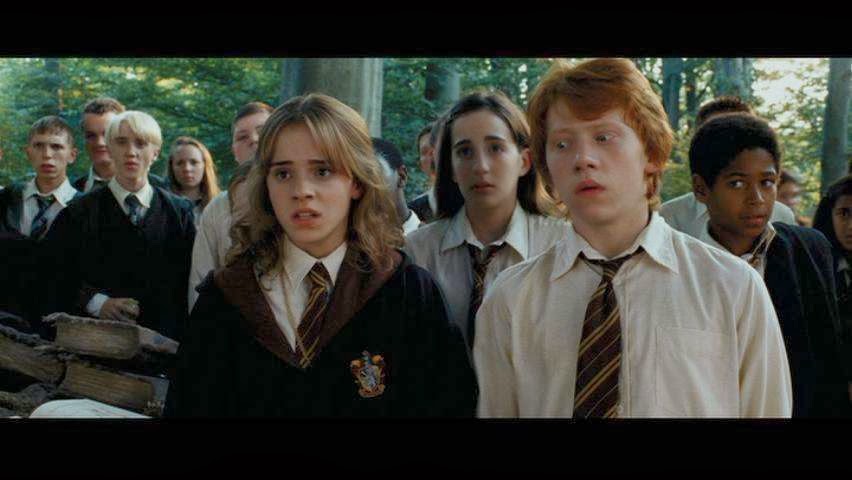
            Now, granted, she’d been slowly pushing things that way for four books, so it’s not like this came out of nowhere.  But I can kind of see what she’s saying.  It made for some interesting articles and assumptions online.  And also gave some validation to my Harry and Luna Lovegood theory…
            Everyone loves a good romance because we all love the idea that there’s someone out there who’s a fantastic match for us.  A soulmate, if you will.  It’s a relatable idea.  And when we can relate to something, as readers or audience members, we can believe it.
            However…how often have you been reading a book or watching a movie when suddenly, out of nowhere, two of the characters started professing their mad love for each other?  Few things can sink a story faster than a pasted-on love interest, because none of us like fake emotions.  It makes people roll their eyes while reading books and it makes movie audiences laugh.
            So, let’s revisit a few simple rules that can help make a love for the ages…
            The First Rule of Love —  Like I just said, love needs real emotions, and I can’t have real emotions without real people.  And real people, oddly enough, act in realistic ways.  I’m not saying rational ways, because love is one of the most irrational things most of us will ever encounter in our lives.  If my characters are real, though, they’re going to have needs, desires, plans,and tastes.  And it’ll stand out if they make choices that go against those traits.  Yes, opposites attract—they even have a lot of fun together—but if we’re talking about real emotions, odds are these two are going to have more in common than not. 

            In other words, the career-minded conservative banker probably isn’t going to make long term plans with the quirky socialist art student.  Not unless he’s trying to get her to sign over her grandmother’s art studio or something.  Although… maybe he’s a failed artist himself, and she reminds him of another path he could’ve taken.  Having past conflicts and secrets can make a character seem real, too.

            Even then, how far and how fast they take things should be consistent.  Some folks live in the moment.  Others plan every day in half hour increments.  People can be confident or nervous, experienced or awkward.  Some people are tearing each others clothes off half an hour after they meet, while for some the huge moment might be that tentative kiss on the third date (if it’s really a date, because that first one was just coffee—not a date!).  
            Simply put, my characters need to be believable if their relationship is going to be believeable.
            The Second Rule of Love  —  If you’ve ever been in a situation where friends are offering advice and pushing you to say something, you know the real result is it makes you want to get away from the object of your potential affection.  Nobody likes feeling forced into something, and we don’t like to see other people forced into things.  That’s just human nature.
            Now, for the record, “other people” includes me, the writer.  Characters need their own motivations.  I can’t just have them do things for the convenience of the story.  If I’ve based my whole story around the mercenary and the archeologist saving the villagers out of mutual respect for each other, then I need a real reason for them to get together (as mentioned in the First Rule). 
            And no, the reason can’t be something like “because they need to face the gargoyle lord as a unified couple in chapter fifteen.”  It also can’t be “I need a sex scene to hold people’s attention.”  If this is the basis of Wakko and Phoebe’s relationship… well, they probably won’t be celebrating any major anniveraries.  Not with each other, anyway…
            To sum up– People get together because they want to get together, not because other people think they should be together.
            The Third Rule of Love – This one could actually count as real-world advice.  Don’t confuse sex with love.  There are lots of points in a story where it might be completely acceptable for two characters to have sex.  We’re all mature adults here (not counting you two), and I’m willing to bet most of us have had sex with someone we weren’t madly in love with at the moment… or at any time later.  Sex is fun.  It’s a stress-reliever.  It lets you not think about other things.  Heck, it can even keep you warm.
            Sex doesn’t always translate to love in stories any more than in the real world, though.  If two characters fall into bed (or up against a wall, in a closet, out in the woods…), I need to make sure I’m clear what it means for both of them.  Forcing something casual into something serious will just read as forced (refer to the Second Rule).
            So… sex and love are not the same thing.
            The Fourth Rule of Love— This is the tough one, because Hollywood keeps trying to insist otherwise.  How often have you watched a movie where you can immediately spot “the love interest” as he or she is introduced?  It doesn’t matter what kind of film it is or what’s going on, it’s easy to pick out him/ her the first time we see them.  In screenwriting, this moment’s often called the “meet-cute.”
            Y’see, Timmy, a romance doesn’t always fit in a story.   Someone could be wounded, fighting for their life, or so scared they’re an inch away from a heart attack.  Maybe they’re already in a relationship with someone else. 
            Forcing something in these situations also poses the risk of making one or both characters very unlikeable.  There was a very odd movie a few years back where the main character develops feelings for his brother’s fiance over a long weekend—and they both act on them!  It made it hard to feel sympathetic toward either of them.  I also read a manuscript once where the two protagonists start feeling urges toward each other while they’re searching for the woman’s abducted daughter.  Not years-back abducted, mind you—four hours ago abducted and possibly at great risk.  But, wow, doesn’t this private detective have a nice smile and great arms…?
            In ten words or less—sometimes it’s just not going to happen.
            So there are the rules.  Now go forth and spread the love.
            Where appropriate for your age group, of course.
            Next week, I might just say something quick, if I can find the right words.
            Until then, go write.

February 11, 2014

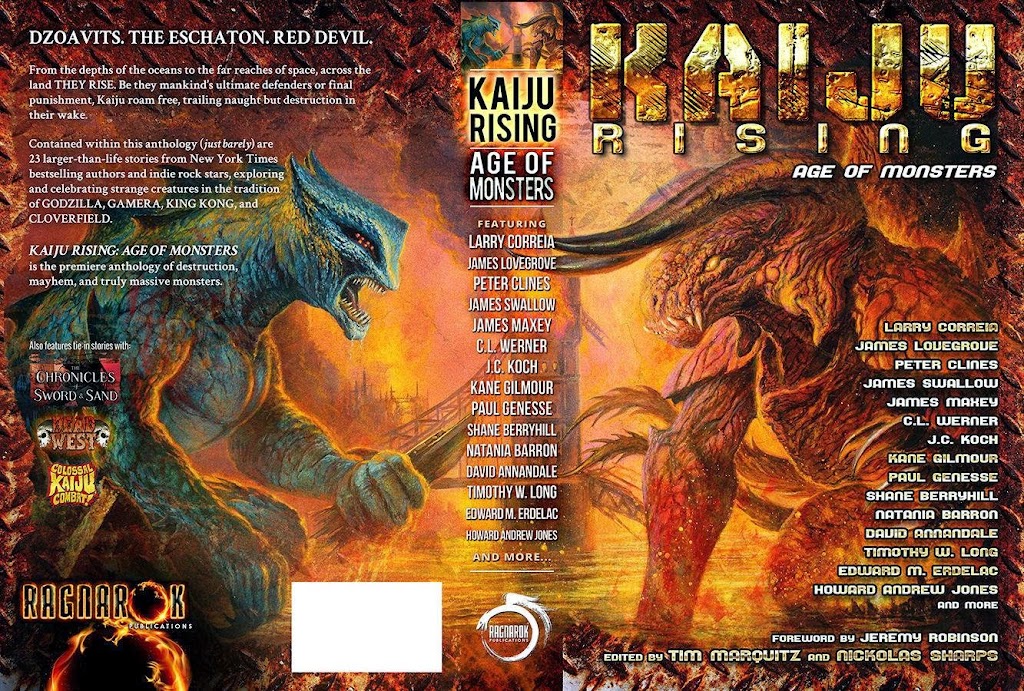
Kaiju Rising

            Last year I was approached about writing a giant monster story for a Kickstarter project.  To be honest, I had a few reservations.  One was that I’ve always sucked at writing anything on demand.  Two is that I’d just watched another Kickstarter book… well, not implode…  It crumbled at an alarming rate, let’s say.
            But I did have most of a World War II-era giant monster novella I’d wanted to do something with.  And Nick, one of the guys behind Kaiju Rising assured me it was going to be done responsibly so that donors would feel like they were getting their money’s worth.
            And so… here’s the monstrous (seriously, it’s huge) Kaiju Rising with my short story “The Banner of the Bent Cross.”  The ebook’s out now, paperback soon to follow.
            Enjoy.
February 7, 2014 / 2 Comments

The Death of a Dozen Cuts

           I almost went with “Cheaper By The Dozen” for the title, but I figured there was no reason to make you all remember that little piece of pop culture.
           I’ve been watching people talk about editing lately in a few different online groups.  More to the point, about the need for more of it in certain corners of the industry.  A side-thread in one of those conversations was about one fellow determined to get his book edited by Thursday so he could get it up on Amazon by Friday.
            Anyway, that got me thinking about easy edits.  The type of stuff that we all let slip though while we’re writing and the experienced folks know to then get rid of in their first round of revisions.  I’ve mentioned some of them before in a broad strokes sort of way, but it struck me that maybe I could even boil this down further.
            So here are a dozen specific words I can cut from my manuscript.  Not all the time, but a fair amount of it.  A lot of them lead to other words, too—they’re indicating a larger problem—so once I get rid of these it’ll probably mean a few words on either side of them go away, too.  Which means I’ll end up with a leaner, stronger story.
            Yes, you’ve probably seen me mention lots of these before.  I even linked to some of the other posts in case anyone might want more explanation.
            Ready?
That—I’ve mentioned that a few times here, so I won’t bore you by explaining it yet again.  Needless to say, I always do a thatpass while I’m editing and end up removing about 80-90% of them.  While I was revising Ex-Purgatory, I cut over 130 thats—more than half a page of them!
Decided—This word is almost always filler.  Maybe not conscious filler, but it’s almost always filler that can be cut.  If Yakko decides to do something and then he does it, I’m just eating up words again.  We all make hundreds of decisions and choices every day, but most readers want to hear about the action, not the decision to take an action.  The action itself implies the decision was made. 
Listen/ Look—If I start a line of dialogue with look or listen, I’d bet that three out of four times that line either states something plainly apparent or it’s an infodump. Which means either these lines aren’t adding anything to the story or they’re adding something I could express better through subtext or actions.
Obvious—If something isn’t obvious, it comes across as arrogant to say it is.  So I shouldn’t use the word obvious, because the character (or writer) in question is going to look like a jerk.
            On the flipside, if something is obvious, they I still don’t need the word.  Things that are obvious are… well, obvious, so it’s just wasted words for a writer to tell us so.
Appeared/ Seemed/Looked These three words show up in phrases like “appeared to be” or “seemed to be” or “looked like.”  Not always, but quite often. The thing is,  appeared to be and its siblings don’t get used alone.  They’re part of a literary construction where the second half of that structure is either an implied or actual contradiction to the appearance.  So when I’m saying “Yakko seemed like the kind of man you didn’t want to mess with,” what I’m really saying is “Yakko seemed like the kind of man you didn’t want to mess with but really he was a pushover who fainted at the sight of blood.”  And what I meant to say all along was just “Yakko was the kind of man you didn’t want to mess with.”
           If I’m not trying to establish a contradiction, using appeared to be and the others isn’t just wasted words– it’s wrong.  So cut them
Was – I always search for was, because it tends to point at weak verb structures.  It’s when I’ve got “Wakko was running” instead of just “Wakko ran.”  It’s a small tweak, but it’s one that gives my writing punch because it makes all my actions read just a bit faster.
            Also, this can save me from the awkward problem of simultaneous actions, when my chosen verb form ends up creating a chain of things happening at the same time rather than a sequence of events.
As you know—I’ve talked about these three words a few times before.  They’re awful.  Just awful.  I won’t say this is the worst way to get the facts out to my readers—I have full confidence there’s a writer out there now working on a worse way—but I’d put this in the 99-out-of-100 category. 
            If I’m saying “as you know” to you, it means you already know what I’m telling you… so why am I saying it?  Why waste words blatantly lecturing about something that you and I both know?  Yeah, you might have amnesia, but if you do then you don’t know… so why am I saying “as you know” to you?
            If these three words pop up together more than once in my manuscript, odds are I’m doing something horribly wrong.
            And there you have it.  A dozen words you can search for and slice away.  Editing made simple.  Well, some of the editing.  I didn’t even mention my more common somewhat syndrome words.
            Next time, it’ll almost be Valentine’s Day, so I guess I should talk about love and all that stuff.
            Until then, go write.

Categories