
Author: Virtual Stranger
October 24, 2013 / 2 Comments
The Finest Emotion
October 18, 2013
The Tin Dog
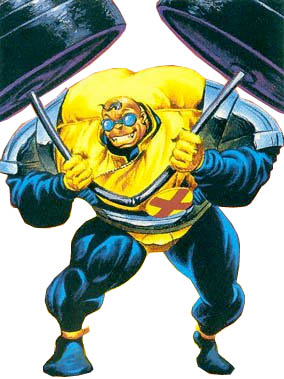
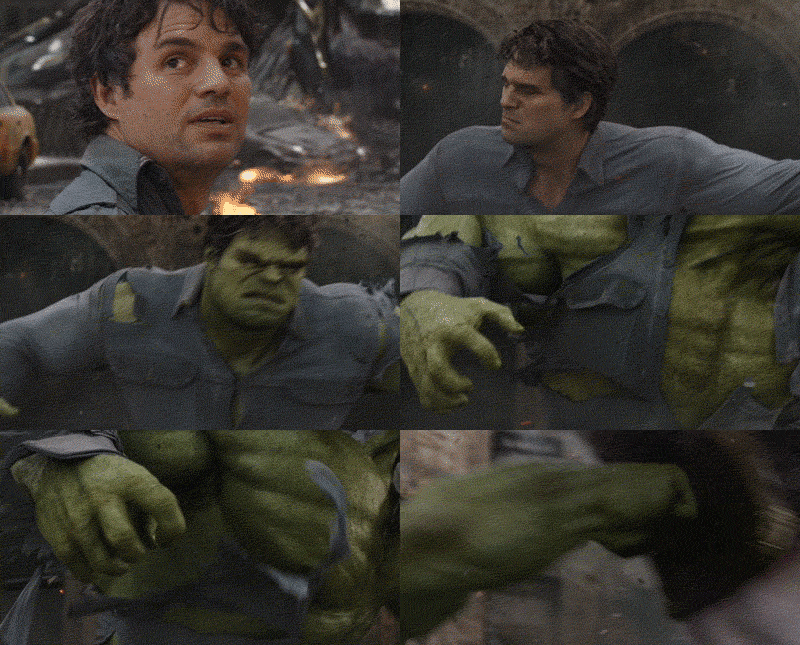
One of those characters was a guy named Guido. He was a very over-muscled, bespectacled guy with super-strength who’d originally been created as a bodyguard (mutant, of course) for another character (mutant, of course). Guido ended up on the new, government-sponsored X-Force team (in the same-titled comic written by Peter David) and he was there when the team was introduced at a press conference.And, much like the film crews, these groups have a strong guy because at some point they’re going to need a strong guy. The whole point of having someone like the Hulk on your team is that eventually there’s going to be some kind of giant space war-snake that needs to be taken out with one punch. If I wasn’t going to have going to have a key moment like that, I wouldn’t bother to include a strong guy.
But in the second season, something happened. Mickey realized he had no purpose. He decided to stop standing around and to become part of the story. In fact, after a few episodes Mickey even decided he needed to have his own story, one that didn’t involve Rose and the Doctor. The next time we saw him, Mickey had become a confident, dimension-hopping resistance fighter. And at that point, we couldn’t wait until the next time we saw him.Mickey went from annoyance to cool, just like that. He was so cool that he turned down an offer from Torchwood and became a freelance alien hunter. Hell, in the end Mickey hooked up with one of the Doctor’s other companions, Martha Jones, and we all knew she was way cooler that Rose.
October 12, 2013
But What About…
Yeah, this is a day late. Lots going on this week, so I thought I could make an exception…
Which, by coincidence, is what I wanted to blabber on about this week.
If you hang out with enough writers (or musicians, or filmmakers, or other artists), either online or in the real world, you’ve probably heard a story about someone who broke the rules and got away with it. And Wakko didn’t just break the rules, mind you… he shattered them. Every one of them. They had to write new rules for him to break. All those people who tell you do this, don’t do that—he ignored them all. And that’s how he got where he is today, with his fame and fortune and living the life we all dream about
People like these tend to get sort of a mythology around them in their respective circles. Which is kind of sad, because these folks—unintentionally or not—tend to make things a lot harder for the folks coming after them. Once I buy into the idea of being the exception, my chances of success drop drastically.
Let me give you an example…
Most of you have probably heard of Cormac McCarthy. He’s a brilliant writer who’s done some wonderful books like The Road and Blood Meridian, among others. He’s also famous for using almost no punctuation, sometimes to the point that his books become difficult to read. Seriously, you’d think the guy got beat up by a pair of quotation marks every day after school when he was a kid.
Now, McCarthy decided a while ago that he wanted to write a screenplay. But, being Cormac McCarthy, he didn’t bother to learn how to write one. He just started throwing dialogue and settings down on the page in whatever format looked right to him. And several accounts say the script was…well, a complete mess. Naturally, though, when word got out that he’d written a script, Hollywood went nuts. The script was grabbed, Ridley Scott directed, and it’s coming out in just a few weeks ( The Counselor).
Now, a lot of would-be screenwriters who believe in ignoring the rules saw this as validation. How can anyone say formatting matters after a format-free script sells and becomes a major motion picture? It’s undeniable proof that sort of thing just isn’t important.
Except, well… not exactly.
Cormac McCarthy’s been a legend for twenty years, and was still famous for twenty before that. He could’ve turned in a script written on a used paper plate and the bidding would’ve started at fifty thousand. His status as a novelist made him the exception to the rules of screenwriting. Just because he can do it doesn’t mean I can. Or you can. Or she can.
Here’s the thing…
Exceptions to the rule tend to be rare. Exceptionally rare, you could say. That’s why they’re the exception and not the rule. McCarthy’s script was snatched up by Hollywood despite its poor formatting, but dozens of them are tossed aside every single day for that very reason. Because that’s the rule. Formatting does matter.
And it’s not just screenwriting. For every person who sold the first draft of the first novel they wrote to the first publisher they showed it to, there are millions of people who did not. Yes, E.L. James, Diablo Cody, J.L. Bourne, and a triple-handful of other writers started out by giving their work away for free and then spun that into successful, paying careers as writers. And that sounds fantastic until you stop to consider there are over two billion people on the internet these days. Even if only one percent of them are trying to make money by writing on a blog or website, that puts the odds of success somewhere in the neighborhood of 20,000 to 1 (about 0.0005 % if my math is right). And that’s with a very generous estimate of how many successful writers have followed this path.
I can’t use an exception to the rule as a basis for how things should be done. By it’s very nature, the exception is the freak chance, the aberrant behavior—it’s just not the way things work. Think of the stories you’ve heard about people who survive falling out of airplanes or getting shot in the head. They’re amazing and true and took almost no effort, yes, but they shouldn’t make anyone rethink using parachutes or gun safety.
If I want to succeed, the best thing I can do—whether I’m jumping out of a plane, getting shot at, or writing a story—is to follow the established rules. The absolute worst thing I can do is scoff at those rules—rules like spelling, grammar, or wearing body armor—and decide they don’t apply to me. No matter how amazing my writing is, I need to follow the basic guidelines for my craft.
The reason I should follow them, before you ask, is because the person reading my work is expecting me to follow them. The publishers, editors, and producers who see it before my chosen audience definitely will, and those readers or viewers will assume I’m going to, too. They all have certain expectations they’ve built up, and these expectations all tend to fall in line with the rules.
Now, does that mean amazing, rule-bending things won’t happen or can’t be done? Not at all. My writing may be so spectacular that no one notices the abundant typos. The basic idea could be so clever that nobody will pick up on the fact that all of my characters have about as much depth as a puddle on the kitchen floor. Heck, the structure of my story could be so rock-hard the reader will forgive and forget those incredibly boring opening chapters.
But you know what? Let’s say on page one of my manuscript I introduce school newspaper reporter Tomm Truth and Joanie Justice, and show them straggling with staph editor Barry O’Bama who doesn’t want them running a article about the poor campus seckurity. After a paragraph or two of that my editor’s going to groan out loud. I know when I was a script reader seeing stuff like that made me roll my eyes and add more rum to my glass.
Y’see, Timmy, the minute I see a bunch of clichés, misused words, poor grammar, and misspellings, I’ve rendered a judgment on that writer. Possibly two or three, depending on how many things I see that look wrong. And they may not be wrong for this story—each one may be carefully chosen to set up certain things for later on. But on page one or two or three, they look wrong, and that’s how they’ll be interpreted and that’s going to color my view of the manuscript from here on.
If I assume I’m the exception, that I don’t need to follow certain rules, I’m setting an obstacle between me and the people who are going to pay me to keep writing. Maybe even multiple obstacles. They’re not insurmountable and they don’t guarantee failure. But it does mean I’ve just limited my potential audience. Some readers will toss a manuscript in that big pile on the left after seeing two or three things that look like mistakes. Others will read ten or fifteen pages before setting it aside. And if I can’t prove I am the exception before that happens, I’m going to get a lot of rejections. My story may be loaded with promise, but if my initial foundation looks weak and poorly designed, why would anyone risk the time to see if the rest of it’s structurally sound?
So try to be the exception. Just don’t automatically assume you are. You need to earn it.
Next time… I want to talk about Guido.
Until then, go write.
October 3, 2013 / 3 Comments
Do You Need Mechanical Assistance?
Your minds always go there first, don’t they. You bunch of perverts…
Some of you may remember Watson, the supercomputer that played against two Jeopardy champions and beat them. Watson was specifically built to understand human language. That was the sole point of its appearance on Jeopardy—to show that a machine could be programmed to understand subtext and clues and irony well enough that it could compete against humans using their rules.
Why am I talking about a supercomputer—a fantastic and kick-ass supercomputer, granted—when I keep insisting this place is about writing?
Do you know how big Watson is? Or how long it took to build? How many people were involved? Watson was a six year project for a team of more than twenty engineers and programmers (plus a ton of students interning with IBM). It’s a collection of processors and drives as big as my first apartment in Los Angeles (which means it’s probably the size of your kitchen).
And you know what? Even with all that computing power and information, Watson still got things wrong. Several times in warm up games and even during the main event, Watson would miss obvious clues and give the most bizarre answers. If you run the numbers, Watson didn’t know how to answer a given question almost twenty percent of the time. When it did answer, it still got one out of every ten questions wrong.
Now, again, please remember what I just said how long all those people worked on this machine. A machine that was built for the specific purpose of understanding human language. That’s going to be important when I ask my next question.
How much work do you think went into your computer’s word processor?
For that matter, how much went into just its spellchecker? Or into that automated proofreader? Do you think the people programming it were IBM-level experts in their field? And in the field of writing?
I’m not going to be a hypocrite and say these things are useless tools. I use my spellchecker. I usually make a pass with it during my third draft. There’s nothing wrong with using it as a tool to help me check spelling. But I have no illusions about the fact that I still need to be the one checking the spelling.
See, I don’t blindly accept every “correction” it offers me. And this isn’t my entire third draft. I still go through the whole manuscript line by line, sentence by sentence. It can take me four or five days. Because I know the machine can’t be trusted to do it for me.
I’ve said it before, and I’ll keep saying it until people listen. A computer cannot write for me. It doesn’t matter how cool someone’s system is, it won’t do the job. That’s why, whenever you ask a real writer for advice, they’ll usually say to hire a good editor, not to upgrade your software.
If I want to be a writer—a working, paid writer–I need to know how to spell and how to use words and what those words mean.
These words, for example.
fair and fare –one of these is how you get through an experience
dual and duel—one of these refers to citizenship
vain and vein – one of these refers to similar things
tics and ticks – one of these is a twitch
mute and moot –one of these is irrelevant
reckless and wreckless—one of these means rash
vain and vane – one of these makes you think this song is about you
desert and dessert—one of these has whipped cream
shudder and shutter – one of these means to shake
soar and sore—one of these relates to diseases
vane and vein—one of these shows the flow of air or liquid
wreck and wreak—one of these means to inflict
wait and weight – seriously, it’s embarrassing I have to ask.
As in the past, these are all mistakes I’ve seen in articles or books over the past few months. When I come across one and it makes me shudder (not shutter), I know I have to add it to the list. Yeah, I keep a list. You don’t think I just come up with all this stuff from scratch once a week, do you?
In the interest of fairness… Two of these are mistakes I’ve made in the recent past. One of them even slipped past me, my proofreaders, my editor, the copyeditor, and then me again while I looked over copyedits and layouts.
Did you know all of the answers? Did you know what the other word meant, too? If I don’t know them both (know—not sort of recognize) there’s a good chance I’ll make a mistake at some point. And, granted, we all make mistakes sometimes.
But some people make a lot of mistakes. And they don’t catch any of them. Because they’re depending on their computer to do it for them.
Next time, I want to…
Actually, before I talk about next time, I’d like to break my rule about no self-promotion and guide you to the Kaiju Rising Kickstarter. It’s a giant monster anthology featuring stories from folks like Peter Stenson, Timothy Long, Larry Correia, and a bunch of others (including me). It’s already fully funded (even stretch goals), but there’s still a day or two left to snag a copy for yourself, and possibly a pile of add-ons.
Anyway, that being said…
Next time, I want to talk about exceptions.
Until then, go write.