
If you’ve been following me for any amount of time, you’ve probably caught on to my questionable Saturday viewing habits. Questionable in the sense of “why would someone keep doing this to themselves? And to their liver?”
I’ll sit down with some little toy soldiers to build, put on a movie with aliens or giant monsters or werewolves, and tweet out the occasional observation, critique, or scream of pain. It’s kinda fun, in a masochistic sort of way, and I’m a big believer that you can learn a lot from figuring out where bad things went wrong and how they could be fixed. And I’ve seen a lot of screenplays go wrong over the years. Some I worked on. Some I read for contests. And… some I watched while building little toy soldiers.
Over all this time, I’ve seen definite patterns emerge. The same mistakes happening again and again and again. It was part of what made me start this whole ranty blog way back when in the distant before-time.
And screenwriting is a form of storytelling, which means some of these mistakes—maybe even all of them—are universal. I might not have any interest in writing movie scripts, sure. Not everyone does. But these issues can show up in books, short stories, comics… all sorts of storytelling formats.
So maybe they’re worth checking out.
Anyway, here are my top ten B-movie mistakes, updated a bit since the last time I write them out. Some of it may seem generally familiar. Some of it… well, I’ve found new ways to look at some problems over the past three years.
10) Bad directing
Let’s just get this one out of the way, because it’s the easiest one. It’s also the most universal one. This’ll be a horrible blow to anyone who likes auteur theory, but while there are some phenomenal directors out there, the simple truth is there’s also a lot who have absolutely no clue what they’re doing. None. Yeah, even some directors you’ve heard of. They have no concept of narrative, continuity, pacing… anything.
This is a killer because ultimately, the director’s the one interpreting the story on the page into a visual story on the screen. Even if they didn’t write the script, the best story can be ruined by a bad storyteller. How often have we seen a book or movie that had a really cool idea or an interesting character and it was just… wasted?
Because of this—random true fact—whenever you see a horrible story on screen, it’s always the fault of the director and producers. Never the screenwriter. The only reason scripts get shot is because the director and producers insist on shooting them. If it was a great script and they butchered it—that’s their fault. If it was a bad script and they decided to shoot it anyway—that’s also their fault.
9) Showing the wrong thing
This kinda falls under bad directing, but I’ve seen it enough times that it really deserves it own number. Sometimes a story keeps pushing X in our face when we really want to see Y. Or Z. Sometimes the story calls for Y to be the center of focus, but we still keep putting X on camera. And sometimes there’s no need to see X at all—we understand it through dialogue and acting and other bits of context—but we show X anyway.
A lot of this is a general failure of empathy—the filmmakers aren’t thinking about how the movie’s going to be seen. I’ve also talked a couple times about subtlety, using the scalpel vs. the sledgehammer, and that’s a big part of this, too. Sometimes there’s a reason we’re seeing a lot of nudity or a swirling vortex of gore, but all too often… it’s just because the storyteller doesn’t know what else to show us.
8) Bad action
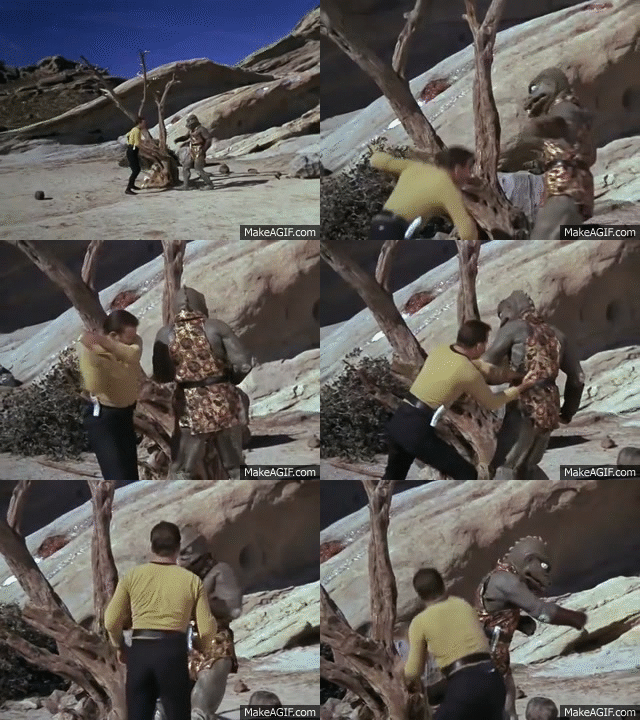
Pretty sure we can all think of an example of this. The almost slow-motion fight scenes that feel like they filmed the rehearsal. The medium-speed chase that drags on waaaaaay too long. The pointless shoot-out that clearly wasn’t thought through since everyone’s standing out in the open.
Action gets seen as filler a lot of the time, and it doesn’t help that a lot of gurus teach it that way. “Hit page 23—you need an action beat! Hit page 42—another action beat!” There’s absolutely nothing wrong with action, but bad action is particularly bad in the visual storytelling format of movies. Unnecessary action isn’t much better.
Think of scale, too. It’s always better to have a small, well-done action scene than a sprawling, poorly-executed one. We can relate to two people fighting so much better that two gangs of sixty people each slamming together. Especially when it’s supposed to be two gangs of sixty members each but there are maybe eight people on screen. Moving in slow motion.
7) Too Much Stuff
Remember when we were young and there was that one kid (we all knew this kid) who got so excited to be Dungeon Master? And he made that awesome dungeon with five liches and a dozen displacer beasts and twenty gold dragons and thirty platinum dragons and fifty minotaurs all wearing +3 plate armor and using +5 flaming axes and a hundred zombies and Demogorgon and half the Egyptian gods and…
I think we’ve all played that game, right? Let’s be honest… maybe some of us were that kid?
Some B-movies get like that. The filmmakers have too many ideas—way more than their budget or schedule allows—and they try to stick everything into the story. Every cool idea from every other cool story, sure to be just as cool here, right? Truth is, they almost never are. All these extra ideas just end up being under-developed distractions at best.
6) Killing the wrong people
There’s always going to be collateral damage in certain types of stories. Thing is, by nature of being collateral damage, the story doesn’t focus on these people and their deaths don’t really register. And they shouldn’t. That’s what collateral means after all—they’re secondary. Not as important. But in the tight, compressed nature of a movie, we need these deaths to be important. They need to serve a purpose in the story, hopefully on more than one level.
I’ve talked about the awful habit of introducing characters for no purpose except to kill them. We meet Phoebe, get three or four minutes of backstory and bamshe’s dead without moving the plot forward an inch. Because Phoebe wasn’t really part of the plot, she was just there to wear a bikini top and let the FX crew show off their new blood fountain.
The only thing worse than this is when it’s time for the ultimate sacrifice… and my hero doesn’t make it. A minor character steps forward to throw the final switch or recite the last words. And the “hero” sits back and watches as someone else saves the day.
5) Wasting Time
This one’s the flipside of point #7. I just mentioned that in the limited space of a movie script, everything needs to serve a purpose. If that touching backstory linking two characters doesn’t affect the plot or story somehow, it’s just five minutes of filler I could’ve spent on something else… like the plot or the story. If these shouted arguments don’t somehow reveal something key to the progress of the movie… they may just be a lot of wasted time.
One of the most common time-wasters in B-movies is the unconnected opening. It’s when the first five or ten minutes focus on a group of characters we’ll never see again, usually never even reference again, and who have no effect on the rest of the plot. Honestly, I don’t think I’ve ever seen one of these openings that couldn’t be cut, and I’d guess 83% of the time the whole movie would be stronger—on many levels—without it.
4) Not knowing what genre my story is
I’ve mentioned a few times that I worked on a B-level sex-revenge-thriller-sequel where the director thought he was making a noir mystery. I’ve seen horror films done as sci-fi and fantasy movies that were done as horror films, and vice versa. Heck, I’ve written stories where I’d planned it as one thing, and realized halfway through it was something very different.
I’ve talked about genre a lot over the past few weeks, so I won’t go into it much more here. To sum up quick if you don’t want to hit the link, all genres have certain expectations when it comes to tone, pacing, and even structure. If I’ve got a story in one genre that I’m telling with the expectations of another, there’s going to be a clash. And that clash probably won’t help my storytelling.
3) Plot Zombies
All credit to A. Lee Martinez, creator of this wonderful term. Sometimes, characters do things that are unnatural for them just to further the plot. The brave person becomes cowardly. The timid person does something wild and unpredictable. People argue and storm off for no reason. Well, so one of them can get murdered by the monster after going for a calming nighttime swim in the lake, but past that… no reason.
Plot zombies just stumble around a movie, doing whatever the story calls for. They don’t have any personality or agency, and really, one plot zombie’s pretty much the same as any other plot zombie. If I have an inspiring speech or an act of wild abandon or a last minute moment of brilliance, and there’s no reason I can’t swap all the characters around in it… it means I’ve got plot zombies.
2) Horrible dialogue
Bad dialogue always makes for bad characters. If we can’t believe in the characters, we can’t believe in the story. If I can’t believe in the story… well, that’s kind of it, isn’t it?
So many movies have painfully bad dialogue. Pointless arguments. Annoying characters. Awful technobabble. And sometimes—too much of the time—it’s just bad. It’s lines that sound like they went back and forth through Google translate and then the actor’s seeing them for the first time on a teleprompter while they’re filming.
Personally, bad dialogue drives me nuts, because it means the storytellers have no idea what human beings sound like. It’s a massive failure of empathy, and that empathy almost always shows up elsewhere. I’ve never, ever seen a story with bad dialogue that excelled everywhere else. It just doesn’t happen.
1) Who am I rooting for?
This is still the number one killer in America. This is what brings so many B-movies—so many STORIES—to a gear-grinding halt.
So many movies have absolutely no likable characters. Everyone’s self-centered, obnoxious, stupid, or arrogant… or a combination of these traits. They’re all awful, sometimes disgusting people. All of them. The bad guys and the good guys. People start dying and I’m always glad, no matter who they are.
If I’m expected to sit here and watch this for ninety minute, I need a reason to follow someone besides “they’re the main character.” I need to like watching their story play out. I need to be able to identify with some aspect of their personality. The movie needs to have someone I actually care about. ‘Cause if it doesn’t. I won’t care if they win or lose. And if I don’t care about that… well… I’m not going to be sitting here for ninety minutes
 And that’s my personal, current top ten B-movie mistakes.
Hey, speaking of movies… this Saturday I’m doing my usual Saturday geekery, but for SDCC @ Home I’m doing it as a watch-along party. Come hang out on Twitter starting at noon (PST) with Krull, followed by the Keanu Reeves Constantineat 2:30, and finishing up the day with Resident Evil at 5:00. It’s going to be fun and maybe a little informative. Plus there’ll be a couple other folks chiming in with the #KrullKon2020 hashtag, and even a few giveaways.
And next time here, I thought I’d talk a bit about editing this new book.
Until then… go write.
And maybe enjoy a movie or three.