January 19, 2012 / 2 Comments

Freeze!

            Okay, first off, it’s time for some shameless pandering.

            Permuted Press just released a collection of short stories I wrote called The Junkie Quatrain.  I talked about it here a couple weeks ago.  There’s a little picture/ link of it over there on the right (the green one).  It’s four connected/ interwoven/ overlapping short stories set in the same post-apocalyptic world.  I’ve been explaining it to people as 28 Days Latercrossed with Akira Kurosawa’s Rashomon.It adds up to a mid-sized novella, so it’s also very cheap.
            Anyway, I was thinking about today’s little rant and a phenomenal analogy sprung to mind.  No, seriously, phenomenal.  You’ll be talking about this one for months to come.  Ready?
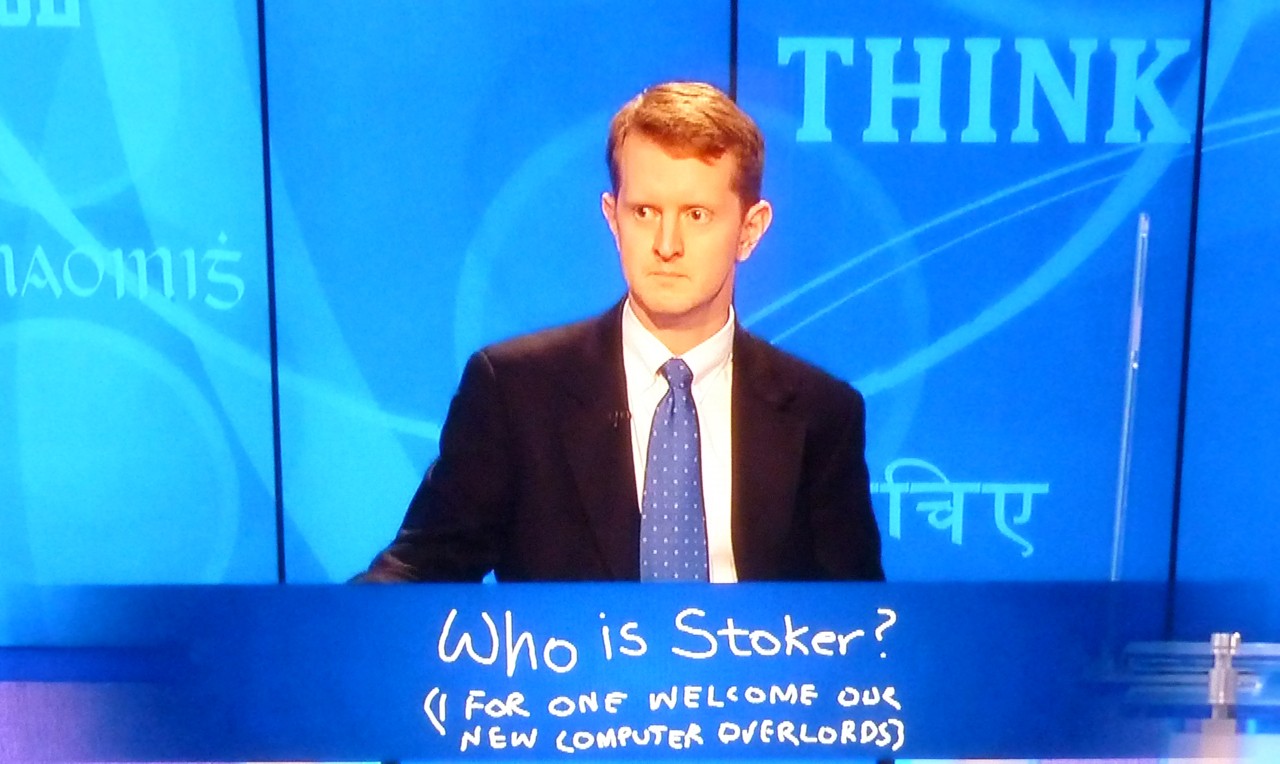
            Jeopardy.
            Have you ever watched an episode of Jeopardy where Alex Trebek will give an extremely easy clue and everyone just stands there?  He’ll say something like, “It’s the longest river in Egypt,” and all three contestants will twist their faces with intense concentration.  The timer eventually runs out and an eight hundred-dollar clue vanishes into the game-show ether.
            The answer is “The Nile,” by the way.
            Thing is, you all knew that, didn’t you?  And so did those three hypothetical contestants.  They were just overthinking it, because there’s no way the answer could be that easy and straightforward.  So they convince themselves it has to be something other than their automatic first response.

            If you watch Jeopardy a lot, you know one of the most challenging categories (statistically) is “Stupid Answers.”  Guaranteed, every time that shows up on the board, the players will miss the first one or two questions.  They’ll get something like “It’s the tomb memorializing soldiers whose identities are unknown,” and all three contestants will frown, furrow their brows, run through lists in their—oh, time just ran out again.

            There’s actually a catchy little term for this you might’ve heard before.  It’s called paralysis by analysis.  It’s when we get so caught up in thinking about how to do something that we never get around to doing it. 
            Some people do this with writing.  They get so wrapped up in having the right word and exquisite language and  perfect characters that they don’t write a single thing.  They’ll spend their time going to seminars with gurus, buying books, and reading article after article about how to write.  And in doing so, the one thing they never get around to is… well,  writing. 
            These folks are convinced there has to be something more to it than just sitting down and putting words on paper.  They think there has to be some special trick of structure or plot, and once they learn it writing will be a breeze.  Until then, it’s not worth doing anything.  They end up paralyzed by constant attempts to break storytelling down to a simple formula.
            The only way to move forward in your writing is to write.  Like so many things, a week of experience is worth more than months of instruction.  I’m not saying instruction is useless, mind you, but I have to know when it’s time to put other people’s books aside and start writing my own.  Put another way, I can’t expect anyone else to think of me as a real writer if I acknowledge I’m still studying how to be a writer, just like I can’t think of someone as a real doctor if they’re still studying in medical school.  We might earn our titles someday… but that day isn’t today.
            It’s still close to the start of the year, so next week I’d like to blab about something for the first time.
            Until then go write.
January 5, 2012 / 4 Comments

Why Are We Here?

            I don’t mean that in some vague, metaphysical sense.  It’s pretty straightforward.  Why are you looking at this web page?  What are you hoping to find here?

            Let me make it easier.  Let me explain why I keep posting here.
            No, there isn’t time to explain.  I will sum up.
            (bonus points if you get that one)
            Two little stories.  Tale the first.
            I’ve wanted to tell stories as far back as I could remember.  I was setting up my Star Wars figures and Micronauts in little tableaus when I was in grade school.  By middle school I’d found my mom’s old electric Smith-Corona (complete with vinyl dust cover) in the back of the closet and I was sending clumsy “submissions” to Jim Shooter at Marvel Comics.  And by high school, well, by then my rejection collection was getting pretty thick.
            It’s gotten thicker since then, believe me.
            Tale the second.
            Not too many months back I stumbled across a link to a published author’s new blog.  He was about at the same level as me—years of trying to get in and finally had a few sales under his belt.  Two of them to a very big, respectable publisher.  Said author, much like myself, wanted to offer some tips for new writers who were just starting out.  However, unlike me, this fellow didn’t want to talk about how to improve your writing. He was going to offer tips on networking, promotion, blog tours, and so on.
            Of course, looking over his first four posts, there was one point he kept hammering home.  The best way to sell your writing is to have good writing.  The best way to spread word of mouth about your writing is to be an excellent writer.  This could not be stressed enough.  All the clever gimmicks and sales tricks and blog tours weren’t going to help in the slightest if you didn’t have something people wanted to read.
            But he wasn’t going to talk about that on his blog.  He was going to talk about clever gimmicks and sales tricks and blog tours.
            That’s kind of what got me started on this whole thing years ago.  At the time, I was seeing tons of articles and websites about the tricks and gimmicks, but very few about the actual craft of writing.  And, yes, I do feel pretentious talking about “craft” when I write books about superheroes fighting zombies.
            Anyway, I’d say a good sixty or seventy percent of the material I saw was tips on what to do after you’d written something.  How to get reps, how to get your books in stores, that sort of thing.  Which always seemed a little cart-before-the-horse, as people used to say in the pre-Segway world.  Perhaps even worse, a large percentage of the remaining material—the stuff that actually talked about writing– spoke about it in terms of absolutes and set down hard rules that didn’t seem to come from any sort of actual experience.  It was just people parroting some rule about storytelling they’d heard somewhere as if it were a quantifiable, scientifically-proven fact.  In some cases, as far as I could tell, these people had just made up their rules out of the blue. 
            And a few of these folks were asking for money. 
            At the time I was sitting on this half-assed Blogspot site.  I’d pulled a loosely Egyptian-themed name from the back of my head (Thoth was the god of writing), a title that I put even less thought into (seriously, check out how many “Writer on Writing” blogs and columns there are out there), and used the space to post a few spec columns I’d created for a magazine I was working for.  They’d been rejected (twice) so I’d thrown them up here as… honestly, I don’t know.  Just so it felt like I’d done something with them.  I thought they were fairly well written and made some good points—I didn’t want them to languish on my computer.  Maybe in the tiny, limited space that was the internet somebody would stumble across them and find them useful.
            Bonus fact.  It was maybe a year after I started posting here more-or-less full time that somebody pointed out Thoth-Amon was also the evil sorcerer in the Conan books and comics.  Completely slipped my mind when I picked this site.
            Anyway, as I worked my way further and further into the life of a full-time writer, I got exposed to more and more people’s work.  I read scripts for a couple different contests and got a bunch of exposure to it (reading 400+ pages a day will do that to you).  And one thing that amazed me was I kept seeing the same basic mistakes.  Often to headache-inducing levels.
            A large number of aspiring writers fall into one of two camps.  Some of them think writing and storytelling are mechanical, quantifiable processes that can be broken down to A1-B2-C3.  These are the folks who will quote the MLA Handbook to explain why their novel deserves to be published and use Syd Field as proof their screenplay is perfect.  The other group think rules are for old-school losers who don’t get that spelling, formatting, and structure just hamper the creative process and will get overlooked when people see the inherent art in the writing.
            Both groups are usually wrong, for the record.
            Note that I said “usually.”  Most folks think it’s all-or-nothing.  You have to be on one extreme or another.  The truth is that it’s more of a middle ground.
            Y’see, Timmy, there are things that are absolutely “right and wrong” in writing. I have to know how to spell (me—not my spellchecker).  I have to understand the basics of grammar.  If I’m writing a script, I’ve got to know the current accepted format.  A writer can’t ignore any of these requirements, because these are things you can get wrong and you will be judged on them.
            On the other hand, there is no “right” way to start your writing day or to develop a character, only the way that’s right for me and my story.  Or you and your story.  Or her and her story.  If you ask twenty different writers about their method, you’re going to get twenty different answers.  And allof these answers are valid, because each of these methods work for that writer.  But that doesn’t mean I can ignore every convention or rule I don’t like.
            And that’s what I’m doing here.  Prattling on about some of the hard rules and general suggestions I discovered during thirty-odd years of learning how to be a writer, along with some of my own I’ve developed after trying to write a hundred or so short stories, scripts, and novels.  It’s stuff I think might be helpful if you’re actually serious about writing for a living.
            And I’m going under the general assumption that if you’ve slogged through all this, you’ve got at least a basic grasp of this writing thing and are hoping to go further with it.  Perhaps even make a few dollars with it.  And if any of you have a specific question or topic you’d like me to prattle on about, let me know.
            Next time, speaking of right and wrong, we return to one of my favorite topics—spilling!
            Until then, go write.
November 4, 2011 / 1 Comment

Changing It Up

            So, the back and forth thing really hasn’t gelled in my mind, so I’m taking the easy way out and just tossing up a quick tip.  A day late.

            Man, I’ve got to be honest.  The new Blogger is not working for me at all.  It’s such a radical change behind the scenes here.  It takes twice as long to do anything because they’ve needlessly spread everything out, and it’s just hard on the eyes.  Who thought orange on white was a good color scheme?
            Anyway…
            I don’t know about you, but I tend to write in Times Roman, single-spaced.  It flows a little easier on my eyes.  It also lets me have more of the story there on the page in front of me.  It’s just my thing.
            Now, speaking of change (as we were), there comes a time when it has to go into the correct format for submissions—Courier 12, double-spaced.  And I don’t do this at the very end.  I do it at the start of my last or second to last draft.
            Changing it like this forces my eyes to look at it differently now. Unlike Times Roman, Courier is a proportional font—it uses the same amount of space for every letter, so an I on the page uses the same area as an M or a W.  You could actually lay out a Courier page on a grid and it would all line up.
             When I reformat my manuscript, all the words sit differently on the page now.  Their spatial relationships shift.  Lines don’t end in the same place.  Because of the spacing, the words themselves look different.  Check it out.
See how different these two lines look?
            What this means for me is that I’ve got a chance to look at my writing fresh.  Which means another chance to look at it with a critical eye.  Since I’m not being distracted (so to speak) by the familiarity of words and sentences that I’ve seen a dozen times, it lets me catch things that could be tightened up or are a bit repetitive.
            Even after a ton of slashing, I cut another two thousand words out of -14-after I switched formats.  So many things stood out now as excessive verbiage or unnecessary descriptors.  I’d made a good five passes at the manuscript at that point, but none of them really popped until I looked at it like this.
            So try changing things up and see if it helps your next round of editing.
            Next time, I should have this other post figured out.
            Until then, go write.

October 14, 2011 / 4 Comments

God is My Co-Writer

So, a few years back one of my friends read for a religious-themed screenplay contest. And, when it got to the point that he was pulling his hair out, I pitched in and read a few scripts for him (I owed him money, anyway). It exposed me to a lot of stories about God, Jesus, various members of the heavenly host, and—to be terribly honest—a lot of really bigoted, small-minded people. Not all of them, by a long shot, but enough that it’s worth mentioning, unfortunately.

Two weeks back I asked for ideas, and one fellow (stand up and wave, Matthew) suggested the idea of approaching God, or any god, in a story. How can you do it without annoying readers while still doing justice to your chosen almighty?
And then, by yet another odd coincidence, on one of my favorite message boards, a few of us were recently batting around the film The Adjustment Bureau, which, in the big picture, is about… well, guess.
First off, a few grammar and spelling points. If we’re talking about the Judeo-Christo-Islamic deity, it’s always God. Capital G. This also holds if you choose to call him the Lord. It doesn’t matter if you or your character are an atheist or agnostic or whatever—this isn’t a religious point, it’s just standard, accepted spelling. This deity is considered the definitive article and as such his (if I may be so presumptuous) name is always capitalized. It’s a proper noun. The same goes for the Bible. If you’re referring to the religious text that encompasses the old and new testament, it’s the Bible. You only use lower case when you’re speaking about a generic book of absolute fact, like if I tell you that Stephen King’s Danse Macabre is my bible.
And, really, if you’re going to write about Biblical-era tales, check out the MLA Handbook, because there are a bunch of unique grammar and spelling rules that apply to these names.
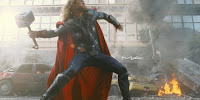
All of which leads to point two. I’m not talking specifically about God in this week’s rant, because a lot of the folks reading this are just as interested in Greek gods, Norse gods, Egyptian gods, Chinese demons, and cosmic entities from beyond time. But when it comes to stories, they all deal with a lot of the same issues.

Now, speaking of definitive articles, I’d like to start with an analogy…
In Danse Macabre, King tells a wonderful story about hearing William F. Nolan (the writer behind Logan’s Run and the legendary Trilogy of Terror films) talk at a convention. Nolan explained horror in terms of a closet at the end of the hall in a creepy, old house. Maybe the hero or heroine can hear something bumping around in there from anywhere in the house, and every now and then it thumps as whatever it is in there knocks an item off a hanger or tips a box off a shelf. As he or she gets closer, perhaps they can hear it scratching on the inside of the closet door. Endless scratching, scratching, scratching…
Finally, despite all our silent urgings, the character reaches out, turns the knob, and yanks open the door to reveal a ten-foot tall cockroach!!!
Thing is, even with the screams and the hissing and the mood music blaring, it’s kind of a relief to see that oversized bug. A ten-foot cockroach is pretty scary, no question about it, but a twenty-foot cockroach… man, I don’t know about you but that’d make me wet my pants pretty quick. It’s kind of a defense mechanism. Once I know what X is, I can imagine a scarier Y and X is reduced by comparison.
In the same way that naming the unknown horror lessens it, deities are lessened by defining them. When a writer tries to explain or show the scope of a god’s power, more often than not they’re really just establishing the god’s limits. If you tell me your god burns with the light of a hundred suns, I can say mine burns with the light of a thousand. If yours is a thousand feet tall and moves mountains, mine is ten-thousand feet tall and moves continents. The more the writer tries to show me, the easier it is for me to imagine something bigger and better (or nastier).
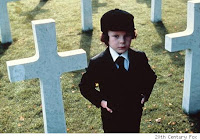
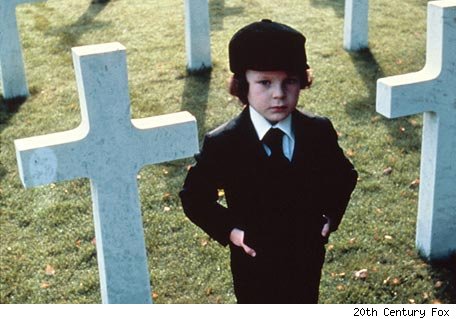
A great example of this is The Omen. No, the original. We shall not mention the remake here. Without giving away too much (although, why don’t you know this story already?), The Omen is about a diplomat who adopts a little boy. The boy, Damien, might be the Antichrist. I say “might” because… well, the movie actually makes you wonder. There are definitely people who think he’s the Antichrist. There sure are a lot of accidents and disturbing events that circle around the little boy. But the thing is… he never does anything. His eyes never glow, he never speaks in a deep, stentorian voice, he doesn’t shoot flames or lightning from his hands. Damien comes across as nigh-omnipotent because it seems completely effortless for him to get to anyone, anywhere—and that what makes him all the more terrifying. Because he doesn’t actively do anything, how’s anyone supposed to stop him? And what will happen when he does start being active?
Y’see, Timmy, defining something in any way automatically minimizes it, because the moment it’s been defined we can think of something bigger. Think of the little kid who yells, “infinity” and immediately gets countered with “infinity-plus-one!”
That’s why it’s always best to leave such omnipotent beings in the shadows rather than dragging them out into the light.  By their very nature, they’re vast, undefinable beings.  Thus, the moment they get any sort of definition they’re being lessened.
So, here’s a few quick thoughts for including a deity in your story.

Don’t—The simplest thing to do. Is a personal appearance really required for this story to work? The members of Congress have a big effect on my life, but I’ve never seen a single one of them in person. Heck, the only messages I’ve gotten from them have been spam emails and robocalls. But it doesn’t mean they aren’t there influencing aspects of my existence, and it doesn’t mean I wouldn’t be impressed if one of their aides gave me a call to chat about something. Which leads nicely to…

Minions—Gods of any type are impossible to fight, so including them on either side of the story equation really unbalances things. But I believe someone could beat cultists or demons or maybe even an angel. These are the beings my characters should be encountering. Remember, you can almost never get to the CEO because there’s a wall of flunkies, advisors, junior execs, and bodyguards in the way.

Silence is Golden—They used this one way back in It’s A Wonderful Life, when Clarence the angel would have one-sided conversations with the sky. Neil Gaiman did it in both The Sandman and the wonderful Good Omens (with Terry Prachett). Kevin Smith did it in Dogma. Mere mortals can’t hear the voice of God and expect to survive, so the Lord speaks through a number of mediums… or not at all. Keep in mind, to pull this off—especially the one sided conversation—your dialogue needs to be sharp and you can’t fall back on clumsy devices like repeating everything the silent person says just to make it clear what your god hates.

Comedy—People are a lot more willing to accept divine intervention (of one kind or another) if it has a comedy element. If I had to guess, I’d say it’s because when the writer’s not taking the matter seriously, it’s hard for people to have serious complaints. That’s why George Burns and Christopher Moore get away with mocking the man upstairs and The Last Temptation of Christ gets months of picketing. But this tone has to spread through your whole story. You can’t have your deity be the only source of comedy, because then you’re mocking him or her in the bad way.

Minimal Miracles—D’you ever hear the old saying about being so tough you don’t need to fight to prove it? More to the point, have you ever watched a movie where the bad-ass hero just fights and fights and fights and fights and fights? It gets boring, no matter how often he wins. Your omnipotent beings shouldn’t be expressing their power just to prove they can, because that power will start to get boring and take all the challenge out of the story one way or another. If everybody who dies gets brought back to life, what are people even fighting for?
Simply put… gods are the ultimate “less is more” when it comes to writing. The more a god—or demon, or cosmic entity—gets defined, the easier it is to name god-plus-one.
Next week… well, I’m going to miss next week. I’m one of the guests at ZomBCon up in Seattle. But when I come back, I’m sure I’ll have all sorts of scary and horrific things to talk about.
Until then, go write.


Categories