
March 29, 2018 / 3 Comments

What Why How

            Okay, I don’t have a ton of time this week because I’m trying to get a draft done.  Had a great time at WonderCon last weekend (thank you all for coming out), but I probably did a lot more prep than I needed to and lost some time.  So this one’s on me.
            Anyway…
            I’ve been trying to read a lot more this year. Combined with my usual Saturday geekery movies, it means I’ve been digesting a lot of stories.  And I’ve noticed a bit of a recurring problem.
            In a lot of stories, we’ll see characters do cool things or have bit s of mysterious dialogue… but it’s kinda hollow.  There’s nothing behind them.  No inspiration or motive or…anything.  It’s just action for the sake of action.  Being cool or mysterious with no motivation except to try to be a little bit cool or mysterious. The story progresses and we never find out why these things happened.
            I mean, I can guess why they happened.  The writer or storyteller saw this moment in another story and tried to transplant it.  But they only transported the moment itself—not all the other elements in the story that support it.
            If I’ve got a completed story—mine or someone else’s—here are three questions I should ask myself.
What is my character trying to do?

Why are they doing it?

How are they trying to do it?

            I should be able to give an answer for all three of these, for any character in my story.  And I can ask these questions at any time.  Right at the start.  Top of the second act. Just as we roll into the third act. At any point in the story, it should be clear to me (the writer) what the character wants to achieve, why they’re doing this, and what they’re doing to accomplish that goal.
            And I may not always get the same answer.  What Dot is trying to do in the first 50 pages of my vampire kaiju novel may not be what she’s trying to do in the last 50 pages.  In fact, it probably won’t be.  It’s extremely common for goals to shift during the course of a story as my character learns new things.
            But there should always be an answer to these questions.  There needs to be.  If I can’t come up with an answer, it means my character is doing something unmotivated at best. At the worst, they’re not doing anything.
            Not only that, once someone’s gone through the whole story as a reader, they should be able to see the evidence of the answers in the story.  Once I know that Wakko’s trying to hide the fact that he murdered his brother, his actions in previous scenes should line up with this. Even if I didn’t understand his motives for doing something then, they should be very clear the second time through.
            Even before that, though, there should be some sense of why my character is acting this way or that.  Most readers aren’t going to sit through 200 pages of “just trust me.”  We need to have some sense of what the answers to those questions might be, even if it later turns out we completely misinterpreted them.
            Y’see, Timmy, there’s another way to think of these three questions. They’re my plot.  If my character has no reason for doing the things they do, or doesn’t do anything… maybe my story doesn’t have a plot.
            Flip through your story. Ask those three questions.  And hopefully… you’ll have the answers.
            Next time… it’s that time again.  Yeah, ewe know what I’m talking abut….
            Until then… go write.
March 15, 2018 / 4 Comments

It’s Not THAT Bad

I tried a few pop culture references for this week, but none of them seemed to work just right. They weren’t awful, but that’s the best I can say about them. They weren’t awful.

Speaking of which…

A while back I mentioned an idea called Crap +1. It’s a viewpoint screenwriters Terry Rossio and Ted Elliott noticed (and named)–a common way some people approached screenwriting. It’s a mindset where I look at something absolutely horrible and say “well, my script is better than that.” And that got made, therefore logic and fairness dictate that my script deserves to get made, right?

I’m betting you’ve probably seen this reasoning applied to books, too, yes? And publishers? That garbage book got published, so of course the publishers are going to want to snatch up my slightly-better-than-garbage book. The bad book proves I deserve to be published just by existing.

It doesn’t work that way, of course. The big problem with the crap+1 theory is that what it really justifies is laziness. It assumes my work just needs to be “slightly better” to qualify as good. Which simply isn’t true. My story might be “better” than an illiterate piece of derivative fan-fic… but that still doesn’t mean my story is any good.

I’ve found this mindset also pushes a certain degree of entitlement. The idea that I’m somehow owed an equal form or level or success (logic and fairness, remember?). If that made it, I deserve to make it. At the end of the day, nobody else’s success has anything to do with my success. The universe—or a Big Five publisher—is not required to do something for me just because it did it for someone else who I feel is less talented/ less creative/ less determined/meaner/uglier than me.

It’s an easy trap to fall into. The crap + 1 mindset. Try to avoid it. In all aspects of your life.

Anyway, it struck me recently that some writers use this sort of logic and justification within their stories, too. Especially in the darker, grittier tales that some folks like. A lot of these stories operate under the idea that my character or their actions or the outcomes will be seen as good once we compare them to something worse. The story has unlikable, awful people as our protagonists or in the cast of supporting characters around them… but that’s okay because there are people in the story who are even more awful and unlikable.

Think about it. How often have we seen something where my protagonist is a violent, abusive, racist… but, wow, you should see the bad guy! My heroine just brutally killed two dozen people, yeah, but that’s not even half as many as her antagonist killed in an earlier scene. Hell, sometimes that bar is literally as low as “well, he didn’t try to rape any of them… I guess he’s the one we’re rooting for?”

How ridiculous is this when we stop and think about it? Yes, serial killer Jeffrey Dahmer was directly responsible for more deaths than Charles Manson, but that doesn’t mean Manson was a nice person. Yakko isn’t likable because he’s only cruel to women when he could be cruel to women and children.

A. Lee Martinez (he of the wonderful Constance Verity books, among others) made an observation once. Being a good person is more than not being a bad person. This is fantastically simple and true. It’s fine to say Wakko’s not a serial killer, but that doesn’t make him a hero. Or even a good person.  That’s the kind of dating logic “nice” guys use. “Well, I’m not going to treat her like crap the way some guys would—so why doesn’t she want to go out with me?”

I’ve talked about this before when discussing characters, especially my main characters. They need to be likable.  By which I mean, my readers need an actual reason to like them. A reason that counts as “good” when it’s divorced from any conditionals. Helping out someone in need. Showing restraint with power. Defending and supporting the weak. These are all inherently good actions that don’t need to be compared to anyone else’s to be good.

Not being awful is just… that’s the bare-bones minimum. It should be baseline human existence. It’s definitely not a quality to cheer about in my main character.

Along with the crap+1 idea, I think this is also a bit of binary thinking slipping in here. This character is marginally better than the antagonist, yes, but you know what else they are…? Not the villain. So, logically then, they must be the hero, right? I mean, who else can they be in my story?

And that brings me to one last aspect of all this. I’ve mentioned before the need for my characters to win. They can still get hurt, physically or emotionally–even die–but they need to succeed at their goals. Because my readers identify with the heroes, and they don’t want to identify with people who don’t win because it reflects back on them.

With this talk of being “slightly better than…,” it’s worth noting that the antagonist losing is not the same thing as the protagonist winning. They can be connected, but this isn’t always a nice Venn diagram overlap.  If someone else stops the bad guy… that doesn’t mean my hero wins.  If the antagonist somehow fumbles things themselves… that doesn’t mean the good guy succeeded.  And if they villain just gives up and walks away… well… nobody’s really earned a victory parade for that.

My hero needs to actually be a hero…not just a rung above the villain. They actually need to win… not just be nearby when the plot is resolved. And all of this needs to be in my story, which is actually good… not just slightly better than someone else’s.

Next time… there’s something I’d like to discuss for the first time.

Until then, go write.

March 13, 2018

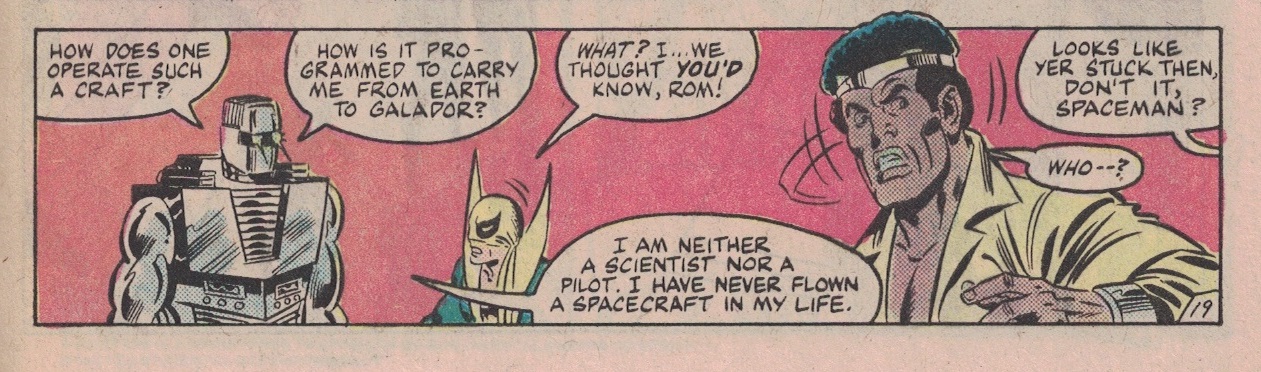
Writing Lessons from ROM

Eight-year old me learned a big lesson about storytelling from this one panel…

Categories