
November 1, 2018

NaNoWriMo—FIGHT!!

            Hey!  It’s November.  Like, just barely scraping into November.  By hours.  You’ve probably still got the taste of chocolate in your mouth, don’t you?
            Yes you do.  Don’t lie.
            Anyway, if you’re even a semi-regular reader of this site, you’ve probably heard of a certain November writing event that starts… well, probably right about now, depending what time zone you’re in.  Some of you may have been writing for the past hour or two, fueled by miniature Heath bars and Reese’s cups.  Power to you for starting right at midnight.
            On the off chance this is all new to you, I’m talking about NaNoWriMo.  National Novel Writing Month.  You sit yourself down at the keyboard, scoop up your legal pad, jack in to your hexadecimal cerebral port, and try to get an entire novel done—start to finish—in just thirty days.
            And when you finish, you get…
            Well, bragging rights, basically.  Pride.  A feeling of accomplishment.
            Sounds a bit intimidating, yes?
            It sure as hell is. 
            Don’t get me wrong.  It can be fun, recharge your batteries, stoke the fires, and lots of other clever aphorisms.  But the simple truth is, it’s a huge, exhausting undertaking.  I do this full time, for a living, and the idea of writing an entire book in thirty days makes me feel a bit overwhelmed just thinking about it.
            So here’s four quick thing to keep in mind so you don’t get as intimidated or overwhelmed.

            1) Don’t be Hard on Yourself—this is supposed to be fun.  You’re on a deadline, yes, but it’s a self-imposed deadline with no consequences if it’s missed.  Seriously, relax.  Don’t beat yourself up if you don’t make your daily or weekly word count.  That’s the kind of thing that makes you feel bad about yourself and about your ability as a writer.  It doesn’t help anything, it just makes you enjoy the act of  writing less.
            Push yourself, but don’t pressure yourself.  The big goal here is to improve, so any and every improvement counts.  Have fun and enjoy all the little victories this month.  This is a time when coming in second or third is still a great achievement.
            2) Pace Yourself—nobody wins a marathon by sprinting the entire way.  Trying to fill every single waking moment with writing is going to burn you out quick.  And it’ll show in your work.
            Try to be aware of diminishing returns.  A lot of times when I’m on a deadline, I’ll work late into the night.  Sometimes it goes great, but sometimes… I start to slow down.  My productivity drops.  And eventually it hits a point where I would’ve been better off going to bed two hours ago because I would’ve gotten just as much done in half an hour on a good night’s sleep.
            It’s so friggin’ simplistic, but think of the Tortoise and the Hare. Slow and steady gets the worm and the second mouse gets the cheese.  Something like that.  You get the idea.
            3) Rest and recharge—if the last two pieces of advice got together and had an advice baby, it would be this.  Don’t be scared to step away, just for a little while.  Have a nice meal and maybe a drink.  Go for a walk.  Take a nap.  Take a shower.  No, seriously, take a shower.  You should probably do that before going out—you’ve been sitting there for days typing and you’ve got writer stink on you.  Play a game.  Call a friend.  Curl up with somebody on the couch and watch an episode of Legends of Tomorrow or The Chilling Adventures of Sabrina or something.
            Point is, don’t feel bad about stepping away from the computer for an hour.  You’re trying to get a lot done, yeah, but with that in mind you don’t want to overwork the machine to the point it overheats and seizes up.  Give it time to cool down and refuel.  I’m not saying take a day or three off in the middle of this, but don’t be scared to get up, stretch, and walk away from your computer for an hour.  In the end, it’ll run smoother and faster overall.

            4) This Won’t Sell—no, seriously.  It’s won’t.  Kick that idea right out of your mind and stop worrying about it altogether.  It’s just not going to happen.  You’re worrying about your wedding venue and playlist when you’re not even dating anybody right now.

            The name NaNoWriMo is kinda deceptive, because you’re not really writing a novel this month.  You’re writing the firstdraft of a novel.  Maybe even just the first draft of a novella.  And there’s a huge difference between a first draft and a polished, completed manuscript.
            Most importantly… nobody’s going to buy a first draft.  No agent’s going to look at it.  No film studio will pre-emptively buy the rights after a prolonged bidding war.
            This draft is for you.  It’s to do whatever you want with.  Don’t spend a second second-guessing what those other people will want.  They’re never going to see this.  They may see the third or fourth draft—and be interested in it—but what you’re doing right now?  This is just a mess of cake batter.  It’s barely halfway through the process.
            So forget them.  Right now, just crank up the music and let your imagination run wild.  Do whatever you want.  Tell your story.  Drop all inhibitions and expectations and just write.

            Keep these things in mind over the next couple days.  Hopefully they’ll make things a little easier for you. Which’ll make the writing a little more enjoyable.

            Next time…
            Well, it’s been a while, so I figured we could talk about characters.  Or, to be more exact, who deserves to be a character in my story.
            Until then… go write.
October 30, 2018 / 1 Comment

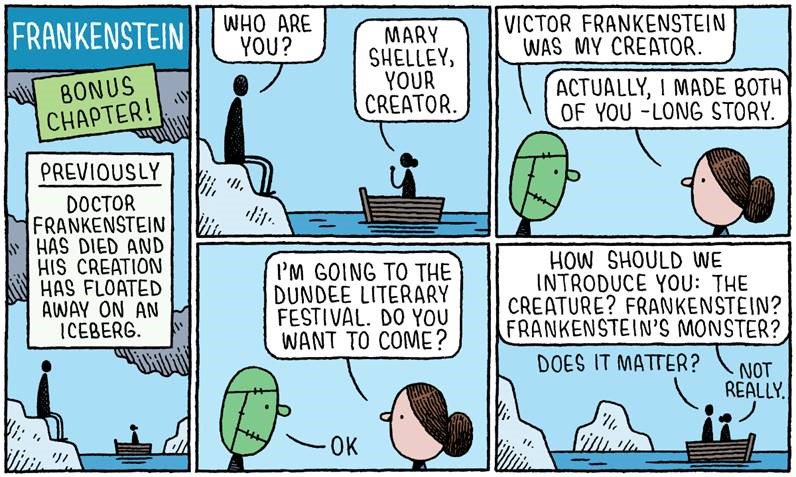
Tom Gauld

October 25, 2018 / 1 Comment

Now and Then

            Okay as we inch closer to a happy Halloween, I wanted to take a moment to address something I see pop up a lot in horror stories.  Not only horror stories, but in my experience it seems the most common with them.
            Plus, as I said, it’s the season…
            Remember this story?  A bunch of people get mysteriously summoned to some remote location (often some kind of mansion), start getting picked off by some kind of ghouls or ghosts, and then discover—oh, crap!  We’re the descendants of the people who did this awful thing fifty/ a hundred/ two hundred years ago.  And now these ghosts want their sweet vengeance.
            I’ve seen a few variations off this, and you probably have, too.  Phoebe’s perfectly happy to live in everybody’s shadow… until she isn’t. Yakko’s seemed perfectly sane… until it’s revealed he’s been completely mad the entire time we’ve known him!  That statue’s sat quietly in the museum since the 19th century… until sundown today, when it opened a portal to hell.
            So here’s my important question for you.
            Why now?
            Why is this happening now?  What made super-shy Phoebe decide this is the week she has to ask Wakko out to the upcoming dance?  Why did Yakko’s mask of sanity finally slip away?  Why did the ancient portal open in the museum tonight?  Why did the ghost choose this weekend to send out the summons to its deadly party? 
            Why now… and not a dozen times earlier? Why not six days ago?  Or six months ago?  Or six decades, in some of these cases?
            The real issue here is motive.  Why is my character doing this?  And a big part of motive is knowing why they’re performing these particular actions at this particular time.  Even for things like ghosts or ancient portals, something has to be kicking them off.
            Let’s look at those ghosts again (it is Halloween, after all).  I mean, those ancestors did their awful thing a hundred and fifty years ago.  There’s at least five generations between them and my characters.  Has everyone been getting mysterious invites out to the old mansion?  How the hell did any of them ever have kids, then?  Or have the ghosts been really incompetent up until now when it comes to reaping sweet vengeance and none of my relatives ever bothered to mention it?
            And if mom and dad and grandma and grandpa haven’t been getting invites… well, what’ve the ghosts been waiting for?  Is tonight an anniversary of some kind?  A cosmic alignment?  Did one of the realtors spill an urn of ashes or unlock the attic or decide they’re bulldozing this place on Monday?
            I’ve touched on this idea before—plot being active while story is more passive.  Even if the ghost are my antagonists (and dead), they’re still characters with their own story.  What’s happened that’s made them finally spring into action?  Either they’ve been doing it all along—which would imply a history and a bunch of evidence from previous attempts—or something has changed.  Drastically changed, in some cases. What outside force has caused this story to happen now instead of… some other time?
            Y’see, Timmy, writing a book—any kind of book—is kinda like solving a crime.  I need to know all the motives.  All the answers to what and whyand how and when.  I may not have characters blatantly explaining them within my story, but they should definitely be there if people look for them.
            Because if they’re not there…
            Well, then I’m writing a really lifeless story.
            Next time…
            Holy crap.  Next time is November.  The year’s almost over.
            But more importantly (for some of you)… it’s NaNoWriMo.
            Have a Happy Halloween
            And go write.
October 18, 2018 / 3 Comments

Chalk Outlines

Oh, hey, it’s Thursday again.

A few weeks back I asked for possible topic ideas and somebody mentioned outlines.  It’s a good topic, and a good time for it since I’m early into a new book.

Fair warning up front.  This whole post is very much going to follow the golden rule.  Outlining is an intensely personal process, and it changes from author to author and even from project to project.  Figuring out what works best for me (or you) might take four or five or twenty attempts.

Hey, nobody said this was going to be quick and easy.

Nobody who knew what they were talking about, anyway…

Outlines are tricky things.  Depending on who you ask, they’re the most important part of the process or a complete waste of time.  They just need to be a few rough lines of notes or pages and pages of meticulously planned out beats.  They can make things incredibly restrictive or let me spit out pages without a moment of hesitation. 

As I mentioned above, I think outlines are incredibly personal.  I’ve talked once or thrice before about how everyone has their own method when it comes to storytelling.  Maybe outlines are part of that method.  Maybe they’re not.

A good analogy—one that’s going to come up a lot here—is travel plans.  There are lots of different ways to travel.  Some of them might make perfect sense to you.  Some of them might be terrifying.  Again, it’s all about what works for you.

So let me blab about how outlines fit into my method a bit.

Or how they’ve fit over time.

First, there’s a pair of terms you may have heard before—plotters and pantsers. It’s (supposedly) the two big groups writers can get divided into.  Plotters are the folks who plan everything out in advance.  Pantsers make it up as they go along—by the seat of their pants.  Get it?  Hahaa, funny stuff. 

This is pretty simplistic, though, and I’ve had a couple discussions with other writers about the problems with such basic classifications.

I started out as a pantser.  I’d sit down at the keyboard and just type and type and type.  New characters, plot points, subplots… the book just went where it went, y’know.  This was how a lizard man from the center of the Earth ended up finding a crystal cave and wielding Excalibur.  Yes, that Excalibur.

Granted, I hadn’t even hit puberty yet.  But even after I did, most of my attempts at writing were usually just me coming up with one clever idea, starting at a point that I knew would take me straight to that idea, and filling in the rest as I went along.

And there’s nothing really wrong with that method.  It’s kinda like grabbing that special someone, throwing some clothes in a bag, and just going.  Pick a direction and drive.  Choose a flight at the airport.  Just go and see where you end up.

I still remember when I made the next big leap in my sophomore year of college.  A lunch conversation with a woman I was dating sparked an idea for a story about an immortal wandering the world.  Which sparked the story of another immortal.  Which implied a third.  And suddenly I realized this would be the beginning of a really cool book.

A week or so later, in the midst of writing all this down, it struck me that I had no idea what this book would actually be about.  I knew the characters, had cool origin stories for them, but past that… 

So, for the first time, I sat down and figured out—in advance—more or less how this story was going to end.  I came up with a pretty solid idea what actions the heroes and villains would be taking on the final page.  Who was going to win.  Who was going to lose.  Even a clever denouement.  And I knew it was a denouement because I’d just learned that term a few weeks earlier.

This is the slightly more planned trip, if we want to keep using that analogy.  Also in college, one of my best friends and I talked about driving cross-country after graduation.  We knew we wanted to end in California, but past that…  The rough plan was just grab clothes, maybe cameras, and go west.  Probably in her car, which was much more suited to a roadtrip than mine.  We knew eventually we’d hit California and the Pacific and who knows what along the way.

We never ended up going.

Anyway… time passes.

My next big outlining leap was kind of a bookkeeping thing.  I tended to scribble out five or six key plot points, but kept most of the story in my head.  Even with big, novel-sized projects.  When I decided I really wanted to start taking this seriously, one thing I started doing was writing everything down.  Every plot point, every idea, every snippet of action or page of dialogue.  When I finally sat down to write, I’d already have five or six pages of jumbled… stuff.  I might spend an afternoon putting it into a rough order and then—done.  Outline.

If we want to stick with our road trip analogy, this is when we know we’re taking the southern route across the USon our way to Los Angeles.  We’re also going to be stopping in Gracelandand Roswell.  A pretty good idea of direction with a few markers along the way.

Again, perfectly acceptable method.   Fine way to do things.  The first four books I sold (sold for actual money) were all written that way.  My book -14- had a little over eight pages of notes, and that included two and a half pages of character sketches. 

It was right around this time that I ended up with Crown Publishing (a division of Random House) and became a writer with a contract.  I mean, I’d had contracts before, but this was the first time the contract came first.  Everything I’d done up until this point had essentially been on spec, me writing the book at whatever pace I wanted and then hammering out a deal afterwards. 

What I was really dealing with now was a schedule.  A timetable of when things had to be done.  This wasn’t just about me anymore.  People had given me large advances based on the idea I could stick to these schedules.

My first contract with Crown was rough.  Exciting, but rough.  I ignored a lot because holy crap I was a Random House author now!!! 

My second contract…

I’ve got to be honest, the second one was brutal.  I’m still kinda aching from it.  Aching in that “Maybe I shouldn’t’ve asked Conor McGregor if he wanted to step outside” way.  It was about two years of near-constant stress trying to get through three books, start to finish.

And to be very clear—it wasn’t about them.  Despite what you may hear on some sites, the folks at Crown weren’t evil taskmasters or uncaring overlords or anything like that.  Hell, my editor gave me extra time whenever I even hinted at needing it.  he wanted the best book they could get.  Of course, extra time on book one meant I was getting into book two later, so I’d have less time for that…  But still, that was all me.  He was fantastic and accommodating pretty much every time an issue came up.  Everyone there was.  So don’t even think of using this as evidence of how “mean and demanding” traditional publishers can be.  It was absolutely, 100% nothing of the sort.

No, all that stress was on me.  My ambling, feeling-things-out-as-I-go method of writing was fine when I could go at my own pace.  But now I was on a schedule.  Those spaces in the outline where I still needed to figure things out had to be a lot smaller, because I just didn’t have time for them.

So—with some gentle prodding from my agent—I started doing larger outlines.  Now I actually figured out the majority of the story points and plot beats and character arcs in advance.  All the twists.  I had to have an ending—an entire ending—mapped out.

If we want to fall back on travel plans, this is when you’re going past “plans” and into more of an itinerary.  Things are mapped out hour-to-hour now.  Most notably, when you’re done traveling.  I just had that trip to Texas last weekend and honestly… having a full itinerary set up for me was kind of comforting.  Of course, my mom tried doing a family trip like this for us when I was twelve and it was… well, a bit less than fun.

My first couple outlines like this were just shy of twenty pages.  And really, that’s nothing.  The book I’m working on right now has a forty-two page outline.  I’ve got the next book about 2/3 plotted and it’s already close to thirty.

Want to hear impressive?  Back when I was doing a lot of screenwriting interviews, I talked with  Tony Gilroy about his script for Duplicity.  He had, by his guess, a sixty page outline.  For what would eventually be a120-130 page screenplay.  He had the whole thing nailed down.

And to be clear, this took time.  Lots of time.  It flexes different mental muscles to be examining the story in a much more clinical way.  And twice I had to junk half my work and start again.  A week or so of work—gone.

I spent about three months last year working on a handful of outlines (one of which I may never do anything with, after all that hammering and rewriting)

To be honest… I’m still not entirely sure I could say outlining saves time.  It may cut four or five weeks off the writing time, but if I spent four or five weeks working on the outline… well, it all just balances out, doesn’t it?

I guess we’ll have to revisit this six or seven months from now.

Again, please don’t take this as me saying you have to use this last method if you want to be a successful writer.  There are no such guarantees and  it’s all going to vary from person to person.  Like I just said, I’m still not 100% sure it’s going to help mebe  successful.  You may try a few of these versions before you figure out which one works for you.  Or you may find a different one altogether.

So think about the path you want to take.

Next time… I’d like to talk about why this is all happening.  To be more exact, why it’s all happening right now.

Until then, go write.

Categories