Well. my agent’s been swamped with stuff and only just got to start reading GJD a week or so back (as you’re reading this, not as I’m writing it). Life happens, sometimes things get slowed down. We’re both still hoping this means we can get it in front of editors before the end of the year. For a few reasons I won’t bore you with right now.
(I started to write them all out and then realized “this’ll probably be really boring to about 83% of the people reading it” )
My current project, TOS, is at about 41K words. I spent the last week or so of July just scribbling like mad, filled up two more legal pads, and now I’m in the slow process of transcribing it all. This is kind of how I wrote Paradox Bound. Longhand on legal pads and then typing it up becomes a sort of preliminary clean up/ edit pass
Why so much at the end of July? Why so slow transcribing? Well, as it turns out…
I’m on vacation.
Yeah, taking the month off. All of August. The whole thing. Yes, I’m very aware how super-lucky I am to be in a position to do that. Also, yes, it’s almost disturbing to not be working on anything for this long.
Which is part of the reason I’m doing it.
See, my partner and I haven’t had a real vacation together in years. I think last one was in… 2006? Around there. Before I was writing full time and definitely before my career took off in any way. Since then I might take a week off, but she’ll usually keep working on her own projects. Or maybe we’d take two weeks at the holidays, but holiday time gets filled up fast with visiting friends and family and, y’know, holiday stuff. And let’s be honest– either way, how often does “taking a few days off” quickly become “doing all those random errands around the house” …?
Another thing is… well, ugly truth of the world is the climate is shifting. A lot of places have had really hot summers and/ or extreme weather events. Here in southern California, we’ve shifted into more of a hot late-summer early fall. Two or three years in a row now, August means regular temperatures of 100+. We’d be blissfully happy when it dropped into the mid-90s because we could work without our computers overheating. Which really meant we spent most of August hot, frustrated, and… well, not working anyway.
So last year we decided y’know what– let’s just plan on not working in August. Let’s take the month off and catch up on reading, gardening, gaming, hobbies, whatever else we want. Do all the stuff that always feels like it’s “other stuff we need/want to do.”
And we’re not being monsters about it. I mean, we both like writing,a lot, so if one of us has this sudden flash of inspiration, we’re not pointing fingers and shrieking accusingly. I’ve been doing some transcribing every day of that end-of-July rush. The ranty writing blog. This newletter, obviously.
Yeah. Vacation. It’s been kind of nice. A little distrubing, like I mentioned above.
In other news…
This is the last newsletter you’ll get through Substack. The newsletter isn’t going away, mind you, it’s just… going away from Substack. I’ll be migrating the mailing list over to either Buttondown or just straight through WordPress. Mentioned this last time, but if you’ve changed your mind about having your email shifted to a new list, I get it. Just say the word.
For the rest of you– you should see this same time as always next month.
Anyway,,,
Cool Stuff I’ve Been Watching— Good Omens 2. The Strange New Worlds/Lower Decks crossover was such pure joy I’ve already watched it three times.
Cool Stuff I’ve Been Reading—The Endless Vessel by Charles Soule. Cult Classic by Stephen Blackmoore, Atomic Robo: The Vengeful Dead by Brian Clevinger and Scott Wegener
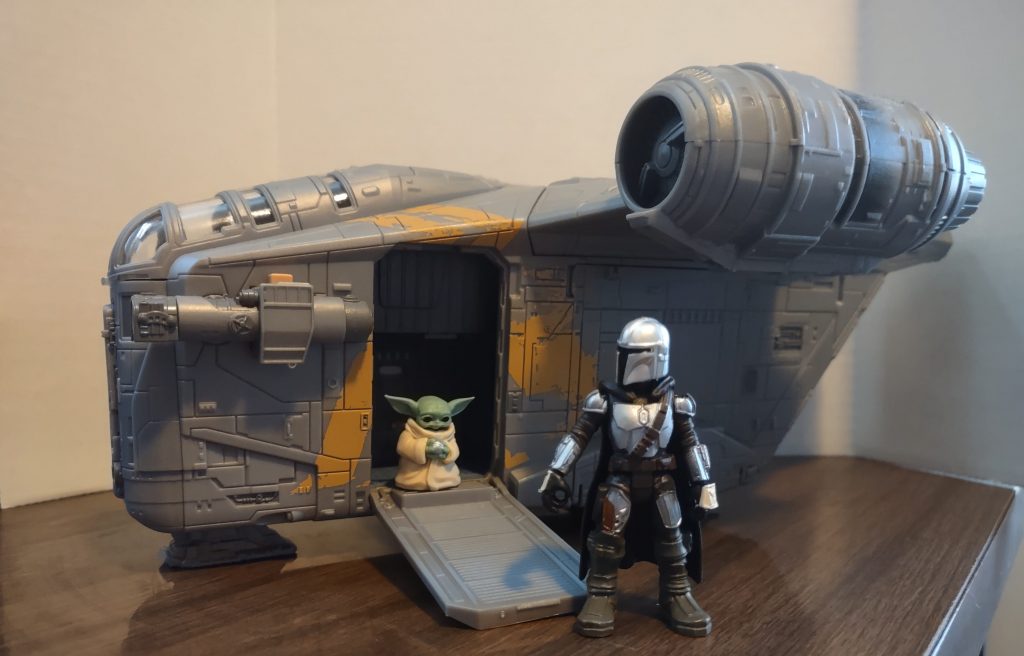
Cool New Toys – Just after the last newsletter I found something I’ve wanted for years—a Comic Con exclusive Micronauts set. An impulse purchase over that weekend has also left me with a small collection of Star Wars: Mission Fleet ships and figures, most of them centered around TheMandalorian. I have a pile of action figures I need to free from their packages, so check out Instagram if that interests you at all.
About a year and a half ago, when the ranty writing blog was still out in the wild, I did a post about being a little cautious when I use made-up words in fiction. Y’know, words like cromulent or midichlorian or squale. In the comments, Oliver asked if the same would hold for real-world foreign languages as well. Should I be cautious using, say, Japanese words the same way I would be using Klingon technospeak?
Which is why I’d like to talk about paint.
I think we’re all familiar with the idea of slapping a quick coat of paint on something to make it look new or different, right? House flippers do it, painting rooms with the latest colors and shades. Not unheard of for a used car to get a fresh coat of paint on it either. Heck, if you’re familiar with Games Workshop, I’d guess 83% of their “new and different” armies are just a lot of the same models with different colored paint on them. Again, it’s not a new idea. It was blue, now it’s red. It was something we’d seen before and now it’s something cool and different and, y’know… red.
And sometimes… we do this with storytelling. It’s the same character, but now she’s a brunette instead of a blonde. It’s the same old capitalism, but now they’re credits instead of dollars. Same problems, but now he’s hooked on stimms instead of drugs. We slap on a quick coat of paint and whoa-ho! now it’s an alien future world with a different financial system and everything! Hey, those stimms are fifty credits each! Your Earth-dollars are no good here on our very different alien planet.
Now let’s talk about languages…
I want to be clear this is a “no easy answers” topic. Much like with completely fictional words, a lot of it’s going to depend on the story, my intended audience, and context. This isn’t something where I can say “only four foreign words per page and never do more than sixteen per chapter” and that answer will fit every scenario in every book by every other author. There’s just too many possibilities to cover.
There’s also that whole gray area of words I can feel relatively confident most people don’t think of as foreign-language words. Even here in the United States, where the majority of our paler citizenry famously only knows one language, most folks would understand words like bonjour, quesadilla, dosvidania, kaiju, aloha, or gesundheit. So should we be counting them? Do I need to explain what a quesadilla is? Or a kaiju?
Anyway, rather than give out any firm rules for how to do this, I’d like to offer you a couple of loose guidelines to keep in mind.
First off, why am I including these words? In a general sense, but also specifically this one and that one and those three on the last page. Am I trying to establish a setting or a character’s speech pattern? Or am I just slapping down that coat of paint to give my characters or setting a thin veneer of “otherness”? Yeah, look, we’re definitely in Cairo now– see, the guy said shookran instead of thanks.
I want it to be clear these words are necessary. They’re an integral, load-bearing part of the setting and the characters. And just in case you didn’t know… paint isn’t load-bearing.
Second, is it going to be clear to my readers what these words mean? Maybe not exactly crystal clear, but is there enough on the page, in context or subtext, for a reader to figure out this is a piece of clothing (maybe outerwear), that was her brother’s name, and that was an expletive (and definitely not one you’d use around your mother)? If there’s not enough there for my reader to understand it, is it going to get explained to them? And if they can’t figure it out and I’m not going to explain it… is it really a word I need?
There’s a bunch of ways to use words in my writing that my readers might not know. I want to remember that hitting an unknown, indecipherable word will break the flow of my story for a reader.
Also worth noting an important aspect of this—my chosen audience. We all want our books to be international best sellers with three or four million readers, but the truth is we’re probably going to be aiming at a specific group of people. Even if it’s just something like “sci-fi fans” or “religious thriller fans.” And hey– religious thriller fans might know a lot more Latin than the average reader. So I might not need as much context/explanation for some of those words.
Third, am I absolutely sure I’m using these words correctly? Look, languages are tricky, complex things. They all have their own subtleties and nuances and… look, this may come as a shock to you but Google Translate is not quite on par with the Federation’s universal translator. Especially now that they’ve plugged it into their half-assed AI. There are languages out there that do things English can’t even wrap its head around. Like, you may remember from high school that a lot of other languages have feminine and masculine verbs. Heck, y’know how English has singular and plural? Well, Arabic has dual. Yep, a whole way of dealing with verbs and nouns that’s specifically for two people. Spend a few minutes thinking how that changes how you write. And think. And if I’m using these words in the wrong way…
Or how about this–there are some words in English that have multiple meanings, but in other languages they’re actually multiple words. If you don’t know the difference, just looking up how to say this word in German could cause problems, he said, from personal experience. When I was writing The Broken Room, at one point in an earlier draft I’d unknowingly used the Spanish verb “shield” (as in, this lead vest will shield you from the X-rays) as opposed to the noun “shield” (the thing Captain America uses). Still can’t remember what made me check it again, but around the third draft I suddenly just had this weird, gnawing worry about it.
Anyway, those are my three personal rules-of-thumb for using other languages.
And I’ll leave you with this one other thing to consider. Benjamin Dreyer, reigning copy editor supreme at Penguin Random House (that’s his actual title) has suggested maybe we should stop italicizing foreign words. Italics generally mean emphasis, and we used to italicize words in other languages to highlight their difference. These weren’t normal words. They were Spanish words, words people used in some strange, different place.
We’re all past that, right? I mean, did any of you have a problem with aloha and gesundheit not being in italics up above? Maybe it’s time to admit words in another language are just… words.
Things to keep in mind when you write.
Speaking of which…
I haven’t had any suggestions or requests in a while now. I’m sure I can struggle on for a bit longer, coming up with ideas on my own. But if there’s something you’d like an answer to or some help with or just wondered what my thoughts were on a topic… please let me know in the comments. And if not, i guess next time I’ll just blather on about, I don’t know, creative writing classes I took in the past or something like that.
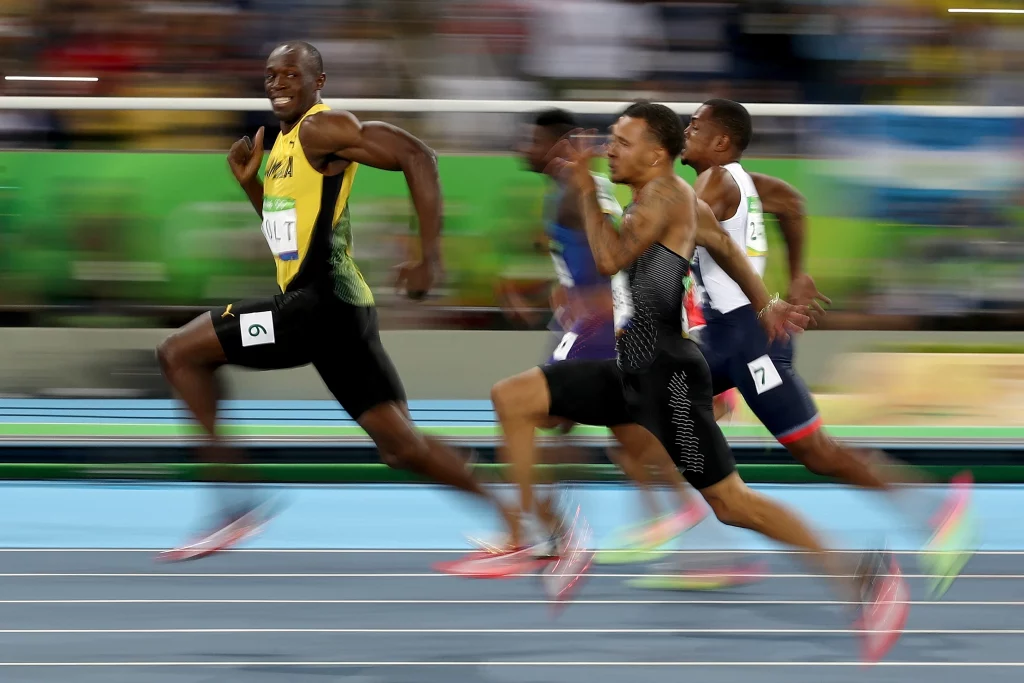
Did you know most Olympians run the 100 meters in about ten seconds. Seriously. Ten meters per second! Men tend to come in a hair under that, women just a bit over, generally speaking. Usain Bolt’s held the record for about fourteen years now with a time of nine-point-five-eight seconds.
So we can say that taking part in an Olympic event requires about ten seconds and then you’re done.
That’s not much of a time commitment at all, is it? One sixth of a minute and I can call myself an Olympic runner? Makes you wonder why more people don’t try it.
Of course, we all know it takes a lot more that ten seconds, even for someone as fast as Usain Bolt. There’s probably going to be months of training for that one specific event, not to mention years of work before that. Most of the major runners were probably training two or three hours every day while they were still in their teens.
So it’s not really about the ten seconds. It’s about all the years before those ten seconds. That’s what makes the ten seconds possible. That’s how you get to the Olympics.
And we understand that. It takes time to be good at something, It’d be silly to think otherwise. Running. Cooking. Dancing. Painting. Brain surgery. There’s some folks who may have a knack for it, may start a rung or two up the ladder, but everybody has a climb ahead of them. Nobody decides they want Olympic gold and just walks out onto the track at… well, wherever the Summer Olympics are this year. Paris? Really? Okay.
Anyway, you can guess where I’m going with this, right?
A while back I saw a self-publishing website talking about how easy it is to write a book. They’d broken it all down into math. According to them, it takes an average of 475 hours to write a novel. Just under twelve standard work weeks to complete a book. Not even three months.
Now, in all fairness, that’s about what it took me to write the first draft of –14-. But this number’svery misleading. It doesn’t count all the hours I put in before writing this book. There were only a handful of outline pages, sure, but that was still a few weeks of random scribbling and thinking. Not to mention all the books I wrote before it. Yeah, they count. Do you think Usain Bolt went straight to the Olympics without running one other race? D’you think he didn’t learn anything from those earlier races? That they didn’t help him?
I think (he said, pulling out his thick cardigan and pipe) there’s a lot of folks out there trying to convince us that time doesn’t matter. That spending time to get good at something is wrong. You shouldn’t have to practice at writing. You already know all the words! Just throw ‘em down and put that first draft up on Amazon! Why wait? Why listen to those gatekeepers who tell you you’re not ready for the Olymp– sorry, to be published! Ignore them and publish now.
What’s that? Don’t even know all the words? Well double-screw those gatekeepers. AI will write the story for me. That’s just as good as me writing it myself. I mean, if Usain Bolt sells me his gold medal, it means now I’m the fastest man alive, right? And I didn’t have to waste any time with all that “years of practice” nonsense. Heck, he doesn’t even have to sell it– AI can just copy his medal and now I’m the fastest man alive. It’s that easy. And heck, if AI copied his medal without permission and just stuck my name on it, well… I mean, I’ve still got the thing saying I’m the fastest man alive. That counts, right?
Whoooo. Sorry Getting a little warm in here. The ranty writing blog’s feeling especially ranty today, isn’t it?
Look, my point is, if you want to do this… don’t be worried about time. Yeah, it looks like she did something so much faster than you or he just popped up out of nowhere, but usually those numbers are just what’s on the surface. You’re only seeing a small part of the writing iceberg. We all had to put the hours in. You’re going to have to put the hours in.
I’ve mentioned here again and again how much writing I’ve done (and still do!) that nobody’s ever seen. So many half-completed (or fully completed!) books, comics, stories, and screenplays. So much stuff. But it’s all experience. It’s training.
Because you’re never going to make it to the Olympics without training.
Next time, I’d like to talk to you about paint. And Arabic grammar.
I don’t like to talk about non-writing related things here on the ranty writing blog. In the sense of I like talking about writing (the art) as opposed to writing (the career). It’s why I rarely talk about publishing, marketing, agents, publicity, any of those after-issues. I’m a big believer that there’s not much point in me worrying about any of the career stuff until I’ve actually done the art stuff. Like I talked about a few weeks back, if you’re here, you’re 100% interested in the art, but not necessarily in the career.
But these are interesting times, and as I find myself navigating a path through them, I figured I might as well drop a bird crumb or three. Or beat the whole loaf into crumbs and just dump it out here. We’ll see which one turns out to be the better approach…
In case you missed it, the human embodiment of the Dunning-Krueger Effect spent an ungodly amount of money to buy a company he had absolutely no idea how to run. What followed next was kind of like a car crash I was once in. Another car slammed us into the side of the freeway, our car kind of bounced off the concrete wall, but momentum and a jammed steering wheel guided us back into side of the freeway again, where we bounced off again, slammed into the wall again, and continued doing this for maybe a full minute/ three or four impacts before the car finally came to rest a few hundred yards down the freeway. And no, the other driver never stopped, just shot off down the 405, looking for another car crash to cause.
So that’s what Twitter’s been like for the past couple of months.
Really, even before the Muskrat, things weren’t looking great. In general, the social media landscape’s been looking more and more like some bombed out no-man’s land during World War One. Algorithms have made sites less and less usable, while a complete lack of algorithms have made other sites less appealing. At this point, the only thing social media shows you is ads and the only thing you can easily find is outrage.
Where does this leave us all now?
Not in a great place.
I’m hardly the first to say it, but I think the age of social media may be over. It’s crumbling fast, at the very least. Yeah, there are a few places that have tried to step up and fill the gap, but none of them are moving at a good speed, either in growth or management. Bluesky’s probably my favorite right now, but it’s still got huge issues. Plus, if they shift to the federated idea, I think that pretty much kills them right there.
Yeah, federation’s just weird. It feels like a buzzword too many techbros are leaping at, even though it pretty much boils down to “social media, but with less reach.” It also feels a lot like “look, we invented subreddits!”
Anyway…
Hopefully it’s clear this really sucks for artists of all types. For a while now publishers (of all types) have kind of been leaning on artists to get their own message out. After all, through social media we can reach everyone pretty much everywhere, right? So… reach! New book coming out, book signing this weekend, anthology story in November, con appearance next month!
BUT… we all hate it when artists just say “buy my stuff” again and again. And most artists hate doing it. That’s why we’re usually just trying to… well, be ourselves. Show you other stuff we’re interested in. Movies, cooking, photography, LEGO, exercise, toys, pets, whatever. I think most people appreciate that honesty, even if it’s not something they might not be interested in themselves.
(like, for example. two writers I know from the fleshworld talk a lot on social media about Magic the Gathering, a game I know absolutely nothing about past “you play it with cards.” But I love their passion for it. It doesn’t matter that I’ve got no clue about it– I can enjoy their love of it)
Worth noting—I’ve never heard of an author not getting a deal because of a small social media following. I don’t think any publisher’s ever said “Wow, it’s the most amazing thing I’ve read this year and we think we can easily move 100K copies BUT you’ve only got 200 followers on Twitter. So sorry. Please try again later.”
I have, however, heard more than a few stories where blame for a book’s failure is quiiiiiiietly shifted to the author. They should’ve promoted more. They should’ve talked about it more. Clearly their fault. Nothing we could’ve done that would’ve changed things.
And the key thing here is it’s been shown time and time and time again that big social media numbers really don’t, in any way, translate to sales. There are famous examples of people with millions of followers who can’t even sell 500 copies of a book. I mentioned a while back how Nathan-freakin’-Fillion tweeted how much he liked the first two Ex-Heroes books and it barely bumped the needle on sales.
So all of this should be inconsequential! Social media collapsing really shouldn’t be the giant source of stress that it is for so many creative folks. But we keep doing it because… everyone expects us to. And we all have this nagging worry that if we don’t do it maybe sales will go down. Maybe my feeble attempts at keeping your attention really are where a third of my sales come from. Which would be sad on numerous levels. For all of us.
Plus… I made a joke about this a while back and Chuck Wendig actually just did a whole post about it over on his site. Most artists are exhausted by all of this. This whole collapse and trying to find a new place and… all of it. Seriously. I mean, we need to use social media—to some extent—as a business tool. So imagine having to move your whole office to another building. The office you’d spent years getting settled into and arranging, where everyone knew where you were and all your clients and associates knew right where to find you. But now you have to move.
So you pack everything up, move it all, get everything unboxed, start moving it all around, figuring where everything’s going to go, you give everyone your new phone number and new address and WHOA hang on, turns out this place has a ton of security issues. Sooooo pack it all up again, move again, get it all unboxed again, give everyone your new-new phone number and address and HOLY CRAP this new place is also owned by a narcissistic billionaire? Okay… pack it all up again, find another place, set it all up again…
And of course, every time you do this you lose something. A few photos. A little memory. There’s one or two people you forget to tell you’re moving. Five or six people who just can’t find that new address. Another five or six who refuse to drive to that part of town.
Again, that’s what the past few months have been like for most artists. Exhausting.
Which leads us to… what can we do?
Well, first off, a lot of it’s going to depend on you and what you can tolerate. What you want to be part of. What you want to support.
Past that…
I think, personally, if you like an author, an artist, a franchise, a toyline, whatever… you should probably bookmark their site now. Not their Twitter page or Instagram account—their site. Every writer and artist I know is trying to let everyone know where they’re going, but there are so many barriers in the way. We’re all scattering and some people are going to get lost. So ignore all the random platforms and just go straight to their little corner of the web. I guarantee you they’ve got something out there, even if it’s just 83% placeholder. So bookmark it, try to check it now and then. Like in the olden times, when the internet was just stone tablets that we threw at each other.
If said artist tells you they’re going somewhere… try to follow them. I screenshotted so many Bluesky addresses before I got an invite. All those folks saying “find me over here.” And when I finally got a code… I found as many of them as I could. Newsletters? Probably not a bad idea to sign up for those, too, if that’s your thing. Do you need a Bluesky invite? Seriously, I’ll just drop codes here if it helps people get away from Twitter. Because none of us can depend on it anymore. For anything.
I don’t know. This is feeling rambly. I have so many thoughts, and I’m also worried nobody’s ever going to read them. Because social media’s collapsed and I have no way to tell you I’ve put up a new post here on the ranty writing blog.
I guess we’ll all just have to see what happens.
Next time, I think I’d like to talk about how little time it took Usain Bolt to win an Olympic gold medal. Unless you’d like to talk about something else? Feel free to leave any thoughts, suggestions, or comments down below