March 30, 2017 / 1 Comment

Can’t Find The Target

            By odd coincidence, this is post 404.
            There’s an old development saying you’ve probably heard—let’s throw it at the wall and see what sticks. The premise here is that if we use every single idea we have, surely the good ones will do something to get noticed.  They’ll stick to the wall or rise to the top or… something.
            The unwritten part of this premise is that you’ll also end up with a serious mess.  Yeah, my two or three good ideas stuck to the wall, but look at all the crap piled up on the floor under them. Hell, look at the wall itself.  It’s all stained and smeared and streaked.  This isn’t a clean-up situation, it’s a straight repaint.  I can say with confidence that we’re not getting our security deposit back.
            With all that in mind, I’d like to tell you the story of Phoebe McProtagonist…
            Phoebe struggled through life from an early age, born ten months premature on the same day her father died in the Middle East, one week before his two-year tour ended.  Overwhelmed with grief, her mother committed suicide during the birth.  Phoebe’s years as an orphan in child protective services left her hard and jaded, and she never had a single role model—growing up without parents, foster parents, inspiring teachers, sports heroes, pop icons, internet stars, or even a giving tree.
            In high school, Phoebe struggled with drug addiction, alcohol addiction, adrenaline addiction, video game addiction, sex addiction, a hoarding problem, OCD, Tourette’s syndrome, and extreme boredom because she wasn’t being challenged (no inspiring teachers, remember). She got pregnant three times on prom night, couldn’t get any abortions because she lived in a red state, then suffered four miscarriages from drinking lead-tainted Jaegerbombs after graduation.
            (alcohol addiction, remember?)  
            Determined to honor the memory of her unborn children, Phoebe withdrew from society and home-grad-schooled herself, eventually receiving magna cum laude, perfect attendance, and a triple doctorate in music theory, film criticism, and genetic engineering.  Thus armed, she applied to be an astronaut and, after months of rigorous testing, was finally accepted into the astronaut training program by those goddamned f@¢%!#g bastards at NASA.
            (Tourette’s, remember?)
            But when the rest of her team was killed in a launchpad fire that also burned down her house,  Phoebe took time off to sort out her life.  She sorted it out, got her groove back, got her ducks in a row, realized what’s important, and was struck by lightning walking along the beach.  As she sprawled on the shore, feeling a moment of divine bliss and agony as all the hair on her body burned away, giant mutant fiddler crabs came out of the ocean, the product of unregulated industrial waste dumping—
            (red state, remember? See how it all ties together? That’s what good literature does!)
            —and dragged her away into the water. In her final moments, the race between drowning and being eaten alive by the mutant crabs, she realized the single secret to clean energy, FTL travel, and how to make the perfect 7&7.  But there was no one to tell before she died, because she walked the beach alone.
~The End~
            Okay, that was maybe a little bit over the top, but you might be surprised how common this kind of storytelling is.  I saw it in writers’ groups in college (part of the reason I don’t belong to such groups anymore) and countless times when I used to read for screenplay contests.  You wouldn’t believe the number of dramatic stories that are just brimming with excess plot devices and story threads. Hell, I freely admit some of the early drafts of The Suffering Map were the same way.
            This springs from a common misconception–that writing a bunch of plot points and character elements is the same thing as writing a story.  The logic is that if I load up my story with every possible dramatic idea for every single character, one of them’s bound to hit the target, right?  And then, eventually, the story will be dramatic.  Plus, adversity builds character, therefore it stands to reason all this extra  adversity in my story will make for fantastic characters.
            I mean, Phoebe comes across a great character, right…?
            Simple truth is, this is all just excessive. If I’m doing this, I’m wasting ideas and wasting words, using thirty or forty examples instead of just three good ones.  It’s the kind of thing that tells a reader I was more interested in creating art than I was in telling any kind of decent story.
            Of course, in all fairness, it’s not just the artsy literature types who do this, although I must admit, they seem to be the most common offenders.  We’ve all read (or seen) the action storywhere every punch draws blood, every car chase ends with an explosion, and every leap rattles bones.  Plus every character had a snappy one-liner to toss out (or at least think about) before, during, and after offing one of the villains. And there were lots and lots of villains…
            Then there’s the sci-fi stories that have vast interstellar conflicts and near-magical technology and unstoppable cyborg monsters and omnipotent, cosmic beingsand sacred orbs   Seriously, reading contest scripts I was so sick of orbs.  I came to loathe the word.  Know what else?  Nobody in bad fantasy ever has eyes, they all have orbs.
            Friggin’ orbs.
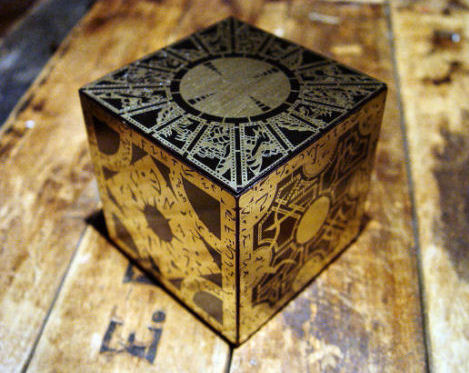
            And sooooo many horror story that have cubic yards of blood and gore everywhere.  Plus there’s a little chalk-skinned child who moves in high-speed “shaky vision.”  And a secret psychopath.  And one person who snaps and gets dozens of people killed because they opened a door or invited something in or played with the puzzle box. 
            It’s been almost thirty years, people. Thirty. Years.  Haven’t you figured this out yet?  Nothing good comes from opening the damned puzzle box!  Even my mom knows this!
            Y’see, Timmy, whatever my chosen genre is, just loading a bucket up with plot elements and flinging them at the wall does not create a story.  It’s the opposite of writing in just about every way possible.  No, not even if I only consider the leftover stuff. As I mentioned above, all those other ideas are still going to leave stains and streaks, no matter how solid the good stuff is.
            Take that as you will.
            Next week I’ll talk a bit more about cons, and I might talk about excessive stuff a little more, too.
            Until then, go write.
            I wanted to prattle on a bit about character development.  I’ve been thinking about it a lot lately, and the way it can sometimes be a stumbling block.  And I think I’ve got my thoughts in an order where they’d make a semi-coherent post.
            So, first, a little story.
            A friend of mine has a semi-popular travel show on PBS.  She’s also been working on a book about how she ended up travelling and one of her first big solo trips (that’s her thing).  She’d been working on it for a while and asked if I’d be willing to take a look at it and maybe offer some thoughts.  Maybe help her think of a title for it.
            I’ll be honest.  There’s always a bit of nervousness when a friend asks for your opinion on something.  I bet most of you can relate.  But I said yes.
            Turned out, no big worry. It was a fun book about her trek through Italy.  No nightmarish spelling or grammar mistakes.  Great voice.  Good description.
            There was one issue I noticed though—it just took a little while to pin down.
            (no, don’t worry,  She and I have talked about this.  And she knows I’m mentioning her book this week)
            Y’see, the book had tons of good elements.  Travel.  History.  Comedy.  Some soul searching.  A little romance.  A touch of sex.  Even a kind of creepy night in a haunted building.
            Thing is, none of these was a dominant element.  They were all more or less equal.  A little more of this here, a little less of that there.  Okay, the creepy factor only lasted four or five pages, but past that… it’d be really tough to pin down the main theme of the book.  An informative travelogue?  An introspective journey to sort out a life?  A passionate summer in Europe?
            Yeah, lots of stories have multiple elements like this.  My own book, The Fold, has sci-fi and horror elements, but also mystery, some action-adventure, a bit of comedy, some sexy romance, and even a touch of political stuff.  At the end of the day, though… it’s pretty much sci-fi and horror.  The other things were side dishes, so to speak.  They were fun and flavorful, but they weren’t the main course.
            See, without that main course, the meal is nothing but side dishes.  And while there’s nothing wrong with that, it becomes very difficult to answer the simple question of “what did I have for dinner?”  Sure, I can say, “side dishes,” but that doesn’t really answer the question, does it?  It’s like asking what I’m wearing and I say “not a green shirt.”  It’s an answer and it’s true, but I haven’t really told you anything useful.
            I need to have some kind of answer to the genre question, because people are going to ask it. People like readers. And agents.  And editors.  And if I can’t give them a real answer, it’s going to be really hard for me to get anyone interested.  If you’ve been reading the ranty blog for a while, you may remember a little tidbit I once heard from an agent named Esmond Harmsworth—“It’s not like anything else is very hard to sell.”
            This brings me to the second half of this little rant…
            I’ve mentioned before that you can follow me on Twitter.  If you do, you get to watch every weekend as I rant about sci-fi and horror B-movies in real time.  Over the years—watching them and working on some of them—I’ve developed a theory about why they turn out so bad.  Not all of them, granted, but a good number of them.
            Genre comes with expectations.  Science fiction and fantasy each have their own standards, benchmarks, and tropes.  These are radically different from the ones we hold for horror, or for mystery stories, or for romances.  Seems straightforward, yes?
            When these expectations aren’t met, or when my story departs radically from them, things begin to stumble. Maybe my story recovers, but sometimes that stumble ends with a full-on faceplant.  I’m willing to bet most of us have read a book or seen a movie where we discover the big twist is aliens did it or angels did it or Bob was a deranged serial killer all this time.  And this made us roll our eyes and find something else to do.
            So, here’s my theory.
            I think sometimes, at one stage or another, a story gets tagged with the wrong genre.  And this creates problems.  Sometimes I look at one of those B-movies I mentioned and I see what may have started out as—for example—a really fine sci-fi movie.  But someone decided it was a horror movie, and they filmed it as a horror movie. And now the sci-fi story has horror timing and emphasis and angles—all those standards we expect from those films.  But they don’t really fit this story. And that awkwardness is why the movie never really hits its stride.
            A great example of this was the latest Fantastic Four movie.  Director Josh Trank has done Chronicle, an indie movie widely hailed as a superhero story. But if we take a good look at it, it was really a superpowers movie.  Then Fox gave him the FF franchise and, well, Trank made another superpowers movie.  He forced the FF out of their natural genre and into a different one. 
            And we all know how that went.
            I’ve seen the flipside of this, too. When something gets made as, say, a sci-fi movie, but we’re told it’s a horror movie, by the advertising or the interviews or whatever.  So we walk in with those standard expectations, and suddenly the movie is “wrong” because it’s failing as a horror movie—which it was never intended to be.  I’ve seen books that were marketed as dark fantasy that were supernatural romance. Movies marketed as horror that were pretty straightforward sci-fi or fantasy.  Or even blog posts that were marked as character development when they’re all about genre…
            From our point of view as writers, this can be deadly.  If I’ve got an agent who wants to see sci-fi, I say my book is sci-fi, and then I send her or him literary horror…  Well, that’s going to get rejected really quick.  Yeah, even if it’s a fantastic horror story. 
            Heck, even if said agent reps horror as well, they can get soured just by those failed expectations.  They can go into it expecting sci-fi, like they were told, and maybe they’ll eventually self-correct.  But even then…  I may have lost those two or three vital ticks off their mental scorecard.
            And those two or three ticks can mean the difference between ending up in the big pile of the left or the very small pile on the right.
            Y’see, Timmy, I need to be sure what my genre is.  And I need to be honest about it, no matter how popular some other genre might be right now.  Because I want to score all the points I can with editors.  And agents.
            And especially with readers.
            Next time I want to talk about one of my favorite topics.  And a little bit about numbers.
            Until then, go write.
            Oh, and if you wanted to toss a buck or two at my friend’s travel show, public television needs all the help it can get.  Thanks.
February 16, 2017

My Latest Brilliant Idea

            So, a few weeks ago I got to witness an all-too common event.  The person whining about how “they stole my idea!”  Who they were isn’t important.  Sad truth is, it was a nonsense claim, one we’ve all seen more than a few times.
            Here’s an ugly truth that all half-decent writers know.  Ideas are cheap.  They’re cheap, borderline worthless, because they’re common.  Ridiculously common.  I can say with absolute certainty that I have more ideas for books than I am ever going to be able to write.  Seriously, even if I live to be a hundred, I’m pretty full up.  And know what? I’m going to have more ideas tomorrow. And the day after that.
            Not only that, but a lot of time my ideas will line up with the ideas other people have.  This is called parallel creation, and it happens a lot.  Especially when you consider how many folks come up with ideas they never do anything with.
            Here’s an absolutely true story.  Throughout 2008 and 2009, I placed in a few screenplay contests with a script I wrote called Reality Check.  It was about the crew of a retro-style spaceship who slowly come to realize they’re actually characters in a 1950s serial. Eventually, they figure out how to escape into the real world—which turns out to be a far more terrifying and dangerous place than they’re prepared to deal with. Especially when one of their mortal enemies follows them through.
            If this sounds vaguely familiar, it should.  It’s got a lot of the same elements as John Scalzi’s Redshirts, a ridiculously fun book that came out about two years after I won my last contest with Reality Check (if memory serves, I got a free copy of Final Draft for that one). 
            Now, I’m sure some people would go nuts and start shrieking about plagiarism and lawsuits.  Heck, I was dragged into a court case a few years back which was pretty clearly just weak parallel creation, but someone decided to sue over it anyway.  And lost.
            Simple truth is, Scalzi and I have never met (I think we were rushed past each other once at NYCC, but I’m not even sure of that). To the best of my knowledge he’s never been a judge or reader for a screenwriting contest.  I have absolutely no reason to think he ever saw my story.  We’re just two guys about the same age with similar educations, backgrounds, and interests who happened to look at something the same way and both decided to do something with it.  I wrote a screenplay, he wrote a novel.  That’s parallel creation.
            There’s also a funny rule of thumb I heard a while back that I think is, alas, horribly true.  The level of worry someone has about their idea being stolen is usually an inverse ratio to how good that idea actually is.  In other words, people tend to get really paranoid about their bad clichés and tropes being stolen.  That court case I mentioned before?  It was based off some ridiculously common clichés.  I mean, embarrassingly common.  I actually laughed out loud when the lawyer told me they were part of the core basis of the lawsuit.
            Y’see, Timmy, we all have ideas.  And the simple truth is, there’s somebody out there with the same influences, the same education, the same resources as me who’s having the same idea.  Maybe even ten or twenty people.
            Now, let me bring up a related point to keep in mind about ideas. In fact, here’s another story.  Genders, genres, and other facts have been changed (or maybe not) to protect the semi-innocent…
            I was at a convention a while back and one of the other attending authors offered me a copy of her book.  My to-read list is so huge I generally don’t accept such offers, but she was insistent so I said sure.  And then it slowly worked its way through my to-read pile until it was at the top.
            Said book was a fantasy novel that was aiming for a Game of Thrones-type feel.  It was very big on swordfighting.  Sword vs. sword, sword vs. axe,  sword vs. two swords, sword vs. sword and a dagger… 
            It just went on and on like this.  Every fifth or sixth page had a sword fight. Or a flashback to a sword fight.  Or someone talking about what they were going to do to someone else in an upcoming sword fight.
            And every battle ended bloody.  No mercy in this world.  Everyone either loses a head or an arm or gets impaled.  Sometimes all three.  Blood and guts sprayed everywhere and got on everyone.  House of a 1000 Corpses looked clean and sanitized compared to this book.
            Needless to say… it wasn’t that good.  There were several places where the book bordered on awful.  I read about fifty pages and skimmed the rest.  More sword fights.  More blood.  A few beatings.  The non-stop actionwasn’t the only issue, alas, but it was the one that matters for today.
            Y’see, some of these battles were actually kind of clever.  They did things I hadn’t seen before in books or on screen. The way they approached a character or their training.  Some of the ways the fights went.  How some of them were described.
            But it’s not enough just to be original.  My book needs to be coherent, both in plot and in structure.  It needs to have flow.  These are the things that tie my ideas together and turn them into a story.
            I’ve mentioned before that ideas are rarely more than plot points, and a pile of plot points is not the same thing as a plot.  No matter how clever my idea is, it’s not going to automatically make my story into a good story.  Especially if… well, I don’t have a story.  And an idea without a story is…
            Well, it’s borderline worthless.
            Next time, I’d like to put a few thoughts on the block.
            Until then… go write.
December 19, 2015 / 2 Comments

Yes, Virginia… There Is A Santa Claus

            December has gone by way too fast for my liking.
            Anyway, before we all head off to watch Star Wars: The Force Awakens and get some final holiday shopping done, I though I’d talk about something completely unbelievable.
            No, seriously.
            There’s a phrase you may have heard called willing suspension of disbelief.  Simply put, it’s when a reader is willing to ignore or forgive obviously false things for the sake of enjoying a story.  They deliberately choose to ignore the impossible.  It’s why we can enjoy Lord of the Rings when we know there’s no such thing as elves, dwarves, or invisibility rings.  It’s also why we can enjoy Star Wars when our adult minds realize the Force, lightsabers, and hyperdrive are all a little questionable, logically.  And if there really was a hockey-masked serial killer taking out a dozen kids per summer up at the same lake… seriously, shouldn’t someone have caught on by now?
            Fantasy, sci-fi, thrillers, a lot of horror—the genre stories are the ones that we immediately think of when it comes to willing suspension of disbelief.  But the ugly truth is that any story can make a reader shake their head and toss it aside.  There is no genre, no point of view, no style of writing that is immune.  Sometimes a writer asks us to make a leap and… we just can’t.
            Why is that, y’think?  When was the last time you shook your head at something you were reading?  Has something ever happened in a movie or television show that just made you decide you couldn’t take it seriously any longer?  Or maybe you just shut it off?
            I have a few thoughts on this topic…
            One of the biggest things that’ll make a story believable—any story—is the characters.  I may have mentioned once or twice or thrice that good characters make for good stories.  I can’t have a believable story without believable characters.  It’s just not possible.
            Yeah, even if I slap “based on a true story” or “inspired by real events” under the title.  Once it’s on the page or on the screen, all anyone cares about is if it’s a good story about believable characters.  This is a common mistake—one I’ve made myself.  Whether or not they’re real is completely irrelevant.  If that’s my only selling point… I’m in trouble.
            If my characters are going to be believable, they’ve got to be consistent—or at least consistently inconsistent.  I can’t have them acting and reacting in whatever random way happens to move my plot along.  My readers need to see motives they can understand.  Natural-sounding dialogue.  Relationships that are somehow relatable to the average person.
            This is important because once my readers believe in my characters, they’ll believe in what happens to my characters.  If I believe in Phoebe and Phoebe ends up meeting Santa, then—by extension—I have to believe in Santa.  Stephen King is a master at this.  He gives us very normal, relatable folks, lets us get to know them, and then plunges them into nightmarish circumstances with inhuman, otherworldly threats. We believe there’s a weird clown-spider-elder god thing living under this small Maine town because we believe in the kids-who-become-adults who encounter it and decide to fight against it.  Just saying that up above—clown-spider-elder god thing—makes it sound kind of goofy and silly.  But millions of people were terrified by ITand completely believed in that creature… because they believed in the characters Pennywise the clown was terrorizing.
            Now, something I haven’t touched on yet.  How can I make someone believable in a completely fictional worldStar Wars is set on other planets centuries ahead of our own, technology-wise (don’t be that person arguing about “a long time ago…”).  The Game of Thrones books are set on another world that’s arguably thousands of years behind us.  The Harry Dresden series by Steve Butcher is set on a different version of Earth.  The whole Marvel Universe (comic book and cinematic) may have been vaguely close to ours once, but is far off into sci-fi at this point, even right in the middle of Manhattan.
            A lot of this will depend on how foreign I make my world.  The more difficult it is for a reader to find relatable ground, the harder it’ll be to find something relatable in the characters.  And as I mentioned last week, being relatable is a key to good characters.
            Let’s consider Star Wars (no, don’t worry, no spoilers).  The first movie (episode IV if you want to be pedantic) starts with a battle between massive starships, but quickly shifts to a boarding party—one on one action where we see people being killed and captured.  And then it’s revealed this is a spy mission and the Empire is looking for some sort of stolen plans. Good so far—all of this is very understandable stuff.
            Our hero, Luke, works on his uncle’s moisture farm where he drinks blue milk and is expected to work on droids who will work on the vaparators.  This is all vaguely understandable, yes.  But, as quickly becomes apparent, Luke doesn’t want to work on the farm his whole life.  He’s suffocating here.  He wants to go off and do big, exciting things. And that’s something we’ve all heard before. Hell, a lot of us have probably felt that before, right?  So even though it’s set on spaceships and desert planets, Star Warsimmediately grounds us with familiar, believable characters and situations.
            Okay, so once I’ve got good characters, that whole disbelief thing is taken care of, right?
            Well… not exactly.
            Another thing that can mess up willing suspension of disbelief is if I get my facts wrong.  If I tell my readers there are only six countries in Africa, that the human heart is made up of just one cell, that Ronald Reagan was the 25th President of the United States, or that Hitler died in 1958… well, most people are going to see the mistakes there.  Even if they don’t know the right answer, they’ll know I got these wrong.  And that knowledge is going to jar them out of the story for a minute.  It moves us from experiencing the story to analyzing it.  We start lookingfor wrong things, and that pokes holes in our suspension of disbelief. 
            Again, the world of my story will have some say in this.  What we consider a fact in one story might not hold true in another.  There’ve been one or two successful stories where Santa Claus was a main character.  A fairly successful movie actually made the claim that Hitler died in 1958.  By the time it made this claim, though, it had already introduced average, relatable guy John Myers (and us) to the hidden supernatural world of the story.
            There’s also a flipside to this, one that takes a bit of empathy.  I can also blow the reader’s willing suspension of disbelief by using completely true facts that are unbelievable.  There are lots of things that are statistically possible, but that doesn’t mean they’re actually going to happen, or happen that often.  Likewise, there are tons of late night cable shows that will tell you about amazing true coincidences or billion-to-one events that actually happened.  If I’m basing a whole chapter—or a whole story—around these things, it could cause problems.
            I spoke with a documentary filmmaker years ago.  He’d just finished a film about the botched invasion of Iraq and the even bigger mess that came after it.  One of the most amazing things he told me, though, was how much he had to cut out of the film.  There were points of such complete incompetence in the year after the invasion that—if he had left them in the film—nobody would’ve believed them.  And he was telling me this three years later, when it was becoming pretty clear to everyone how poorly things had been thought out over there.  Even then, he had to cut some things so his documentary wouldn’t get dismissed as a hatchet job.
             If I present something that’s too hard to believe, even if it’s true, it’s still going to make the reader pause and shake their head.  As I mentioned above, nobody cares if it’s true or not.  There’s a phrase you may have heard that started with Lord Byron, passed through Mark Twain, and has even been used by Tom Clancy—the difference between fiction and reality is that fiction has to make sense.  And when it doesn’t make sense, it’s going to knock people out of the story and chip away at their disbelief some more.
            Y’see, Timmy, this is the big thing.  When our suspension of disbelief is broken, even for a moment, it breaks the flow of the story.  The more often the flow is broken, the harder it becomes for my readers to be invested in the story.  And soon they’re setting it aside to do something more exciting… like the dishes or thank-you cards.
            So keep it believable.
            Next time… Heck, next time is Christmas Eve.  Wow.  I may try to jot down something really quick for that morning, but I’ll understand if you have other plans.
            Until then… go write.
            Believably.

Categories