
December 20, 2017 / 4 Comments

Critical Hit

            Okay, first of two posts this week, as promised…
            So a while back at the LA Writers Coffeehouse we were going to talk about criticism.  All the directions it can come from.  What it’s like from either end. How to put it out there.  How to receive it.  We never got around to it there, so I thought I’d talk about it here.
            Just to be different, though, let’s approach this from the tougher angle, in my opinion.  Giving criticism.
            I know that’s hard to believe—that giving criticism can be the hard part.  I mean, just check out any social media site.  Over the past week or so there’ve been tons of people offering critiques of… y’know, different stories.  Often for free. Usually unasked for.
            And, most of the time, not very good.
            Criticism—actual, constructive criticism—is a bit more than ranting online.  It’s being able to state quantifiable, true, relevant facts about a work.  There are a lot of folks who consider themselves critics who really just… spout their opinions a lot.
            I saw one of these recently.  Directed at me.  Someone had read one of my books, loved the first two thirds, but then it had an “action-packed, nonsense finale” that the reader didn’t like.  Which was a shame, because the rest of the book had been pretty good.
            I’ve talked a bit about this before, one of the first things to learn about giving criticism..  Me liking or not liking something isn’t really criticism.  It’s irrelevant.  That’s just a subjective opinion.
            This can be a tough thing to figure out sometimes.  It took me years to be able to separate my opinions from actual facts and observations about the story I was reading.  There are a lot of books and movies I didn’t like, but I can also acknowledge that doesn’t make them bad.  It just means they’re not for me. 
            So that’s lesson one in offering good criticism. Separating my opinion from actual facts.  Anyone can say “this sucks.”  If I’m trying to offer valid criticism, I need to be the person  who can explain whyit sucks.
            And remember—“I didn’t like it” isn’t a reason.

            This should bring us to the second point about giving criticism.  It should be constructive, not destructive.  The goal isn’t to rip something apart, it’s to explain why and how it can be better.  Yes, sometimes this might mean a couple blunt, harsh truths will need to come out.  But even these don’t need to be designed to make the writer cry for weeks.  If that’s why I offered to critique someone’s work, well… I’m doing this for all the wrong reasons.
            Here’s a good rule of thumb.  I shouldn’t point out problems if I can’t offer some kind of actual solution.  This is also a good way to figure out if this is an opinion-vs.-criticism issue.  It’s tough to change opinions, but if something’s actually wrong, it shouldn’t be hard for me to figure out some way to fix it.
            Keep in mind, this doesn’t have to be a good solution.  My editor—a very high ranking editor at Random House—freely admits he’s great at spotting problems, awful at coming up with solutions.  But he’ll always have an answer whenever I ask about something.
            And I shouldn’t offer these solutions unless the writer specifically asks for them—it’d be rude of me to start explaining how someone else should be writing their story.  I mentioned helping a friend with her travel book a while back, and twice or thrice in the notes I’d point out an issue and say “I have an idea that might help with this—let me know if you’re interested.”
            Which is a great lead in to my third point.  If I’m going to offer criticism, I should know what I’m talking about.  This is a tricky one, because it means a lot more than “I read a book every week” or “I’ve seen every Best Picture winner.”  It especially means more than “I just want to read it early.”

            Being able to offer a good critical analysis means being able to juggle a lot of hats.  I need some actual knowledge and understanding of different structure forms and grammar.  I need to have read more than two or three “how to write a bestseller” books.  It wouldn’t hurt if I’ve sat and thought about this knowledge and absorbed it a bit.

            And just book-learning isn’t going to cut it.  I also need a lot of practical experience.  Lots and lots of reading.  Not just the classics. Not just the NYT bestsellers.  Not just the “good” stuff.  I need a broad-yet-solid background in the subject matter—no one should be asking me to read their hospital-based romance, and if they do I should be clear up front this isn’t quite my area of expertise.

            There’s also an empathy issue here, too.  I’ve mentioned a few times that writers have to have a good sense of empathy—if I can’t put myself in other people’s shoes, I’m going to have a tough time as a storyteller. Same goes for critiquing a story.  I need to be able to see what effect the writer’s going for andbe able to predict how people are going to react to it.  If I can’t do this, my whole critique is going to collapse.
            And that brings us to the fourthand final point.  This one’s going to sound obvious.  If someone’s going to trust me with their work, if I’m going to tell them I’ll critique it… I should.  They’re asking for feedback and I should make an honest effort to give it to them.  There’s few things more frustrating for a writer than waiting weeks for feedback and getting a one line email that says “Yeah, I liked it.  It was fun.”
            You may laugh but…  I’ve had beta-readers do that.  Which is why they’re not beta-reading for me anymore.
            Likewise, comments that are too vague to help… don’t really help.  I shouldn’t be writing things like “I saw a couple typos—you’ll probably catch them next time through.”  Again, if I’m doing a critique, I should be noting all this stuff.  Getting caught up in it isn’t an excuse—I’m not supposed to be reading this for fun.  I should take my time and do it right.  As the man says (paraphrased), treat them the way you’d want to be treated.
            Now, with all that said… here’s two positive things about giving criticism.

            Oneis that it doesn’t need to be stiff. Unless I’ve been hired as a professional, I’m reading/critiquing for somebody I know.  Possibly someone I even consider a friend.  I can have fun with this.  It can be conversational.  It can be funny/snarky/flirty whatever.  I don’t need to change my relationship with someone to offer them criticism.  They want it from me, not from Professor Huffy von Formalnotes.
            Twois that… well, I don’t have to read it all.  No, I don’t.  Really. I’m not getting paid, I’m not doing this as part of a formal submission… I don’t need to read all 815 pages. 
            At least three or four times I’ve read books for friends who wanted feedback and forty or fifty pages in it was clear there were… inherent issues.  Things that weren’t going to change.  Things that were going to kill the book’s chances if an editor or agent read those first fifty pages. So I stopped there.  I gave them all the notes I’d made up to that point, and then explained the bigger problems I was seeing.  And that was it. My time is valuable—and so’s theirs.  They don’t need to read twenty pages of notes from me repeating the same things over and over and over again.
            And again.
            There you have it.  Some tips to giving better criticism.  Maybe even a few tips about dealing with it if you read around the edges a bit (and follow some of the links).
            Next time… well, we’re closing in on the holidays, and after all this criticism we could probably talk about some good stuff, yes?
            Until then, go write.
March 16, 2017 / 4 Comments

Our Aluminum Anniversary Post

            So very sorry I missed last week.  There were copyedits.  I got about 3/4 of a post done in my spare time, but I was never quite happy with it, and then last Thursday was here and gone.
            And now here’s Thursday again.
            As it turns out, though, this turned out to be a fantastic bit of lucky timing.
            This, my friends-students-lurkers-haters-et al, is the 400th post here on the ranty blog.  Yep.  Four.  Hundred.  I know that doesn’t really mean much, in the big scheme of things.  There are some folks who post way, way more frequently than I ever will.
            Still, though… that’s a lot of random writing rules and advice I’ve been spouting out over the years.  Granted, there were a couple of amusing pictures mixed in there, plus I’ve revisited the same topic a few times, but…c’mon, it’s a pretty cool milestone.
            Okay, fine. You’re not impressed.  How about this, then…
            Sunday, it’ll be ten years since I first started said ranty blog.
            TEN. YEARS.
            To put that in perspective, the first Iron Man movie, the one that kicked off the entire Marvel Cinematic Universe?  That was nine years ago.  Ten years ago nobody’d heard of Breaking Bad or Fifty Shades of Grey.  Hell, ten years ago nobody’d ever heard of Sarah Palin.
            To be honest, nobody’d ever heard of me, either.
            Probably also worth mentioning there’ve been a little over 770 comments posted here in that time. So many thanks to all of you who’ve stumbled across this pile of rants. It’s always nice to know I’m not shouting into the void.
            Ten years.
            This revamp’s long overdue, yes?  Blogger’s overhauled many of its formats. A lot more of you are reading this on tablets or smartphones (something else that would’ve been a mystery ten years ago).  This whole page could be a lot more mobile-friendly.
            Plus, let’s be honest. I’m ten years older. Some of you are, too.  Most of you are going to be.  The white-text-on-black setup wasn’t helping anyone.
            Soooooooo… Whadda you think?
            Okay, talk about that down in the comments. Since we’re looking at a big momentous anniversary (and did anyone get me an aluminum ring?  No!) and I’ve been doing the Writers Coffeehouse for over a year now, I wanted to be clear on something.  I’ve kind of talked about this on and off, but it struck me it might be worth saying in really clear, absolute terms.
            I am not a writing guru. 
            Hell, forget guru, I’m not much of a writing teacher.  I’m barely a writing adviser.  Most of the Coffeehouse folks can vouch for this.  At best, I’m kind of the old writing hermit up in the hills.  You can ask me questions and I’ll shake my fist and shout some kind of answer, but I’d guess at least half the time my answer won’t work for you.  Probably closer to 2/3 of the time.
            That’s the Golden Rule I’ve mentioned here once or thrice.  Writing is a very individual, very personal process. What works for me might not work for you. It definitely won’t work for him.
            So… how is that different from being a guru?
            Well, because I’m admitting it might not work.  Not for everyone.  I’m telling you that up front.  There is no “right” way to do this.  At best, we can pin down some methods that work better than others and a few more that are more likely to hinder than help.  But past that…
          Okay, I’m going to tell you a really old, really stupid joke.  I apologize in advance, but it’s kind of important.  Ready?
            A man goes to the doctor’s office.  He holds his arm out, rotates it counter-clockwise at the shoulder, and says “Doc, it hurts like hell whenever I do this.” 
            The doctor looks at him, shrugs, and says “Don’t do that.  That’ll be twenty dollars.”
            Yep, twenty dollars for a doctor’s visit.  Told you it was an old joke.

           Now, on a basic level, the doctor has taken care of the patient’s problem.  And it’s kind of a win-win for the doctor.  If the man keeps doing it and the pain persists, he’s going against the doctor’s orders and the doc was right telling him to stop.  If he doesn’t do it and there’s no pain, then the doctor was right telling him to stop.

            The catch here, of course, is that the doctor hasn’t actually done anything.  And that’s how a lot of gurus operate.  They know how tough it can be to succeed in this business, so they charge a lot of money and offer foolproof advice.  Foolproof in the sense of it can’t fail, because the advice is not to do anything.
            I used to see this mentality in the film industry a lot.  A script will normally go through what they call “clearance.”  It’s when a lawyer or legal assistant goes through the screenplay looking for possible legal issues, usually with names, addresses, and prominently mentioned items.  Is this character name common, or is there only one person with this namein that city?  Should someone bitch and complain about Microsoft products by name on screen?  The clearance people are supposed to do some research and then give everything a thumbs down (because you might get sued) or a thumbs up (you’re in the clear).
            Guess what, though?  About nineteen times out of twenty, they just say don’t do it.  Don’t use that name, don’t mention that product, don’t refer to that person.  No matter what it is, you might get sued, so don’t use it. 
            Y’see, Timmy, if I tell you not to do something and you don’t, there’s no problem—I was right.  If I tell you not to do it, you do anyway, and nothing happens, then you were lucky—and I was right.  If I tell you not to do it, you do anyway, and  you get sued… well, I told you not to do it.  It’s not my fault.  No matter what the actual outcome is, by saying no, I’m always correct. 
            This is what I see overwhelmingly from gurus (both prose and screenwriting).  Rather than actually teach anything, far too many of them just give lists of what not to do.  Don’t do flashbacks. Don’t use passive voice.  Don’t take too long to introduce characters.   Don’t have your inciting incident any later than page nineteen.  Don’t use “we see.” Don’t use “said.”  Don’t do voiceover in scripts.
            And, again, they’re never wrong, because saying no is always correct.
            On the other hand, I try to explain how these things work. Of course you can use flashbacksIntroduce characterswhenever it’s appropriate for your individual story.  And please, please, please try to use “said” morethan any other dialogue descriptor. These devices wouldn’t exist if they didn’t work—they would’ve died out centuries ago. Actual centuries.  It’s just easier and quicker to say “don’t use them” then it is to explain how to use them correctly.
            Especially if said guru doesn’t know how to use them correctly.
            There’s another way I’m different from a guru.  I have actual, recent experience.  Not references or testimonials—experience.  I honestly can’t tell you the number of self-proclaimed experts I’ve seen who haven’t had a single sale in their chosen industry in years.  Assuming they’ve ever even had a sale.  One of my favorites was a “script doctor” I’d never, ever heard of (keeping in mind, I worked in the film industry for fifteen years and then reported on it for another five) who assured would-be clients that he’d worked on lots and lots of big box office films… none of which he was allowed to name for confidentiality reasons. 
            Remember, real professionals don’t have testimonials—they have credits. Recent credits.  Every industry changes over time.  Publishing, filmmaking, programming, farming—all of them.  The longer it’s been since I’ve done something, the less likely it is that my knowledge of said industry is any good.  You might remember a couple weeks back I mentioned I wasn’t going to offer screenplay advice anymore because it’d been a while since I actively did anything in the film industry.  I don’t want to mislead anyone with out-of-date advice about how to put a screenplay together. 
            Yeah, there are still format posts here if anyone wanted to go digging (look, here’s one), but it’s also clear these aren’t current.  So I’m going off the basic assumption that if someone finds their way here, they’re smart enough to think twice before blindly following something from a year ago.
            I mean, let’s just approach this logically.  If Wakko really knows how to write a novel that publishers will pay half a million for… why is he nickel-and diming you and me? Why are we paying him $500 for a three-day weekend course when a film studio might give him $750,000—plus residuals?
            Don’t get me wrong.  There are a bunch of very talented, very experienced people out there offering writing advice and asking for a couple of bucks.  I personally know at least half a dozen writers who’ve put out books of writing tips and advice.  I’ve toyed with the idea myself.  But, again, they’re all professionals.  Offering writing advice is a side business, not their primary one. 
            Which is, y’know… writing.
            And that brings me to my last point.  It’s not a hard fast rule, but I’d say it’s a pretty solid rule of thumb.  Most of the professionals who offer writing advice… just offer it.  They don’t want a huge amount of cash up front. They’re not asking $85 for a self-published textbook.
            The reason for this is pretty simple.  The vast majority of us who’ve made it up here to the top half of the ladder only got here because we got help and encouragement from other professionals along the way.  I can look back and know I only made it here because of advice and tips I got from several writing professionals along the way, almost all of whom gave me that advice for free (one was a college professor—and a two-time Pen/Faulkner winner with nine books to his name at that point).
            The question I need to ask myself is… is that big pile of don’ts from somebody with no experience worth $650?  Or maybe a grand?  Hell, is it even worth fifty bucks?
            And that’s why I’m not a guru.
            And it’s part of the reason I’ve been writing out suggestions and tips and not-so-gentle nudges here for the past ten years.
            Again, thanks for being here.
            Next time, I’ll probably prattle about words, like I said I was going to do last week. Or maybe I’ll talk about this really cute foreign exchange student I knew in college. One of those things.
            Until then… go write.
February 23, 2017

Dealing With Blockage

This week, I wanted to talk a bit about a familiar malady we’ve all heard of—writer’s block.

It happens to all of us. Y’know, four out of five writers experience writer’s block at some point in their career.  Almost 83% on average end up…

Okay, that’s not true.

None of it.

I’ve got to be honest. I fall into the same camp as Isaac Asimov and Piers Anthony.  I just don’t believe in writer’s block.  Sorry.

Now, let me be clear.  Yeah, there are days that I hate writing.  Of course there are.  This is a full time job for me, and guess what—like everyone else on Earth, there are days I hate my job.

Don’t get me wrong.  It’s a fantastic job, it’s the job I’ve wanted pretty much my whole life (aside from brief dabblings with “astronaut” and “giant robot pilot”)… but there are days it frustrates me. There are days I pull my hair out. There are days I still worry if I’m good enough, days I fret about my future, and days I wonder if I should’ve just sucked it up and found another job as a prop master.

But… I never have writer’s block.

There’s always something I want to write.  I never have a shortage of words or ideas.  I never stare at the screen and can’t come up with anything.

I think–and this is all just my opinion, so YMMV—that writer’s block is kind of a made up thing, like the muse.  It’s an easy excuse not to write.  When I see people online talking about being blocked for months or years… I have to be honest, I just don’t buy it.

I think writer’s block tends to boil down to three very real, very relatable things…

First is a voice issue.  Or maybe an empathy issue.  Kinda the same thing, for our purposes here.

Let me explain.

A few weeks ago at the Writers Coffeehouse, we talked a bit about voice.  I think—especially when we start out—a lot of us tend to write the way we speak.  Maybe a little cleaner or clearer, but it’s not that odd for writing patterns to match up with speech patterns.  Our narrative voice uses all the same words and phrases and metaphors that we do in our day to day life, because that comes naturally.  Makes sense, right?

Thing is, when we go to write… things stop matching up.  If we’re any good at this writing thing, we recognize that high elf ladies probably don’t talk like office drones from Dallas or check out clerks from Portland.  They’re going to have different vocabularies and cadences.  They’re not going to sound like me.

Suddenly I’m not writing “naturally” anymore.  This takes effort!  It’s work.  It means I need to put myself in a different headspace and look at the world—even my fictional world—in different ways.

I think this particular form of writer’s block eliminates a lot of folks from the pool, one way or another. Either they keep going, writing dozens of different characters that all sound pretty much the same… or they give up because they can’t make them sound different.  And those folks will talk about being blocked. How they couldn’t get the ideas to flow or the characters didn’t want to come out or something like that…

The second thing behind writer’s block is fear.  Plain old-fashioned fear.

I’ve talked about this before.  I think a lot of times when people say they can’t write, it’s more that they’re worried the stuff they are writing isn’t good enough.  Is this page, this paragraph, this sentence as good as it could be?  Have I used the best words?  The best description?  Is this the best way to phrase this?  Will this win me a Pulitzer or get me mocked on GoodReads?

I think most of us go through this phase at one point or another.  We start over-analyzing our work and second-guessing everything we put down.  I’ve mentioned the term paralysis by analysis before, which I think sums this up perfectly.  We get so scared at the thought of doing something wrong—something that isn’t perfect—that we don’t do anything.  We freeze up.  We get… blocked.

But we already know the solution to this one, too.  It’s just admitting that my work isn’t going to be perfect the first time out.  Perhaps not the second, either. It’s going to need editing.  Second and third and fourth drafts.  Maybe even full rewrites.  That’s just the way writing goes. And once I realize this—once I can really admit it to myself—I can get past that fear and my productivity will go through the roof.

And this brings us to the third thing behind writer’s block. And this is the tough one. The hardest one to deal with.

Sometimes people have writer’s block because they don’t have anything to write.

There’s a lot of reasons people sit down and try to write.  Sometimes they think it’s easy.  Often they have a clever idea, but no real story.  Maybe they want the adoration for a finished work more than they want to… well, finish something.

This sounds harsh, I know, but I think most of us know someone like this.  Someone who isn’t suffering from writers block, they just like the idea of being a writer more than the reality of being a writer.  Because the reality is that this isn’t easy—it’s a lot of work.  Some people just aren’t cut out for it.

And look, if that’s you… this is a good thing.  Personally, if this isn’t what I’m made for, I’d rather know sooner than later.  Maybe I love writing as a recreational thing, but I’m just not geared to do it professionally.  That’s how I am with cooking.  And drawing.  And cosplay.  And running.  I like it, I have some rough talent for it, but I freely admit I’m not mentally wired to do it as more than a pastime.  If I hit a rough patch… well, I just shift to something else.

Like some folks do with writing.

Y’see, Timmy, if you ask me, writer’s block is really just a big, catch-all name we throw over other problems.  Inexperience.  Fear.  Lack of interest. It’s intimidating when it’s a vague concept, but once we break it down into an actual issue, we can address it and deal with it.

And beat it.

Next time, I’d like to talk about the type of story I’m working on.

Until then… go write.

November 23, 2016 / 1 Comment

Imposter!

            Look!  We’re a day early because tomorrow I’m going to be cooking and watching a lot of my favorite black-and-white movies.  Joy!
            Well, not all joy…
            I need to get something off my chest.
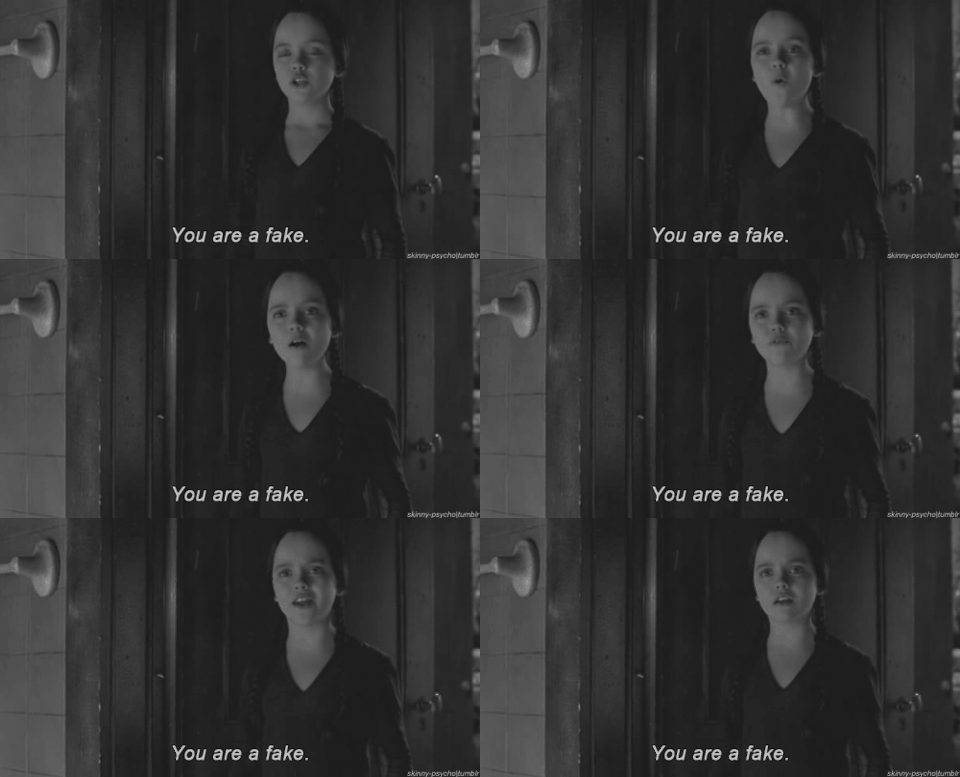
            I’m a fraud.
            Seriously.
            I would guess, on an average week, this idea runs through my head five or six times (by odd coincidence, I tend to work five or six days a week).  The notion that I’m a complete fake who’s kind of stumbled into this life off sheer luck more than ability.  I re-read my new projects and wonder if they’re good or if I’m just deluding myself.  Maybe I don’t know a tenth of what I think I know—a textbook case of the Dunning-Kruger effect. 
            I sometimes wonder if the next book is going to be the one where my small fanbase gives a big shrug and says “ehhhhh… I guess he’s burned out.  Time to move on.” 
            I fret a lot about whether or not my publisher’s going to dump me as a writer, too. Well, not dump me, but just decide this latest contact will be… well, the last one.  Same with my agent.  He has some much, much bigger clients than me, and it’s not irrational to think he might decide his time and efforts are better spent focused on them.
            You may have heard of people feeling this way before.  It’s called imposter syndrome, and it’s really common.  I get it all the time.  Chuck Wendig gets it.  Victoria Schwab gets it.  Pretty much every writer I’ve ever talked to at length has copped to it. They’re plagued with self-doubt. They question most everything they write.
            (You didn’t think Hemingway drank that much because it was fashionable at the time, did you…?)
            I’m not saying this to freak you out or feed your insecurities.  I’m hoping it reassures you a bit.  We all feel this way sometimes.  Yeah, even those of us so-called-pros who are doing this full time.
            There are two reasons people get hit with imposter syndrome, in my so-called expert opinion.  For what it’s worth.  And they’re kinda related.  It’s almost the same thing, really.
            First is that, once I hit a certain stage in my writing, I start to see certain things.  I can admit to flaws in my work.  Of course, once I admit problems might be there, that also opens me up to imagining and creating problems. 
            As it happens, imagining and creating is what most writers do.  We’re good at it. Sometimes we do it even when we don’t want to…
            Second is fear.  I think imposter syndrome is a lot like writers block.  The act of creation—of pulling something out of my head and setting it down on paper—can be terrifying.  If you think about, it’s really common for people to talk themselves out of doing scary things.  Think of a couple times in your life when you had to do something that scared you.  How often did you end up thinking something along the lines of “ I can’t do this! What was I thinking?  I shouldn’t be here!”
            I can think of three or four times that sort of mantra ran through my head, all long before I became a full time writer.
            There’s a flipside to this, too.  The folks who are utterly, 110% confident their work is perfect, and that they absolutely shouldbe professionals.  The ones who have no doubts at all.
            And yet, for some reason… they’re not.  They don’t make sales. They don’t get deals.  Usually because of gatekeepers or antiquated systems or something.  Definitely not because of them.
            I’ve run into a few folks like this. You probably have, too.
            Y’see, Timmy, I shouldn’t look at imposter syndrome as a problem.  Oh, it sucks, yeah, and it can lead to one or three stressful days or nights. But really it’s a sign of my maturity as a writer. It shows that I’m open to the possibility my work isn’t perfect, which means I’m open to improving it.
            And improving it is the big goal for all of us.
            Next time I might shout at you real quick.

            Until then, go write.

Categories