

August 12, 2010 / 3 Comments

Nothing Up My Sleeve…

Presto!

Looks like I gotta get another hat…

Anyway, back in the day, when there just weren’t as many stories to be told, there was a very common structure to Greek stage plays. Essentially, the characters screwed up. A lot. They’d fail at tasks and get themselves in way over their heads. Just when all seemed lost, the stagehands would lower in “the gods,” one or more actors on a mechanical cloud, and the gods would use their omnipotent magical powers to take care of everything. No harm, no foul. Everybody wins.

If you didn’t already know, the name of this mechanical cloud was the deus ex machina (god from a machine). The term is still used today, although it doesn’t have the lofty implications it used to. It’s when a solution to a problem drops out of the sky.

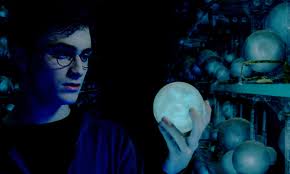
Or, in this case, drops out of the sacred orb of Shen’nikarruan.

With the cinematic success of Lord of the Rings and the overall success of Harry Potter, fantasy is a hot genre again. Mix in a little softcore horror like Twilight and a lot of folks are probably tempted to write in that sexy-dark-mystic sort of style. Even a lot of people who’ve never had any interest in this sort of story before. Which is a shame because a writer really needs to be familiar in whatever genre they decide to write in.

A common problem beginning writers make–especially genre writers– is to fall back on magic to solve their problems. Characters get into a load of trouble, back themselves into a corner, square off against nigh-impossible odds, but are saved at the last moment as they all lay hands on the sacred orb. It doesn’t matter how world-spanning or universe-threatening the problem is, when the pure-of-heart grab that big emerald sphere it’s all going to go away and make life so much better for the good people.

For the record, it’s not just mystic orbs. The offenders also include–

–magic wands

–mystic swords

–enchanted rings, necklaces, or bracelets

–tiger-repelling rocks

–artifact X which must be returned to/ retrieved from the temple of Y

Now, before any other genre writers reading this start feeling smug, let me remind you of Clarke’s Law. You’ve probably heard some variation on it before. Any sufficiently advanced technology would be indistinguishable from magic. A writer may call it the Technotron 9000 and explain it harnesses neutrinos to bend quantum fields, but for all intents and purposes it’s just another mystic orb.
This all goes back to something I’ve ranted about many times before. No one wants to read about a problem that solves itself. They want to read about characters who solve problems, preferably the characters they’ve been following for most of your manuscript. Lord of the Rings does not end with god-like mystic flames destroying the one true ring when the heroes reach the end of their journey. No, it ends with one character all-but driven mad from the burden of carrying it and another one who was driven mad by the ring accidentally destroying it because of his obsession to possess it again. Likewise, Harry Potter never beats his final challenge with magic but just through his sheer determination to do the right thing.

Y’see, Timmy, in good stories the sacred orb of Shen’nikarruan isn’t a solution, it’s just a MacGuffin. For those not familiar with the term, Alfred Hitchcock coined it to describe things that motivate plot and story without actually interacting with them. The Maltese Falcon (in the book and movie of the same name) is a classic MacGuffin. It’s what motivates almost every character in the story, but the legendary statue itself never even appears.

Now, as I often point out, this isn’t to say a magical plot device will never work. If you think about it, Raiders of the Lost Ark has God step out of a box at the last minute to kick some Nazi ass (and save Indy and Marion). Take a moment, however, and think of how many other things in that movie have to work perfectly in order for that ending to work. It’s a level of storytelling most of us–myself included–never have a prayer of reaching.

Which actually brings me to a potentially touchy angle, but one I feel obliged to point out. So if you’re easily offended, you may want to stop reading now…

There is a nice little niche market of faith-based films these days, and a few well-paying contests as well. In these stories, it’s completely acceptable to have prayers answered and problems solved by divine intervention. Heck, it’s almost expected in some of these markets. The Lord steps in to cure diseases, cast out evil spirits, and sometimes even make a personal appearance. At the very least, he’ll send down one of the archangels to help that nice woman who couldn’t pay her mortgage to the evil capitalist developer.

The thing is, despite the previous example of Raiders, “God saves the day” really isn’t an acceptable conclusion to a story. In those niche markets it’s fantastic, but for every other audience it’s just as much a cop-out as the magic orb or the Technotron 9000. The characters aren’t solving problems or doing anything active. In fact, they tend to be innately passive while they wait for the big guy to solve things for them. Which makes sense, because these faith-based stories usually aren’t about the characters, they’re about a religious message the writers are trying to get across.

Again, nothing wrong with having magic, uber-technology, or even divine intervention. But this isn’t ancient Greece. These days, it has to be about character first.

(I had no idea how I was going to end this, and then the archangel Beleth pointed out that I could just bring it back around to the opening idea…)

Next time, I’m going to drop names and prattle on about the time I talked with Hawkins from Predator about storytelling. Yeah, the skinny guy with the glasses. Him.

Until then, go write something.
I’m sure most of you reading this are familiar with the title of this week’s little rant. Nowadays it’s just useless marketing hyperbole. I mean, really, is every episode of Gray’s Anatomy that powerful?

If you watched television as a kid, though, you knew that phrase was a hidden message from the network. We all knew “on a very special episode of…” really meant “this week’s episode is going to suck.”

Really suck.

Because “on a very special episode of…” meant this week wasn’t going to be about laughs or action or something enjoyable. It was going to be about a message. A message that, more often than not, was wedged and crammed and kicked into the episode until it fit. The characters were going to talk about racism or bigotry or death or drugs or sex or something else that just did not fit the tone of the show. Those episodes always felt awkward and forced because they disrupted the storytelling rhythm the shows had established.

One thing I see on a fairly regular basis is people who decide to write a story about a message. Not a story with a message, mind you, but a story about a message. There’s a small but oh-so-important difference there. When the writer is more interested in the message than the story, things quickly fall out of balance.

Let me give you a few examples.

I’ve seen scripts about people sinking deeper and deeper into addiction and dragging their friends and loved ones down with them. There’ve been more than a few stories about people who mess up the priorities of their lives and later come to realize what’s really important. I also read a story about the ghosts of aborted children haunting a clinic worker until he leads a crusade against his evil and sadistic employers. For the record, they really were evil and sadistic, and would keep a running tally of which doctor could abort the most babies in a day. I am dead serious about this.

I was even given one deeply disturbing script where a cute young woman came to realize that the real problem with America today was “all the coloreds moving in everywhere” and how much better off everything would be if we just got rid of them all… y’know, for the good of the country.

Yeah. I probably would’ve called the FBI about that last one if there’d been contact info on it. Needless to say, I gave them a low score.

Now, before anyone freaks out, there’s nothing wrong with having a message in your story. Most of the best stories do, on one level or another. Problems arise, however, when the writer approaches things from the wrong end, like some of the folks above did.

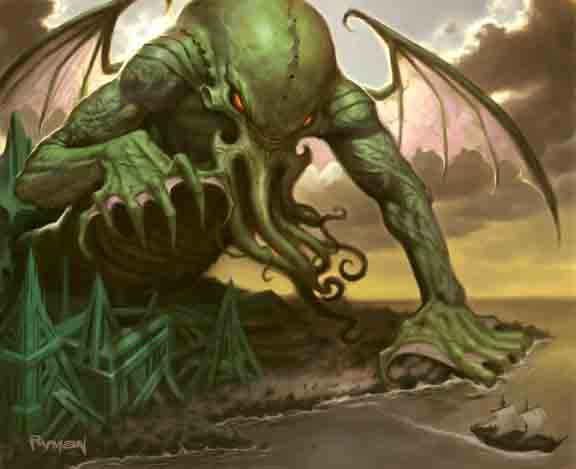
Here’s a simple test. If your story or script has a message in it (God is good, illegal immigrants are bad, Cthulhu is really bad), at what point did the message come into it? Did it grow naturally from the idea for a certain character or scene? Or did this story start with the message, and then get fleshed out with minor things like characters, plot, and dialogue?

When a writer starts with the message, everything else tends to get slaved to that singular idea. Characters in these tales tend to have awkward or unbelievable motivations because the story isn’t about what these folks would naturally, organically do. Their decisions, actions, and reactions are bent to reinforce the idea that’s being promoted. So they often come across as puppets that all enforce the idea. In one of the examples I gave above, no matter what your personal views, does anyone seriously think the people who work at abortion clinics sit around twirling their mustaches and giving out Machiavellian cackles as they do their job? Of course not. If they didn’t, though, they’d weaken the message that particular story was written around. So the story suffers because the characters aren’t relatable or believable.

This leads into the next point, which is dialogue. When the message dominates, dialogue suffers. People will spout out emphatic monologues, and a lot of the time they just sound insincere. The characters just end up serving as a mouthpiece for the writer’s views and ideas. Like motivations, this makes their words become stiff and wooden. It also has a tendency of being very on the nose. Characters can’t be there just to parrot the writer’s viewpoint on different matters.

Now, I gave some vague examples above, but let me give you a specific one. Who’s heard of Robinson Crusoe? Most of you, yes? I’m also guessing most of you have read it in one form or another as well.

How many of you have read the sequels?

I’m not talking about spin-offs or modern takes or anything like that, mind you. I’m taking about the two sequels Daniel Defoe himself wrote to one of the most famous books in English literature. Crusoe ends by claiming this is the end of the first volume of his adventures, after all.

Did you even know there were sequels?

Most people don’t, and they reason they don’t is because the sequels are considered to be some of Defoe’s worst writing. Now that he had an incredibly popular character, he decided he had a vehicle to pontificate about whatever he felt like. So in the next two books, Robinson Crusoe basically complains about people a lot and makes snide comments about how much more virtuous he is than everyone else. The most believable part of the second book is when the crew of his ship get tired of this non-stop commentary about their flaws and decide to dump Crusoe on the next island they pass (how’s that for irony?). The third book borders on being a manifesto from Defoe, thinly veiled by Crusoe’s voice.

Needless to say, books two and three didn’t go over that well with anyone.

Y’see, Timmy, your story can have a message, but it can’t be about the message. The message needs to serve the story, not the other way around. When it gets skewed like that, the writer ends up with something on par with one of those silly “Chick tracts” that tried to show how Dungeons & Dragons always led to suicide and Satanism. Not necessarily in that order.

And nobody here wants that, right?

Next week, I want to talk to you medieval primates about my boomstick.

Until then, go write.

July 22, 2010 / 3 Comments

Flow Charts

Do you want to be a writer? YES / NO

Continue to the next paragraph.

One thing I’ve mentioned here once or thrice before is flow. It’s one of those elements of writing that we’re all instinctively aware of but it rarely gets a consistent name put to it. I first heard it referred to as flow years back by a writing coach named Drusilla Campbell. It was such a perfect term I’ve used it myself ever since.

Flow is how well the reader can move through your writing. It’s the way every line of dialogue rolls off the tongue, how each paragraph and chapter draws the reader into the next one. Like the flow of a river or the flow of traffic on a freeway. When the flow of writing is going well, you love it.

We can also define what makes for bad flow. When the river or the freeway aren’t going so well you get rapids, bottlenecks, gridlock, and so on. More to the point, you get frustrated and angry. A story that makes you stumble a lot doesn’t flow well at all. Clumsy, wooden dialogue and poor characterization don’t work either. Whenever a reader pauses to scratch their head or roll their eyes over the latest “twist,” that’s another speedbump in the proverbial road. If you’ve ever tried a book and just couldn’t get into it, odds are the flow sucked. You’ll read, trip over a page or two, and put it back down.

Y’see, Timmy, it’s not a bad thing to shock the reader once or twice with a bit of unexpected action, a clever reveal, or something else that jars them out of complacency.. It’s important, though, to remember that those shocks are the exception, not the rule. If a story is nothing but flashbacks or “gotcha” moments one after another, it degenerates into nonsense and frustration.

Readers keep reading material with good flow because it’s easier to keep reading than to put it down. Stephen King writes books with great flow. So do Lee Child and Clive Cussler. They’re all famous for it, in fact. Shane Black’s screenplays are notoriously fun to read. It’s also a big part of the reason all these people keep selling their work for high sums of money.

Now, for the record, flow is another one of those things I believe you can’t easily work on and develop in your writing. It’s one of those X-factors, where you can manipulate each of the variables but still not affect the final outcome. You just have to keep writing and keep writing and eventually one day it will all come together.

For example, in Goju-ryu, one of the original three forms of karate developed on Okinawa, there’s a kata called senchin (no, trust me, this is another one of those brilliant metaphors). The moves for senchin are often taught to the white belt novices. The instructors know that by the time the novices become black belts, they’ll have an understanding of how all the moves go together and can start to work on the form itself. The Okinawan masters understand that working on parts doesn’t always help you master the whole. One day, it just all comes together.

I’ve mentioned most of these before (often in greater detail), but here are a few easy tips that can help the flow of a story. I’m not saying doing these guarantees great flow, but if you’re going out of your way not to do them… well…

Keep it interesting– Easiest way in the world to keep readers from getting bored is not to be boring. A story that drags on and on before getting to the point doesn’t have good flow. If you’re telling a story, get to the story. If it’s a murder mystery, give me a body. If it’s sci fi, show me something amazing. If it’s a love story, show me passion on some level.

Keep it honest– Nothing will kill a story’s flow faster than something that reads as inherently false. People don’t give long speeches about love, honor, or duty in real life. Most of us stopped with the silly, mushy, giggly, fluttering eyelids in ninth grade. And it takes a lot for someone to stay angry for days, let alone years. Fake emotions and actions comes from fake people. Fake people are boring. See above for tips on boring your reader.

Keep it simple— If a writer tries to cram fifteen supporting characters, eight subplots, and the setup for four sequels into a 110 page screenplay, there’s not going to be a lot of room for a coherent story. If said writer decides to alternate each chapter, scene, or spoken line of dialogue between one of ten different time frames it’s going to keep knocking the reader out of the story as they try to keep track of what’s happening where and when to who. Don’t forget the basic goal of writing is to make the reader go on to the next page, not to baffle and confuse them.

Keep it smooth — If you’re picking obscure, awkward, or overly-long words just to show off your vocabulary, there’s a good chance you’re disrupting the flow of your own writing. It’s very impressive that you can picture what a titian-haired female with atramentous works of muted ink inlaid in her flesh looks like, but it’s much smoother, easier, and just as visual to tell us she’s a tattoed redhead.

Keep it relevant–One thing that pretty much always causes a stumble is when the writer adds in something completely irrelevant. Not when this character makes an odd movie reference or a cat walks by for no reason. No, the stumbling point is when the writer spends a paragraph or a page or more on something that has no bearing on the story whatsoever. When there’s an exacting description of the bus driver, a monologue about the morality of Israel vs. Palestine, or a flashback to fourth grade art class, odds are the flow has just been dammed up for no reason.

Watch your dialogue– You can get away with one character who talks like a robot and uses all those obscure, overly-long words I was just talking about. Possibly another who keeps slipping into a foreign language. Too much unnatural, stylized, or just plain bad dialogue brings the story (and the reader) to a screeching halt, though. Mechanics talk like mechanics. Investment bankers talk like investment bankers. Heavily armored mutants from Skaros talk like heavily… well, you get the point.

Have characters act in character.— On the same panel where she talked about flow, Drusilla Campbell commented that when the nun viciously kills a gardener is also when most people remember they have laundry they should be folding. Master snipers who can’t hit what they’re aiming at. Genius investigators who miss obvious clues. High school students who talk and act like 35-year-old investment bankers. If you’re not very, very careful, these are the characters who get books and screenplays tossed in the big left-hand pile.

Take it seriously– So, everyone makes a joke now and then to break the tension. But you should never be winking at the audience. Even if you’re doing camp or comedy, you need to be approaching your material as a sincere and honest effort on your own part. If you’re not, the reader will know and they won’t take you seriously. Not being taken seriously gets your manuscript put down in the left hand pile. After all, if the reader thinks the events in your writing don’t mean all that much to you, why should they care about them?

Eight tips for all of us to follow. Especially you. Yeah, you.

Next week’s little rant comes with an important message, so please be here.

Until then, go write.

June 10, 2010 / 2 Comments

Lifts and Supports

Perverts. Your minds always go there, don’t they?

By the way, I’d like to take this moment to note that this marks my 100th post on this here ranty blog. Who would’ve ever guessed I’d have this much to say about writing. Well, without it devolving into incoherent jabbering and a lot of gestures.

Anyway…

There’s a comic book writer/ novelist/ screenwriter by the name of Peter David. If you’re reading this and haven’t heard of him, I highly recommend hitting Borders or Amazon and grabbing one or three samples of his work. The man knows how to write characters like no one else.

In one of the early issues of his run on the comic X-Factor, David had someone make the keen observation that every super-hero group has a strong guy. The immediate joke was to explain the huge muscle-bound guy on the team (who was then inspired to adopt the codename “Strong Guy”), but there’s a larger point to be made with this.

Every superhero group has a strong guy because at some point they need a strong guy. As a writer, the reason you have a character who can bench press 90 tons is because at some point in the story there will be a Sherman Tank that needs throwing, a house-sized boulder that needs to be shifted, or a giant ninja-robot between your team and their ultimate goal. You put the strong guy on the team because you’re going to give him a chance to show off his strength.

This has been an enduring theme in literature for centuries. The mismatched team where every member eventually becomes necessary. You’ve probably heard some variation on the classic fairy tale about the six friends. A young man sets out to perform some tasks so he can win the hand of a princess. During his journeys he becomes friends with the fastest man in the world, the strongest man in the world, the hungriest man in the world, the man with the sharpest vision in the world, and so on. Oddly enough, to complete his tasks the young man needs someone who is incredibly fast, strong, hungry, etc. Charles McKeown and Terry Gilliam adapted this tale, by the way, and called it The Adventures of Baron Munchausen.

Now, there’s a simple corollary to this I’m sure most of you have already figured out. If there isn’t something for the strong guy to do, you shouldn’t have a strong guy on your team. You’ll notice few superhero groups include someone who can blink at amazing speed. None of the variations of the Grimm’s fairy tale feature someone who can shoe oxen better than anyone else in the world. In no version of the Ocean’s 11 films do they make a point of getting a great pastry chef on their team (although I freely admit I never saw the last one so… maybe they did). These people all may be fascinating in their own way, but they don’t really contribute anything to the particular story being told. High-speed blinking may be superhuman and somewhat interesting, but it’s also kind of useless when you’re saving the world from Galactus.

Thing is, this little observation holds for every character, not just ones in genre stories. If the character isn’t doing anything and doesn’t contribute, why are they there? As the name implies, a supporting character should be helping to hold things up. Not big things–that’s what your main characters are for–but they’re bearing the load around the perimeter and on the edges. They keep the tone balanced, give the main characters a sounding board for ideas and exposition, and help sustain the suspension of disbelief. If you’ll pardon my saying it, they’re the ones keeping it real.

A good chunk of the time, though, a supporting character get stuck into a story for the wrong reasons. Often it’s because the writer has seen a similar character in a similar story, so said writer just wedges a rough copy of that character into their own story. It doesn’t matter if this character does anything or not, there’s just this unspoken assumption they have to be there. A lot of comic-relief characters come about this way. Fledgling comedy writers stick in the goofy sidekick or wild neighbor because comedies always have a goofy sidekick or wild neighbor. Zorro, the Green Hornet, and Batman all have helpful manservants, so I should stick one into my adaptations of Doctor Fate, right?

Y’see, Timmy, much like the golden rule, just because something works in your story doesn’t mean it’s going to work in my story. This is especially true of the characters. I can’t just cram a random person into my novel or screenplay because there’s a good chance they don’t mesh with the story or the existing characters. Forcing them in means they’re unnatural, which usually means they’ve just become unbelievable characters within the scope of this story. Why would Phoebe and Dot possibly be friends when they’re complete opposites in every way? How could a bumbler like Yakko have possibly made it onto this elite squad of high-tech thieves? Why would dark ninja overlord Wakko allow someone like me (or worse, me as played by Rob Schneider) to stumble along behind him on his mission of vengeance? There has to be a reason for a supporting character to be in your story, otherwise they’re just eating up words and pages that should be spent on your main characters.

Speaking of which, a follow up problem is when main characters take a backseat to the supporting characters. We’re following Wakko for the whole manuscript, but suddenly at the end Chicken Boo dashes in and defuses the bomb, gets the girl, or lands the plane. To be terribly honest, I did this myself in the first two drafts of Ex-Heroes. It wasn’t St. George that beat the monster in the end, but a guy on the walls of the Mount named Ilya. It was still a fun, cool scene, but what I’d effectively done with it was made my hero useless. He didn’t save the day–some regular guy with a rifle did. Not impossible, but also not what this story was about.

Main characters do the main things. Supporting characters do lesser things. In the movie Aliens, Corporal Hicks survives and helps Ripley and Newt escape the hiveworld because he’s a main character. Vice versa, he’s a main character because he survives and helps Ripley and Newt escape the hiveworld. Aliens doesn’t focus on Frost or Apone or even Vasquez because they’re the lesser characters. One of the reason we can tell this is because they die early on in the story.

It sounds a bit like circular logic, I admit. However, don’t look at it from the story point of view (where it’s confusing) but from the storytelling point of view. If Hicks wasn’t the main character, why would he survive over someone else? Why would he succeed where others fail? I’m not a good storyteller if the focus of my tale isn’t about the people who survive and succeed (assuming anyone does survive this particular story).

Dan Abnett has a habit of introducing characters in his Gaunt’s Ghosts series, giving us a name and a thumbnail description, showing them in a few action scenes, and then killing them. Why? Because the Ghosts are fighting a war. They’re almost constantly wrapped up in one battle or another, and, awful as it is to say, it’s not a believable war when only the bad guys die. Abnett introduces these secondary characters–and then often shoots them in the head– to remind the reader how brutal life is on the battlefield. Even the sci-fi battlefield of the future.

Next time around, on a somewhat similar note, I’d like to prattle on about your story. The one you want to tell.

Until then, go write.

Categories