

Category: character
March 15, 2018 / 4 Comments
It’s Not THAT Bad
I tried a few pop culture references for this week, but none of them seemed to work just right. They weren’t awful, but that’s the best I can say about them. They weren’t awful.
Speaking of which…
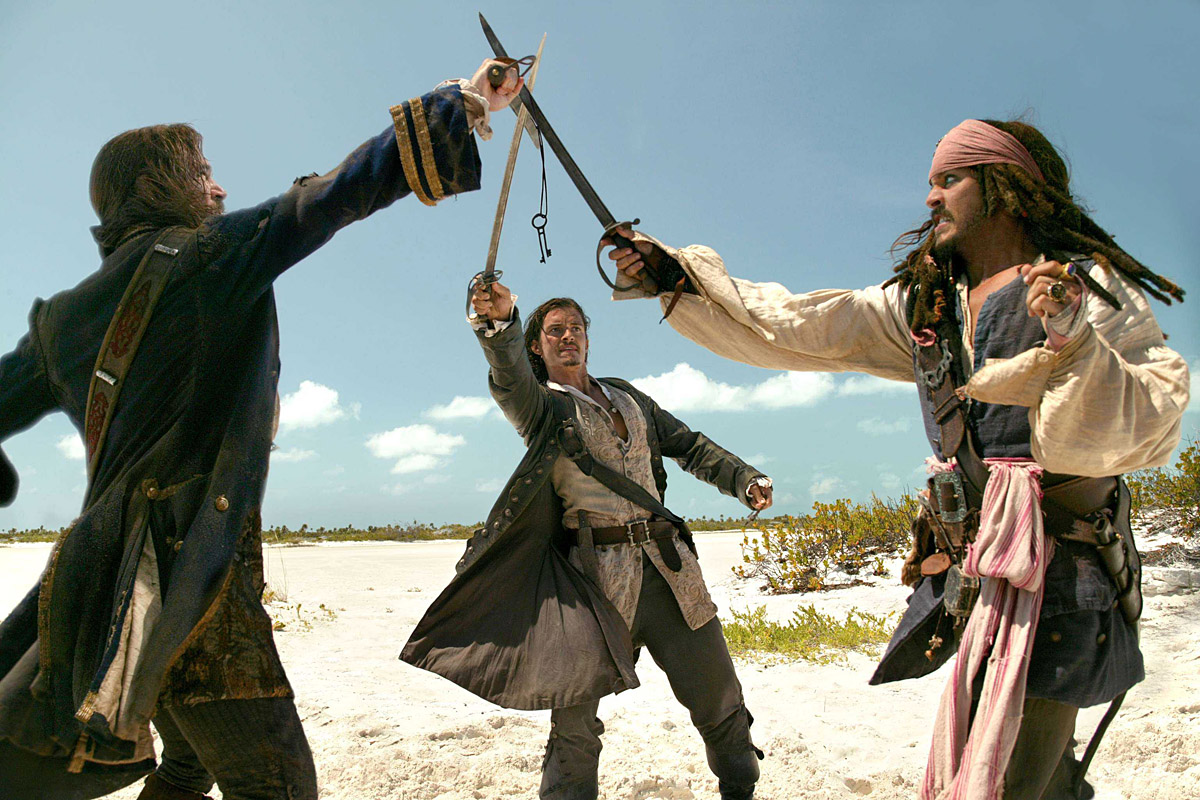 A while back I mentioned an idea called Crap +1. It’s a viewpoint screenwriters Terry Rossio and Ted Elliott noticed (and named)–a common way some people approached screenwriting. It’s a mindset where I look at something absolutely horrible and say “well, my script is better than that.” And that got made, therefore logic and fairness dictate that my script deserves to get made, right?
I’m betting you’ve probably seen this reasoning applied to books, too, yes? And publishers? That garbage book got published, so of course the publishers are going to want to snatch up my slightly-better-than-garbage book. The bad book proves I deserve to be published just by existing.
It doesn’t work that way, of course. The big problem with the crap+1 theory is that what it really justifies is laziness. It assumes my work just needs to be “slightly better” to qualify as good. Which simply isn’t true. My story might be “better” than an illiterate piece of derivative fan-fic… but that still doesn’t mean my story is any good.
I’ve found this mindset also pushes a certain degree of entitlement. The idea that I’m somehow owed an equal form or level or success (logic and fairness, remember?). If that made it, I deserve to make it. At the end of the day, nobody else’s success has anything to do with my success. The universe—or a Big Five publisher—is not required to do something for me just because it did it for someone else who I feel is less talented/ less creative/ less determined/meaner/uglier than me.
It’s an easy trap to fall into. The crap + 1 mindset. Try to avoid it. In all aspects of your life.
Anyway, it struck me recently that some writers use this sort of logic and justification within their stories, too. Especially in the darker, grittier tales that some folks like. A lot of these stories operate under the idea that my character or their actions or the outcomes will be seen as good once we compare them to something worse. The story has unlikable, awful people as our protagonists or in the cast of supporting characters around them… but that’s okay because there are people in the story who are even more awful and unlikable.
Think about it. How often have we seen something where my protagonist is a violent, abusive, racist… but, wow, you should see the bad guy! My heroine just brutally killed two dozen people, yeah, but that’s not even half as many as her antagonist killed in an earlier scene. Hell, sometimes that bar is literally as low as “well, he didn’t try to rape any of them… I guess he’s the one we’re rooting for?”
How ridiculous is this when we stop and think about it? Yes, serial killer Jeffrey Dahmer was responsible for more deaths than Charles Manson, but that doesn’t mean Manson was a nice person. Yakko isn’t likable because he’s only cruel to women when he could be cruel to women and children.
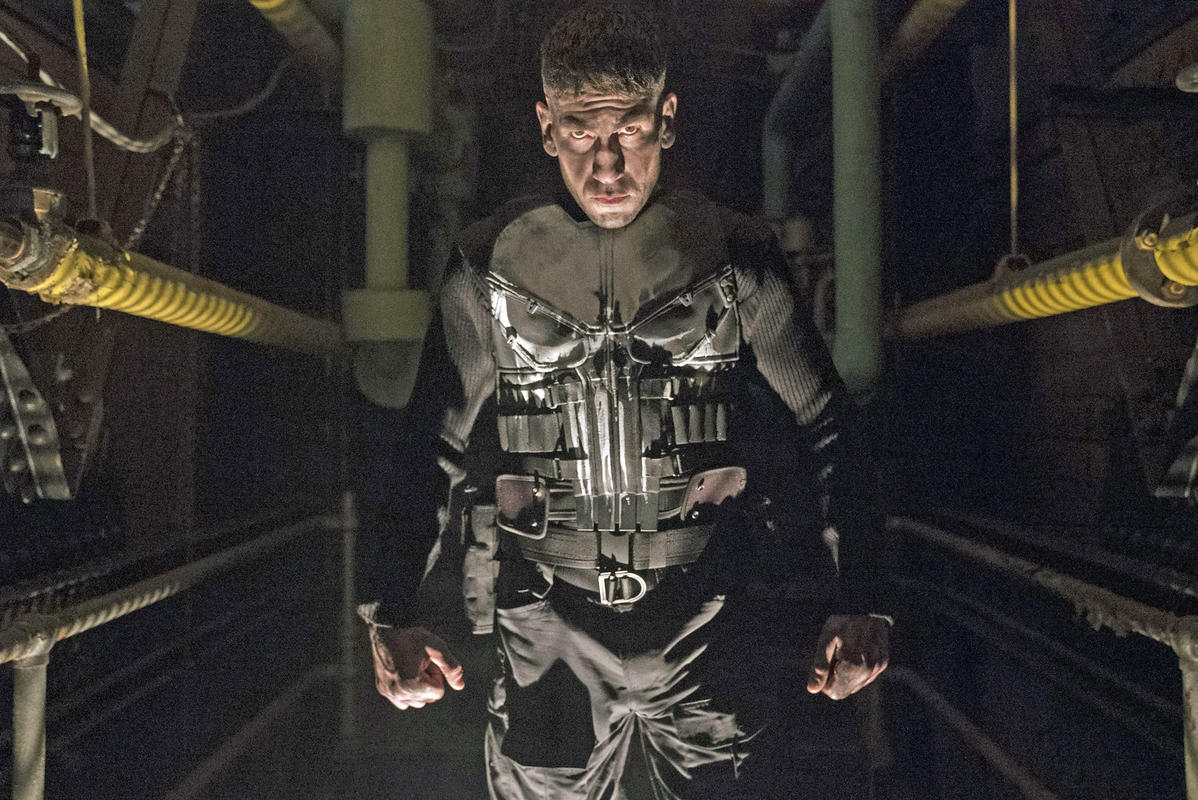 A. Lee Martinez (he of the wonderful Constance Verity books, among others) made an observation once. Being a good person is more than not being a bad person. This is fantastically simple and true. It’s fine to say Wakko’s not a serial killer, but that doesn’t make him a hero. Or even a good person. That’s the kind of dating logic “nice” guys use. “Well, I’m not going to treat her like crap the way some guys would—so why doesn’t she want to go out with me?”
I’ve talked about this before when discussing characters, especially my main characters. They need to be likable. By which I mean, my readers need an actual reason to like them. A reason that counts as “good” when it’s divorced from any conditionals. Helping out someone in need. Showing restraint with power. Defending and supporting the weak. These are all inherently good actions that don’t need to be compared to anyone else’s to be good.
Not being awful is just… that’s the bare-bones minimum. It should be baseline human existence. It’s definitely not a quality to cheer about in my main character.
Along with the crap+1 idea, I think this is also a bit of binary thinking slipping in here. This character is marginally better than the antagonist, yes, but you know what else they are…? Not the villain. So, logically then, they must be the hero, right? I mean, who else can they be in my story?
And that brings me to one last aspect of all this. I’ve mentioned before the need for my characters to win. They can still get hurt, physically or emotionally–even die–but they need to succeed at their goals. Because my readers identify with the heroes, and they don’t want to identify with people who don’t win because it reflects back on them.
With this talk of being “slightly better than…,” it’s worth noting that the antagonist losing is not the same thing as the protagonist winning. They can be connected, but this isn’t always a nice Venn diagram overlap. If someone else stops the bad guy… that doesn’t mean my hero wins. If the antagonist somehow fumbles things themselves… that doesn’t mean the good guy succeeded. And if they villain just gives up and walks away… well… nobody’s really earned a victory parade for that.
My hero needs to actually be a hero…not just a rung above the villain. They actually need to win… not just be nearby when the plot is resolved. And all of this needs to be in my story, which is actually good… not just slightly better than someone else’s.
Next time… there’s something I’d like to discuss for the first time.
Until then, go write.
March 13, 2018
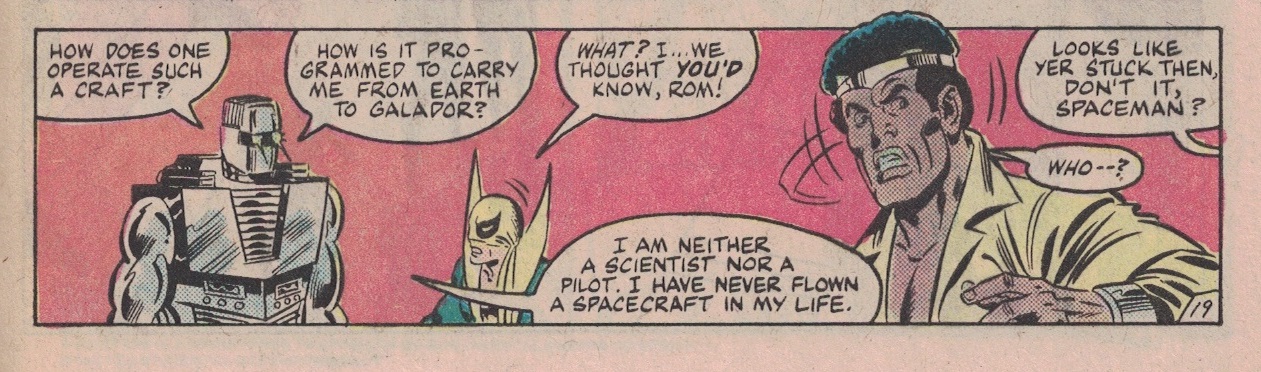
Writing Lessons from ROM
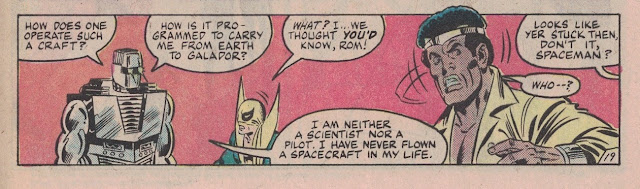
Eight-year old me learned a big lesson about storytelling from this one panel…
January 18, 2018 / 5 Comments
Down to Basics
It’s come up once or thrice that I’m a lover of bad movies. Partly for the laughing aspect, partly because I think you can learn as much from bad storytelling as you can from good. Partly because I need to justify my drinking, and some of these movies make it reeeeeally easy.
A while back I tossed out a list of really basic things a lot of these movies messed up. Film school 101-level stuff that people were getting wrong. Even though some of them went to film school. And I wondered if it might be possible to do something with stories in general.
Kristi Charish (of the fantastic Kincaid Strange series—book two coming soon) recently mentioned this idea (for a different topic) in a much better way—the invisible handshake. It’s sort of an unofficial, unspoken contract between the author and the reader. If you’re picking up my book, there are certain automatic assumptions you’re making about what I’ll be providing you with, and I should be meeting these assumptions. Basic things about plot and structure and character that are just… well, basic.
 At the end of last year I read a book that fumbled that handshake. Fumbled it bad. It was like that awkward moment with someone at the end of the night where you’re not sure how to say goodbye, so the two of you make a bunch of half-moves toward different things. Do we hug? Shake hands? Peck on the cheek? Write an awful book?
Kristi Charish (of the fantastic Kincaid Strange series—book two coming soon) recently mentioned this idea (for a different topic) in a much better way—the invisible handshake. It’s sort of an unofficial, unspoken contract between the author and the reader. If you’re picking up my book, there are certain automatic assumptions you’re making about what I’ll be providing you with, and I should be meeting these assumptions. Basic things about plot and structure and character that are just… well, basic.
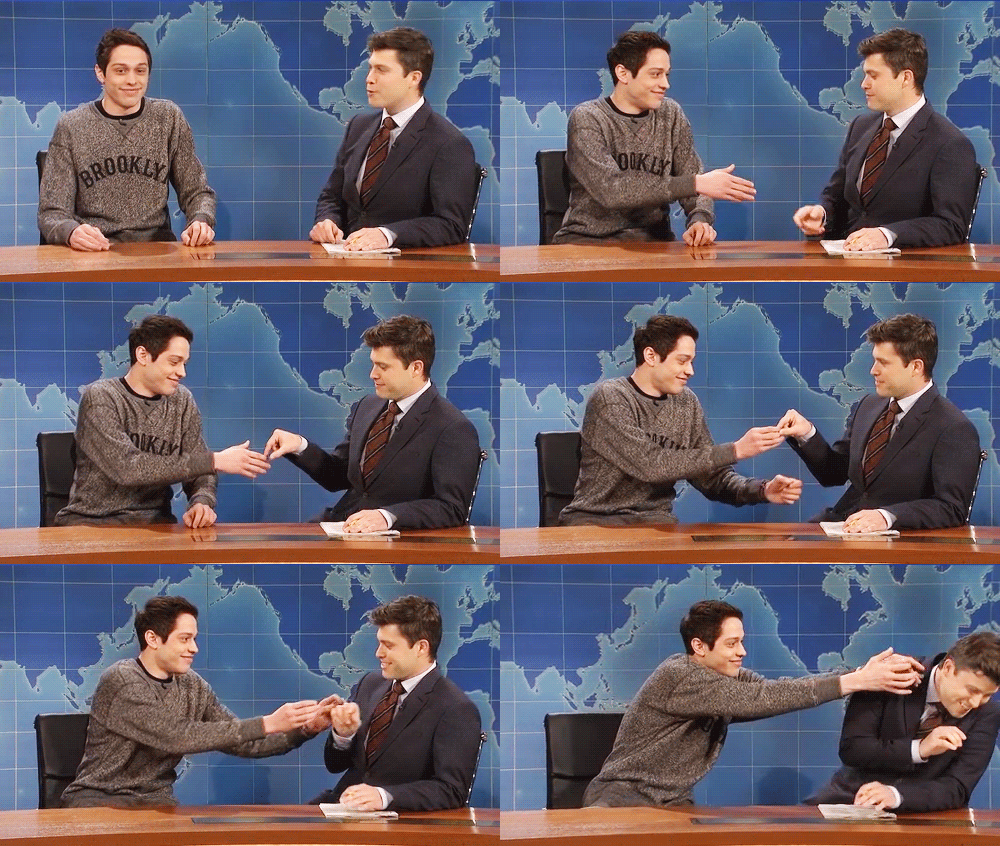 At the end of last year I read a book that fumbled that handshake. Fumbled it bad. It was like that awkward moment with someone at the end of the night where you’re not sure how to say goodbye, so the two of you make a bunch of half-moves toward different things. Do we hug? Shake hands? Peck on the cheek? Write an awful book?
 We’ve all been there, right?
I ranted a bit about said book on Twitter, but even then I was thinking I should revisit a lot of those issues here. And while said book was very rant-worthy, I’ve been .trying to keep things a bit more on the positive side here.
So, a few general things I need to keep in mind when I’m writing. I’ve mentioned most of them before, but I thought a general, all–at-once
First, I need to be clear who my main character is. If I spend the first four chapters of my book with Yakko… everyone’s going to assume Yakko’s the main character. This book’s clearly about him, right? So when he vanishes for the next seven chapters… well, people are going to keep wondering when we’re getting back to him. Because he’s the main character.
Now, a lot of books have a big cast of characters. An ensemble, as some might say. That’s cool. But if my book’s going to be spending time between a bunch of characters, I need to establish that as soon as possible. If the first three or four chapters are all the same character, it’s only natural my readers will assume that’s going to be the norm in this book.
Secondis that I need to keep my point of view consistent. This kinda goes with the first point—being clear who my main character is. Even with a third person POV, we’re usually looking over a specific person’s shoulder, so to speak. Which means that character can’t walk away and leave us behind. Likewise, we can’t start over Wakko’s shoulder and then driiiiiiiiiiiiiift over so we’re suddenly looking over Dot’s.
Again, it’s cool to switch POV and there’s nothing wrong with it, but I need to make it clear to my readers that I’m doing it. If they start seeing things from new angles or hearing new pronouns, it’s going to knock them out of the story and break the flow. That’s never a good thing.
Thirdthing I need to do is be clear who my actual characters are. Who’s part of the story and who’s just… well, window dressing. If my two protagonists go out to dinner, there’s going to be other people in the restaurant. But I shouldn’t describe them all. Or name them all.
Thirdthing I need to do is be clear who my actual characters are. Who’s part of the story and who’s just… well, window dressing. If my two protagonists go out to dinner, there’s going to be other people in the restaurant. But I shouldn’t describe them all. Or name them all.
Names and descriptions are how I tell my reader a character’s going to be important and worth remembering. Three paragraphs of character details means “Pay attention to this one.” So if I’m telling the reader to keep track of people for no reason, I’m wasting their time and my word count.

I want to note a specific way people do this, too. I’m calling it “describe and die” (trademark 2018). This is when the author introduces a character, spends five or six pages describing them, their history, their goals, their loves, their life—and then kills them. We’ve all seen this, yes? Here’s Yakkoshiro, a twenty-nine year-old salaryman who spends all his free income on Gundam models and always wears long sleeves to the office because he won’t stop wearing his fathers watch, even though nobody wears watches anymore and looking behind the times like that could hurt his chances at a promotion so… long sleeves, never rolled up, even when the air conditioner dies (which happens a lot). And tonight he has a date with the beautiful woman from the Gundam store, who he’s exchanged nervous banter with for months now and, oh, he’s dead. A kaiju stepped on him. Now, back to our heroes…
Don’t do that.
Fourthis that I need to have an actual plot before I start focusing on subplots. What’s the big, overall story of my book? If it’s about Wakko trying to save the family car wash, I should probably get that out to my readers before I start the romance subplot or the backstabbing partner subplot or the Uncle Gus has cancer and wants to travel around the world before he dies subplot. After all, they picked up my book because the back cover said it was about saving the family car wash or escaping that Egyptian tomb. I should be working toward that first—meeting those expectations.
If I’m spending more time on a subplot than the actual plot, maybe I need to revisit what my story’s actually about.
Fifth, closely related to four, is that my subplots should relate to the main story somehow. They should loop around, tie back in to the main plot, or at least have similar themes so we see the parallels. If I can pull out a subplot out of my story and it doesn’t change the main story in the slightest… I probably need to reconsider it.
And if it’s an unrelated subplot to an unrelated subplot… okay, seriously, I’m wasting pages at that point. Not to mention this all starts getting, well, distracting. I don’t want to kill whatever tension I’m building in my main plot by putting it on hold for eight or nine pages while I deal with… well, something completely unrelated. It’s like switching channels in the middle of a television show. Nobody’s saying what’s on the other channel is bad, but it doesn’t have anything to do with the show we’re trying to watch.
Sixth…
Okay, this is an odd one.
Remember how much fun it is when you meet someone you’re interested in and there’s all these fascinating little mysteries about them? We want to learn all their tics and hidden secrets. Where are they from? What’d they study in school? What movies do they like? How’d they develop a taste for that? Why do they have that accent? Where’d they get that scar? Just how big is that tattoo?
 But… we don’t want to learn those secrets from a book report. We want to hang out with these people, talk over drinks, go on road trips, maybe stay up all night on the phone or on the couch. It’s how we get to know real people… and it’s how we want to learn about characters, too. Pages and pages of backstory often makes characters less interesting because it leaves me with nothing to reveal about them. It kills that sense of mystery, because there’s nothing left to learn about them.
 There’s nothing wrong with me having all that backstory, but I don’t need to use it all in book.
And I definitely don’t need to reveal it all in the first two or three chapters.
Seventhand last is flashbacks. Flashbacks are a fantastic narrative device, but they get used wrong a lot. And when they’re wrong… they’re brutal. A clumsy flashback can kill a story really fast.
A flashback needs to be advancing the plot. Or increasing tension. Or giving my readers new information. In a great story, it’s doing more than one of these things. Maybe even all of them.
But a flashback that doesn’t do any of these things… that’s not a good flashback. That’s wrong. And it’ll bring things to a grinding halt and break the flow.
Seven basic things to keep in mind while I’m writing my story.
Now, as always, none of these are hard-fast, absolute rules. If I hire a pastry chef for my bakery, there’s always a possibility this particular one doesn’t use a whisk. There can always be an exception. But I should be striving to be the exception, not just assuming everyone will be okay with me not following all the standards. My readers are going in with certain expectations, and I need to be doing honestly amazing things to go against them.
Because if that same pastry chef also doesn’t use a spatula… Or butter… Or flour…
Again—the invisible handshake (trademark K. Charish, 2018).
It’s a legally binding contract in forty-two states and four Canadian provinces.
Next time, I’d like to tell you about something that happened off-camera on a TV show I worked on years ago.
Until then, go write