May 3, 2018 / 1 Comment

Dogs and Cats! Living Together!

            Pop culture reference!  From a movie I used to love and now have mixed feelings toward because of a bunch of internet trolls.
            But anyway…
            I was working on a rough outline for a book I’m hoping to write next year, and it occurred to me that I’d written a classic device into the story. About halfway through the book, my protagonist saves her cat.
            …in a really clever and freaky way, I assure you.
            You’ve heard that phrase before, yes?  Saving the cat?  I’ve talked about it here once or twice, and this little incident made me think it might be worth mentioning again.
            “Saving the cat” is a term screenwriter Blake Snyder came up with many years ago.  It’s when my character does something simple and quick early on in my story that gets everyone on their side.  The example Snyder uses is saving a cat.  My heroine sees a cat stuck in a tree, she gets the cat out of the tree.  No big deal, moving on, right?  It’s just a simple action or moment that assures my readers that this character is an overall decent human being.
            (fun fact—“saving the cat” is a reference to Ripley saving Jones in Alien. Seriously.  Look it up.)
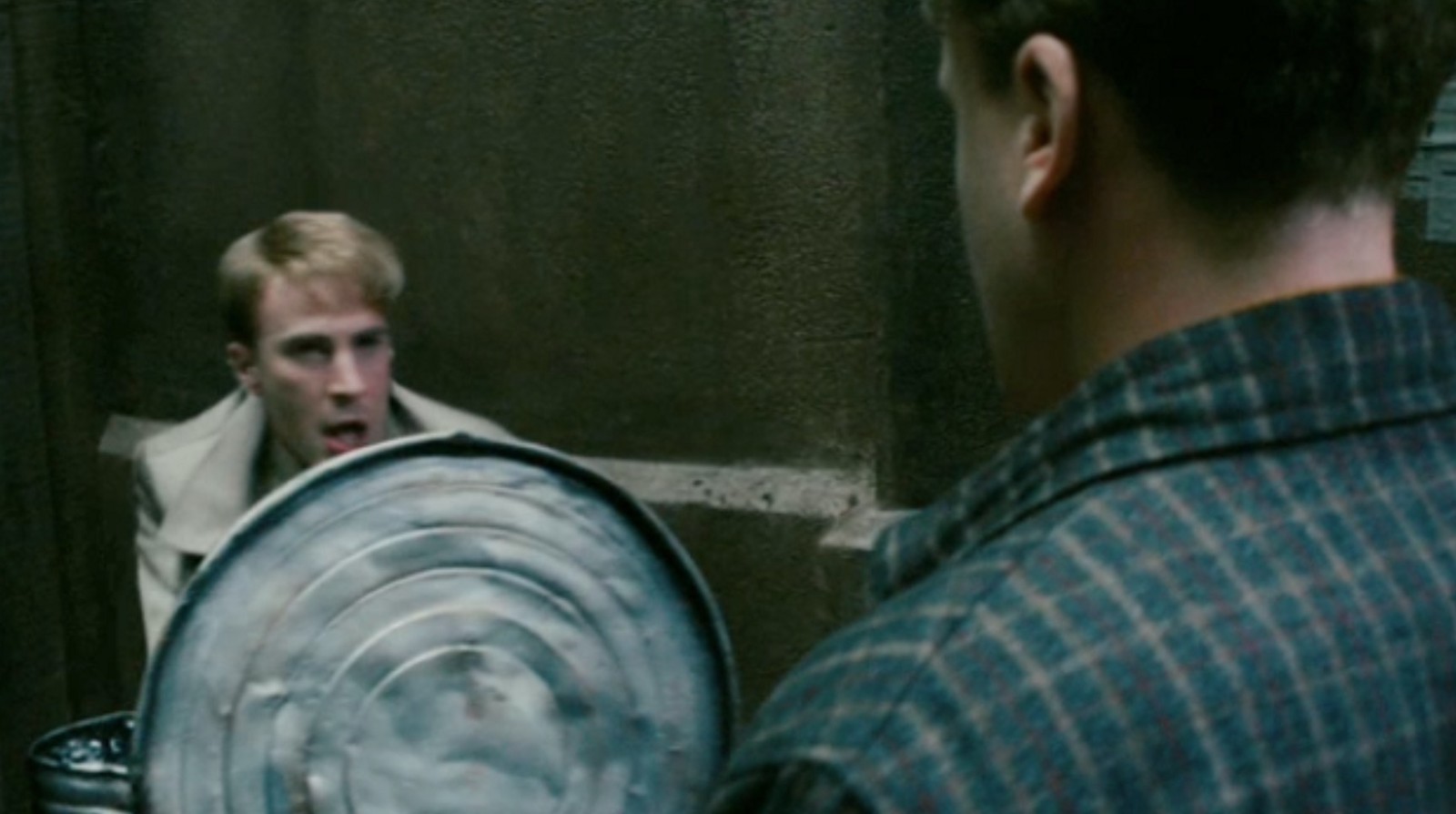
            Remember in the first Captain America movie, when scrawny Steve Rogers stands up to Hodge out behind the movie theater, even though Hodge is twice his size?  That’s a saving the cat moment.  How about in Wesley Chu’s The Rise of Io, when the title character makes a point of sharing her food with the mangy dog that hangs around outside her apartment?  Or when poor unloved Harry Potter sympathizes with the snake in the zoo about being raised in captivity? 
            All of these are save the cat moments.  They’re small, almost inconsequential things that rarely have repercussions in the larger plot. But they affect how we view the character.
            Now, here’s two key things to remember when I’m playing around with a save the cat moment.  First, as I mentioned before, they almost always come fairly early in my story.  Second. the reader has never been against the character who’s having this moment.  Because saving the cat isn’t about changing my reader’s opinion of this person, it’s about emphasizing their opinion.  It’s a shortcut to help my reader like them more and get invested in them sooner so I can move on to bigger and better things.  The plot, for example.
            Why do I mention these key things?
            Well, there’s another device that mistakenly sometimes get lumped in with saving the cat, but it’s really the exact opposite.  It’s not even a device so much as a bad habit some people have.  It’s called patting the dog.  This is when one of my characters does a small token thing late in the story and it’s supposed to make up for the numerous awful things we’ve seen said character do up ‘til this point.
            See, patting the dog is usually third-act type stuff, because I’ve spent all my story up til now establishing this character in a certain way, that they have certain beliefs and loyalties.  And the whole point of patting the dog is to then reverse how my reader feels about this person.  If up until now, we wanted to see them dead under a bulldozer, at this point we should cheer for them.  This one small act’s supposed to cause an emotional 180 in the reader.
            Like I said, it’s pretty much the exact opposite of saving the cat.
            It’s worth noting—patting the dog is almost always applied to antagonists.  Usually as some kind of twist to turn the bad guy into some sort of anti-hero, or even a full on hero.  When Wakko murders a dozen families and their children, but then realizes killing *this* person would be wrong… that’s patting the dog.  Same with the evil cheerleader who’s made Dot’s four years of high school a living nightmare, but then decides to chip and help make posters for a bake sale.  So’s the evil villain’s loyal lieutenant who tortures and maims our hero’s friends, but then discovers he has some vague relationship with the protagonist and decides to turn on his boss of ten years.       
            Now, this isn’t to say I can’t reverse how my readers see one of my characters.  That’s one of the big goals in writing—to change how people think about things. But it’s never going to be a quick fix I can pull off with one paragraph.  It’s going to take lots of moments and a lot of work.  It’s a process that can’t be rushed.  Even if I’m doing it with a clever twist, the reader needs to look back and see that the seeds of this change stretch all through my story.
            Because you may remember the other word for when someone does a sudden change of beliefs and loyalties.  It’s called a betrayal.  And no one likes to be betrayed. 
            Even if it’s just by something they’re reading.
            Next time, I’d like to talk a bit about what’s going on in that other scene.
            Until then, go write. 
April 27, 2018 / 11 Comments

Workhorses

            Very sorry for the delay. Taxes.  Jury Duty.  Making the New York Times bestsellers list with Paradox Bound.  And that’s just what I can talk about.  The past two weeks have been kind of crazy, and last Thursday was when it all caught up with me.  Well, Wednesday night, to be honest.
            But now that I’ve got my excuses out of the way…
            (did I mention the New York Times bit…?)
            I stumbled across an interview I did with author Jessica Meigs a few years back.  I said something that sounded vaguely profound.  Or, at least something I was trying to make sound profound…

            “I think people like radical new ideas, but sometimes—most of the time, honestly—they just want the basics. There’s only so many times you can go out and have a mesquite-smoked sirloin patty garnished with goat cheese and pine nuts on a croissant. It’s cool, but eventually you just want to have a cheeseburger.”
            If it sounds vaguely familiar, Stephen King’s said something similar a few times.  I think I may have been subconsciously mimicking him.  Plus, I’ve used cooking metaphorshere a few times.  Hopefully it’s not too obscure or vague as metaphors go.
            Now, I don’t watch a lot of cooking shows (used to love Kitchen Nightmares), but I’ve never heard anyone make the argument that we should all eat nothing but gourmet food.  I can imagine how much we’d all scoff at someone who campaigned to ban cheeseburgers.  And if anyone tried to tell me I’m a crappy cook because I don’t make my own pizza dough from scratch, I’d probably laugh in their face. And then not invite them over for pizza.
            But…
            Every couple of months I’ll see some new article about how aspiring writers should use better words. Better descriptions.  Better structures.  Only uneducated simpletons and talentless hacks would use verbs like said or was. You used redinstead of encarmine?  It’s cute that you’re trying to write for grade schoolers…
            None of this is true, of course.  And I can’t help but notice that the vast majority of people who make these declarations… well, they don’t tend to sell a lot of books.  In fact, I’d guess the majority of them aren’t even professional writers. Or even amateur writers.
            It keeps coming up, though. And aspiring writers keep trying to follow it.  And often they end up in this horrible downward spiral, progressing less and less as they try to make every sentence “better.”
            Possibly weird aside.  But it has a point.  Honest.
            There’s a type of riddle that often stumps people—the one with the obvious answer.  Those ones where we stop and think and think because the answer can’t be that simple.  I mean, isn’t the whole point of a riddle to trick you into giving the wrong answer?  So even if the simple answer fits all the requirements of the question, people will convince themselves it’s got to be something more complex and spend who knows how long trying to figure out what that unnecessarily complex answer must be
            When I’m telling a story, there’s going to be lots of times that call for simplicity over complexity.  It’s not uncommon for a short, straightforward sentence to have far more impact than a far more elaborately-crafted one.  A simple structure can be a faster, much more enjoyable read for my audience than a twisting, interwoven one.  And a basic character motivation is going to be much easier for my readers to grasp and relate to than one that needs thirty pages to explain.
            Let me mention two or three basic, solid writing devices that get a bad rap.
            It was/ he was/ she was—If I’m writing in third person, past tense (it’s not as dominant as it used to be, but I think it’s still the most common type of narration you’re going to stumble across), I’ll be coming across this form of “be” a lot.  If I’m leaning toward present tense—and that’s okay, a lot of the cool kids are doing it—I’ll probably see isjust as often.
            There are times was can be the sign of some needed work. Whenever I edit I tend to do a was pass and see how often I can turn things like “Wakko was running” into “Wakko ran.”  But sometimes, after all that running, I might just have “He was exhausted.”  Sure I could be a lot more descriptive and evocative, but there’s also going to be points where “He was exhausted” is quick, gets the information across, and lets me move on to other things.
            Said—The most basic dialogue descriptor there is.  Said is a classic. Quite literally.  People have been using said for almost a thousand years.  And it’s still around and still in regular use.
            I’ve talked about said a few times in the past, so I won’t go into too much here.  I just want to remind you that one of my first face-to-face interactions with an actual, book-buying, money-paying editor was him telling me to get rid of the dozens of different descriptors I was using on every page and replace 95% of them with said.  Let it do all the heavy lifting and save the special words for special occasions.
            Linear Structure—I also talked about this just a few months ago.  It’s very common for linear structure and narrative structure to run side by side.  It’s so common  because it’s the way we’re used to experiencing things.  Our brains are pretty much  programmed to accept stories this way, and if we’re given them in other ways we’ll try to mentally wrestle them into this format.
            Now, personally, I love a story that uses clever structure or devices to move the plot along.  I think most people do. That’s kind of the trick though—I’m using them to move the plot along.  If I have dozens of flashbacks that don’t really accomplish anything, or running the story backwards just because it sounded like a cool idea, I’m just making the story more complex for no reason.  And once my convoluted structure breaks the flow for the third or fourth time, well…
            Again, something like 85-90% of all fiction (numbers pulled from experienced ether) is going to have this very straightforward format.  There’s nothing wrong with it.  I shouldn’t be nervous about just… telling my story. 
            Y’see, Timmy, there’s nothing wrong with simplicity.  Nothing’s inherently good just because of overly-complex structure or incredibly obscure vocabulary.  My writing isn’t automatically better because I decided to use four syllable words rather than two syllable ones.
            And to be very clear—I’m not saying there’s anything wrong with complexity either.  Nothing at all.  There are some wonderfully complex books out there.  It’s when I insist that everything has to be one or the other that problems arise.
            Okay, that’s a lie.  Problems arise all the time.  Hell, I could shut this blog down if that was the only time problems arose…
            My point is, if I insist that everything has to be exquisitely crafted, impenetrably structured, polysyllabic sentences that run on for pages, collected in an order that would stump most cryptography software… my writing’s probably going to be very hard for most people to get into.  It’s going to be tough for it to have any kind of flow.  And it’s going to take me a very, very long time to get that first book done.
            And that means it’s going to be tough for me to have a lot of readers.
            Anyway… I’m going to go watch Infinity War now.
            Next time, enough about workhorses.  Let’s talk about cats and dogs.
            Until then… go write.
April 17, 2018 / 9 Comments

We’ve Never Met, But…

            I wanted to take a brief moment to re-address an issue I’ve seen pop up a few times recently.  It’s happened to me, it’s happened to friends, it’s happened to acquaintances.  Josh Olson and David Gerrold have both written impassioned pieces about it in the past.
            So let’s talk about bad networking…
            Yeah, this is going to be one of those divisive posts.  I’m betting a third of you walk away thinking I’m a jerk, and another third (possibly some overlap) walks away thinking this was aimed specifically at you. Very sorry in advance.  It’s really not aimed at anyone, just general observations from the past… oh, thirty years or so.
           These days it’s almost too easy to get in touch with people.  Especially famous (and semi-famous) people.  Email.  Social media.  Appearances.  It’s not uncommon to get a like, a response, maybe even a follow from somebody you admire.
            Of course, it’s important to be honest about what kind of relationships these are.  Mark Hamill’s liked two tweets I wrote, but I don’t think he’s going to be showing up to offer friendly support at my next book signing (even though we’re in the same city). Hell, Leslie Jones follows me on Twitter, but I’m pretty sure it’s just because I replied to a comment she made about Timeless and made her laugh.  That’s all it is.  I’ve gone to three Bruce Campbell signings, and the last two he pretended not to know me.
            Sounds a little creepy, that last bit, doesn’t it? 
            That being said…
            At least once a month I’ll get contacted by complete strangers or vague acquaintances, asking if I can read their manuscript or just a few chapters or maybe the final product for a blurb. Most of them are polite.  Some are… not as polite.  A few are flat-out arrogant.  I had one person demandmy time—insisting that I owed it to people to help them out.
            Actually, let’s talk time for a moment.
            I write full-time.  It’s my job.  It’s how I pay for food, rent, bills, everything.  I work forty to fifty hours a week.  Sometimes closer to sixty as deadlines loom.  I don’t think I’m terribly unusual in this.  I know a few professional writers who still have unrelated full time jobs, and then they’re still putting in twenty or thirty hours writing on top of that.
            Plus, there’s probably another ten or fifteen hours of various social media things mixed in there.  Posts, answering questions, chatting with folks online.  Tossing up random tips and ideas here.  It’s fun, and I enjoy talking with people, but that visibility is also part of my job.  Yeah, even when I’m drinking and ranting about bad movies on Twitter. Yes, I’m drinking on the job.
            And I get sent stuff professionally.  We’re just barely into the fourth month of the year and I’ve already been sent half a dozen books by editors, publicists, and my agent.  That’s part of the job, too.  Blurbing books helps out all of those people, so it’s just good office politics to read them.
            So—even on the very low end—we’re looking at a 55-60 hour work week.  I don’t think that’s out of the ordinary for a professional writer. Heck, it might be even a bit sub-par, by the standards of some folks.
            When someone asks me for a favor, they’re asking me to cut into that time.  To cut into the “this is how I make a living” time.  Oh, sure, I could cut into my free time instead, but… well, I don’t get a lot of it, so I tend to be protective.
            This isn’t to say I—or any professional—won’t help people.  I’ve got several writer-friends who help me with projects and I’d gladly help any of them with theirs.  There are people I’ve known for years and I often offer them tips or suggestions, when they’re wanted.  A few folks have standing offers from me to read their hopefully-soon-to-be-finished manuscripts.
            Again… I don’t think I’m out of the ordinary here.
            Alas, there is still this school of thought that successful writers must help less-successful ones.  Under any circumstances.  Bring their careers to a dead halt and do absolutely anything they’re asked to do.  Countless gurus push this idea, and spin it so the professional’s the one being rude or unhelpful is they don’t immediately leap to assist.  Especially when I call them on it in public.  Heck, if they don’t go above and beyond to help me… well, it’s just proof of what a selfish jackass they are. 
            But, hey, if I never ask, I’ll never know, right?
            Well… maybe, I should know.
            Here’s a handy checklist of things to keep in mind before I start asking favors of people.  If none of these apply to me… maybe I’m being a little forward asking a professional to give up part of their work week.
            And, yes, I’m mostly basing these off my own criteria and experiences.  But going off other interactions I’ve seen… I think most professional writers would agree with these.
[  ] I’m literate.
            If I’m trying to convince a chef to take me on as apprentice, what’s he going to think when I tell him my secret pizza topping is iron filings?  Or if I tell a doctor my last patient’s midichlorian count was super-low because Mercury’s in retrograde?  If I want help from a professional, I’ve got to show them I’ve got a firm grasp on the basics of my chosen field.  For us, that’s spelling and grammar.
            If I send a letter to pro-writer Wakko full of txtspk or weird references or just tins of spelling mistakes, I’m showing him I don’t know what I’m doing.  I don’t know the basics.  If I’m telling him this right up front, why would I expect him to spend several hours wading through my manuscript?  Or even part of it?
[  ] I’ve known them for several years 
            Just to be clear, if I said hello and shook hands with Wakko at a party three years ago, this really doesn’t mean I’ve known him for three years.  Do you remember that guy you met at a party three years ago and then never spoke with again? No? Odd that…
            This also holds true for being part of the same Facebook group.  And for following the same person on Twitter.  Or shopping at the same stores.
            Wait.  How do you know what stores they shop at…?
[  ] I’ve shared several meals with them 
            This doesn’t include me eating in the same food court while I stalked Wakko in the mall.  Again, what is it with following people around stores. Cut it out. That’s just creepy.
            No, this means me repeatedly sitting down with Wakko and chatting over drinks or maybe pizza and a bad Netflix movie.  What does it mean when I say I grabbed a bite with one of my friends?  Those are the same conditions I should be applying here.  That’s what real networking is.
[  ] We communicate with each other (via phone, email, social media) on a regular basis
            The key thing here is I need to remember communication is a two-way street.  Me spamming Wakko with messages and responses through multiple channels does not count as communicating.  Just being someone’s friend on Facebook, Twitter, or Mastodon doesn’t qualify, either.  No, really.  Check the terms of agreement—none of these websites have a “guaranteed friends with benefits” clause.  
            (If they did, we’d all probably be a lot more careful about accepting friend requests…)
[  ] I’ve lived with them
            This should be self-explanatory.  Not in the sense of “on the planet at the same time” or “crashed on the couch for a week,” but more in the “sharing rent and chores around the kitchen for several months” way.  After living in the same apartment/house/hostel for six months, I shouldn’t feel too much reluctance about asking Wakko to take a quick look at something I wrote. 
            Unless I really screwed him over on the last month’s rent or was a serious nightmare roommate
[  ] I’ve slept with them
            In any sense. Again, this should be self-explanatory.  I’d very much advise against making this an active networking technique, though.  For a whole bunch of reasons.
            But if I’m already sleeping with someone and they won’t look at my writing? Wow.  There’s some issues there I might want to address…
[  ] I actually want to hear what they have to say.
            Okay, here’s one of those ugly truths, and if you’ve been listening to me rant for any amount of time you’re probably already aware of it.
            Lots of folks say they want feedback, but what they’re really looking for is to get back wild praise and promises their manuscript will be passed on and up to agents, editors, publishers, and whoever makes the big Hollywood movie deals.  In my experience, very few people actually want to hear criticism of their work (even if it’s constructive).  They just want the fan mail and to skip to the next step. 
            Reading takes time. Writing up notes and thoughts takes time.  Honestly, if all I want is the praise and the handoff, I’m wasting Wakko’s time asking for feedback.  And he’s a pro, so his time is worth money.
[  ] I haven’t asked before.
            When I was in the film industry, there was kind of this unwritten rule—if you had some passion project or low budget thing you wanted to do, you could ask your professional friends to help out.
            Once.
            The idea is that I’m acknowledging their skills and experience, but also that I’m calling in a big favor asking them to work for little or no money.  So, again, the quiet, unwritten rule.  You got one. It would be tacky and unprofessional to ask for more unless a lot of time had passed.  Like, several years.
            And since everyone knew and understood this, people were much more cautious about asking.  They’d make sure their project was solid and ready to bring other people in on, because nobody wanted to waste their one shot.  It would suck to get Wakko on board and then realize my script needed another draft.  Or two more drafts.
            I don’t want to waste that opportunity.
[  ] I’m not asking for something I could find out on my own.
            Look, when I was starting out as a writer you had to dig through magazines, make phone calls, send request letters, then go dig through more magazines, make different phone calls, and send different letters–and keep track of all of it. 
            These days all of this information is available with a bit of thought and a few keystrokes.  Really, there’s a huge amount of information I can get all on my own without bothering anyone else.  Honestly, the fact that we’re all right here looking at this post means we all have access to Google, yes?
            I think a lot of time when this happens, people are looking for the “real” answers.  They don’t want to know someplace to sell short stories—they want to know the ‘zine that pays a dollar a word and always gets the Edgar/Hugo/Stoker Award for short stories and inevitably lands their contributor with a big five publisher within a three-week window.  They want to know the agent who has a direct line to Simon & Schuster and takes unsolicited submissions.  Because there has to be one out there, right?  Surely all those big authors didn’t spend time in the junior leagues.  They just leapt from obscurity to six-figure incomes… like I want to do.
            If I want to make writing my career, part of the work is… well, doing the work.
            If I can tic off a couple of these boxes, I’m probably in a good place.  I’d feel pretty good about dropping someone like me a note, so to speak.  Again, I can really only speak for myself, but I think most professionals would feel the same way.
            If I can’t put any check marks up there… maybe I should reconsider that email or tweet I’m about to send out.  I might be burning a bridge—perhaps even a couple bridges—before I get anywhere near it.  And if I try anyway…
            Well, I shouldn’t act indignant or surprised when things go up in flames.

Categories