
Pop culture reference.  Long overdue.
            This is overdue, too.  Many thanks for your patience while I was away last week.  ConDor was lots of fun, got to speak with some great people, and even ended up with a few ideas for future ranty blog posts.
            Speaking of which…
            I blabbered on a while back about the bad habit of sticking absolutely everything into a story—the kitchen sink approach to storytelling, if you will.  If I’m writing a historical story, it’s crammed full of historical events and people.  If it’s a sci-fi story, I make sure every single person, place, and thing has a sci-fi, high-tech twist.  When I do this, it can get distracting really fast as my reader is buried in facts and details that really have nothing to do with my actual story.
            Sometimes, writers do this with their characters.  They give them lots of elements and defining points.  Lots of them.  Again, the kitchen sink approach.
            For example, I could make Yakko a guy from the backwoods of Maine and constantly reference his sheltered New England upbringing.   And he’s also a Piggers fan (go Piggers!) who’ll cheer/ defend/ quote/ relate things to the Piggers at every chance he gets.  Oh, and he’s also a ninja who studied for twenty years in Japan before returning to America.
            Now, in and of themselves, none of these are bad character elements.  Being the fish out of water isn’t far from being the ignorant stranger.  Ninjas are cool.  Lots of folks love the Piggers.
            But if Yakko’s ninja skills are never going to be necessary to further the plot—or even just to deal with an action set piece—maybe they’re not such a great character element after all.  If his devout love of the Piggers is irrelevant to the story, maybe I shouldn’t spend forty or fifty pages on it.  And if I could switch his background from rural Maine to suburban Texas with no repercussions, maybe it’s not that much of a character trait.  Again, none of these are inherently bad elements, but I really should spend time on an aspect of Yakko’s personality or backstory that has an affect on the story. 
            And if he doesn’t have an aspect that affects the story… well, why is he there?  Sure, he cracks some funny jokes and other characters bounce some dialogue off him.  Maybe he even throws a key punch during a fight. 
            But in the long run, does Yakko do anything that another character couldn’t do?  What makes him unique?  Why is he here and not Wakko or Dot?
            I see a lot of this, I hate to say, in genre material.  Fantasy.  Urban fantasy.  Sci-fi.  Writers add in lots and lots of stuff to show how their world is different from other fictional ones.  And they do the same thing with their characters.  No one is just human.  They’re all sorcerers, telepaths, half-zombies, androids, paladins, and time traveling prophets.  But four out of five times this is just a label that’s been slapped on them as an attempt at characterization.  None of these traits are relevant in any way.
            For example…
            I read a story recently where one of the characters, a very small woman, turned out to be a female leprechaun.  Kind of makes sense—little leprechauns have to come from somewhere, right?  Whenever she got worked up (in any sense) her eyes and hair would turn green and she’d get a sparkly rainbow aura.  Halfway through the story she’s bitten by a vampire and becomes one herself.  So now she’s a vampire leprechaun.  No, I’m not joking.  She’d even change into a green bat.  And eventually she dies when she can’t find cover at sunrise.
            This all sounds kind of cool, yeah, but the thing is… none of this had any affect on the story. Not a single bit.  Her leprechaun abilities didn’t do anything.  Her vampire abilities didn’t do anything.  The combination of them didn’t do anything. 
            In fact, the biggest effect on the story was a four page discussion over drinks about being a leprechaun, followed by an interesting scene (see above) back at the protagonist’s apartment, and then many references to the fact that she was now one of the undead, and an undead leprechaun at that.  Heck, sunrise happened during a big fight scene, so she just could’ve been killed by one of the evil plant people.  If she’d just been a small woman the story would’ve progressed almost exactly the same, just with more time and space to give her some… well, useful traits.  And she would’ve been a lot more relatable
            If I had to give this a name, I’d call it the Stefon Factor.  If you’re not familiar with Stefon, the overly-enthusiastic club promoter from Saturday Night Live, he tends to talk about clubs that are filled with… well, oddities.  Lots of oddities.  In his own words, “This club has everything!”  But the truth is he rarely talks about the clubs themselves.  They just get defined by the patrons (which, granted, was part of the joke).
            Y’see, Timmy, in the same way a pile of random story points don’t automatically add up to an interesting story, a handful of assorted character elements doesn’t always result in a worthwhile character.  When I’m creating a character, his or her traits should have an effect on the story.  As I’ve mentioned before, every superhero group has a strong guy because at some point they need a strong guy.  And if my story has a vampire leprechaun, then at some point things should come to a dead halt if I don’t have the powers  of a vampire leprechaun to call on.
            Now, let me give you a more positive example…
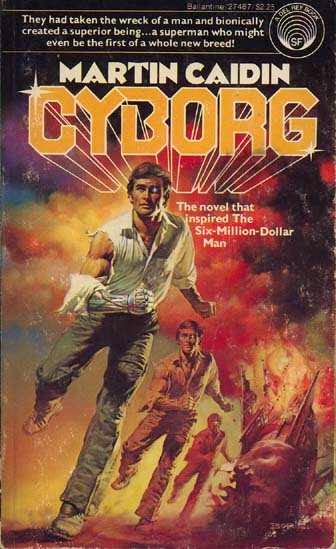
            There’s an old Martin Caidin book called Cyborg which inspired a much more well-known television show called The Six Million Dollar Man.  Now, this may sound kind of obvious, but the entire book is about the fact that Colonel Steve Austin has been loaded full of bionic parts after a plane crash.  He goes on a couple of missions which would be nigh-impossible without his cybernetics.  The story also focuses on Austin coming to grips with the fact that his government has turned him into a Frankenstein’s Monster, that almost half of his body isn’t him anymore.   If he wasn’t a bionic man, none of this would work.  The plot would struggle and his character arc would be nonexistent.  It’s not just a random label—the whole book hinges on the fact that he’s a cyborg.
            So give your characters relevant traits.  Make them necessary to your story.  Because if they aren’t… why are they there?
            Next time, a few quick thoughts on dating.
            Until then, go write.
March 14, 2014 / 1 Comment

Plucking the Black Bird

            Very sorry for missing a week.  And a day.  I’m really trying to get this draft done before I have a bunch of late spring/ early summer cons.  Like next week, when I’ll be at ConDor in San Diego
            Anyway, for today’s rant… a little storytelling history lesson.
           I’m sure most of you reading this are familiar with the classic film Satan Met a Lady.  It’s adapted from a novel, something Hollywood really did a lot of at the time (thank God that phase is over).  The story focuses on a pair of detectives who take on a simple missing persons case and  find themselves in a complicated web of double and triple-crosses involving a bunch of murderous collectors and mercenaries searching for a priceless artifact lost since the Crusades.  One of the detectives is killed and the other one ends up playing a dangerous game, bluffing the assorted treasure hunters while he tries to figure out who he can trust and how far he can trust them.
            Not ringing any bells?
            No, of course not.  Nobody ever remembers the originals, just the remake.  The third remake, in this case.  But at least this time Warner Brothers decided to stick with the title of the book—The Maltese Falcon.
            Alas, there was a slight problem… 
            The Maltese Falcon is a story chock full of adultery, violent crime, seduction, backstabbing, womanizing, and more than a sprinkling of (gasp!) homosexuality.  Today these all seem like good, wholesome American values and activities, I know.  In the early 1940s, though…
            Y’see, when Warner Brothers decided to film their now-legendary remake, Hollywood was operating under an incredibly restrictive set of rules called the Hays Code.  One way to think of it would be that the Code was Prohibition for the film industry.  It put severe and very strict limits on what could be shown or spoken about in a movie.  Swearing was not allowed, especially taking the Lord’s name in vain.  Same with drugs in pretty much any form.  Blood and violence had to be minimal.  There was a list of crimes you could only show in very specific ways (including arson, prostitution, theft, smuggling, murder, sabotage, and more).  Nudity—even suggested nudity—was right out. 
            Also, films had to be morally upright.  People had to be good or bad—no gray areas or questionable ethics.  The good guys always won, the bad guys always got what was coming to them.  No one insulted the church or the flag or anyone else’s flag.  This was not a time of moral conundrums.  Y’know, like whether or not white and black people should date…
            The thing is, though, in the end, the Hays Code really did make The Maltese Falcon a better movie… just not in the way the censors expected. 
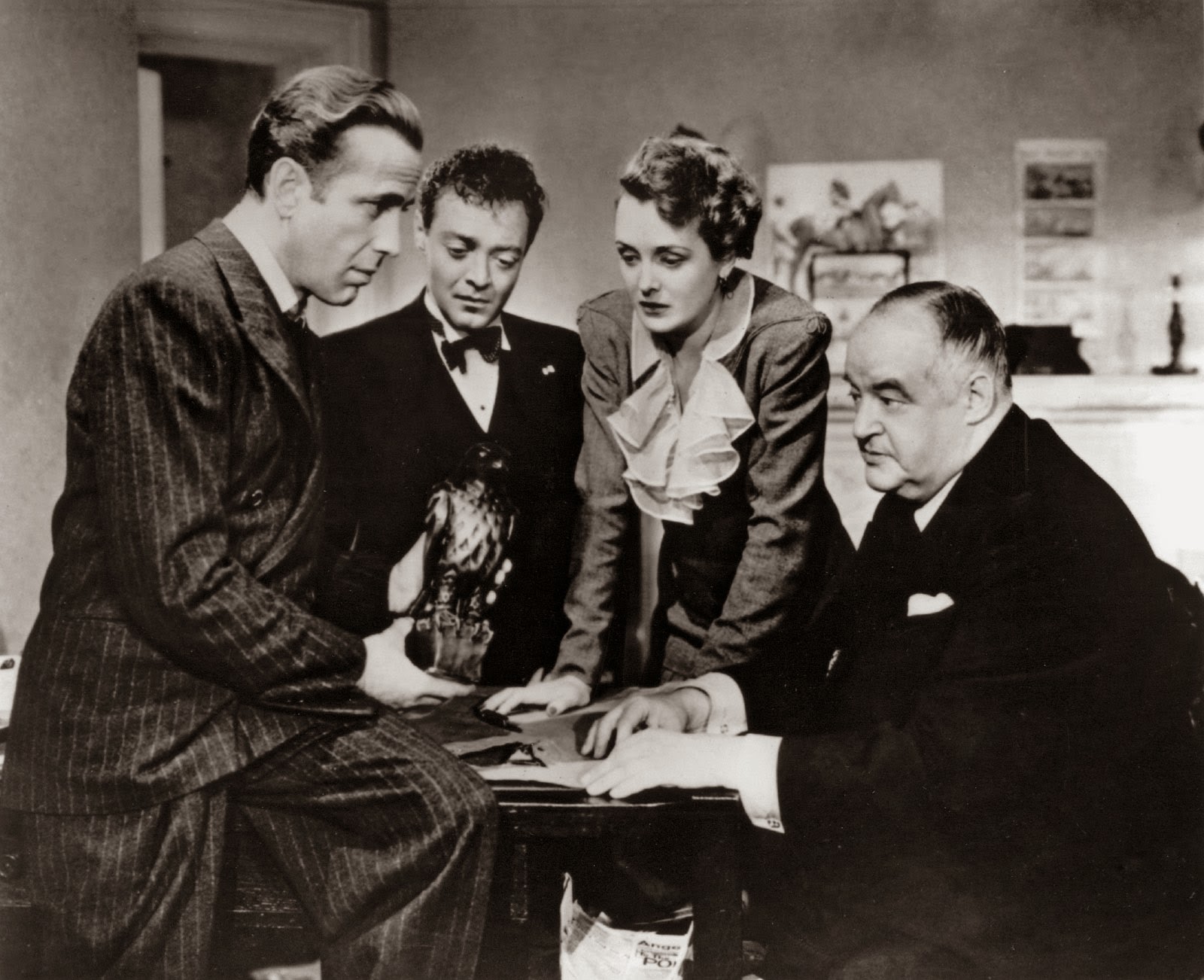
            Unable to use graphic images or even mention certain topics out loud—such as Spade’s affair with Archer’s wife, Joe Cairo’s homosexuality, or even the extent of Gutman’s ruthlessness—the writers and filmmakers were forced to rely much more on subtlety, subtext, and implied action.  Several major events happened off-camera.  Some of the relationships are revealed in a few carefully chosen words.
            (also, fun fact—Elisha Cook Jr., the actor who played Gutman’s hired gunslinger, Wilmer, was later cast as Captain Kirk’s lawyer on one of the original episodes of Star Trek.  No, seriously. Check it out…)
            You might remember a few months back I mentioned a movie from the same era that did something similar.  Chain Gang had two rival reporters discussing whether or not they were going to blow off a court case they were covering and go have a nooner.  The woman eventually shot the man down.  Except all they really did was talk about how certain the outcome of the case was and order lunch.
            What am I getting at?
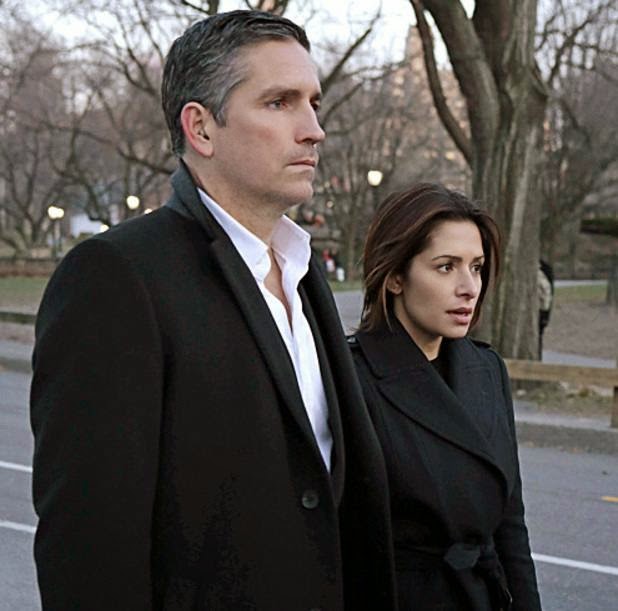
            One of my favorite shows right now, Person of Interest, recently made an interesting distinction between two of the lead characters.  Mr. Reese, the former black-ops-turned CIA assassin-turned-avenging angel, is the team’s scalpel.  Miss Shaw, the sociopathic former NSA killer, is their hammer.  This was a big moment in a somewhat uneven third season, because it finally nailed down what role each of them filled. As their employer points out, there are times you need a hammer, but there are far more times you should use a scalpel.
            These days, there’s a lot of freedom for writers.  No one telling them what works or what doesn’t.  Very little is considered taboo.  Because of this, I think, I see a lot of folks who rely on the hammer.  They’ll show all the gore.  In fact, they’ll dial the gore up to eleven.  And the sex.  Same with violence.  If I may tread on sensitive ground, rape gets used as a hammer quite often in fiction—it’s a blunt, graphic act that gets an equally blunt reaction from the reader and other characters.
            There are many times the hammer works.  The hammer tends to get an immediate emotional response.  The downside to it is that after three or four hammer blows, my target’s just not going to be feeling that much.  The very extreme nature of it means I can’t keep hammering forever without reducing things to mush.
            That’s why we have the scalpel, and why it’s good to fall back on it now and then.  Anyone can swing a hammer, but there’s a reason surgeons have several years of training before they’re set loose in an operating room.  If someone knows what they’re doing with a scalpel, well, they can keep getting a reaction out of you… pretty much forever.
            See that?  That was a scalpel moment.  I just left the implications there for you to figure out.  And the thoughts and images that cut through your mind were so much worse than anything I could’ve described.
            Y’see, Timmy, if I can train myself to use a scalpel instead of always falling back on the sledgehammer, it’s going to give my writing much more variety and depth.  It’s also going to make my readers feel smart, because the scalpel depends on them doing a lot of the work.  And they’ll like that.  Honest.
            So here’s my challenge.  Next time you sit down to write (which will either be later today or first thing tomorrow, yes?), make a point of using the scalpel.  If your story calls for a sex scene, go out of your way not to describe body parts or sounds.  If there’s a moment of gruesome horror, see what happens when you don’t use blood and gore.  If it’s a romantic conversation, try not talking about anything romantic.  See where it gets you.
            Next time, I’d like to talk about New York’s hottest club—Stufft.
            Until then, go write.
            With a scalpel.
March 10, 2014 / 7 Comments

Terminology

Last night I was directed to a blog post that said self-publishers should not be allowed to call themselves authors.  Fighting words, I know.  It was a ham-fisted, blanket statement,  and I think it’s pretty tough to say something that broad without getting some deserved backlash.  Plus, in all fairness, the person who wrote it had a bunch of issues when it came to their own writing ability.  Then again, said writer wasn’t insisting on being called an author anywhere that I saw…
I found myself kind of agreeing with the general idea, though, if not the way it was delivered.  “Author” used to be a term that meant something.  It implied a degree of prestige, that someone had worked at their chosen art for years and been rewarded with a title.
Nowadays, though… no work needed.  I can just demand that title for doing well… anything.  Or nothing.

Take the Baboon Fart Story book.  If you’re not familiar with it, the story goes something like this.  Chuck Wendig made an offhand comment a while back that these days someone can just print the word “fart” 100,000 times, slap a picture of a baboon on the cover, and have it up on Amazon within the hour.  So, this being the internet, someone did just that.  Baboon Fart Story, clearly stating it was just the word “fart” repeated 100,000 times and referencing Wendig, was for sale on Amazon for about a day before someone at the company realized it was a mockery of their whole business plan and it was pulled for content reasons.  I think their official excuse was “a less than satisfactory reading experience.”

So, question for the floor… should the person who slapped Baboon Fart Storytogether be considered an author?  Has he or she earned that title with that book?  It was 100,000 words.  It even sold a couple dozen copies (some of the equally humorous reviews on Amazon were verified purchases).

Baboon Fart Story.  Author or not?

Now, let me spare some of you a bit of time.  I’m sure someone’s leaping down to the comments right now to explain that Baboon Fart was just a joke.  A not-very elaborate joke to illustrate a point.  Heck, it was really just an exercise in cut-and-paste.

To which I say, whoa!  Are we now putting definitions on what counts as a book?  On who gets to call themselves an author?

Of course we are.

As I’ve said many times over on my ranty blog, most of us know how to cook, but very few of us would consider ourselves chefs.  I make a fairly good almost-from-scratch pizza and decent stir-fried rice, but I’d never call myself a chef.  Someone would have to be arrogant as hell to insist we call them a chef because they poured orange juice and heated up waffles in the toaster.  Because we all understand that chef is a title which reflects a certain degree of experience and education past the commonly-known basics. 
Are there self-published writers who deserve to be called authors?  Absolutely and without question.  There are some phenomenally talented and practiced people who’ve chosen to go that route, and they’ve earned that title a hundred times over.  I’d argue the point with anyone who tried to say otherwise.
Does everyone who self-publishes immediately and automatically deserve the title of author?  No.  No, they do not.  Because being an author means something, and it’s more than “able to upload files.”  It implies someone doesn’t just have a base ability to write—or to cut and paste—but a certain level of experience and ability with words.  The exact definition is changing with some of these new paths, but it’s still there.  And it should be there. And we should all be happy it’s there and strive to earn it.

Because if anyone can call themselves an author for doing anything, then the word is meaningless.  

February 27, 2014

The Ecchh Factor

Pop culture pun.  I don’t do puns, normally, but it works.  As you’ll see.

This is mostly going to be for screenwriters.  Writers of prose—please don’t feel left out.  There’s a couple of things in here for you, too.

Tis the season for screenplay contests.  A few of the big names have opened their mailboxes for submissions, and there’s a dozen more noteworthy ones past that.  It’s a great way to get your name out there and even win some decent money, too, if you plan accordingly.

However…

As some long-time readers know, I used to read for a couple of screenplay contests (four different ones, in fact). I have several friends who read for some of the same ones, and some others, too. This time of year used to be a time of great sadness for us. And also a time of great drinking. Usually for the same reasons.

For an average contest, I’d probably read about a hundred scripts per year. That means there were years I’d read over three hundred scripts, usually all in the space of three or four months. It was a fascinating (and sometimes horrifying) overview of amateur screenwriting. To be honest, it’s one of the big things that convinced me to start the ranty blog.

It also gave me a real sense of certain patterns. There were certain types of scripts that would show up again and again and again. And it got to the point that I (and most of my friends) would let out a groan—an Ecchh, if you will—when we opened the next script and realized it was another one of those stories. Usually we could tell within the first few pages. In rare cases, the story would go along fine for twenty or thirty pages and the big first act reveal was… it’s just another one of those stories.

I drank a lot during this period of my life.

Now, I’m not saying any of these are automatically bad scripts that no one would ever pay a dime for. We could probably check IMDb box office listings right now and find examples of more than half of them. But contests aren’t about the box office, they’re about the submissions pool. Unless it’s something truly, utterly spectacular, each of these all-too-common screenplays is going to get an automatic response from a contest reader. An Ecchh.  And that means my script is already starting in the negative. And even if the reader’s just subconsciously knocking off two or three points for being an Ecchh-inducing script, those points could mean the difference between making it to the next round or winning a contest.

So, a few types of screenplays you should think twice about before submitting.  I’ve mentioned some of these before, so if they sound familiar… well, I thought it was worth repeating.

The 50% Script
I’ve mentioned this idea here a few times. In any pool of submitted material, around half of the submissions can be usually be disqualified by page three. It’s when I submit my stoner sex comedy to a Christian values screenplay contest.  Or my romantic comedy to a horror contest. Or my five-act play to… well, any screenwriting contest. The same goes for short stories. Very few screenplay contests want to see short stories. Hard to believe, I know, but there it is.

The 50% scripts are also the result of me being incompetent and/or lazy. If I  don’t know how to spell, have only the faintest understanding of grammar, and no concept of story structure…  that’s a 50% script. Or if I send in a first draft with all its flat characters and wooden dialogue. Or if I don’t even bother to learn how to format a screenplay. Or if I wrote my screenplay under the assumption I’d be directing it from this draft.

If my script falls in that 50% group, the reader’s going to know very soon. And they’re going to Ecchh because a lot of contests require them to read the whole script… even if they know it’s not going to win. Most readers will toss a 50% script as soon as they can. Sometimes sooner, if they think they can get away with it.

The Writer Script
I’ve said this a dozen or so times. Do not write about writers. I did the math one year as a reader and it turned out almost 15% of the scripts I read had a writer as one of the main characters (yeah, I started keeping track of this stuff). When I was interviewing contest directors for Creative Screenwriting, one joked that if her contest banned scripts about writers they’d probably lose a quarter of their entries. More than a few professional editors have said they’ll toss a book manuscript if it opens with someone writing on their computer.

No one cares about the day-to-day struggles I go through as a writer. No one. Most of you don’t—you’re here to learn about the successes. Definitely not a bunch of script readers, many of whom are writers themselves. If I’m being sincere, I’m going to bore everyone (more on that in a bit). If I make up some idealized writing lifestyle, the readers will Ecchh over that because now I’m delving into fantasy.

Let’s assume they didn’t toss my script aside as soon as they saw the writer character. If they get to the end and said writer-character finally sells their book or screenplay and wins the Pulitzer/ Oscar/ whatever… the reader will crumple my script into a ball and burn it so nobody else will have  to read the damned thing. Then they will get my personal information from the contest director, hunt me down, and cram the ashes in my mouth.

And I probably won’t advance in the contest.

The Current Events Script
I’m going to go out on a limb here. If we could look at the pool of Nicholl submissions for this year, I’d bet we’d see a fair number of Olympic scripts.  Several of them would be about stray dogs in Sochi. Also a bunch of screenplays that tie somehow to health care laws. A few on government gridlock, too. And most of them were probably written in four weeks or less.

Y’see, Timmy, if I saw a news report about some fascinating nuance of the world and realized it’d make a great script… it’s a safe bet at least a thousand other aspiring screenwriters saw the same news story and had the same idea. Probably more with the way stories spread on the internet. Even if only half of those writers do anything with the idea, and even if only ten percent of those people are sending their script to the same contest as me… that’s still fifty people rushing out scripts about the exact same thing I am. Even if half of them are completely incompetent and the other half are just barely on par, it means the contest reader is going to be reading a dozen scripts just like mine. Ecchh. And that’s if we stick to a thousand as our base number.

Mine may be the best in the batch, of course, but it’s going to lose a lot of appeal because now it’s a tired, overdone idea. And none of us want to be thought of as the best take on a tired, overdone idea.

The Actor Script
When people are trying to be positive about this one, they’ll call it “a character script.” It means my screenplay is just a thin plot with a handful of over-detailed character sketches piled up in it. There’s usually lots of deep and meaningful multi-page conversations about mundane things, often held in a few basic locations, and very little action. Of any sort.

The thing is though, is there anything remotely interesting about a story that’s indistinguishable from the boring, everyday life we all lead? Is there anything impressive about me putting all that boring stuff down on paper? Is there any sort of challenge there, for me as a writer or you as a reader?

Ecchh.

As it happens, this leads nicely into…

The True Script
A kissing cousin of the character script is the true script. On the cover or either the first or last page (sometimes several of these) I assure the reader this tale is based on true events involving me/ my parents/ my best friend/ someone I read about in a magazine article. These true events are often stressed to give a certain validity to what the reader is about to take in. After all, they can’t call my story or characters or dialogue unbelievable if it really happened, right?

Thing is, no one cares if my story is true or not. Nobody. Ecchh. They just care that it’s a good story and it’s well-told.  So my tale of prepubescent paraplegic drug addicts in 1990s Los Angeles needs to be as enjoyable—on some level—as a story about Neanderthal superheroes battling prehistoric lizard men in 1990s Los Angeles. Whether or not one of them’s a true story is irrelevant. In the end, I’m telling a story, and it’s either going to be good or it isn’t. Reality doesn’t enter into the equation for the reader, so it can’t for me.

The Formula Rom-Com
The man pursuing his dream girl realizes his best friend has been his real dream girl all along. A woman’s engaged to a condescending, controlling executive and then meets a poor artist and discovers he’s the real love of her life. Aphrodite/ Cupid/ an angel comes down to Earth on an assignment and falls in love.

Do any of these sound familiar? They should. Pretty much every one of them has been made into a dozen movies and a few thousand screenplays. Yeah, flipping the genders doesn’t make them any more original, sorry. Once it’s clear on page three this is a rom-com… Ecchh.

My romantic comedy has to be really spectacular and original to impress a reader. Again, it’s that sheer numbers thing. In four years of contest reading—a hundred romcoms, easy—I read one that stood out. Just one.

The Holiday Script
If you add in straight-to-DVD, movies of the week, and pretty much everything Shane Black‘s done, there’s a good argument to be made that holiday films are one of the best selling genres out there. However, just because my script is very sellable does not mean my script is very good. Or original. And if my contest is looking for good (see above), well…

The trick is to come up with something a contest reader hasn’t already seen again and again, to the point that they go Ecchh as soon as they see the mention of Halloween decorations. And—speaking from experience—they’ve seen most of it. They’ve Santa Claus quit, get fired, and get replaced by a temp, an elf, Mrs. Clause, his son, his daughter, his evil twin, his evil other personality, a robot, an alien, another holiday figure, another supernatural figure, Jesus. It’s all been done. The Easter Bunny has learned the true meaning of Easter, Cupid has learned the true meaning of love (see above… again), and Gobbles the Turkey has learned the true meaning of Thanksgiving. The hard way. Many, many times and in many, many ways.

There you are.  Seven very common types of scripts that will make a contest reader Ecchh. Probably more like eight or nine if you read between the lines a bit.

Again, I’m not saying I could never, ever win with one of these scripts. But I am saying that if I’m going to go this path I absolutely must knock it out of the park. No questions, no conditions, no exceptions.

Speaking of movies, next week I’d like to talk about the lessons we can all learn from that fine classic film Satan Met A Lady and its slightly more well-known remake, The Maltese Falcon.

Until then, go write.

Categories