
So here’s an easy thing to look for. I used to do this… let’s say a fair amount in my early writing. I see it happen in other’s people’s writing—especially first big projects. And I see it happen all the time in low-budget B-movies that didn’t bother with, well, a script. It’s really common when actors start to ad-lib scenes. Enough so that I feel very comfortable saying it’s really common.

What is it? Well, wouldn’t you like to know. No, I don’t have to tell you. BECAUSE I’M IN CHARGE, THAT’S WHY! WELL THEN GO START YOUR OWN WRITING BLOG!!!

Okay, let’s just pause for a moment, all take a breath, and try this again…

NO, YOU DIE! YOU GO TO HELL AND YOU DIE!!!

Anyway…

If you spend any amount of time online, arguments almost feel like the default form of human interaction. Because let’s be honest, there are some folks out there who just want to argue. About anything. You like kittens? Of course you would. That’s exactly the kind of thing someone like you would like!

As we’ve all learned, these sort of arguments rarely go anywhere. The people starting it, well… they’re not really interested in opposing views or hearing a counter-argument. So these discussions often amount to a lot of yelling that goes nowhere. Everyone ends up more or less right where they started, position-wise. Nobody’s been convinced to hate kittens or stop carrying their AR-15 to the elementary school bus stop. So in retrospect… they’re kind of a waste of time.

When we’re writing, I think arguments are an easy form of dialogue. Lots of folks think shouting means conflict and tension and drama, so if all my characters are shouting at each other, well, my story must be filled with conflict and tension and drama. Right? Plus, wow, that just filled three pages. It must’ve been good.

So characters argue about a lot of really stupid stuff. Like, anything at anytime can set off an argument. And these irrational arguments go on and on, no matter what else is going on. There can be a kaiju stomping toward our car but the five of us will sit and argue for ten minutes about driving away vs getting out of the car and running away vs just sitting here because maybe we’re just imagining the kaiju, did you think of that?

No? Well that’s why I’M IN CHARGE!

Anyway…

I think a lot of the time when characters are arguing in a book or movie, it’s the writer trying to create a false sense of tension. Or just padding. Or both. Maybe consciously, maybe unconsciously.

Please note I said a lot of the time. Not all. This isn’t a blanket rule, and there are some fantastic examples out there of characters who have heated discussions in books and movies. Or who just, y’know, argue all the time. Because in any good story there’s going to be actual conflict and there are going to be things people have real, justified arguments about.

And, sometimes arguing can be funny. It can actually lighten the mood to see people start bickering over something really silly and irrelevant. Especially when we see the context of what they’re arguing about and where/ when they’ve decided to argue about it.

But all of these arguments have a point to them. They’re either advancing the plot somehow, or advancing the story of one (or both) of these characters. In some cases, they might even be representative of some other intense interaction…

As of late, if I find my dialogue sliding into combative arguments, I try to step back. Look at the scene and the story as a whole, not just my brilliant and snarky dialogue exchanges. What else is going on right now? What’s the actual point of this moment? Does it make sense that these people would be arguing about this? Right now? Is this really driving anything forward?

Or are my characters just arguing to make it seem like there’s some sort of conflict going on? Is it a bunch of false drama that doesn’t really make sense when you consider the characters and what’s happening to them at the moment? Am I just boosting my page count?

So if you’ve got a two and a half page argument… maybe look at it again. See if it actually makes sense. And if it’s really doing anything for the story as a whole.

BECAUSE I SAID SO, THAT’S WHY!!!

Next time… well, next week’s my birthday, so I think I’d like to put on my old white beard and blather on about some life-experience wisdom type stuff. As I have in the past.

Until then, go write.

May 24, 2023

May Newsletter

Wow. Are we halfway through the month again? That didn’t feel like it took long. Well, okay, the last one was kind of late, wasn’t it?

Anyway… let’s get to it.

The past few weeks have sucked. There’s been roadwork all around my house and actually right in front of my house. Like, the little jackhammer-Bobcat was fifteen feet from my office window. Ripping up all the landscaping in the parking strip I spent the past year or two working on. And the sidewalk. And the curb. And parts of the street. And the sidewalk across the street. That went on for, ha ha ha, well, it’s been two weeks and technically it’s still going on, it’s just moved far enough up the street that I can almost blot out the sound by cranking up my earbuds.

Plus, the neighbors on one side are getting a new roof, so those guys have had an air compressor running between our two houses. And on the other side, two houses down, we think someone’s flipping the house and they’ve got a whole crew in there doing stuff. Loud stuff.

And on top of all that… there’s a neighborhood cat we’ve been calling Vincent (one of his ears is kind of mangled) who decided our place might make a good full time home. Which we weren’t against (he’s a cool and handsome man-about-town), but he kept getting beat up really bad by another cat (the Orange Whip) who passes through once or twice a day. So then he was slashed up. And lost a lot of fur. And a lot of weight. And injured one of his legs bad enough he was just dragging it behind him. We kept trying to help and cater to him, but last week we realized he’d hit the point where he wasn’t going to recover from any of this. So, with great regret and a lot of tears, we made sure he didn’t suffer any more.

TL;DR—the first weeks of May have not been very productive. There’s a fair argument to be made they’ve been a bit damaging on the sleep/ stress/ mental health fronts. Actually, no argument. The past few weeks have sucked hard.

With all that in mind…

As I type this I’m 212 pages into the rewrites/edits of GJD. A little more than halfway in this single-spaced draft. My early readers caught a lot of things that I definitely need to tweak, and offered a few comments that made me want to adjust a few more. Fortunately, it’s almost all the kind of thing that once you see the problem, you know how to fix the problem. I think there’s a good chance I can still have this done by the end of the month, when I promised it to my agent.

Which means it’s still on schedule to get to you.

On the flip side, that last short story I owed an anthology did not get done during these weeks, and I’m probably going to be getting that one to the editor right under the wire. An unfortunate but necessary reshuffling of priorities.

That’s one aspect of this whole professional writing thing I don’t see folks talk about that often. Sometimes… life happens. You end up moving a little slow because of stuff at home. Maybe you need to take a personal day or three. And when you do, hopefully your boss is one of those cool, progressive bosses who doesn’t glorify working yourself to death or berate you for missing a day or needing time off. Hopefully they understand there’s more to life than work and sometimes… work needs to be flexible.

This is especially true if your boss is you. Yeah, there’s always going to be deadlines or something that just can’t move. But if there’s a ton going on in your life… don’t make things worse for yourself if you don’t have to. Be that understanding boss you always wish you had.

Anyway…

Cool Stuff I’ve Been WatchingBarry (only the first season, no spoilers!!), The Why Files, still enjoying Moon Girl and Devil Dinosaur


Cool Stuff I’ve Been ReadingWalking the Dusk by Mike Robinson


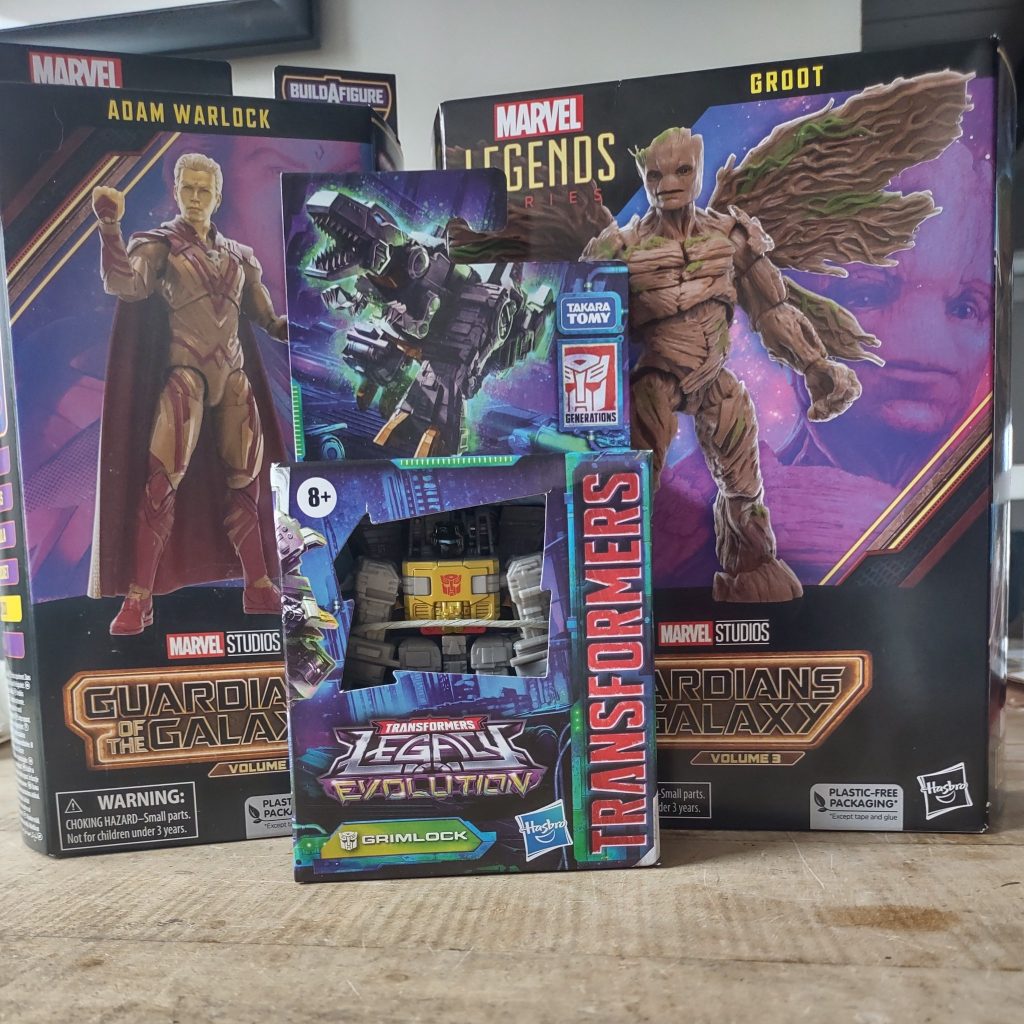
Cool New Toys – We’re closing in on my birthday, so I’m not allowed to get myself anything. Well, I try to restrain myself, anyway. But I still picked up a T’Challa Starlord (from What If… ) on eBay because it was a fantastic price. Also another Talos/ Skrull I found at a local used toy store. And Morphonauts sent me a few of their beautiful resin ExTerminator figures.

May 18, 2023

Getting the Last Word

Not a great surprise, I’m sure, but I follow a lot of writers on social media. Other authors, screenwriters of television and movies, some game writers, some journalists, an essayist or three. I love reading their random thoughts about writing-related things. Because, as I’ve mentioned here once or thrice or dozens of times, there are always other ways to do things. New angles to approach problems from. Different ways to catch problems before they go too far or grow too big.

And that of course brings us to Q getting punched in the face on Deep Space Nine and Sherlock Holmes living in New York.

There’s a screenwriter named Robert Hewitt Wolfe who (odds are) worked on at least one of your favorite genre shows. A while back on Twitter he did a list of 25 things he’d learned about writing for television. It’s a really fantastic little thread and you should check it out. A bunch of it applies to storytelling in general, not just television.

One particular bit stood out to me. Wolfe mentions giving the good lines to your main characters, not the dayplayers—what you’d probably think of as the guest stars. The folks who are just there on set for a day or two of this particular episode. He also adds on that your main characters should definitely be the ones getting the last line before the show cuts to commercial. Which all makes sense, if you think about it.

But I think this applies in a greater sense, too. My main characters should be the ones doing things. They should get the funny lines, yeah, but they should also be the ones taking the risks. They should be the ones solving deadly puzzles and and capturing the scorpions and working up their courage to ask out Dinah from accounting. Nobody watches a show (or picks up a book) thinking “wow, I hope that cashier is a lot smarter than our protagonist, because there’s no way Yakko’s getting out of this on his own…”

This really sums up what was wrong with so many of the B movies I used to watch during Saturday geekery. They didn’t know who they were supposed to be focused on. They’d give the cool lines, the big fight, the horrifying death, or the dramatic sacrifice to… well, anyone except one of the main characters.

And that means all these things are immediately diminished because they’re not happening to people we care about. I mean, sure, on a basic human level we care that the mutant landshark just chomped Hiker #3 into bloody chunks but honestly… did it get any reaction from you? Maybe a chuckle? Definitely not any concern or horror. Hiker #3 was pretty much just there to die. I mean, if they’d killed Phoebe… holy crap, can you imagine?

Maybe even more to the point, if my supporting characters are the ones being clever, being brave, and getting things done… what are my main characters doing? Are they just standing there being less interesting? Less active? Hell, they’re not even pushing the plot along by dying. If the landshark killed Phoebe, we’d be screwed right now. But Hiker #3? My main characters don’t even know he exists. He’s somewhere on the other side of the forest, barely on the fringes of our story. His death is irrelevant.

And, yeah, sure, maybe it’s an ensemble piece. Maybe I’m writing a huge epic with twenty main characters. My WIP, the thing I’ve been calling GJD, has over half a dozen characters in it I’d consider protagonists. But even then… I’ve got my heroes and I’ve got everyone else. In any given scene, it should be one of said heroes doing things, noticing things, reasoning things out.

It’s not exactly uncommon in my rough drafts to have a scene or a chapter end in a way that just doesn’t feel quite right. Maybe the beat’s there, but it’s just not landing the way I want it to. And more often than not, when I step back and look at it, I realize the problem’s usually that the beat’s landing with the wrong person. I’ve let someone else—someone we’re not invested in—make the big reveal or get in that cool last line.

So as you’re going through your manuscript, take a look at who’s talking. Who’s doing stuff. Who’s drawing the reader’s attention with their dialogue and their actions. Because it should be main characters. Not always, sure, but the majority of the time… yeah. And if it’s not them, maybe I need to reconsider who’s talking. Or who my hero is.

And that’s my last word on this topic.

Next time… be ready for an argument.

Until then, go write.

May 12, 2023 / 1 Comment

The Right Kind of Doctor

So, rather than talk about writing, I wanted to spend a few minutes talking about doctors.

I’m guessing most of us have dealt with a doctor at some point in our lives. I know I’ve dealt with a bunch. General practitioners, sure, but I also had a long bout with a nose and throat specialist that ended with… well, a lot of stuff cut out of my head. I’ve also seen doctors for a pair of knee injuries that I’ve talked about once or thrice. And another doctor for one of those, well, men-over-a-certain-age examinations. And one of those led to another specialist doctor, and another surgery, where I believe a few other specialist doctors were in attendance.

That’s not even counting dentists and orthodontists. People like to make jokes, but they’re doctors too. When I finally fought my way out of poverty, well, my mouth was a mess. I hadn’t seen a dentist in over a decade. I’d had one tooth actually crumble in my jaw. Another one cracked in half. I probably count as a cyborg with all the metal and ceramic in my head now.

Plus, I had a high school biology teacher who was very firm that we call him doctor, not mister. He had a doctorate and he wanted to be sure everyone knew it. And I mean, most of my college professors were doctors. English literature, comparative literature, astronomy, art history, anthropology, and more. Hell, I had one anthropology TA who had his doctorate, he just couldn’t get a better position, job-wise.

Oh, and my friend Mary (credited in the back of several books) is a doctor, and she puts up with so many bizarre questions from me about drugs, injuries, zombies, stuff like that

Point is, I’ve known a lot of doctors. You probably have, too. We all understand that doctor can mean a lot of different things. I don’t want an art history professor operating on my throat, and I probably have a better understanding of early American literature than my proctologist, even though he’s got a doctorate and I don’t.

And there’s nothing wrong with this. We’re not putting anyone down, we’re just acknowledging that doctor is a term that can mean a lot of very different things. The advice my dentist gives about, well, dental matters is not going to apply to art history. And vice versa.

Okay, yeah, I’m really talking about writing.

Structure is one of those things people talk about a lot, but so often it’s clear (to me, anyway) they don’t really know what they’re talking about. They’re that guy whining that their art history professor can’t treat cancer or Jill Biden isn’t really a doctor. They’ve chosen one definition for structure and they discard (or mock) anything that doesn’t meet said definition. One example I see a lot is folks railing against three act structure, but I’ve found most of them don’t seem really clear about what three act structure is. Especially in relation to other types of structure.

Structure can be confusing in writing because there are so many different types. Three act structure is a thing, yes. But so is dramatic structure. And linear structure. And narrative structure. And network TV shows and movies tend to have a four or five act structure (or even six in some cases) but that has to do less with storytelling and more with how many ad breaks said network insists on.

I think the problem some folks have is that when the idea of three act structure got more or less loosely codified, it became something they could point to. Especially people who… well, didn’t know what they were talking about. What was supposed to be guidelines suddenly became RULES. Solid, well-defined rules, which meant I could now say you were breaking the rules or following them.

The problem was, they were trying to apply the rules of three act structure on television’s five act structure. Or they’d insist narrative structure had to follow the rules for linear structure. Which, again, is like insisting Jill Biden isn’t a real doctor because she doesn’t do open heart surgery. Which would also apply to Dr. Mendelsohn, the guy at UCLA who spent several hours poking around inside my neck and skull, as mentioned earlier. He’s clearly not a real doctor.

(He is. He’s fantastic. Honestly saved my life)

Anyway… my point is, structure is a big umbrella with a lot of things under it. And if we want to get good at this, we need to understand the differences between them, but also how they work together to create a good story. I can’t just take one type of structure and say this is the only one that matters. Especially if I’m applying the basic rules of another type of structure to it.

Think of it this way (to use our doctor analogy again). Your body has a digestive system. And a nervous system. Circulatory, endocrine, skeletal, so many systems. We understand they’re all separate things that operate in different ways. The rules of one don’t apply to another.

But we also understand all these systems need to work together. Even on our basic, layman’s, non-doctor level we can see the places they overlap or brush up against each other. How changes to this one will affect that one.

And that’s how stories work. We’ve got several types of structure, each with their own individual rules, each working in their own way. But they rub up against one another, and this structure is going to affect that structure. Making some blanket, universal edict that covers all of them just shows I don’t really understand any of them.

And I need to understand them if I want to tell good stories.

Yeah, I’ve mentioned a lot of different types of structure. There are links to more detailed posts about almost all of them. Which also means I need to go clean up at least four or five older posts so they don’t look too chaotic when you click on those links.

Anyway, next time… I wanted to talk about getting the last word.

Until then, go write.

Categories