February 9, 2012

The Lessons of Petrichor

            Normally, on the entry before Valentine’s day, I try to post something about ways to effectively use love as an element in stories, or at least sex.  The thing is, I haven’t really had any clever thoughts on these topics in the past year (well, not about writing it, anyway).  Rather than bore you all with a straight repost—or a thinly-reworded one—I figured I’d just put up a few links to the old stuff and move on with something new.

            So, Happy Valentine’s Day.  Enjoy the love.  Or at least the sex.
            Moving on…
            I’ve talked more than once about the dangers of writers using flowery language and obscure words for no other reason but to show off their vocabulary.  It alienates and often frustrates readers because they can sense there’s no point to this except the writer trying to act superior.  After running into archaic words six or seven times they’ll just put the story down in favor of doing something productive like folding laundry or watching episodes of Chuckon DVD.
            This week, I thought I’d give an example of how you can use obscure words in your story in a way that not only makes them natural, but will make your readers love you for it.
            So… biology lesson.
            “Petrichor” is an extremely specialized word that was coined by a couple of botanists back in the sixties.  It’s so rare and uncommon it won’t show up in most spellcheckers.  It has to do with plant oils that get absorbed into dry soil and then released into the air when that soil gets exposed to moisture.  Simply put, petrichor is that unique smell you get just as it starts to rain somewhere that’s been very dry.
            Over the past year or so, I’ve seen this word cropping up all over the place.  I don’t think I’m out of line by giving all the credit to Neil Gaiman, who used it in a phenomenal episode of Doctor Who called “The Doctor’s Wife,” and the word carried over later in that season as well.
            So, how did Gaiman get away with using such an obscure, specialized word?  Not only that, how did he do it in such a way that hundreds of other people immediately added it to their vocabularies and began using it?
            Here’s how, in three easy steps.
            First, within the context of the story, it makes sense to use an obscure word at this point.  This is supposed to be a password to a locked part of the ship, and it makes sense that a password wouldn’t be a common word or one that could be deduced without much effort.  So on this level, the audience (viewer or reader) can accept that there’s a valid, in-story reason for the writer to be using a word they’ve never heard before.
            Second is that it’s a real word that’s explained within the course of the episode.  It isn’t just a jumble of syllables I need to reason out through context.  It gets defined, which means its no longer an obscure word the audience doesn’t know, it’s a word they just learned.
            Finally, it makes sense within the story that this obscure word is introduced and then defined.  It isn’t just mindless exposition to justify the vocabulary.  The TARDIS is so advanced that its locks are telepathic.  Amy and Rory need to know this word and what it means in order to open the door into the old control room.  So when Idris explains “petrichor” to Rory, there’s a perfect in-story reason for this bit of ignorant stranger-ism.
            That’s the kind of thing I need to do when I want to randomly toss a rarely-seen, little-known word into my writing.  I don’t do it at the expense of the story, I do it in a way that strengthens the story.
            Next week I plan to blather on about birdhouses.
            Until then, go write.
September 2, 2011

The Sonic Screwdriver

First off, my apologies for running late. Lots of work on the new book.

Second off, a bit of shameful self-promotion. If you haven’t picked up my “debut novel” Ex-Heroes, the publisher’s put the ebook version on a fantastic sale right now. $2.99 for the next week (starting today). Kindle, Nook, Kobo, whatever. If you haven’t grabbed it, now’s a great chance. If you’ve been pushing a friend to get it, tell them about it now. Or just buy it for them. After all, the sequel’s out in about four weeks.

And now, with that ugly bit of capitalism out of the way…

If you’re a big fan of Doctor Who (like me), you know the sonic screwdriver is about the most useful tool ever invented. It opens and closes locks, takes readings, repairs barbed wire, gives phones universal roaming, acts as a TARDIS remote control, and hundreds of other things. Put simply, it’s the greatest all-in-one tool that has ever existed.

Alas, most of us just have to buy a whole tool box worth of stuff. Hammers. Wrenches. Pliers. Tape measures. And of course, screwdrivers. But it’s not enough to have all this stuff. You can only really work on something if those tools are handy.

For example…

Let’s say your significant other comes home from the market and says “Hey, the flux capacitor on the car isn’t fluxxing. You might want to check it out.”

So you go out to the car and see you need a screwdriver to open the housing on the flux capacitor. So you go back inside, dig your toolbox out of the cabinet under the sink, and get a screwdriver out. Then you go back out to the garage and discover you needed a Phillips head screwdriver, not a flathead. Head back in, grab a Phillips, back out to the garage.

You get the housing open on the flux

I’m sure you can all see what’s going wrong here. It’s not that we’re trying to fix the plutonium intake when the problem’s clearly in the flux dispersal array. The problem is that we’re attacking this project piecemeal, trying to solve it a single element at a time, and in doing so things are dragging out far longer than they need to. Unless you’ve actually got a sonic screwdriver, you can’t grab one tool out of your toolbox and go see what the problem is. You also don’t go check the problem, walk back, and grab the next item you need at this particular stage.

No, you take the whole toolbox. You bring everything. Because it’s worth the little extra effort to have it all handy and there to work with if you need it. Yeah, you’re not going to use every single tool you brought out there, but the amount of time you save is worth that initial extra effort.

For the record, my friend Laura got me a sonic screwdriver for my birthday.

But that’s not important right now.

How many of you have figured out the point of this little scenario…?

A lot of people take forever when they write. Years and years. Sometimes it’s basic procrastination, yes, but sometimes it’s just that they’re trying to get every single element right before they put it down on paper (so to speak). They won’t write one word unless they know it’s the word they’re going to have in the final draft. So each sentence takes hours and each chapter can take weeks.

Now, there’s nothing wrong with wanting to get things right. That’s the whole point of feedback and editing and doing multiple drafts. Thing is, you can’t do a second draft until you have a first one. Which means the entire process is really at a dead halt until that first draft is done.

When I sat down with my new project, -14-, I spewed out pages and pages of stuff over three months, and soooooooo much of it got cut in later drafts. A lot of it got reworded and some of it got completely rewritten. But I was able to keep working because I had stuff to work with.

Y’see, Timmy, it’s always better to have something to work with than to have nothing to work with. Don’t be scared to put everything in your first draft. Bring it all. Don’t hold back because you think you might not need something or it might not work. Write bits you know you’re going to cut and characters you know are going to be trimmed out. Because you can’t edit or rewrite a paragraph that doesn’t exist.

Next week, unless I get a really cool request or suggestion, a little free verse love poem about the Oxford English Dictionary.

Until then, go write.

Hopefully you know the answer to that one. It’s kind of relevant.

Structure is how a story is put together. It’s the underlying shape and order that everything else hangs on. I know that sounds obvious, but every now and then you need to point out the obvious stuff. If you don’t have structure, all you have is a pile. Even something as amazing as the Guggenheim follows a lot of the basics of building construction.

Which is a great example. Much like the physical architecture of buildings, there are certain rules a writer needs to follow with the structure of their story. A very skilled person can bend or tweak these rules to accomplish a clever effect, but ignoring the rules often means the story (or building) will just collapse. At the least, it’ll end up so ugly and misshapen nobody will want anything to do with it.

As I have in the past, I may use a few terms here in slightly different ways than they get used in other places. I’m mostly doing it to keep things as clear as possible, so try to think of the ideas and concepts I’m tossing about more than the label I slap on them for this little rant.

There are two types of story structure I want to blather on about. One is linear structure. The other is narrative structure. They’re two separate things. If the writer is doing things correctly, they tie together in the same smooth, effortless way character and dialogue tie together.

First up is linear structure. This is how the characters in a story perceive events. Unless you’re writing a story from the point of view of Doctor Manhattan, your characters are going to experience the story in a linear fashion. Morning will be followed by afternoon, then evening. Thursday comes before Friday, which is the start of the weekend. People begin life young and then grow old. Another good way to think of linear structure is continuity. A before B. Cause before effect.

The other half is narrative structure. This is how your audience experiences the story, and it can come in a number of forms–many of which we’ll deal with next week. I just wanted you to have both terms in your forebrain right now.

So, a term some of you may have heard before is three-act structure. It gets tossed around in screenwriting a lot, but it shows up in most forms of storytelling and showmanship. Despite attempts to define it as something much more rigid and page-dependent, three act structure really just means that a story has a beginning, a middle, and an end. The beginning happens first, then the middle, then the end.

Again… every now and then you have to point out the obvious stuff.

Now, it’s key to note they may not always come in that order, but they do always need to be there. We’re going to get into that in a little bit (again, probably next week). For now, the key thing to remember is that even if these events are presented to the reader out of order, the characters are still experiencing them in order.

One easy way you can check a non-linear story is to cut it up and put the bits in chronological order, like a timetable. This is the order the characters and the world are experiencing the story (as opposed to the reader). Does effect still follow cause? Are the actions and dialogue still motivated? If everything’s right, there should be a clear chain of continuity. If it starts to get fuzzy or questionable, that’s not a good sign.

Now, I’m sure the question some of you are asking is “why?” Since so many tales involve flashbacks and frames and non-linear storytelling, why does a linear structure matter? It should only matter in straightforward stories like 24, right?

Wrong again, Timmy.

As I mentioned above, linear structure is how the characters experience the story. And as I’ve said many, many times, characters are key. If they’re not grounded in a linear structure, they end up tripping over themselves. They know things they shouldn’t know yet or bear the scars of events that haven’t happened. Once it starts with characters, these flaws and oddities ripple out into the plot and there’s a notable lack of continuity. Suddenly effect is coming before cause, and B comes before A, with D between them.

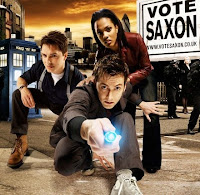
A quick note for genre fans. Time travel stories get called on continuity a lot. Not in the altering history sense, just in the who-knows-what-when sense. Just remember that time travel isn’t going to affect a character’s personal linear timeline. My day four can be your day one. In the handy diagram here (developed with a $25,000,000 grant from NASA), you can see that our time traveler (in blue) has a coherent, linear story–even though it seems at odds with the story of the mundane non-time traveler (in black) who also has a linear story (no one said time travel was easy). One of the best things I can suggest for this is the third season of Doctor Who. It deals with this idea in the first episode and in two different arcs that span the entire season. Plus it’s really fun and Freema Agyeman is gorgeous, so win-win all around.

My novel, Ex-Heroes, has almost a dozen major flashbacks in it to a period before the beginning of the novel. But if you were to rip all of those chapters out and rearrange them in chronological order (go ahead, buy an extra copy just to tear it up), you’d see that the story still makes sense. The heroes appear. The zombies appear. Society collapses. The heroes try to salvage what they can and rebuild society (which is where the book begins). A new threat appears. The story itself is linear, even though it’s presented in a non-linear way.

On the flipside, I once worked on the straight-to-DVD sequel to a very popular murder mystery/ Hitchcock-style thriller (which was, in all fairness, mostly popular because Denise Richards and Neve Campbell get topless and make out in a pool). When you took many of the “hidden scenes” at the end of the sequel and put them in order, the story actually made less sense than it did without them. This film, needless to say, had horrible linear structure. The writers were just throwing down “cool” moments with no regard to where and how they actually fit into the story.

One more general note for you. When you look at the linear structure of a story, it should be very straightforward. A-B-C-D-E- and so on. If you’re looking over this and suddenly hit 4-5-6 somewhere… well, there’s a reason that looks odd there. It’s falling outside the scope of the plot. An example I’ve used before is the scene in Raiders of the Lost Ark when Doctor Jones gives a speech about Masada to the two government agents. Don’t remember that scene? Yeah, well, that’s because it has nothing to do with the story so they didn’t put it in the movie. Linear structure is a great place to see if there are extra things hanging on a story that don’t need to be there.

So that’s linear structure in a somewhat large nutshell. Next time I’ll babble on about narrative structure and, if I’m doing it right, this will all start to make sense.

Until then, go write.

November 19, 2009 / 5 Comments

And Now For Something Completely Different…

A long-overdue pop culture reference for the title, just to get us moving.

It’s always interesting to me when I try to figure out what next week’s blog will be about, for that little teaser at the end of this week’s blog. This week’s started off when I was passing quick notes back and forth with a friend who’s doing the NaNoWriMo challenge this year. He had a clever idea for one of his upcoming chapters, about midway though his work-in-progress, and I… well, I was advising against it. Then someone brought up the same issue on a publisher’s message board I frequent. A few days later, I was reading scripts for a contest and found one where said issue had become one of the problems crippling the screenplay.

What is said problem, you ask?

Well, the first time I ever saw Doctor Who was halfway through a very trippy story arc called “The Deadly Assassin” (which has finally become available on DVD). It was probably the worst set of episodes to try to start watching the show on, because the Doctor spent a good chunk of it in the mind-twisting reality of the Matrix (yes, Doctor Who had a Matrix decades before Keanu Reeves did). A few months later I tried again and WGBH (which only had so many episodes) had circled back around to “Robot,” which was the first Tom Baker story, also featuring the lovely Elizabeth Sladen as Sarah Jane. And that’s how I became a Doctor Who fan, and have remained one for most of my life.

What the heck does that have to do with any of this?

Well, it’s hard to tell, isn’t it? Suddenly bam I’ve gone from the usual rant to some senile doddering about my childhood without any sort of transition.

Ahhhh-haaaahhhhhh…

Transitions are what I wanted to rant about this week. That moment your story goes from this to something else. It can be a shift in character, person, location, or time. Every time you switch, you’re asking your audience to take a moment to readjust. The bigger the shift, the bigger the time of adjustment. Most of us could make it past either a six inch step or a three foot drop, but one’s going to take a lot more effort than the other.

As a writer, you don’t want the audience to think about that adjustment. If everything’s done right, the transitions will be as invisible as the word “said.” If there are too many transitions, though, going in too many different directions, it’s too much like driving on a road covered with speed bumps. You’re asking the reader to pause again and again and again and again. If a manuscript has too many transitions, or too many extreme ones, it’s going to go into that large pile on the left. What would you do if a manuscript made you pause half a dozen times in the first ten pages? Would you keep reading or get back to folding laundry?

I mentioned my friend who started all this off (and who most likely is reading this). Let me be blunt and hope he forgives me. In the middle of his superhero action-intrigue story, he wanted to do an entire chapter in verse. Chaucer-style, Canterbury Tales verse. Why isn’t important for our purposes, just that he was going to do it. He had a very solid reason for it, and I have no doubt he could’ve pulled it off.

The thing was, he’d actually had several point of view shifts in his novel already. Some of them were basic shifts– we’d go from third person focused on him to third person on him. Then there would be jumps to first person narratives. And epistolary chapters. And flashbacks. Plus a frame that was a flash-forward. So it wasn’t just that he wanted to do a chapter in verse, it’s that he wanted to do a chapter in verse on top of everything else. All fine and good on their own, but as they begin to pile up…

As a brief but relevant segue, let me talk about Dean Koontz for a moment, author of (among many, many others) Watchers, Dark Rivers of the Heart, and the Fear Nothing series (which I really hope he goes back to some day). Early in his career, Koontz wrote a great little book called How To Write Best Selling Fiction It’s gone out of print, and the author himself has said he’s got no interest in seeing it re-issued. I think a lot of the reasons for both are political, because in this book young Koontz did say a lot of blunt, rather unkind things about publishing, gurus, and wannabe writers. Now, in all fairness, many of these things were completely true, and still are today. They’re not what people want to hear or admit, but, as a friend of mine once told our boss, if you wanted a cheerleader you should’ve hired one. If you can find a copy– grab it (they go for big bucks on eBay). If you can find it online, download it, memorize it, and delete it. Than write an angry letter to Writers Digest Books telling them how they’ve forced you to resort to piracy.

Back on track, though.

One thing Koontz stresses, and you can see it in his work, is to never shift viewpoints within a chapter. Use the chapter break itself as the big pause and try to have as few little ones within it as possible. Now, I’d never go as far to say you should never switch within a chapter, but I also think Koontz has a solid track record backing him up.

So, a few quick tips for transitions…

Fewer – This is the easiest one. The simplest way to avoid troubling shifts is… well, avoid them. Look at the transitions in your writing and figure out how many of them can be trimmed out or consolidated. Is it harder to tell a story with fewer transitions? A bit, yes, but far from impossible. Alfred Hitchcock’s Rope doesn’t have one transition in it. It’s a single continuous film narrative from start to finish. Defoe’s Robinson Crusoe only has two in the entire novel. It switches to an epistolary journal for a few dozen pages and then back to the regular narrative. There aren’t even chapter breaks.

Smaller – As I mentioned above, it’s easier to go down a six inch step than a three foot drop. It’s easy for a reader to go from third person, past- tense to another third person, past tense. It’s a bit harder to start in third person, past tense and jump to second person, future tense section and then back… or to a first person, present. Likewise, jumping between the thoughts of a Harvard professor and a golden retriever is going to be a bit jarring. Bigger jumps mean bigger pauses to adjust, and also more of a disruption in the flow of your story.

Smoother – One way to lessen the impact between sections is to make the transition as organic as possible. A common way of doing this is by creating parallel structure in text or dialogue to keep up a certain rhythym. Another is to do continuations, where, for example, a question gets asked in the first part but the answer is given after the transition.

Make Them Have Purpose – Is there a real reason the story’s going from this point of view to that one? If so, your readers will be more willing to accept the change. If not, it’s just going to frustrate them more. Much like when I prattled on about structure, if the shift doesn’t accomplish something in the story, you shouldn’t be doing it. Make sure the story as a whole is focused, and that there’s a real reason we’re suddenly spending a page with Wakko, the wannabe actor who’s working as a waiter on weekends and about to serve a drink to the main character.

Now, there is sort of a halfbreed flipside to this. A common problem, especially in screenplays, is a complete lack of transitions. Gurus and how-to books tell people to cut description, cut words, cut everything. So fledgling writers take that advice and cut… well, everything.

The problem with that approach is, while it sounds wise on the surface, what it really does is leave you with nothing on the page and nothing between scenes. Suddenly, we’re in a house with Jane. What kind of house? Old? Modern? Is it the present day? Are we in the kitchen at lunchtime? The bedroom at midnight? And while I’m still reeling trying to figure out where we are and why Jane is yelling at George, suddenly we’re in an office. A newspaper office? A telemarketing office? Is it real office or a field of cubicles? Too late, now we’re with George in his car…

I’ve set down a lot of scripts like this while I was reading for contests. None of them went in the pile on the right.

So, there’s my random musings on transitions. Hopefully not too random.

By the way, the reason “The Deadly Assassin” was so hard to follow as an introductory episode was because it took place across a virtual landscape formed from the stored memories of the Time Lords. In other words, it was a mish-mash of settings with no transitions between them. It would’ve been so much smoother if I’d said that up front, yes…?

Next week we’re getting into the holidays, so I won’t take up too much of your time. I may talk about it, though.

Until then, go write.
Categories