November 23, 2016 / 1 Comment

Imposter!

            Look!  We’re a day early because tomorrow I’m going to be cooking and watching a lot of my favorite black-and-white movies.  Joy!
            Well, not all joy…
            I need to get something off my chest.
            I’m a fraud.
            Seriously.
            I would guess, on an average week, this idea runs through my head five or six times (by odd coincidence, I tend to work five or six days a week).  The notion that I’m a complete fake who’s kind of stumbled into this life off sheer luck more than ability.  I re-read my new projects and wonder if they’re good or if I’m just deluding myself.  Maybe I don’t know a tenth of what I think I know—a textbook case of the Dunning-Kruger effect. 
            I sometimes wonder if the next book is going to be the one where my small fanbase gives a big shrug and says “ehhhhh… I guess he’s burned out.  Time to move on.” 
            I fret a lot about whether or not my publisher’s going to dump me as a writer, too. Well, not dump me, but just decide this latest contact will be… well, the last one.  Same with my agent.  He has some much, much bigger clients than me, and it’s not irrational to think he might decide his time and efforts are better spent focused on them.
            You may have heard of people feeling this way before.  It’s called imposter syndrome, and it’s really common.  I get it all the time.  Chuck Wendig gets it.  Victoria Schwab gets it.  Pretty much every writer I’ve ever talked to at length has copped to it. They’re plagued with self-doubt. They question most everything they write.
            (You didn’t think Hemingway drank that much because it was fashionable at the time, did you…?)
            I’m not saying this to freak you out or feed your insecurities.  I’m hoping it reassures you a bit.  We all feel this way sometimes.  Yeah, even those of us so-called-pros who are doing this full time.
            There are two reasons people get hit with imposter syndrome, in my so-called expert opinion.  For what it’s worth.  And they’re kinda related.  It’s almost the same thing, really.
            First is that, once I hit a certain stage in my writing, I start to see certain things.  I can admit to flaws in my work.  Of course, once I admit problems might be there, that also opens me up to imagining and creating problems. 
            As it happens, imagining and creating is what most writers do.  We’re good at it. Sometimes we do it even when we don’t want to…
            Second is fear.  I think imposter syndrome is a lot like writers block.  The act of creation—of pulling something out of my head and setting it down on paper—can be terrifying.  If you think about, it’s really common for people to talk themselves out of doing scary things.  Think of a couple times in your life when you had to do something that scared you.  How often did you end up thinking something along the lines of “ I can’t do this! What was I thinking?  I shouldn’t be here!”
            I can think of three or four times that sort of mantra ran through my head, all long before I became a full time writer.
            There’s a flipside to this, too.  The folks who are utterly, 110% confident their work is perfect, and that they absolutely shouldbe professionals.  The ones who have no doubts at all.
            And yet, for some reason… they’re not.  They don’t make sales. They don’t get deals.  Usually because of gatekeepers or antiquated systems or something.  Definitely not because of them.
            I’ve run into a few folks like this. You probably have, too.
            Y’see, Timmy, I shouldn’t look at imposter syndrome as a problem.  Oh, it sucks, yeah, and it can lead to one or three stressful days or nights. But really it’s a sign of my maturity as a writer. It shows that I’m open to the possibility my work isn’t perfect, which means I’m open to improving it.
            And improving it is the big goal for all of us.
            Next time I might shout at you real quick.

            Until then, go write.

October 7, 2016

Procrasti Nation

You remember the Procrasti from Deep Space Nine, right? They were that race from the Gamma Quadrant that was going to come through the wormhole someday…

Geek joke.

I saw a thing floating around Twitter a month or three back, one of those clickbaity “this article EXPLODES one of the biggest myths about writing…”  And that myth was that writers need to write every day. Which, granted, the vast majority of professional writers—myself included—will all tell you to do if you want to do this for a living.  But according to this little piece, that’s complete nonsense.  If I only write once a week, good for me.  If I need to wait for inspiration, that’s fine.  What’s important is that I’m writing at a rate that’s comfortable for me.

Now, in all fairness to the article, I’ve said similar things here.  If you can only write on Sundays, standing on your head while wearing that “enhancing” corset you bought at the ren faire last year, but you always write 15,000 words in a session… well,  congratulations.  It’s a damned weird system, but it works for you.  So what if you don’t write the other six days of the week.  Fifteen thousand words a week is fantastic.  I know some pros who don’t hit those numbers consistently. Hell, I usually don’t hit those numbers.

However…

If I’m only cinching myself into the corset once every two or three weeks, and only writing a hundred words when I do… there’s a chance I just may not be taking this whole writing thing that seriously.

And there’s nothing wrong with that in a larger sense.  If I just want to scribble blog posts or fan fic as the mood strikes me, that’s fine. I know a few people who write as more of a therapy thing, some who do it for fun, and one who did it as a sort of… well, she’d been single for a while.  Let’s leave it at that.

Again, no big deal if that’s how I approach it.  To fall back on an analogy I’ve used once or thrice, not everybody who cooks needs to be a chef.  Or wants to be.  I love cooking, playing around with spices, trying new things with pizzas or pasta… but I’m never going to be a chef.  I’m fine with that.  I’m just doing this to have some fun on the weekends.

But… if I wanted to be a chef, to actually get paid for cooking, I’m probably going to have to put some work into it. And that means doing it more often than when the mood strikes me.  It means sometimes I’d need to stay home and cook rather than going out with friends.

And, yeah, sometimes that work can mean other things. It can mean reading cookbooks. Or watching cooking videos on YouTube.  Maybe even eating out sometimes.

But in the end… it means I’m going to be cooking.  A lot.  There’s really no other way to do it.

Same with writing.  If I want to make money off this storytelling thing—if I want to do it for a living—I’m going to have to write. A lot.  On a fairly regular, consistent basis.

I wrote my first three novels and a good-sized novella while I was working full time as an entertainment journalist. And reading scripts on the side.  So I was often doing four or five thousand words a week to put food on the table and pay rent, then staying in the chair to do another six or seven thousand on the stuff that I wanted to be paying rent with.

Hell, I know two full-time, professional writers (about to be three) who had babies this year.  Little, squishy new-humans who pretty much need constant attention (granted, I’ve never had one myself, so that’s just conjecture on my part).  And those three are all still writing.

It’s fine to tell myself that I’m waiting for the muse.  Or that I’m reading a how-to book about crafting the perfect first sentence.  Or that playing Dawn of War III is going to be a vital part of my creative process.  We all have our own methods when it comes to writing. Like that corset.

But there is also a point that… well, I’m just not writing.

Again, depending on what I want out of this, that may be fine.  If I only post on my blog once a month… so what?  If I just write slash-fic when I’m bored, hey, it passes the time.  If this is just a hobby that I do every couple of weeks… awesome.

If I keep telling you how much I want to be a chef, though… wouldn’t it be weird if I only cooked one or two meals a week?  Or two or three times a month?

I mean, that just doesn’t make much sense, right?

Next time, I want to talk about something crazy.

Until then, go write.

Oh!  And if you’re in the Los Angeles area, this Sunday is the Writers Coffeehouse at Dark Delicacies in Burbank.  Noon to three, open to writers of all levels.  It’s completely free—no sign up or anything, just stop by and pull up a chair.

Okay… now go write.

August 2, 2016

Amazon Review Policy

            So, for those who came in late…
            Amazon has always had a vague policy when it comes to authors leaving reviews for other authors.  We’ve all heard different stories and explanations, yes?  I can’t leave reviews using the same account my author profile’s linked to.  I can’t leave reviews for books I have a clear link to (through publisher or even just through topic).  I can’t leave reviews for people I have a social media connection to.
            Naturally, this annoys a lot of writer-types.  Reviews are like gold to us. They are the spice, the precious, that which we prize above all other things. 
            Well, maybe not above being paid. But there’s a connection there…
            Anyway, it struck me that I’ve seen a lot of articles about this sort of review-limitation.  I’ve also heard many stories about this person or that person having a review deleted for one book or another.  But I’ve never seen any hard data on this.  No real stats or numbers.  Which isn’t that surprising as Amazon tends to be pretty tight-lipped about such things.  Since I’m kind of a nerd for such things, though… I thought I’d do it myself.
            (oh, get your mind out of the gutter for once…)
            So, here’s a couple ground rules/conditions/variables…
            First off, I’m only going to review books.  That should seem like a no-brainer, but I figured I’d write it down just to be clear.  No movies or LEGO sets or anything like that.

            Next, I’m not going to put up any negative reviews. They might not all be five-star golden, but they’ll all be positive.  These are all books I really liked and enjoyed.  Part of this is just my own preference, but it also helps eliminate one variable (does Amazon view this as an “attack” review?) and simplify things a bit.  Yeah, there’s still the chance they’ll view it as a “kissing up to your friends” thing, but at least we’ve narrowed it down to that.

            Some of these are big-name books by big name, New York Times bestselling authors. Some are from little indie presses or self published.  I won’t spell out which is which, but it won’t be hard to track if that aspect interests you.  I happen to think they’re all good and you should read all of them.
            I follow all of the authors I’m going to review on Twitter, and have been for some time.  Most of them follow me as well.  I’ll note any cases where they don’t.  I’d guess maybe a third to half of them I’m also friends with on Facebook (I have a very small circle of friends there—most of my interaction is through my fan page). I’ll try to note that (and figure out those numbers).  Either way, I’ve had some level of public, back-and-forth online interaction
with all of them.
            Some of these will not be Amazon purchases.  I’d guess about half of these books I received for blurbs or as gifts.  I’ll try to make a note of that as well.
            I’m only going to put up one review a day to try to avoid being seen as a spam account.  I’ll most likely post at different times, just because, y’know, life.  I’ll try to keep them at least twelve hours apart.
            Finally, I’m also going to put up a few reviews at the end as a sort of control group, reviews that shouldbe rejected immediately.  For example, a review of one of my own books, an anthology I have a story in, and a few books that I’ve openly blurbed and also have strong ties to the authors.
            Also, at this point, a heartfelt thank you to Kristi Charish, a great author and actual-for-real scientist who helped me beat this little dataset into semi-solid shape. So please remember, when said experiment goes berserk, breaks loose, terrorizes a nearby city, and kills thousands… she’s the one who insisted it had to be stronger.  Address your comments and lawsuits accordingly.
            The first review, as it happens, went up yesterday. The second will be up shortly after this posts.  At the end of the month I’ll list all the books and authors in the order I reviewed them. 
            And a month after that… we’ll see where everything is and crunch some numbers.
            Three weeks until San Diego ComicCon!
            As it happens. I’m actually a bit bogged down right now, trying to get everything set up for SDCC while also doing a ton of edits (and also trying to deal with a killer headache).  To be honest, I was half-thinking of skipping this week.
            Fortunately for all of us, Timothy Johnson stepped up and offered to scribble out some quick thoughts on editing as a tool for improving our writing.  Tim’s an editor based out of Washington, D.C., and he’s got a debut sci-fi/horror novel, Carrier, available right now from Permuted Press (go check it out).  All things said, he has a pretty good idea what he’s talking about.  You can find him regularly on Twitter or Facebook.
            Next week, I’ll be back to talk about sorting through feedback. For now, here’s Tim…
——————-
            This post is not about commas. It’s not about mechanics or style. It’s not about verb conjugation or misplaced modifiers.
            I know many writers bemoan the editing process. I get it. It can seem unnecessary and even like a waste of time. But I promise you it’s not. Even though you wrote your story, it’s still a crudely formed lump of clay.
            So, I’m not going to get into the nuts and bolts of grammar. This post is about helping you, a writer, become better at writing. Through editing, you can take your writing to the next level. It’s about how you take the word stream of your writing process and turn it into a cyclical filtration system for distilling tight, compelling prose.
            It’s basically how to become a Brita filter for literature.
            If you came in here thinking, “Ugh, I don’t want to learn stuff. This is why I pay an editor to make my writing good,” stick around. As an editor, I can assure you I’m human, and that’s relevant because there’s a quality quotient that we can achieve based upon the work you present to us. That is to say, if you serve us crap, we might be able to make a crap casserole, but it’s still a crap casserole. Give us better ingredients to work with, and the end result will be better for it.
            So pick up your hammer and chisel, and let’s get to work.
Find your brain stutters.
            If you’re human, you probably say, “um,” more than any other word in a typical day. We say, “um,” when our brains search for the right word but our mouths want to keep going. Similarly, we have the same disconnect between our brains and our fingers, those overzealous bastards.
             Look out for “that,” “this/these/those,” and passive voice.
            “That” is simple. It’s the most overused word in the English language. If you see “that” in your writing, chances are it’s unnecessary and you can destroy it with zero regret.
            “This/these/those” are a little different. We often use “this/these/those” as demonstrative pronouns. That’s basically fancy grammar talk for “you know what I’m talking about, shut up.” And they’re perfectly acceptable, grammatically speaking. The problem is they’re vague, and if our objective is to get our language tight and compelling, they aren’t going to do the job.
           Find these (see what I did there?) and destroy them. Ask yourself what you’re actually writing about, and use a noun.
            Another stutter to look out for is passive voice. For many people, it can be difficult to recognize, and some will even argue it’s not that big of a deal. Well, to those people, I say it’s super popular in legal speak for a reason: passive voice is unclear and confusing.
            We often write passive voice because we have action-oriented minds. We consider more strongly the thing that is happening than the people who are performing the action. You get a pass as a human, but as a fiction writer, you don’t get to rest on your laurels. Writing active sentences will serve you better.
            To find your passive sentences, look for statements in which it isn’t clear who or what the subject is. Most times, you can find passive voice by looking for any form of the verb “be.”
            Let’s write a stupendously ridiculous example that combines all three of these brain stutters:
            “This is something that you are wanted to do.”
            Now, if we unsuck that, it becomes the following:
            “I want you to kill him.”
            See how this edited version is way more direct, clear, and powerful? If this stuff is a bit too abstract for you, let’s dial it back a bit.
Find your weak language.
            Generally, people write how they speak. There’s nothing wrong with that, but one of the points of thinking about your own writing critically is to construct storytelling prose that isn’t boring, mundane, everyday language as if you’re telling someone a story in a grocery store checkout line.
            You can certainly crank the wrench too far and edit the human quality out of your words, so the onus is on you to find a balance where your prose leaps off the page but still is identifiable as yours.
            “To be” is the worst offender of being weak. I mean, “to be” is the worst offender of weak language. “To be” verbs can signify passive language (see above), but most often, they mark an opportunity to do something more interesting. Find all instances of “be/been,” “is/are,” and “was/were,” and see what else you can do with those sentences other than pointing out that the subjects of those sentences exist.
            Beyond existential quandaries, however, authors tend to filter actions unnecessarily. For example, they may relate how the main character felt a bullet hit his arm, rather than writing, “The bullet tore through his arm.” Similarly, authors tend to explain how the main character watched as a comet flew through the atmosphere instead of writing, “The comet blazed across the night sky.”
            Unless your point is the character’s internal experience with these happenings, you are creating a buffer zone between me and the visceral experience. This is akin to pulling your punches in boxing. Are you trying to lose the fight for your reader’s attention? Find all instances of “feel/felt” and “watch/watched/see/saw.” Chances are, you can hack the first part of the sentence off, and nobody will miss it.
            Moving on, Stephen King wrote that the road to hell is paved in adverbs. He then continued to use adverbs, but I digress. What are adverbs? They are essentially any word that ends in “-ly.” So, “happily,” “dangerously,” “doggedly,” “grimly,” and on and on. You get the idea. These words are useful, but they signal a weak verb. Like adjectives, which modify nouns, adverbs modify verbs; however, unlike nouns, verbs have the power to imply additional information. In other words, we don’t need no stinkin’ adverbs.
            Find them and destroy them. While you’re at it, take care of “very,” “almost,” “about,” and the like. They indicate inexact language and have no place in tight, powerful fiction. If we don’t get the idea from the word you’re modifying, you’ve used the wrong word.
            Let’s keep going. I’m good. You good? Good.
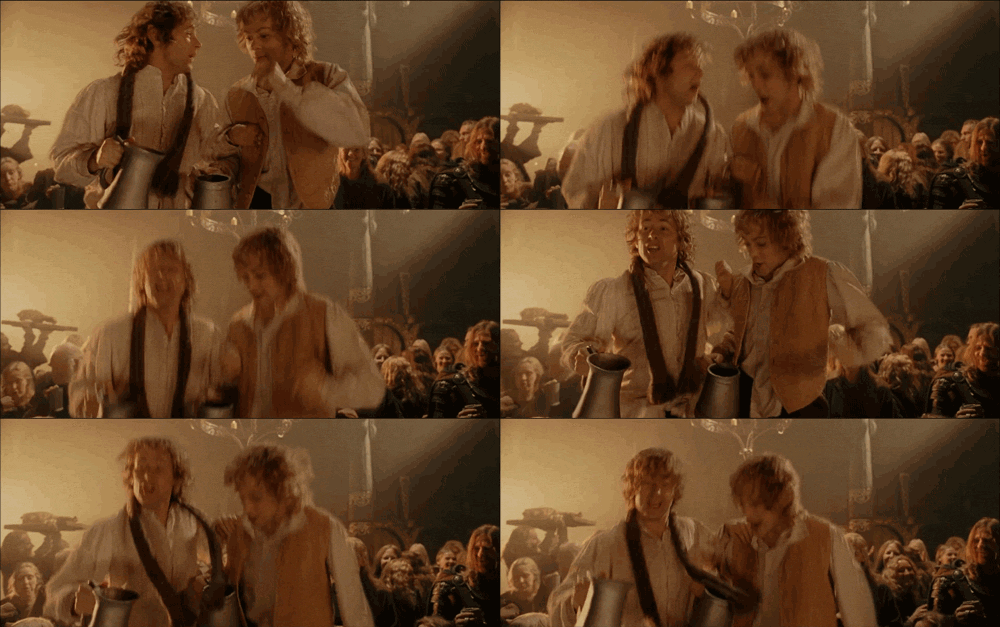
            Gerunds. Gerunds are the verb form that ends in “-ing.” Generally, gerunds describe a process that is ongoing, and while there’s technically nothing wrong with them, many authors overuse them and use them incorrectly. Seek them out, and see if the regular form of the verb will suffice. For example, what’s the difference between, “The hobbits were dancing at the Prancing Pony,” and “The hobbits danced at the Prancing Pony”? Five letters and a space, and stronger prose.
            As a final language-strengthening tip, look for repetitive words. It can be jarring to a reader to see the same word twice in a short amount of space, but also variety is the spice of life. If you find you’ve used the same word twice in the same paragraph (even the same page, if you want to be as anal as I am), it’s an opportunity to edit and make your writing more interesting. Seize that chance. Your readers won’t thank you, but that’s the point. They’ll never know your writing was worse. They’ll just be impressed at how good it is.
Oops! You learned something.
            By employing these tips, I promise your work will read better. And, by editing your work, you will force yourself to think critically about your prose. You will slow yourself down, focusing on the small ideas instead of concerning yourself with the big ideas. The small ideas are extremely important, because only through those ideas do we, as readers, understand your big ideas.
            If you keep at it, eventually, you will recognize these weaknesses while you write, and you will discover better versions of your sentences with progressively less effort. It will become automatic and ingrained in your writing. By using these techniques to improve the writing you’ve already done, you will improve your future writing before you write it. More important, you’ll look back and realize that, on a fundamental level, you’ve become a better writer.


Categories