
August 4, 2017

Stop Hitting Yourself…

            Just want to thank you all for your patience while I was off at (and recovering from) SDCC.
            Now, back to our usual rants about storytelling…
            I’ve mentioned once or thrice before that I like watching (and commenting on) bad movies.  Sometimes I find a hidden gem.  Most of the time, though, they’re just fodder for these little rants. Much like when I used to read scripts for screenplay contests, if I watch three or four bad movies in a row I almost always find some common flaws and teachable moments.
            So I saw a Dracula movie recently… 
            He’s arguably the most commonly-filmed fictional character on Earth.  It’s not that big a surprise I stumbled across one.  Actually, it was a three-Dracula geekery day, if memory serves.
            Anyway, this one was set back in the 16th Century and went the ancient-noble-prince route.  It’s a not-uncommon take on the character (Fred Saberhagen wrote a whole series that used it). Dracula used his supernatural powers to protect Transylvania and had this whole warrior code and all that.  And I’m kind of guessing 16th century.  Vlad Tepes lived in the 15th, but these people were actually dressed in a more medieval-fantasy style.
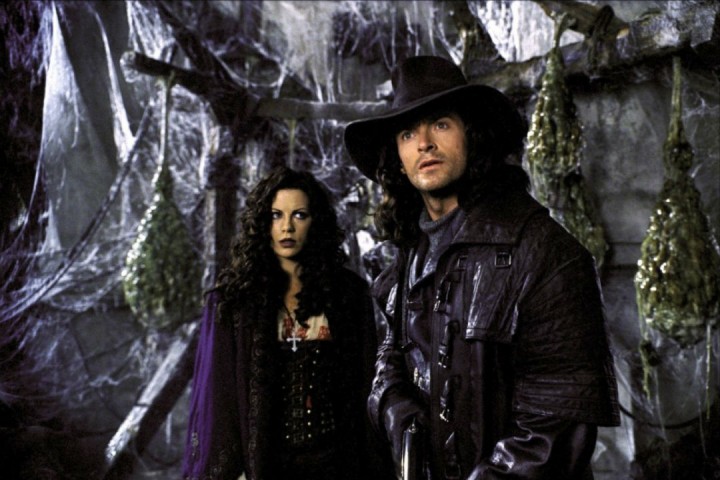
            Except… we also had Jonathan Harker and Mina and Lucy and Van Helsing.  Medieval versions of all of them.  Again, not terribly uncommon.  We’ve seen lots of interpretations of these characters (looking at you, Hugh Jackman).  So Mina and Lucy being kickass demonhunters isn’t that odd.

            Except… we also had this huge biblical subplot, where vampires are all descended from Cain and can only be truly killed by descendants of Abel.  Which, I mean, I’ve heard stories that tied vampires to the bible before.  So it wasn’t really an outlandish, crazy thing.
            Except… we also had the romance.  You know the one.  Mina is a near double/reincarnation of Dracula’s long-dead princess.  Long scenes of wistful staring and passionate confusion ensue.
            Man, that’s kind of a lot for a ninety-odd minute movie, isn’t it?
            I think one or two Saturday geekeries later I ended up watching this twisty-turvything about dead children and stalkers and swapped identities and second marriages with creepy undertones.  That could all balance out kinda cool, right?  But there was also this whole parallel plot about guardian angels and angel sex (no, seriously) and sin and redemption.  And the plots didn’t so much as dovetail together as butt heads for a while and then have a high-speed impact (which also involved some fatalities…)
            What’s my point here?  Well, I have two, believe it or not.  They’re kinda related, but still—bonus tips for you.

           First, in both of these movies, the plot kept getting in its own way.  There were so many clever ideas that none of them really got developed to a satisfying degree.  We’d start dealing with one and then have to rush off to deal with another one before people forgot about it.  Or the ideas would collide head on, which led to analyzing the story instead of… y’know, enjoying it.

            I’ve talked about this problem a few times before—where a plot or story is just overpacked with ideas.  And what tends to happen is the plot will overwhelm the story, the story will smother the plot, or sometimes they’ll just collapse into this mess of well… random plot and story points.
            This is a really tough idea for new writers to grasp, because it feels counterintuitive to everything we’ve been led to believe as storytellers. If the idea’s good, how can it be wrong for a story?  Thing is, sometimes a really good idea just doesn’t work in the story I’m telling.  If it’s not driving the plot or motivating the characters, if it’s pulling us too far off course or just filling space that could be used for something else… it probably doesn’t belong there. 
            I got to interview Kevin Smith a few years back, and we talked for a few minutes about his legendary hatred of ad-libs. He was quick to point out that he didn’t hatead-libs. His problem was that ad-libs rarely fit into the final story. Sure, they might be hysterically funny at the moment while filming on set, but then you’d get to the editing room. Now they had to fit in with the tone and pacing of the overall movie.  And more often than not… they didn’t.  It’s not that they weren’t funny or clever, they just didn’t fit. And then Smith even made a point of praising his then-leading man, Seth Rogen, for the ability to fire off lots of funny lines that were, as he put it “very germane to the discussion.”
            Y’see, Timmy, when we come up with these really cool ideas for a new take on werewolves, some really hot and sexy dialogue, or an incredibly cool way to describe the feeling of a knife piercing the flesh… well, we want to use them.  That’s our job, after all.  To take cool ideas and make cool stories out of them.  But sometimes—a lot of the time—our job is really knowing when to take the cool ideas out.  It’s being able to cut away the excess, to figure out what our story’s about and what parts are just wasting time and space.
            Which brings us to my second clever point…
            There’s a general idea  I see crop up a lot that stories can be any length.  Any length at all.  I can make the story whatever it needs to be—fifty pages long to five hundred pages long.
            And while, in a general sense, there’s some truth to this, the stark reality is that there are a lot of limits on how long a story can be.
            Look at screenwriting. We all acknowledge that movies are generally ninety minutes to a little over two hours.  It’s just how it is.  When a movie’s only seventy-plus minutes… we feel kinda cheated.  It can be really good, but almost always there’s a response of “That’s it?  Only seventy-one minutes?”  Likewise, when a film stretches out over two and a half hours, it usually feels pretty excessive.  There are a few really great just-shy-of-three-hour movies, but there are a lot of really bloated, desperately-in-need-of-editing ones.  So if my screenplay doesn’t fall in the 90-130 page range… I might get some folks to look at it, but not many professionals are going to take me seriously.
            And if I’m publishing… well, paper costs money.  And shelf space in book stores is precious.  Most publishers don’t want to see a massive, beef-slab of a book unless they know they’re going to sell a lot of copies of it.
            Ahhh, I say, well I’ll just publish it myself, then nobody can turn it down for financial reasons.  True, but a lot of the POD sources still work off page length to calculate costs, and they’ve got much more hard ranges. Just a few pages this way or that can mean a price jump of three or four dollars per copy. And somebody’s got to eat that cost.  It’s not going to be them, so it’s either me or my readers.  This is why I had to cut almost 30,000 words out of my book 14 –the small publisher couldn’t afford to have it stretch into the next page-range.
            Heck, even if I just give up on print altogether and go with epublishing only—check the numbers. Shorter books do better as ebooks, especially from self publishers.  The vast number of folks who’ve had any degree of success with ebooks are doing it with books under 100,000 words.  I think many of them are under 70,000. The “why” of this is a whole ‘nother discussion we could debate for a while, but for now we just need the simple numbers. Ebooks tend to do better as shorter books.
            Y’see, Timmy (yep, a double Y’see Timmy—haven’t had one of those in a while) what all this adds up to is limited space.  Those pages are precious.  My words are precious. I don’t want to waste them on irrelevant things.  I want them to be moving things along for the plot and for my characters.  I want the ideas to work for the story, not to be flexing and contorting my story to accommodate some ideas.
            A while back a friend of mine was working on a Frankenstein-esque story, and he had this super-cool idea for a detail about the monster’s origins.  And it really was a cool idea.  Thing is… his story was all structured around the idea that we never really learn much about where the monster came from or how it was built.  That was part of the mystery.  There wasn’t anywhere to use this idea, but he was soooo determined.  Even when it made no logical sense for this detail to be revealed, he kept trying to force it into different chapters. Because it was too cool an idea not to use… even though the rest of his story was suffering because of it.
            You may have heard that old chestnut—kill your darlings. This is kinda like that.  I may have the coolest line of dialogue, the neatest way to explain something, or the most fantastic description of a giant robot ever, but if it doesn’t work in my story…

            Well, then it doesn’t work.

            And if it doesn’t work—if it’s not adding to my story—then it shouldn’t be there.
            Next time, unless someone has some other ideas, I was going to toss out a few quick little tips about genre and devices.
            Until then… go write.
February 11, 2016 / 1 Comment

Ignorance Is Bliss

            I just realized that Valentine’s Day is this weekend. If I’d remembered earlier, I wouldn’t‘ve spent the time on this post, I would’ve done my traditional love and/or sex themed post.  And while surprise sex usually goes over well with everyone, I’m afraid I don’t have the time for it right now. Maybe next year.
            Wow.
            It sounds pretty grim when I say it like that.
            Anyway, I wanted to go over something one more time.  Because a couple of you still seem to be baffled by this for some reason…
            Take the Blu-ray case off the shelf.  Use your thumb on the right-hand edge to open the case.  Locate the Blu-ray disc inside the case.  Note that if this is a multi-disc set, you’ll need to select the specific disc you want to watch.  They’re usually numbered.  The number will correspond to a guide of some sort, usually located on the opposing panel of the cover or on the back of the case.  Look for the specific material you want to watch, then find the disc with the same number.  Remove the disc from its bracket.  Hold it by the edges (you don’t need to do this, but it’s easier in the long run).  Set the case back down.  Press power on your television controls.  Press power on your Blu-ray player, and then open.  A small tray will extend out from the player.  Set the disc on the tray with the picture/logo side up and the shiny side down.  Let go of the disc.  Press play and the tray should retract.  Go sit on the couch.  Pick up the remote control for the Blu-ray player.  If you are given the option to skip over all of the previews, do this.  Watch the movie or television episode you have selected. Do not talk during the movie or television episode.  If you have seen the movie or television episode before, do not spoil plot points or character moments for other viewers..
            Now, let’s stop and consider the previous paragraph.
            How many of you started skimming halfway through that?
            It’s okay.  It was kind of mind-numbing for me to write, so I can’t imagine reading it was any better.  As it happens, though, pretty much every reason why exposition tends to suck is in that fascinating explanation of how to watch a Blu-ray. 
            Allow me to explain. 
            First, that paragraph is something we know.  I know it, you know it.  I know you know it. You know that I know you know it.  
            Exposition is boring and pointless if we know the information being presented to us.   It’s just wasting time while we wait for something to happen.  Plus, none of us enjoys sitting through a lecture on something we already know, right?  The more detailed (read—unnecessary) it is, the less interested we are.  So we just zone out and start skimming.
            Damon Knight pointed out that a fact we don’t know is information, but a fact we do know is just noise.  No one wants to read a story full of noise.  As writers, we need to know what our audience knows and work our story around that.  I don’t want to waste time telling people how to open a Blu-ray case.  It’s just a given.  All those words are better spent on something useful.
            The Second  thing to consider is that a lengthy explanation about how a Blu-ray player works serves no purpose here.  None.  This is a blog about writing tips, so a paragraph about electronics is a waste of space.  Nobody came here looking for that information, and the people who are looking for it won’t be looking here.  You’ll notice that those instructions don’t tell you the best way to kill a Deathclaw in Fallout 4—even though Fallout is a really cool game which (like Blu-rays) can be played on a PS4.  The instructions also don’t mention that I don’t even own a Blu-ray player. Or a PS4.  Mildly interesting facts, sure, but even less relevant than the bit about killing a Deathclaw.
            These two points are, on a guess, about 83% of the reason most exposition sucks.  Find any book or story  with exposition that gnaws at you, and I’ll bet it falls into one of those two categories.
            So, how do we get around that?
            I’ve mentioned something called the ignorant stranger  a few times.  It’s my own term, one which I came up with while writing a review of Shogun years ago.  It’s a simple way to use as much exposition as I want in a short story, screenplay, or novel.    
            Just have a source of information explain something to someone who doesn’t know these facts.
             Easy, right?  Just remember these three things…
            First, my ignorant stranger has to be on the same level as my readers.  I don’t want to confuse ignorant with stupid.  It’s only this particular situation that has put him or her at a disadvantage.  The reader or audience is learning alongside my character, so we don’t want to wait while the stranger’s educated on how Amazon works, where Antarctica is on a map, and why people eat food.  Again, my ignorant stranger can’t actually be stupid
            Second, the person explaining things, the source of knowledge, has to be smarterthan the stranger on this topic, and thus, smarter than my audience.  If what’s being explained is something my readers can figure out on their own then the Source is wasting everyone’s time (and my page count) by explaining it.  Remember, I want information, not noise.  Yeah, maybe this particular Source doesn’t know much about baseball, Star Wars, or the eternal mystery that is love, but on the topic they’re explaining this character needs to be an authority.  It needs to be clear the Source’s knowledge dwarfs the ignorant stranger’s on this topic.
            Finally (or third, if you like), there needs to be a pressing need for the Source to explain this.  There may be lots of things our stranger (and the reader) is ignorant about, so why are they talking about this fact right now?
            Shogun gets away with tons of exposition because Blackthorne—an English sailor trapped in feudal Japan—is a perfect ignorant stranger.  He’s a smart man, a man we can relate to, but he’s in a  country where he doesn’t know the language, the customs, the culture, anything.  So even as his situation forces him to interact with people, they’re forced to explain pretty much everything to him.
            So there it is.  If anyone tries to tell you only bad writers use exposition in a story, tell them it’s only the bad writers who don’t know how to use exposition.  Then explain the ignorant stranger to them.  And then look smug while you pop in a Blu-ray and watch Star Wars
            Next time, I’d like to tell you about my perfect woman.
            Until then, go write.
January 30, 2015 / 2 Comments

What’s In Your Arsenal?

            Y’know, while I was pulling links for this post, I realized something kind of amazing (and I’m glad I caught it).  This is the 300th time I’ve posted on this page.  Three hundred ranty posts about characters and dialogue and spelling and structure. Wow.
            I’m kind of surprised we’re all still here.
            But let’s get back to it…
            Odd fact—I’ve probably fired more types of handguns and rifles than anyone reading this.  You might be a firearm enthusiast, you might be former military, you might be in the military now… but there’s a very good chance I’ve got you beat.  I once compared notes with an Army weapons specialist and it turned out I could name almost twice as many firearms than him that I’d used, including a few obscure ones he’d never even heard of.
            The reason why I can do this is all my time in the film industry.  With the different procedural and crime shows I worked on, it was very common to have a new murder weapon every week, along with a red herring weapon and possibly some random thug weapons as well. Pistols, shotguns, rifles, bolt action, lever action, pump, semi-auto, full-auto…  And every one of these that was actually used on screen had to be test fired by me and then by the actors. 
            Even with some common weapons repeating, over the course of fifteen years… I fired a lot of weapons.
            Now, with all that being said, even though I’ve worked with a ton of weapons, I would never consider myself any kind of marksman.  Definitely not a sniper.  Because there is much, much more to being good with weapons then just being able to pull a trigger.  An AK-47 might seem like a ticket to badass-dom, but not if I don’t know how to load it. Or hold it.  Or turn the safety off.  I’ve heard some great (and kind of awful) stories from soldiers about gunfights with people who don’t know how their own weapons work.
            I bet a few folks reading this have an acquaintance who buys nothing but the most expensive, top-of-the-line tools yet still can’t put an IKEA bookshelf together.  Most of us have heard stories about some guy who spends a quarter-million on a car and then wrecks it within a week because “the car outperformed the driver.” Heck, we’ve all seen proof that giving a director access to grade-A actors and millions in film technology is absolutely no guarantee of a decent movie.
            Y’see, Timmy, having high-level tools doesn’t automatically make me skilled.  They’re two entirely different things.  Sure, I can keep jabbing at that bookshelf with my $300 DeWalt Max XR  20 volt hammer drill, but if I just need to tap in a few finishing nails it’s not going to help much. And the parts the drill would actually work for… well, a Phillips head screwdriver would do the same job.  It might even work better, all things considered.  DeWalt’s are great, but they can kind of suck when you need to work in tight spaces.
            Anyway… where am I going with this?
            I’d like to share something with you.  As I’ve mentioned once or thrice before, I used to work on a text-based online game, what some of you might know as a MUD.  Because it was text-dependent, it was a chance for some people to really show off their skills.  Or complete lack thereof.  A friend of mine still works there and sometimes she shares things with me.
            So, check out this sentence…
            (names have been changed to protect the horribly guilty)
“Lashes aflutter like the wings of a satin bird, Phoebe sets glaukosphaerite lagoons on the newcomer, a smirk glissading across twin folds.”

             WTF…

            Now, I was going to try to sift through this sentence and break down all the places it went wrong.  To be honest, I did.  And I had a page and a half of notes, which is a lot more negativity than I want to have here.  So, instead, let me break all of that down into four simple rules for your writing arsenal.
            And yes, these would be rules, not advice.
            Know what words meanIt doesn’t matter how much my reciprocal saw cost if I keep trying to use it as a butter knife.  An elephant gun is not a sidearm.  And diffuse and defuse mean two entirely different things.
            This is the most important of these rules.  If I want to make my living with words, I need to know them intimately.   Not more or less what they mean or a general idea of how they’re used.  I cannot say words are the tools of my trade and then get repeatedly stumped by vocabulary questions on Jeopardy!. I’ve been doing this for many years, full time for over eight now, and I still pick up the dictionary once or thrice a week to make sure I’m using a given word correctly.  Because I have to know what they mean.
            This is also one of the worst rules to get wrong because it’s a mistake that’s hard to catch.  I won’t catch it because, well, I don’t know I’m using the word wrong.  My computer won’t catch it, because computers are idiots and will only tell me if a word’s spelled right, not if it’s being used correctly. Which means the readers will probably be the ones to catch it… and it won’t give them a good opinion of my skills as a writer.
           
            Don’t overcomplicate—Stephen King once said that any word you go looking for in the thesaurus for is the wrong word.  I’ve mentioned a few different versions of this rule at one time or another.  I’m not saying my writing can’t have some clever bits to it, but I should never confuse (or equate) overcomplicating my writing with complexity in my writing.
            If I have metaphors for metaphors (like using lagoons instead of pools because I don’t want to use eyes), I am pushing my audience away from reading and into analysis.  This is the kind of thing that destroys the flow of my writing.  And that’s the kind of thing that gets my writing set aside in favor of something else.
            Know how things go together—Remember that AK-47?  It’s not going to be half as effective after I force a lot of shotgun shells into the magazine.  They’re two powerful items that do not work well together.

            People can’t read my sentences if they don’t understand my sentences.  That “descriptive”sentence up above arguably has five completely different similes and metaphors. It’s spinning in multiple directions. This is when things go past overcomplicated and into full-on incomprehensible.  I need to have a firm understanding of the individual parts, how they’ll be perceived, and how they’ll work as a whole.

            Know what words mean—Did I mention this one already? Well, it’s probably worth mentioning again.  It is the most important of these rules after all.  And the one most people will ignore, because I need to be able to admit I don’t know stuff before I can learn new stuff.
            Have a big arsenal of words because you need it and you can use it.  Not just because you think it makes you look cool.  I can spend twenty minutes looking up glaukosphaerite and making sure it’s spelled correctly (because it won’t be in the spellchecker), but I could also just use green and then finish this whole page in that same amount of time. 
            And more people would understand what I was trying to say.
            Next time, I wanted to tell you about something I’ve felt for a while now…
            Until then, go write.
December 8, 2014 / 2 Comments

There Are Those Who Call Me…

            So very sorry about missing last week.  I was juggling a few things, time slipped away from me, and suddenly it was Saturday and somebody hadn’t updated things here.  Past me, I’ve discovered, can be a real lazy bastard sometimes.
            To make up for this, I’m going to do two shorter posts and put them both up this week.  Just some quick, easy tips.  I’m sure future me won’t mind writing them.
Not this Doug
            Anyway…
            I read a book a while ago about a character named Doug.  Good solid name.  That’s how the book referred to him.  Doug.
            Except to his parents.  They were only in the first two chapters, and they called him Douglas.  But even then, he thought of himself as Doug and that’s what he was called for the rest of the book.
            Although every now and then he was “the short guy” or “the short man” to break things up a bit.  Which is understandable.  Using someone’s name over and over and over again gets boring fast.  So once or twice on a page he’d be the short guy.  Or the short man.
            Except… there was a character, Jay, who’d been friends with Doug for years, and whenever they spoke Jay would always refer to Doug as “wingman.”  “Hey, wingman, grab me a drink while you’re up.” 
            Except… there was another character, an older one, who had met Doug briefly years ago (a friend of his parents).  At the time, Doug had been four and playing in a mud puddle.  So this guy kept referring to Doug as “the dirty kid.”  “Hey, dirty kid, what’s up?”  “The dirty kid said you might stop by.”
            Now, it’s understandable why people do this.  Over the course of our lives, most of us accumulate a number of names and nicknames and titles.  Most of my friends call me Pete, but I have a fair amount who call me Peter, as do most folks who don’t know me as well.  There’s also a bunch of family terms (son, brother, uncle, cousin) that different people use for me.  There’s also a number of folks who just refer to me by my last name.  For almost fifteen years I was regularly called Peter Props.  An early experiment with facial hair had a few mindless jocks referring to me as Goat-boy for a year of high school.  Heck, a woman in my college fencing class started calling me Hamlet and stuck with it for the whole time I knew her. 
            And there are more names past that.  We all end up with them.  That’s just life.
            But we’re not talking about real life.  We’re talking about fiction.  Two different animals.  I’d never use all these names consistently for myself, or for a character in one of my stories.  This is a variation on a problem I’ve mentioned before, usually in regards to screenwriting–the dump truck.  It’s a ton of names that I’m throwing at the reader for no real reason.  That’s just going to get confusing, and confusion breaks the flow.
            Think of Agents of SHIELD, where many characters have codenames (the Cavalry, Mockingbird, Hawkeye).  Nine times out of ten, though, if a name is used, it’s just their given one (Melinda May, Bobbi, Clint).  Because it’s less confusing that way.  It’s the same in my Ex-Heroes books, where everyone has secret identities
            Y’see, Timmy, it’s okay to reference some of these things, but they shouldn’t be fighting with the name I’ve chosen to use for my character.  I may have a rich history written up for my character Eli, which includes a few names he’s collected, but I’m only going to use what’s relevant for my story.
            Next time, this Thursday, I shall continue things at this fast clip.

            Until then… well, come on.  You should know by now.

Categories