
July 14, 2023 / 2 Comments

While in Egypt…

Okay, so…

I’ve been fascinated with ancient Egypt since I was very little. Not sure what sparked it, but by the time I was ten I could rattle off the names of a dozen Egyptian gods and their relationship to one another. My fifth grade science fair project was a model pyramid with numerous “reconstructed” tools and a chart of heiroglyphs.

Many years back I was dating a woman and maybe a month into our relationship she mentioned she was going to Egypt in a few months. Would I want to come along? Spend a few weeks traveling Egypt with her?

I tried not to seem too desperate when I said yes.

As someone who grew up in New England, I was used to the idea of having history around you. Not just grandpa’s history or old family history, but serious history. Lots of buildings and landmarks in my hometown in Maine date back to the early 1700s, and the town’s history goes back even further.

But wow… getting to Egypt? There is HISTORY there. Thousands of years of it. I wasn’t ready for the crushing awe of it. And the scale of it. It’s one thing to read about how big some of these monuments are, to see them on television, but you honestly can’t grasp the size of them until you’re right there. Or in some cases, until you realize what you’re seeing in the distance.

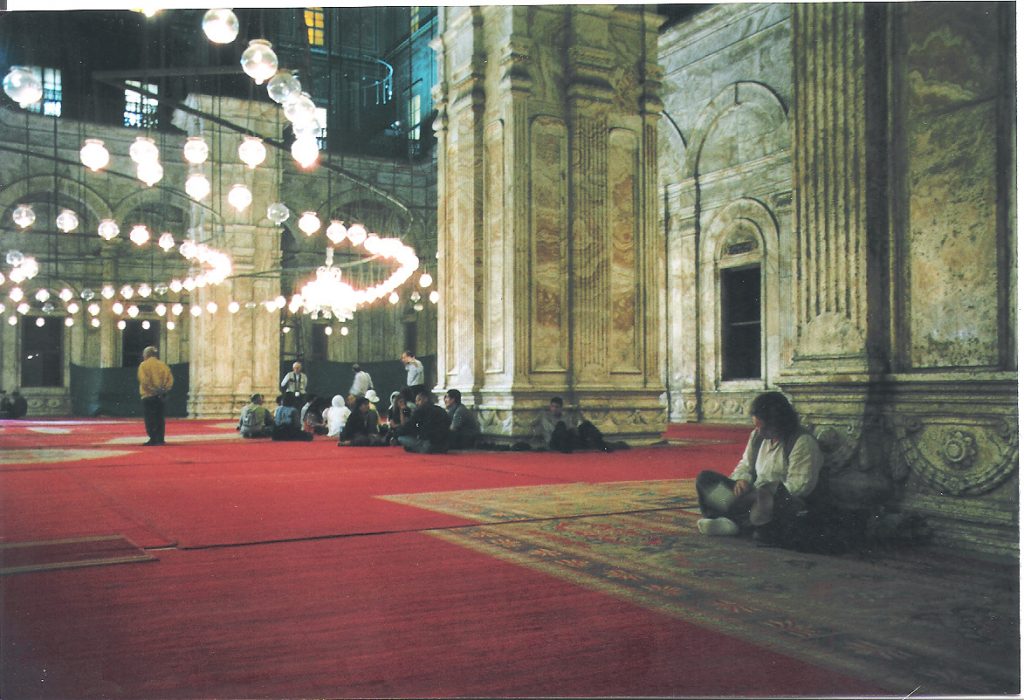
I was very lucky that we had no set schedule, so we could go somewhere and just… spend the day. We traveled from Cairo down to Aswan. Stopped for several days in Luxor. I’d just stare at temple walls, statues, and sometimes tombs. One time I just sat for an hour or so on a small cliff above the Valley of Kings and watched boats on the Nile.

Anyway, another thing I saw a lot of in Egypt was folks who spent a lot of time… well, today we’d probably say “taking selfies.” They’d pose in front of this or that, stand with this guide or that guard or hey, look, a camel! And then they’d race off to find the next thing to take a picture with.

It took me a while to realize these folks weren’t really interested in seeing Egypt. They were more interested in telling people they’d been to Egypt. They wanted to show off the photos and tell stories. For them, it was more about the secondary aspects of taking the trip. The after-effects, if you were.

So, while I’m sure this is incredibly fascinating to some of you, I’m sure far more are wondering what all this has to do with writing?

When we talk about writing, I think one thing that gets skimmed over a lot is what our actual goals are. What do we want out of this? Our endgame, so to speak. And this is important because if I don’t know what my real objective is—or I’m not being honest with myself about it—it’s going to be tough to find the right path to reach it.

Like, I’m willing to bet at least one of you reading this has thought “the goal is to get published.” Okay, cool. But what does that actually mean? Do I just want to be able to say someone paid me for a story and it saw print? That’s cool. I think for some folks there’s a degree of validation that comes with getting published, and maybe that’s all they need.

Maybe I just want to tell stories. That’s all that matters. Getting these ideas and situations and conversations out of my head and down on paper (down on electromagnetic bubble? Down on flash drive?) and sharing it with the world somehow. Or not sharing it. Maybe I just write because it’s what I do and it’s therapeutic on some level. Maybe I write a ton of stuff that nobody will ever see, and I’m totally cool with that. Nothing wrong with that.

Or am I hoping to maybe make money? Nothing wrong with that, either. More than a few folks write as a sort of side job. They’ve got their full-time career and writing’s what they do on weekends or the occasional late night, selling a short story or novella or even a full book. Or maybe the goal is to make writing itself the full-time career. To make enough money stringing words together that I can pay my bills, live in semi-comfort, and don’t need to do anything else.

But maybe the money’s irrelevant, and so’s publication. What I really want is for people to recognize that I’m good at this. Very good. Masterclass good. Maybe I want the accolades and the starred reviews and the numerous awards where I get to stand in front of people who understand how talented I am.

Or look, maybe I just want to be a writer because I want to be part of the club. That group gathered at the bar at the con. Those people online making clever comments to each other. I want to be in with them, and maybe I want people to look at me the way they look at those folks. It might sound a little silly but there are clearly people who only want to be writers for this… the same way those folks only wanted to say they’d been in Egypt. The want the destination, not the journey.

(yes, this may be me talking about a current hot topic)

Y’see, Timmy, there’s a ton of different reasons I may want to write. And whichever one is my reason… that’s fantastic. But I think it’s important to be aware of why I’m doing this. Because there are a lot of paths open to writers these days, and I don’t want to spend time and energy on a path that’s taking me away from what I really want.

So be honest. With other folks and yourself. What do you want?
Next time…

Actually, before I talk about next time, I wanted to bounce something off you. How many of you use the “categories” there on the side (also sometimes called tag or labels or…)? I was thinking of paring the list down a bit to make it easier to use. None of the tags will actually go away, they just won’t be in that list anymore. I was thinking I’d snip out all the proper names—nice easy way to lose twenty or thirty lines, and it’ s probably one of the least-used ways to search for things, yes?

Anyway…next time I’d like to talk a little bit about the devil. Specifically, the one in the details.

Until then, go write.
August 12, 2021

The Great Migration

A week or so back on Twitter I was asked to comment on a question that needed a little more response than 280 characters allowed. I tried to give a quick, simple answer, but it gnawed at me for a bit, ‘cause I’ve seen this question many times before (from several angles), and it always feels like the answers it gets are very simplified. So a few days later I added it to my list of topics for here.

“Anyone know whether publishers will pick up a book that’s
already been self-published for a new edition?”

Like so many things in this industry, this is one of those questions that sounds really simple, but there’s actually a lot more to it. I think this is really a few questions that’ve been Voltroned together and then demanding a single, comprehensive answer. Which is why the answers it gets tend to always feel a bit over-simplified and off. To me, anyway.

For example, even if we’re just asking how many self-pubbed books get picked up by traditional presses, this is a loaded question. Because most people don’t consider smaller traditional presses in that—they’re really just interested in the big ones. And small presses are, generally speaking, more open to picking up a formerly self-pubbed book. So viewing things this way already skews my answer.

Plus, it depends on just how we’re phrasing things—slightly different questions can get very different answers. If I’m asking how many Big Five books started off a self published works… the odds aren’t horrible. I mean, just personally, I know enough people it’s happened to, and I have a good enough sense of how many books get published, so I feel comfortable saying yeah, there’s passable odds it can happen. It’s not exactly common, but I’d be willing to bet out of the thousands of books the big presses put out each year, more than a couple were previously self-published. And, as I just said, the odds get even better if we bring in smaller presses.

However… if my question is what are the odds of a self published book getting picked up by a big traditional press… well, those numbers plummet. Because now we’re talking about hundreds of thousands, possibly millions of self published books each year and (as I said above) maaaaybe a dozen of them get picked up. So I can end up with a very different picture of things depending on what I ask. And, to be honest, how people want to answer. There’s a lot of wiggle room here to make the answers fit what somebody wants to believe. Or wants you to believe.

All that in mind… why don’t we try to break this Voltron-question down into its three (or maybe four) component lion-questions and answer each of those.

First off is the big one. Is my book something a traditional publisher would even want? Let’s be honest—anything can be self-published. Absolutely anything. The most illiterate, nonsensical garbage can be self-published. So right off the bat, I need to have actually written a good book. Something a publisher might’ve picked up if they’d originally seen it. Something with a very solid structure, good characters, and strong dialogue. In this aspect, it’s just like any other book they’d be looking at, and they’re probably going to have much higher standards than… well KDP.

Not only that, but odds are they’re going to be looking at my actual self-published book. I mean, I’m now a small press trying to convince a big press to take on one of my titles, so is it shocking to think they might look at it? Is it edited and copyedited? Does it have a nice layout? Awful as it sounds, does it have a halfway decent cover? They’re not going to judge on any one of these things, but they’re all going to have a degree of influence. I’m asking them to pick up this book, and if it looks like a crap book… well, they’re going to notice that.

Second is the money side of things. Is it worth it for a traditional publisher to pick up my book and republish it? Again, one aspect of this is going to be like any other book—is this the kind of thing the publisher usually sells? Not a lot of historical romances coming out of Tor, and Ballantine isn’t picking up a ton of splatterpunk. And even if I’ve written a straight sci-fi book, is it so sub-sub-niche that Tor might only sell a few hundred copies altogether?

That’s actually a good place to bring up a sort of second-and-a-half point. There’s also some math at work here. See, if my self-published book’s only sold sixty or seventy copies, it means it’s not getting any interest or word of mouth… which means it’s probably not worth it for a big press to republish it. But if the book’s sold too many copies, that means I’ve actually eaten into the potential audience. Every book realistically is only going to sell so many copies, so if all the market research says my book might appeal to an audience of ten thousand and I’m telling them it’s already sold eight thousand self published… that also means it’s probably not worth it to them to pick it up.

Also (what are we up to, my second and three-quarters point?) right now, as I’m writing this and you’re reading it—okay, maybe not as you’re reading it, depending—publishers are actually having meetings about what’s going to be on sale for Christmas 2022 and even talking a bit about spring of 2023. Seriously. They’re working that far ahead. Which means, on a lot of levels, they’re not as interested in what’s going on right now. So I might think this is a fantastic time for my book to go big, but as far as they’re concerned… that time was fifteen months ago.

Third is what am I expecting to get out of this? Mass distribution? Book signing tours? A futon stuffed with twenty dollar bills?  Welllll… remember that math I mentioned above? How much they think they can make off my republished book is going to affect how much they’re going to pay me. I can’t expect to get a huge advance off something that’s been out there selling copies for a year or two now, so if I’m demanding a six or seven figure check out of this… get used to disappointment.

And them paying less money means they need to make less of an effort to recoup that money. So no book tours. Not on their dime, anyway. I’m probably still going to be pushing this a lot myself. It’ll be more available, and it’ll have a little more weight behind it, but I’ll still probably be doing the same level of self-promotion I was doing when it was self-pubbed.

Also worth noting that the days of piecemeal rights deals are pretty much long over. I can’t be thinking I’ll ask the traditional publisher to take over just print and audio rights, but I’ll still get to put out the ebook. Doesn’t matter if it’s my choice or because things are locked up in some previous deal. It’s extremelyunlikely someone’s going to accept very limited rights for the book, especially a big publisher. I might be able to make it happen with a smaller press, but even they’re going to be a bit leery about it.

And all that’s kind of a broader answer to “will traditional publishers pick up a book that’s been self published.” There’s lots of ifsand buts in there, and I need to figure out where my book (and where I ) sit with all of them to get a real sense of an answer. And again, that’s just to get us to whether or not it’ll happen. Y’see Timmy, ultimately—like any other publishing venture—my journey of getting a self-published book picked up is going to be different than your journey, and odds are neither of us are going to get a deal like she did.

So… very long answer to a deceptively short question.

Next time, I want to talk about cake.

Until then… go write.

April 20, 2021 / 3 Comments

A Social Media Question

 Hey, remember when I said if you post questions in the comments I’d try to answer them?

Well, last week, Tantilloon asked,..

“Do you think it’s still possible to get a book published without any social media presence? Asking because I finished a manuscript. I’m just opposed to social media in general, so I’m sort of wondering if my book is DOA just because the idea of using something like Facebook is a deal breaker.”

Not word for word, but that was the thrust of their question. And questions get answers!

Okay, I’ve seen variations of this floating around the interwebs for a few years now, and it’s come up once or thrice at the Writers Coffeehouse. Y’know, back in the before-time. When we all met in person.

I’m getting my second shot next week. How about you?

Anyway…

This isn’t an easy yes or no question, but I’ll try my best. As always, this is based off my own experience, but I’m also considering what I know/have seen from other authors, things I’ve bounced off a few agents I know (including my own), and talking with some editors.

First, the answer depends a lot on if we’re talking about fiction or non-fiction. Overall, it definitely helps a non-fictionbook if I’ve got a good-sized social media presence. Simple reason why—if I’m writing a non-fiction book, the implication is I’m an expert in some field, and a strong social media following shows that people are interested in my expertise. Yes, it’s possible people are just following me because they’re interested in my novels even though I’m an expert in all behind-the-scenes, non-fiction things related to Rom Spaceknight, but the overall assumption is still going to be that a strong social media presence is a very big plus for a non-fiction book.

So a big following on Facebook, Twitter, Instagram, TikTok, or… I don’t know, is Tumblr even still a thing? A big social media following isn’t strictly necessary for a non-fiction book, but it’s definitely going to help if I’ve got one. And what counts as “big” is going to depend a lot on how niche my book is. If I’m writing a political book intended to reach half the country, I probably want a larger following than if I’ve written a book on, say, the psychology of Rom embodying the sci-fi trope of paranoia vs. trust.

If we’re talking about fiction, this is kind of flipped. Most agents and editors neither require nor expect a big social media following. They don’t. Honest. Because, realistically… why would I have one? I mean, sure, I’ve got family and friends, and maybe a dozen or so people follow me for my insightful takes on Rom, but that’s still only going to add up to what… fifty or sixty people? Those publishing folks are aware that one aspect of being an unknown author is being, well, unknown. Seriously, think about it. If I’m not a known entity, why would I possibly have an online following of a size that could notably affect book sales?

Plus, sad truth is… social media doesn’t sell a lot of books. Either partaking in it or advertising on it. It sells one or two, sure, and it lets the fans I already have know I’ve got a book coming out. But let’s be honest—you and I both get hit with promoted tweets and Facebook adsevery day. Well, okay, I deleted my Facebook account over a year ago. Instagram ads, then. Point is… we ignore them most of the time, don’t we? And we ignore that guy who’s always going “Hey, buy my book! Buy my book! Buy MYbook! Buy my BOOK! HEY! MY BOOK! BUY IT!”

It’s just not what most of us are on social media for, and publishers know this. Because they’re people too. And their business is selling books.

True story—almost exactly ten years ago Nathan Fillion tweeted a few times how much he loved the Ex-Heroes books. Seriously, he did. I think he had a little under two million followers at the time. So let’s just say a million people saw him say how much he loved the books. One million potential readers.

We barely saw a ripple in sales. The book sold a little more that quarter, but it was selling a little more every quarter. Even with a million sets of eyes, there wasn’t a big spike we could call “the Fillion Effect” or anything like that.

Now, in all fairness—a publisher usually wouldn’t be upset if I did have a few hundred thousand followers and I liked hanging out on social media. It does make getting the word out there a bit easier. But again, it’s not going to affect if they pick up my book or not, because it’s not really going to sell a lot of books.

And if it does affect how a publisher’s looking at my book… that’s a little bit of a red flag, in my opinion. If they’re that concerned with my social media, it might be a sign they’re expecting me to do all the marketing and publicity. And since social media doesn’t sell books (see above), that’s not really a winning strategy.

So, no. Absolute not necessary to have a social media account.

Now, let me toss out one last bit of advice that kind of applies either way…

Social media is about, well, being social. Honest interaction. When people interact with me on Twitter or Instagram or whatever’s coming next, they’re expecting to interact with me. Not my assistant. Not my sales plan (as mentioned above). Not my month of pre-scheduled posts. They just want a sense of… me. That’s why most of my Twitter and Instagram is about interacting with friends, toys, cats, and B-movies. Occasionally some tabletop games or politics (if I’m especially frustrated by something). And most people seem to like it. That’s just who I am, and I enjoy sharing the stuff I’m interested in and/or love. I’ve got friends who put up pet pics, some who play random games, some who like taking weird photos of the world or themselves. It’s whatever you enjoy doing, because that honest enjoyment shines through.

If someone’s not really into social media, if they don’t want to deal with that interaction or whatever level of responsibility they think it needs to be… fine. Don’t do it. Seriously. People will sense that insincerity, that I see this more as an obligation than an honest interaction. And they won’t be that into it. Better to honestly not be on social media than be on it in a dishonest, disinterested way.

One last thing, which ties back to that insincerity. Let’s say I decide I don’t want to leave anything to chance. If a big follower count only increases my odds of getting picked up by 0.83%, I’ll still take what I can get! In this scenario, it might be tempting to do a lot of things in an attempt to artificially boost my follower count. Following back everyone who follows me, for example, trying to jump on whatever trend I can, or maybe even paying for likes and followers.

Editors and agents can spot this stuff just like you and I can. Again, they’re people. A lot of them have social media accounts of their own. And if they see I’ve got 50,000 followers but I’m following 49,892 people… well, they’re going to have a good sense of how wide my reach really is.

But again… it doesn’t really matter for a fiction book.

Anyway… regular post on Thursday. Clowns and true love. See you then.

February 9, 2021 / 3 Comments

Three Things About Publishing

After I put up my list of publishing definitions last week, I got a comment that made the gears in my brain start spinning.

Part of it was because they (innocently, I believe) mentioned the idea that publishing is some sort of competition. Which it isn’t. Anyone who’s earnestly pushing that idea, that I’m somehow competing against other writers, is saying a lot more about themselves than they are about any aspect of publishing. Seriously.

And right after that someone on my twitter feed mentioned they’d given up on the idea they’d ever be a published novelist. Which was kind of heartbreaking, to hear someone’s given up on a dream. But it’s also tough to counter because… well, “published” isn’t always the neat, clean goal some folks think it is.

Anyway, I went to answer the first comment, started thinking about the second, and that’s how we ended up with a bonus post. These aren’t tips or tricks but more guideposts. If I’ve finished my manuscript and I want to be published, there are certain decisions and admissions that need to be made. I may be way off—and I’m open to hearing other thoughts–but I think if I want to succeed in publishing, there’s three things I need to be very honest about.

That’s the big thing here. I need to be completely, brutally honest with myself.

First is being honest about my manuscript. Is it the absolute best it can be? Have I really put in the work? Did I do multiple drafts? Line edits? Get feedback? Did I listen to the feedback? I’ve mentioned once or thrice that “good enough” isn’t going to be an easy sell, for me to an agent or for an agent to an editor.

Again, we’re not talking about what it can be with help from that professional editor. We don’t care about how cool the adaptation’s going to look on the big screen. How is this manuscript? Seriously.

Second is being honest about how many people my manuscript is really going to appeal to. We all love the idea of the runaway bestseller with millions of copies in print and  dozens of  translations. But the simple truth is that’s very rare. Maybe one book a year does that. Maybe. And simple math tells us… it’s probably not going to be our book. I mean, hell… my own grandmother never read any of my books. They just weren’t her thing.

So I need to really consider this. How many people are realistically going to want to read my book? Will it only appeal to die-hard splatterpunk fans? Would most mystery readers enjoy it, or only cozy readers? Yeah, it’s a fantastic sci-fi epic, but how big is the market for sci-fi epics right now?

Having a realistic understanding of how much my book will sell makes it a lot easier to sell my book. It also gives me a good sense of what path I want to be on. A book with broad appeal has a better chance with a big traditional publisher, while a more niche book may do well at a small press, and a very niche book could make me a lot of money self-published.

Third, maybe the toughest, is being honest about what I really want out of this. Why do I want to be published? Am I hoping to make storytelling a career? Do I just crave the validation that somebody thought I was worth publishing? Do I want a six-figure advance? Am I just hoping to get invited to better parties the next time I’m at a con? Am I seeing this as a stepping stone to Hollywoodor comics or something else? Is this just all about getting chosen for you-know-who’s book club?

There’s a lot of book clubs out there after this past year. There’s probably one we’d all like to get chosen for.

It may feel like there’s a lot of overlap and room for multiple choices in that mess of questions, but again… what am I reallyhoping to get out of this? What’s the thing that pops to mind when I hear “published author” applied to me? Do I want the money? The recognition? Something to put on my shelves? Hopefully it’s clear that what I’m hoping to get should affect how I go about trying to get it. And maybe, if I’m being honest, I might even realize my primary goal in writing a book is a bit… unrealistic?

Again… be honest.

And once I’ve been honest about these three things, I should be able to see some overlap. Places where pushing at this one means pulling on that one. And when I’m done, it might give me a better sense of where I am. And what I may need to do to get where I want to be. I’m not saying these things can guarantee anyone a publishing contract, but I think it’s worth noting that most of the successful writers I know consider this stuff.

Anyway, just a few quick thoughts. Your mileage may vary, as the kids say.

Next time… Cloverfield.

No, wait, what am I saying. This weekend is Valentine’s Day. And book club! Thursday we’ll talk about love. Cloverfield can wait until next week.

Categories