
December 19, 2025 / 1 Comment

Then to Now

Oh! Hello there. Yes, this is very overdue, isn’t it?

The past month has just been wild. The book tour. Thanksgiving. Three or four vet visits. Two or three doctor visits for me (minor stuff, in the big scheme, don’t worry). Assorted holiday activities.

Oh, and this book I’ve been editing. And another book I’ve been poking at.

It’s still really weird to me sometimes to think I’ve had over a dozen books published. Me! That’s not even counting all the short stories and collections. It’s just… weird.

Which leads me to this (very overdue) ranty blog post. I’d planned to do it waaaay back at the start of November but… y’know, maybe it’s better now, as we’re all starting to think about top ten lists and how much we got done and all that sort of thing. Those can be fun, but I think they can also be kind of demoralizing. It can be rough when you’re trying to find time to write while someone else is pounding out three or four books a year. Heck, even once you’re kind of established, it’s easy to watch people talk about all those end of year accomplishments and feel like… wow, I didn’t do much at all, did I?

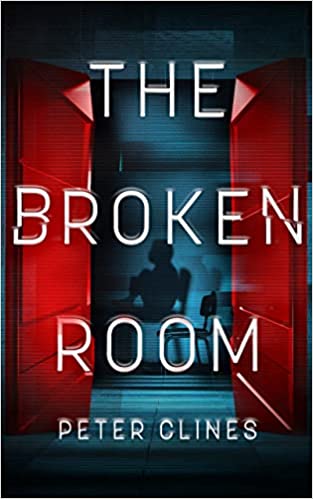
One thing it took me a while to figure out was that a lot of us have very skewed ideas of the time frames involved when we talk about “how long things take” when it comes to art and artistic careers. F’r example, when I first started out, people thought I was ridiculously prolific because I had four really solid books (and a bunch of short stories) published in less than two and a half years. But it actually took five years to write all of that. Likewise, right now it looks like it took me three years to write God’s Junk Drawer, since that’s how long it’s been since The Broken Room came out. But I actually wrote three books in that time. You just haven’t seen them all yet. And when those start coming out, I’ll bet you anything someone pulls out the prolific label again.

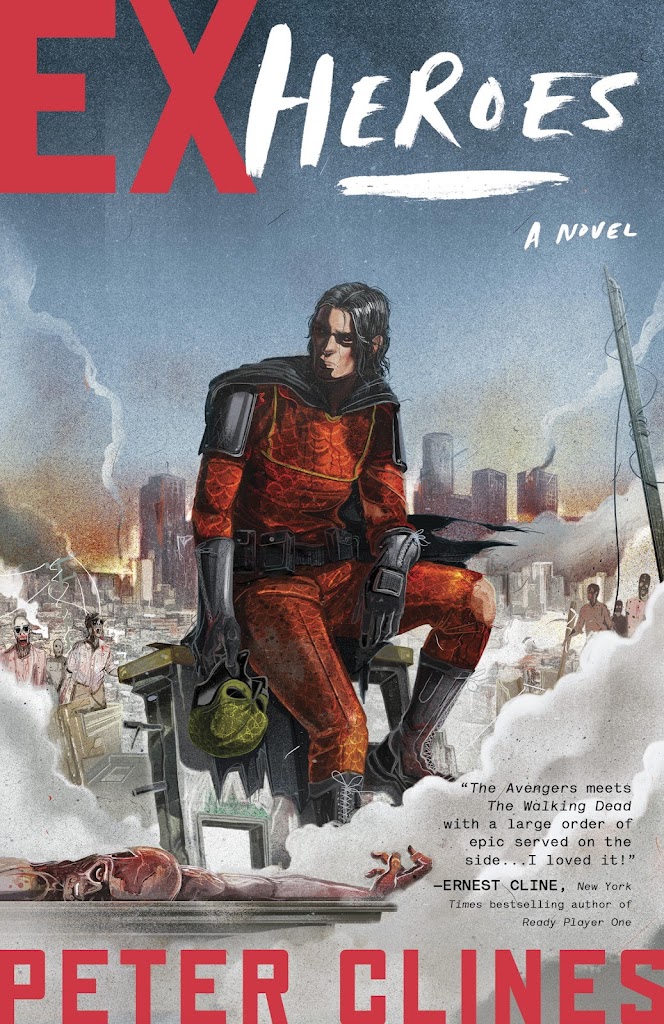
Like, okay, how often do we (as a society) dwell on how long it was since someone started writing until they sold their first book? Once they decided to do this, how long did it take them to get published? It sounds straightforward, but all of these are kind of tricksy points in time. Like, okay, my first published novel (Ex-Heroes) was written in 2008 but it came out in early 2010. And there were a few novels before that one, but they didn’t sell. For good reasons.

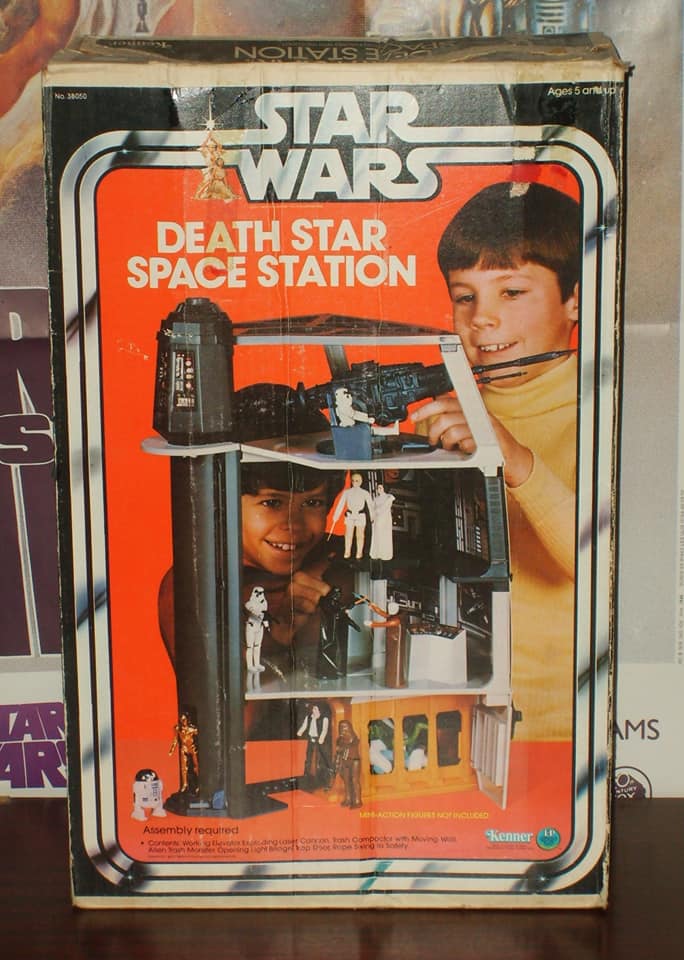
And the starting point? When did I actually start writing? Well, if we use when I started telling stories as an eight year old (using my Death Star playset as a slowly-evolving diorama of Star Wars figures), then from that to first published novel was about thirty-two years. But if we go off when I first actually writing things out on my mom’s typewriter and my first attempt at a “novel” (the often-mentioned Lizard Men From the Center of the Earth), then we’re looking at about thirty years.

Then again, we could go off when I first tried submitting stuff (some just-as-awful comic book “scripts” to Marvel when I was eleven) and then it’s twenty-nine years from starting to write to first published novel. But those were comic book submissions, not novels soooooooooo… I don’t know. Do we count that? Yes? No?

If we want to start at when I actually learned how to submit (whoa, publishers and editors and agents have guidelines? who knew?), then I guess we’re looking at about twenty-two years from “starting to write” to “published novel.

We could also consider the college novel as my starting point, so now it was nineteen years. Or if we use the after college/ moved to California novel it was maybe seventeen.

Also, to be honest, for about seven years in there (while I was working in the film industry) I put books aside and just worked on screenplays. Had some mild success, too, relatively speaking. But like with the comic book scripts… should we count that time? Skip over it? Half-count it as general storytelling?

It was in 2001 that I decided I’m going to go back and finish the after-college novel. Polish it up, actually turn it into something I could submit. I remember the moment I decided it. So if we go from there, it only took nine years to get from “starting to write” to “published novel.”

And, of course, in late 2006 I left the film industry to focus on writing. Fiction and non-fiction. If we want to use *that* as the starting point… well, it only took me two years to sell a novel once I put my mind to it.

See what I mean? Those points are pretty damned flexible. Depending on how we want to look at it—and the story we want to tell—it can look like my career took forever to take off or I did it without much effort at all.

This is true of most books. There are early inspirations and ideas, first thoughts, outlines, drafts. Once we mix in behind the scenes stuff—like the very random amount of time between writing and publication—it’s not hard for people to look very slow or very prolific. Sometimes deliberately, sometimes accidentally.

Y’see Timmy, we shouldn’t beat ourselves up over those end-of-year lists. I got a lot of stuff done. I bet you did, too. That’s what matters. Not how much someone else got done.

Next time…

Hell, next time is Christmas. And the Thursday after that is, well, next year. But I’ll still try to squeeze in one more post about… something? I’m taking requests, if there’s something you’d like to hear me blather on about.

Oh, and if you’re looking for a last minute gift– hey, maybe a copy of God’s Junk Drawer? No, no, Grandma will love it. Really.

Until then, go write.
October 9, 2025

Massive Cuts!

Running a little late with this one, sorry. This fall/ early winter’s going to be very chaotic for me.

Last month when I was guest-hosting the Coffeehouse, we talked a bit about word count. Not in the sense of making your word count, but what publishers are generally expecting from books in different genres. Should we be aiming for those points as we write? Or do we just write with the acknowledgment we may need to cut some later?

Since this is something I have some experience with—some very recent, in fact—I thought it was worth talking about a bit more. It’s one of those things where we’re going to dance a little bit between writing and publishing, going back and forth between the art and business sides of the line.

First off, let me be clear up front– you should always write the story you want to tell. Always. Don’t try to chase a trend or guess what some agent or editor might want to see. The thing they want to see is your story, as you wanted to tell it. That’s what gets attention—the story with all that passion and energy and excitement.

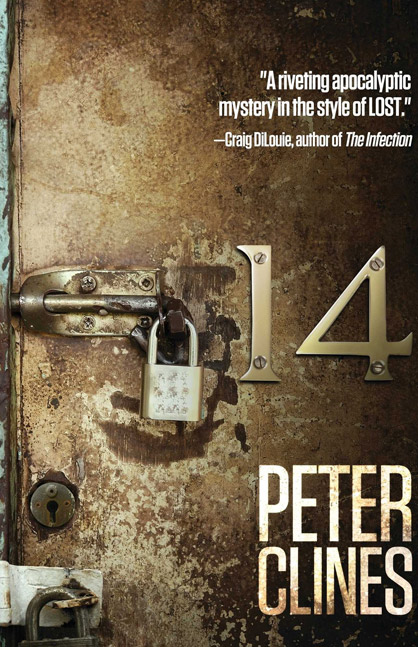
For example, let me talk about two of my books. One of them—the one you know—is -14-. It was a wild, crazy story that had been bubbling in my mind for a while. I wrote it out, tightened it up, polished it and sent off the to the small press publisher I was working with at the time. He absolutely loved it. Told me it was one of the best things that’d he’d ever received as a submission and offered me a contract pretty much right then and there.

The other book is the one we just sold last month. If you’re subscribed to the newsletter, it’s the one I’ve been calling TOS. Three different publishers wanted it. And they all loved it. All of them talked about how much the loved the story, the characters, the writing, how it was equally playful and fun and terrifying.

So, let’s be clear. In both cases, the editors/ publishers loved the book I wrote. These book sold because I wrote the book I wanted to write and people could see that passion and excitement in it.

Then… the business aspect of this sets in.

In the case of -14- the small press used print on demand, and that meant there were very solid costs that came come down to specific page counts. One line past this page and the book goes up by X. Go past this page and it goes up by 3X. And the publisher either has to absorb those costs (not great) or pass them on to the customer (also not great). So the publisher loved it, but we had to make some serious cuts just to make the book affordable. No way around it.

And with TOS… well, it’s a book that definitely leans into horror, and most horror books tend to lean on, well, the lean side. Yeah, there’s some big, beefy horror books out there, but two editors—the final two, in fact, who wanted it the most—both made it clear the book was going to have to lose some weight. One thought 20K. The other thought closer to 35K.

Yeah. Scary thought, isn’t it? Happy October!

As a slight aside, I think this is one of those things that makes people say “Big publishers will make you change everything about your book!” And on one hand, yeah, they’re absolutely asking me to change things. Kind of insisting on it, in fact. But they’re not just doing it at random. Remember, they bought my book because they like my book. Why else would they have bought it? But this is definitely a business vs. art thing.

Also please keep in mind—none of this is me saying we can ignore actual submission guidelines. If anything, this is kind of making that case. If somebody doesn’t want to see anything over 100K words and my manuscript’s currently at 135K… well, I’ve got some cutting to do if I want to submit to them.

Anyway…

All this brings me to an exercise I wanted to bounce off you, especially for those folk working on an early draft of a first novel (but it works for everyone, so don’t feel shy). I want you to imagine, right now, you open up your email and you’ve got an acceptance letter. That publisher you sent your book to likes it They love it! They want it, they want to sign you, it’s a done deal. There’s only one catch…

You need to cut 20,000 words out of the book. It has to be shorter. Maybe it’s a marketing thing, a financial thing, a random decision from someone higher up the food chain. But you must lose 20,000 words. They’re willing to sign that big contract with you today, but there’s no negotiation on that point. 20K gone before it can see print.

So, let’s open up our latest draft and take a long, hard look at it.

What can go?

No, come on. What can go? Do we really need all that description? Every one of of those funny dialogue exchange? All that banter? Does Phoebe need that little soliloquy about rediscovering the sanctity of life?

What really happens in that driving chapter? Yeah, Phoebe gets Dot caught up on everything, sure, but the reader already knows all of it. I’m just repeating information, having her re-tell it to Dot. And wouldn’t we probably assume she told her if they just got out of the car an hour and fifty miles later and Dot said “So that’s all of it?”

Do we need Wakko at all? No, seriously. What does Wakko do in this story? He makes some random comments, carries some stuff at one point, has a few funny lines, but does he actually affect the plot or Phoebe’s story in any way? Would anything at all change if we just cut him out altogether?

Be honest– would it? Think hard, because we have to cut 20K words.

I’ve already cut two full chapters out of TOS. Big, full chapters. One was near the end, and it was sort of a fun, pushing-the-conceit-of-the-book bit that also helped show how horribly wrong things had gone. One was closer to the beginning, and it played with another conceit while also… damn, it had one of my favorite passages in the book. One of those bits that was simple but also kind of deeply, under-your-skin creepy. And that might just be gone for good. It’s so situation-specific I’m not sure I could ever use it for anything else. But ultimately, that three-quarters of a page is the only reason this whole chapter exists. Everything else in it is kind of redundant.

So right there… almost 5000 words cut out of the 20K my editor’s asking for.

One more time, I’m not saying we should plan on this—again, write the book you want to write. But it’s worth thinking about. Because no matter who we’re writing for, we’re going to have to edit and tighten cut. That’s a basic part of the process.

And if I’m finding it really easy to cut something out… well, maybe that’s a sign it wasn’t needed in the first place.

Next time, I’d like to talk about that phaser rifle Chekov left on the bridge

Until then, go write.

February 10, 2022

How Long Did It Take…

I’d already planned this week’s topic and then the writing discourse, as some call it, veered toward length anyway. So call it happy coincidence. Or serendipity.

Okay, granted, they were talking about how long a manuscript should be, and we’ve talked about that here before. It’s old news, right? This week, when I’m talking about length, I wanted to talk about time. How long some of this takes.

I’ve blathered on before about how easy it is to follow your favorite writers on social media these days. So many of them are active to some degree on one platform or another. And they toss out advice and updates about their work. Plus, we can find authors at our own level, people who are going through the same struggles and frustrations.

Not surprisingly, we end up comparing ourselves to these other folks. Yeah, there’s dozens of reasons not to, but we can’t help ourselves. It’s human nature. We’re curious how we measure up. Has she written more than me? Does he write faster than me? How did their career take off so much faster than mine?

And a lot of the time, the answers to these questions are a bit intimidating. Maybe even discouraging. I mean, I’ve been working on this book for over a year now and she just pumped one out in eight weeks? What the hell? I know other writers aren’t my competition but seriously… how am I supposed to compete with that?

So the point I wanted to make is that… well, art’s a little subjective. It’s not like a construction project where we can say we broke ground last May and people are moving in this month. A lot of the starting and stopping points of art can be a little fuzzy. And some people… well, play with that fuzz. So to speak.

Like, we’ve talked before about how long it takes to write a book. Some folks consider the starting point when they started outlining. Some consider it when the idea first struck them. And others say they started writing when they typed Chapter One.

Let’s consider my first published novel– Ex-Heroes. When did I start writing it? Well, I made up a lot of the characters before I hit high school, so that was the early ‘80s. I jotted down my first rough notes in the summer of 2006, but I didn’t start actively working on it until mid-2008. So when did I start? Depending on how you want to look at it, we could say it took twenty-five years or about six months to write.

That’s not even considering most traditionally-published novels go through an editing process that can be a few months, and it might be even more months before the book’s actually out there in the world. So when are we saying the book’s done? When I turn it in? When the publishers edits are done? When the layouts are locked and it goes to print?

Or how about this one–a common yardstick people like to look at. How long was it from when you started writing until your first novel? But again, both of those points are kind of debatable. Yeah, I sold Ex-Heroes in late 2008, but it didn’t actually come out until early 2010. And there were a couple novels before it, but they didn’t sell. The first full novel that I actually completed was started in early ‘93 and finished in 2001… but then I spent about three years editing and rewriting. So when was my “first” novel?

And when did I start writing? When I was eight and blocking out original Star Wars stories in my Kenner Death Star playset? When I started using my mom’s massive electric typewriter? When I first started submitting stuff? When I started writing the first novel I actually finished? When I quit my film job to start writing full time? When I quit that job to start writing fiction full time? Any of these is a valid starting point, but they cover about thirty years.

Hopefully you see what I’m getting at. I can easily—and truthfully—say I started writing anytime between 1979 and 2010 and give solid justifications for why that’s the point I chose. Likewise, I can manipulate how long it took to go from “starting to work” to “first sold novel” and make it look really fast or really slow. I mean, we’ve talked once or thrice about the overnight success with a decade or more of work behind them.

And there’s a lot of reasons people might give these different figures. It could be a marketing thing. It might just be what they think counts as actual “writing.” Maybe it’s a deliberate attempt to fudge the numbers to try to make themselves look more impressive. It might be how some MFA professor taught them to do it and they’ve never shaken that particular habit.

My point is… don’t worry about these numbers. I shouldn’t worry abut how long it took to write my book. I don’t have to freak out because it feels like my career hasn’t taken off yet. My speed is my speed. Yeah, we’re all going to compare ourselves to other people’s numbers, but just remember… those numbers may have a bit of range to them.

Next time…

Actually, before I talk about next time—if you happen to be of the reviewing type and have access to NetGalley, my new novel The Broken Room is now there and can be requested. For the rest of you… holy crap, only eighteen more days!

Anyway, next time let’s talk about… the unknown.

(cue spooky music)

Until then, go write.
April 15, 2021 / 3 Comments

Let’s Talk About Sax

Yes, I went there.

So, more than a few times here, I’ve talked about the need to pare away non-essential things. Characters. Names. Descriptions. Maybe whole chapters. These are all things that start to weigh my manuscript down like concrete blocks as it tries to tread water in my reader’s consciousness. Or something like that.

Maybe a better way to think of them is speed bumps. I might not notice one or two, but hitting four or five in a row is going to get annoying really quick. And hitting one once I get going fast… well, it either means slamming on my brakes or possibly crashing. It’s definitely going to be jarring.

But, as I’ve also tried to say once or thrice before, that doesn’t mean I need to strip everything down to a bare skeleton. There’s nothing wrong with elements that don’t tie directly—or even indirectly—to the plot or story of my manuscript. It’s more about being very careful how and when I deploy them.

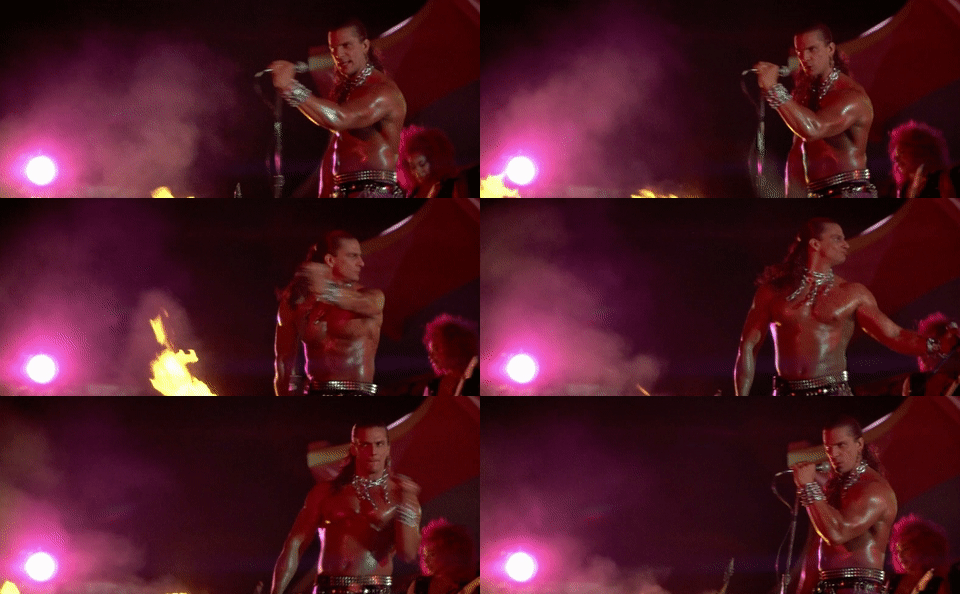
And to illustrate this point, I’d like to tell you about Tim Cappello.

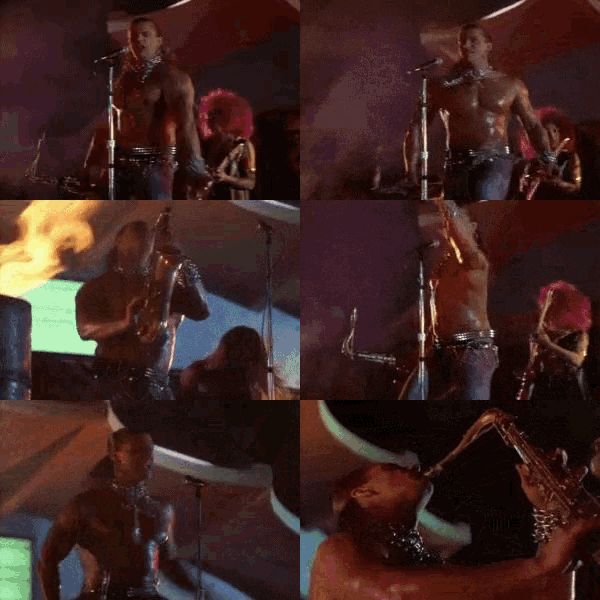
Tim Cappello’s a well-known-in-the-industry singer and saxophonist who had regular gigs with Ringo Star, Peter Gabriel, and spent over a decade touring with Tina Turner (he’s in the video for “We Don’t Need Another Hero”). But most of you probably know him for an incredibly tiny background part he had in an ‘80s vampire movie. And just putting those clues together, I bet most of you’ve already figured out who he is. He’s the legendary “Sax Man” from The Lost Boys.

Think about how weird that is, you immediately knowing who I was talking about. The entire concert scene’s maybe two minutes, and it’s super-generous to say he’s on-screen for twenty seconds of that. So running the math real quick (granted, not my strong suit) he’s maybe… one third of one percent of the movie?

And let’s be honest. The Sax Man doesn’t even do anything, plot-wise. He’s just window dressing that makes the beach concert feel a little more ‘80s. The whole scene’s pretty much just an excuse for Michael to gaze across the crowd at Star.

So… why is Cappello such an excellent background character in The Lost Boys? One that we all remember thirty years later? More than we tend to remember one of the members of the vampire gang was Bill from the Bill & Ted movies. No, seriously. Alex Winter is one of the vampires. He’s the one with the denim vest who gets staked in their cave.

Anyway, back on track…

First off, the Sax Man’s not excessive. I mean, okay, yeah he’s an oiled-up bodybuilder singing and doing hard rock saxophone riffs next to a flaming barrel. No denying that. But he’s the lead performer at a nighttime California beach concert in the late ‘80s. He’s not exactly over-the-top in that context. Plus, like I said, not even half a minute of screen time, and that’s broken into five or six shots. We hear him more than we see him, which also helps hint that he’s much more about the background and the setting than the actual story. He doesn’t even have a name. I mean, we all call him “Sax Man,” but apparently the actual credits at the end of the movie call him “Beach Concert Star” and Wikipedia just lists him as “Saxophone Player.”

Also, we kind of get him out of the way early. The beach concert’s just eleven minutes into the movie. We’ve still got 90% of the story to go, and we haven’t even introduced half the characters yet. It’s not like the movie’s bringing things to a halt so we can cut away to the singer at the concert.

Finally… I mean, he’s cool. He’s good-looking guy singing a high-energy song in front of a crowd. He’s having fun, they’re having fun. If I’m going to cut away from my leads and the plot, I want it to be to someone (or something) interesting. And Sax Man is definitely interesting.

So let’s break this down into some rough rules of thumb.

1) I don’t want to spend a lot of time on things that are just colorful set dressing (even if they’re people). As I’ve mentioned before, pages are precious and I only get so many of them. I can spend time on things not related to my plot… but I probably shouldn’t spend a lot of time.

2) I probably want to do it early. Sci-fi and fantasy editors will usually allow a little extra space for worldbuilding, and everyone expects me to set the tone with a few extra descriptions. But by their very nature, these additional details show up early in my story. If I’m doing a lot of worldbuilding in my third act, there’s a good chance something’s gone wrong.

3) If I’m going to use up a paragraph or three describing something… it should probably be something worth describing. Not something mundane, not something we see every day, not the kind of person we see every day. If it’s not something my characters would pay much attention to, why would I force my readers to examine it in detail?

Easy, yes? Three quick rules. They won’t hold in every instance, but they’re probably worth considering in every instance. If I’ve got a random colorful page describing that bus driver or this door frame, and it only kinda-sorta hits one of those guidelines… maybe that page should be used for something else.

Y’know… maybe something related to the story I’m telling.

Next time, I think I’d like to talk with you about creepy clowns, true love, and one of those common geekery movie flaws I see all the time.

Until then, go write.

And hey… you could listen to The Lost Boys soundtrack while you do.

Categories