
December 19, 2025 / 1 Comment

Then to Now

Oh! Hello there. Yes, this is very overdue, isn’t it?

The past month has just been wild. The book tour. Thanksgiving. Three or four vet visits. Two or three doctor visits for me (minor stuff, in the big scheme, don’t worry). Assorted holiday activities.

Oh, and this book I’ve been editing. And another book I’ve been poking at.

It’s still really weird to me sometimes to think I’ve had over a dozen books published. Me! That’s not even counting all the short stories and collections. It’s just… weird.

Which leads me to this (very overdue) ranty blog post. I’d planned to do it waaaay back at the start of November but… y’know, maybe it’s better now, as we’re all starting to think about top ten lists and how much we got done and all that sort of thing. Those can be fun, but I think they can also be kind of demoralizing. It can be rough when you’re trying to find time to write while someone else is pounding out three or four books a year. Heck, even once you’re kind of established, it’s easy to watch people talk about all those end of year accomplishments and feel like… wow, I didn’t do much at all, did I?

One thing it took me a while to figure out was that a lot of us have very skewed ideas of the time frames involved when we talk about “how long things take” when it comes to art and artistic careers. F’r example, when I first started out, people thought I was ridiculously prolific because I had four really solid books (and a bunch of short stories) published in less than two and a half years. But it actually took five years to write all of that. Likewise, right now it looks like it took me three years to write God’s Junk Drawer, since that’s how long it’s been since The Broken Room came out. But I actually wrote three books in that time. You just haven’t seen them all yet. And when those start coming out, I’ll bet you anything someone pulls out the prolific label again.

Like, okay, how often do we (as a society) dwell on how long it was since someone started writing until they sold their first book? Once they decided to do this, how long did it take them to get published? It sounds straightforward, but all of these are kind of tricksy points in time. Like, okay, my first published novel (Ex-Heroes) was written in 2008 but it came out in early 2010. And there were a few novels before that one, but they didn’t sell. For good reasons.

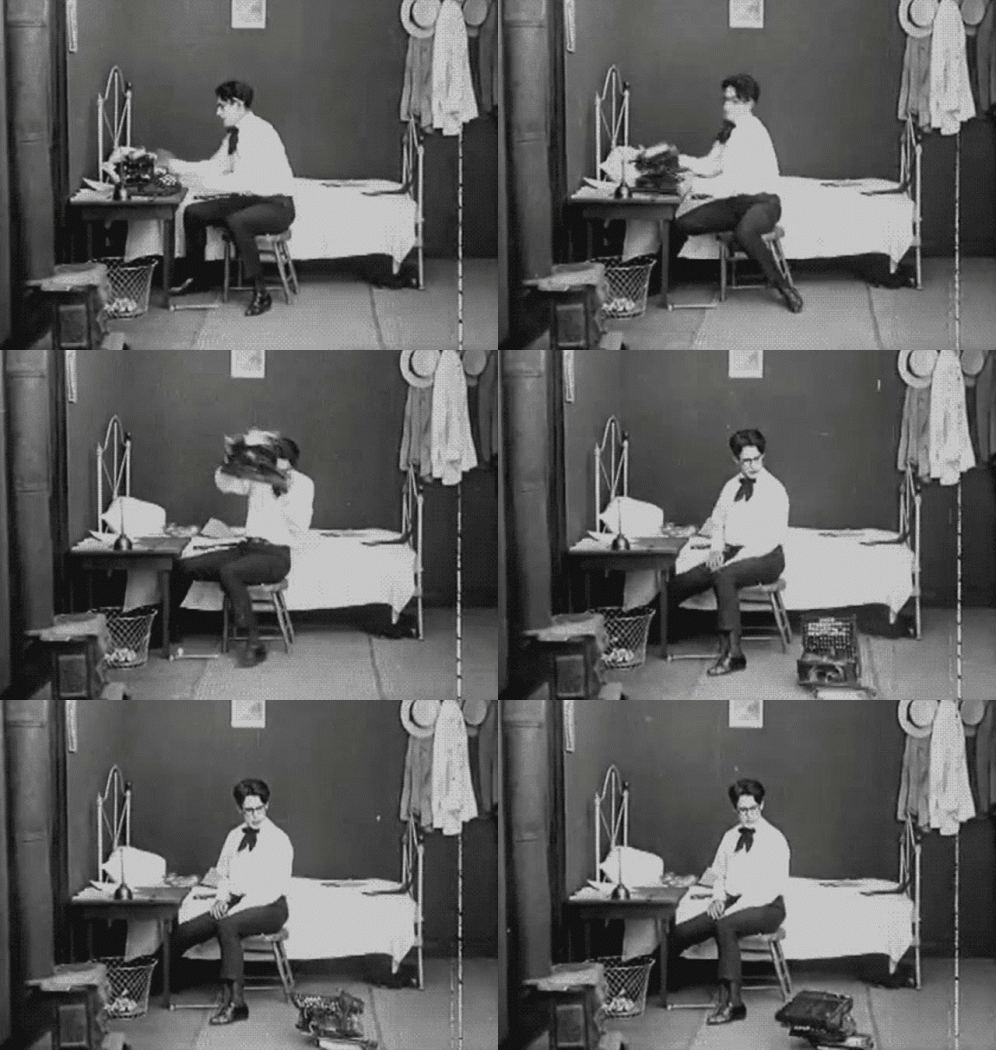
And the starting point? When did I actually start writing? Well, if we use when I started telling stories as an eight year old (using my Death Star playset as a slowly-evolving diorama of Star Wars figures), then from that to first published novel was about thirty-two years. But if we go off when I first actually writing things out on my mom’s typewriter and my first attempt at a “novel” (the often-mentioned Lizard Men From the Center of the Earth), then we’re looking at about thirty years.

Then again, we could go off when I first tried submitting stuff (some just-as-awful comic book “scripts” to Marvel when I was eleven) and then it’s twenty-nine years from starting to write to first published novel. But those were comic book submissions, not novels soooooooooo… I don’t know. Do we count that? Yes? No?

If we want to start at when I actually learned how to submit (whoa, publishers and editors and agents have guidelines? who knew?), then I guess we’re looking at about twenty-two years from “starting to write” to “published novel.

We could also consider the college novel as my starting point, so now it was nineteen years. Or if we use the after college/ moved to California novel it was maybe seventeen.

Also, to be honest, for about seven years in there (while I was working in the film industry) I put books aside and just worked on screenplays. Had some mild success, too, relatively speaking. But like with the comic book scripts… should we count that time? Skip over it? Half-count it as general storytelling?

It was in 2001 that I decided I’m going to go back and finish the after-college novel. Polish it up, actually turn it into something I could submit. I remember the moment I decided it. So if we go from there, it only took nine years to get from “starting to write” to “published novel.”

And, of course, in late 2006 I left the film industry to focus on writing. Fiction and non-fiction. If we want to use *that* as the starting point… well, it only took me two years to sell a novel once I put my mind to it.

See what I mean? Those points are pretty damned flexible. Depending on how we want to look at it—and the story we want to tell—it can look like my career took forever to take off or I did it without much effort at all.

This is true of most books. There are early inspirations and ideas, first thoughts, outlines, drafts. Once we mix in behind the scenes stuff—like the very random amount of time between writing and publication—it’s not hard for people to look very slow or very prolific. Sometimes deliberately, sometimes accidentally.

Y’see Timmy, we shouldn’t beat ourselves up over those end-of-year lists. I got a lot of stuff done. I bet you did, too. That’s what matters. Not how much someone else got done.

Next time…

Hell, next time is Christmas. And the Thursday after that is, well, next year. But I’ll still try to squeeze in one more post about… something? I’m taking requests, if there’s something you’d like to hear me blather on about.

Oh, and if you’re looking for a last minute gift– hey, maybe a copy of God’s Junk Drawer? No, no, Grandma will love it. Really.

Until then, go write.

February 6, 2025 / 2 Comments

Cut to the Quick

Well, I offered you all a chance to make requests and not one of you took me up on it. Which means I get to rant about whatever I want this week. If you want rants more focused to your particular needs right now, just let me know down below.

But for now…

Back in November I talked about my drafting process—taking something from that messy, ugly first draft through to something I’m not ashamed to show my beloved or friends or, well, my agent. One part of that was my third draft, where I tighten and cut. And guess what? I just finished my third draft of TOS two weeks ago. And I took a bunch of notes as I was going through, because I was planning ahead for this.

Also, keep in mind this isn’t one-size-fits-all advice. Your story is your story, and your writing process is your process. Like so much stuff I toss out here I’m showing you how I do things with the hope it’ll help you figure out how you should be doing things.

So let’s talk about some cuts I made.

First off, I did a basic spellcheck. I’ve talked about spellcheckers a lot, and about using them correctly. I go through the manuscript one click at a time, examining each and every word the spellchecker flags. I don’t just blindly agree to change everything it says is a mistake because… well, it’s usually wrong. For example, it doesn’t recognize a lot of given names, and definitely a lot of nicknames, so I had to check each of those (or add them to the dictionary in some cases). Then there were words it just didn’t have (cyborg? Still? Really?) and a few where it refused to recognize a more common, alternate spelling (which, if I really wanted to put the work in, could probably tell me exactly which dictionary was fed into this particular spellchecker).

Again, each and every word. Check all of it. I’d guess the breakdown ended up being around 35% actual mistakes, 65% things that were correct but it flagged as mistakes.

Also, a lot of the time while going through, I’d check the whole sentence. Was there a better word to use? A better way to phrase this? Maybe switch a name to a pronoun?

This spellcheck pass took close to a full work day for a 300 page book. Sound like a lot? I mean, it averages out to about a minute and a half per flagged word. Some were easy to zip past. Some took a minute or two as I double-checked spellings myself or considered other factors (like I was just talking about). Plus, to be completely honest, I think I slowed down a bit while I was eating lunch. And I stopped to use the bathroom twice. On company time! I know!!!

Anyway… after this, I started doing passes for passes for different words. Lots of different words.

Adverbs and adjectives are some obvious culprits. I’m not one of those “kill all adverbs” zealots, but I do think a lot of the time they can use a good pruning. I once got to talk with editor Pat LoBrutto and his advice was “one adverb per page, four adjectives.” Like any rule, I think there’s some flex room in there, and different situations will call for different things. But I also think a lot of times we do overuse adverbs and adjectives because we just don’t know the really, really good word we could be using.

Some of the words and phrases I look for are what a friend of mine called “somewhat syndrome.” For me, it usually kicks in when a character says, for example, Yakko stood six foot four. It sounds too precise for a casual observation, right? Weirdly exact. So we write things like “Yakko stood a little over six feet” or “he was around six feet” or “stood a bit taller than six feet.” I used to do this a lot, with pretty much every description of anything, and it still show up sometimes when I’ve got a sort of casual, limited third person POV. So I search for a lot of things like about, kind of, sort of, around

There’s also a bunch of phrases that we tend do toss in, but we’re not using them correctly. Looked like, appeared to be, seemed to be, and constructions like that. These feel like the somewhat words and phrases I just mentioned, but almost all of these are part of an implied contradiction. Yakko looked like he was over six feet tall (but it was all just high boot heels). The door appeared to be made of wood (but was actually a veneer over steel plate). The car seemed to be in working order (but would fall apart if you drove it more than ten miles). See what I mean? What I probably want to say here is just Yakko was over six feet tall, the door was made of wood, and the car was in working order. So I should cut some extra words (that I wasn’t using correctly anyway) and just say that.

Also, there’s a bunch of verbs that have… well, they’re verbs we inherently associate with certain things. I shrug my shoulders. Nod my head. Point with my finger. I mean, it’s so understood if I told you “I pointed across the room”… well, what would you think I was pointing with? Which means those are all extra words. Just shrug. Just nod. Just point. You can probably think of a few, too.

Finally, there’s a bunch of words that fall into different categories and… look, they’re pretty much always good words to take a second look at. Very. Just. Rather. Really. Actually. Of course. Quite. So. Began to. Suddenly. I think some of these Benjamin Dreyer has pointed at (with his finger) as words you can almost always cut.

And yes, for the most part, these are going to be small cuts. But small cuts add up. When I was done making pass after pass for all these words and phrases… I’d effectively cut twelve pages out of my manuscript. Over three thousand words.

Want a few quick examples?

I cut 196 uses of very.

Also cut 141 uses of really.

And 139 maybes.

118 uses of kind of.

86 uses of about.

80 arounds.

Going off a standard 250 words per page for a double-spaced manuscript, that’s three pages gone right there.

Now in all fairness, every one of these wasn’t just that specific word. Sometimes while doing a pass and looking at everything (because, like with spellcheck, I don’t want to just delete everything that comes up), I’d realize I could reword a sentence, or maybe reword one and delete another. For example, out of those 196 words that vanished in the very pass, I’d guess maybe only 100-120 of them were the word “very” and the rest were other things.

Also, a small tip. Have you ever done find-and-replace on something and then discover you’ve accidentally created a bunch of mistakes throughout your manuscript? Like, you decide maybe Beth should be named Liz, but then discover her girlfriend now studies Elizalizan playwrights? Same principle holds here. I don’t want to just delete every very, for example, because then I’m also going to mess up every, everyone, delivery, slavery, recovery, and more.

And again… yeah, this is slow work. Slow, boring work. That’s what editing is a lot of the time. But it’s also a chance to sharpen things. Concentrate them. To make this hit a little harder and that get a bigger thrill. Editing might not be as thrilling as that initial raw creation, but I still get some creative joy out of it.

And I bet you will, too.

Also, I just realized I used this title for an editing post about twelve and a half years ago. What a hack.

Next time, unless somebody has a topic or question they’d rather I blather on about, I’m probably going to talk about the first time I saw Yakko Warner.

Until then, go write.

January 20, 2025

First of the Year

Well, here we are in the far flung sci-fi future year of 2025. The year of Pacific Rim, as I mentioned in the newsletter the other day. What? You’re still not subbed to the newsletter? Well, there’s your first thing to do this year.

Anyway, first ranty blog post of the year (and already running late). What to write about? I’ve already planned out a lot of my year, writing-wise, and maybe so have you. Or maybe not. No worries there, either way. This is my job, so I’ve got to schedule things to some extent. You may have a lot more leeway. Heck, writing might be your zero-stress after work cool-down thing. If that’s how you like to do it, that’s great. What works for you works for you.

I’ve had a couple possible topics bouncing around in my head for two weeks now. And in that time I’ve seen a lot of other folks offering their own start-of-the-year advice nuggets. And that got me thinking even more…

So, look, some of you may be thinking of finally writing that novel. 2025 is the year we’re getting it done. Maybe we’re starting from scratch. Could be we’ve had a few false starts. Maybe some of it’s already done and this is the year we finish it.

And it’s possible, as I mentioned above, that you’re seeing all sorts of advice and encouragement from different folks.

They’ll tell you not to worry about how much you write every day. Don’t worry about how often you write. And don’t worry about spelling. Don’t worry about grammar, either. Don’t worry about structure. Don’t worry about getting the facts right. None of that matters! What matters is the writing! Which, uh, you don’t have to do today.

And it may cross your mind after some of this, well, hang on. What the heck am I doing? If none of this stuff matters… I mean, what am I supposed to do? Seriously?

This is a little tricky to understand because technically all of this is true, but it’s true at different points in the process and in different ways. If I apply all of these rules (or lack of rules, I guess) evenly throughout my whole process, I can be doing more harm than good.

For example, I’ve talked about first drafts and forward motion—just getting it done. That’s how I tend to write. I won’t worry about spelling or formatting and it’s really common for me to leave notes to myself about checking if this is correct and how that actually works. So at this point in the process… yeah, don’t worry about any of that stuff.

But this doesn’t mean I never worry about these things. It’s more a question of when I worry about them. Personally, I tend to clean most of this up in my second draft, and I’m usually still adjusting it in my third. Because these things matter. No, really, they do.

A lot of this is going to boil down to what I want to do with my writing. What are my end goals, so to speak. Is it my after-work cool down? A personal project? Maybe something I want to share on a Reddit thread or Wattpad. Am I going to self-publish it? Am I hoping a traditional press will pick this up?

Y’see Timmy, the truth is when I’m at home, the park, the office, the library, on the train, or wherever it is that I do most of my writing… I can do whatever I want. Seriously. When it’s just me and my keyboard, absolutely no rules apply. Whatever I want, however I want, for as long as I want. That’s my process, and nobody can say my process is wrong or weird or whatever.

But…

If I want to send something out into the world, to put it in front of other people’s eyes—especially people I’m hoping will give me money—I need to start seriously thinking about all of this stuff. That’s when I do need to worry about spelling. I definitely want to double check my grammar. And triple-check my facts. And if I’ve got a deadline, I absolutely need to be considering how much I’m writing and how often I’m writing. Because these things will matter to other people. They’ll matter to different degrees for different people, but they will matter.

And the more chances I give people to say “that’s wrong” are more chances they’re going to set my story aside and move on to something else.

So, yeah, write freely. Don’t be concerned about things. Just write.

But be aware we’re just deferring that concern till later. Not saying goodbye to it forever.

Next time…

Well, heck, like I was saying. Start of the year. new projects and new goals all around. Is there anything specific I could cover for anyone? Something that’s been gnawing at you, a topic where you’d really like some kind of advice or tips or encouragement? Let me know down in the comments and I’ll make that happen for you.

And until then… go write.

December 31, 2024 / 2 Comments

A Quick Look Back…

And just like that, 2024 is over.

It was a rough year for me, personally (I got a little reminder of that this morning), but there were a lot of good things about it, too. It’s rare, I think, to have a year that’s all bad or all good, and a lot of how we think about it just comes down to how we decide to look back it and remember things.

There were a lot of plusses for me this year. Creatively. Socially. Hobby-ly? I’m going to try to focus on those.

So speaking of creatively… what did I get done this year?

Well, 2024 started with a massive rewrite of God’s Junk Drawer. David, my agent, read it at the end of 2023 and made a lot of really solid points. I cut almost 20k words, reorganized a bunch of it, then turned around and added 22K of new material. It’s going to be my biggest book ever. Well, ever published. We don’t need to talk about… the other one.

I finished a first draft of TOS which I’d had to set down (around 40K words) for the above rewrites. Then I did a second draft of it. And I’m maybe halfway into a third draft. It’s really good. I’m enjoying it a lot. I think you will, too. I’m hoping to show it to a few folks in a week or three.

I wrote a story for Weird Tales which was an all time, never-gonna-happen bucket list thing for me. Issue #370 with “Straw Man” is available now. If you’re more of an audiophile, you can get it that way, too, and hear my story read by the ever-wonderful Ray Porter.

I also wrote a new Carter & Kraft story for Combat Monsters, which is out in February. I’ve wanted to tell this one– “The Night Crew” –for a while and Henry Herz gave me the perfect chance to do it, and it fits in quite nicely between two of their previously published adventures. We’re doing a little signing tour for it, too.

And there were thirty-four assorted ranty writing blog posts (counting this one) and a dozen newsletters.

That may not look like much to some of you. I know there are some writers who are much more prolific than me. And other folks might be thinking “holy crap, that’s what he thinks is not much?!?”

But y’see Timmy—it doesn’t matter. I’m not telling you this to make you feel better or worse. You shouldn’t be judging yourself off me either way. Nobody is a better/ worse writer just because they managed to put down more or less words than someone else. What matters is that you keep doing it. Keep writing.

So I hope that’s what you plan to do in the coming year. Tell your stories your way. Let your voice be heard. Don’t stop.

Next time… it’s a new year. Who knows what we’ll do. What do you want to see here?

Until then… go write.

Categories