
September 10, 2020 / 2 Comments

The End… Or Is It?

I don’t know if you can tell from that side but holy crap is the new Blogger a mess on this side.

I’ve been threatening to talk about endings for a while now. Shouldn’t be that big a deal, right? Easy topic.

One thing all of our books and stories and screenplays have in common is an ending. They’re going to be different for all of us, and for all of our different projects, but everyone of them has an end. Even if it’s part of a series, this discrete part of that overall story has concluded and another part will (hopefully) begin at some other time. Hopefully on the sooner side

Endings come in all shapes and sizes. They can be happy. They can be semi-positive. They can be ambiguous. They can be blunt. They can tease more potential story or be very, very clear this is the end

But one way or another… the story ends.
We don’t talk much about the fact that there are different types of endings. Not just in that happy-sad-ambiguous sense. In a structural, nuts and bolts sense. There’s also the type of ending where I think I might get to do another book someday, the ending where I know I’m going to get another book immediately, and the ending where I know that this is it, we’re done. Just to name a few.

Also, before I go much further, I’m going to toss around some terms here and I think some of them get used in very general, catch-all ways a lot of the time. Which I also think is what causes some of the issues I’m blathering on about. So some of my blathering may go against things you’ve been taught or picked up here and there.

That said, let’s lean into television for a moment. Yeah, I know most of you aren’t here for screenwriting, but I think this is a good, universal reference point. You should all understand what I’m talking about.

There’s a certain class of network show that tends to have what we might think of as a respawn point most of the time. No matter what’s happened, no matter what the characters have gone through, by the end of the episode they’re pretty much right back where they began—physically and emotionally. They’ve reset for new stories next week. We see this in a lot of sitcoms and even some one hour dramas.

There are also shows that have season arcs, with story elements that carry through from episode to episode. A lot of these end on dramatic revelations or beats that aren’t quite cliffhangers, but still compel the audience to think about what’s going to happen next.

What’s that? Why aren’t they cliffhangers? Good question. This is just my own musings, granted, but I think the big difference between a cliffhanger and a dramatic ending is where they compel us to pick things back up next time. What does the audience/reader need to see next? So it’s a structural, framing difference. If I’ve got a cliffhanger, the next chapter/episode/issue/book needs to begin right here, right at this moment where we left off. With a dramatic ending… the story can resume a little later. We’ve all seen this. “Three hours later, his mind was still reeling from this new information…”

Again, this is just my take, but I think it’s a take that hold up pretty well. And I’ve experienced the jarring results when someone sets up a cliffhanger, but then just treats it as a dramatic ending when the story resumes. Or doesn’t resume. Because if it doesn’t resume, that kinda kills the whole “needs to resume” aspect of it, doesn’t it?
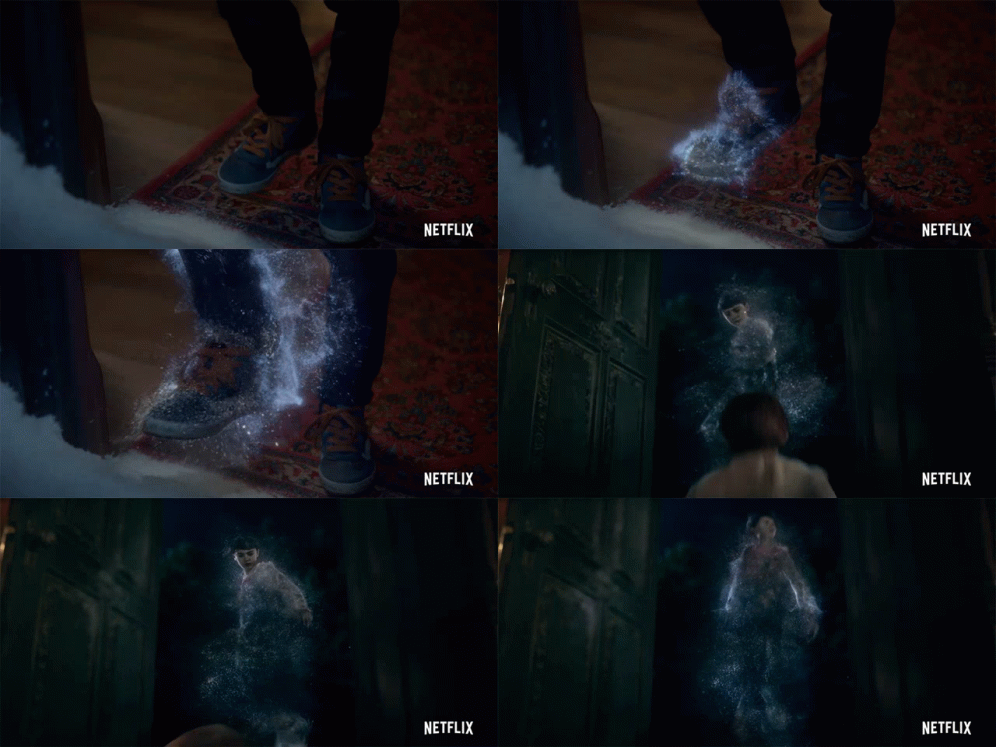
I think it’s also worth noting that a lot of newer, bingeable content is created to be seen as one ongoing story. Each episode still has an ending, but they’re structured very deliberately to line right up with the next episode, more like act breaks than episode conclusions. These shows tend to have really powerful season finales, because that’s the ending that really matters—the one that makes us come back for next season.

And, as I mentioned above with books, there are the endings that imply the potential for more story if the opportunity arises (“hey, we don’t know if we’re renewed yet so just in case…”) and the ones that wrap everything up nice and tight. They all lived happily ever after.

Why am I blathering on about all of this?

Hopefully it’s clear that the type of ending I have—structurally–should give the reader a sense of what comes next. And what doesn’t come next. Again, this is an ending, which means… something should end.

That doesn’t mean I just stop typing. But I’ve seen that plenty of times in books and on some shows, and even a few movies. Things just… stop. The werewolves lunge down the street, our heroes raise their swords and shotguns to fight and wait why is the next page blank.

This is why I’ve been going back and forth with this for so many weeks. It’s tough to talk about endings because each one’s going to be unique to that story and that writer. I can’t say “Don’t do X” when X might be exactly what need to happen in your particular story. A lot of it is going to come down to each of us looking at our story with an honest, critical eye.

Let me toss this out, and then I’ll ramble on a little more. Have I actually ended my story? Or have I just stopped telling it? They’re not the same thing, and if I don’t realize that… well, that’s probably a bit or a red flag right there.

I think one thing we need to do, as writers, is make sure we’ve finished our stories. If my book is about a chosen one accepting his destiny and fighting the manifestation of pure evil… well, by the end of my book he should’ve accepted his destiny and fought the manifestation of pure evil. If my story is all about the school valedictorian desperately wanting to ask out the head cheerleader… at the end of the story she should’ve asked out the cheerleader. This is basic, three-act structure stuff. Once I’ve set up conflict, I need to resolve that conflict. If I don’t… I’ve kinda failed as a  storyteller. You remember what Chekov said about that phaser rifle hanging over the fireplace in act one, right?

Ahh, I see some hands and at least one scoffing shake of the head. Yes you did. I saw you. Let me slap down two provisos on this, not so much exceptions as places for a little more thought and that honest, critical eye I mentioned up above.

First, it’s not unusual for my protagonist’s stated goals to be different from the actual goals of the story. The valedictorian may think this is about asking out the cheerleader, but the book is more about her accepting who she is and gaining self confidence. Plus, she’s clearly supposed to be with the goth girl who paints all the drama club’s backdrops. So, yes, in this sense the resolution may not be the one the character hoped for or originally set out, but my story’s (hopefully) structured in a way that still makes this a cohesive whole.

Also, it’s not unusual for a story to veer off and for characters to suddenly find themselves with all new goals. Maybe the valedictorian had worked up her nerve, was approaching the cheerleader out in front of the school and oh holy crap! Cyborg werewolf kidnappers! They’ve got the cheerleader! And they’re going to infect her with lycanthropic nanites at midnightif the valedictorian doesn’t stop them! This is going to take all her computer and science skills, plus maybe some help from that goth girl who paints all the drama club’s backdrops…

Again, though, there should’ve maybe been a few tiny hints so this kidnapping wasn’t coming out of nowhere. Or didn’t happen in the back third of the book after 200 pages of high school drama and musings. It’s a goal that’s carried through the narrative and eventually achieved.

Second, there’s the possibility there’s more to this. Maybe my book’s part of a trilogy or an ongoing series. Maybe it’s in a shared universe and questions here are going to be answered over there. If the story’s going to continue on and spill over into other places, isn’t it normal that things won’t end yet?That questions will be left unanswered?

Well, yes and no. Sure, there may be three or four more books, or another season’s worth of episodes, or maybe a new issue in just a month. But that doesn’t change that this, the book I’m holding (or season I’m watching or what have you), is a single thing. Yes, The Hunger Games is a story of a ruling elite being overthrown by a rising rebellion, but book one (and two) are really the story of Katniss training for the arena and then surviving in the Games (again). If book one had ended with five people still alive in the arena, will she make it out, pick up book two in just ten months… well, you’re already laughing, aren’t you? I’m pretty sure I wouldn’t’ve bothered with book two after an ending like that. I’d bet a few million other people wouldn’t’ve, either.

Y’see, Timmy, this one book still needs to stand on its own . It may have threads or whole subplots that continue on in other places, but this book still needs to be a self-contained thing. It has to hold some kind of story within itself. Yes, the series might be about finding the six, errr… seven… Eternity Crystals (copyright 2020, Peter Clines), but what’s happening in this part of that overall story? Are my heroes involved in a big heist to get the Chronos Crystal, even if they don’t fully realize what it is yet? Or has an old friend distracted them away from their quest to help rescue a cheerleader from cyborg werewolf kidnappers? What goals have I set for my characters to accomplish in this book?

Because if this book doesn’t have any goals for them… what are my characters accomplishing? They either don’t have goals, or they have goals that aren’t met. Either way… not an exiting read. And not likely to get a lot of folks to book two.

Again, every ending is going to be unique to every book by every author. But the one thing they should all have in common is that things need to be resolved. No resolution means my characters (and my readers) are just kind of left flailing and unfulfilled.

Ultimately, the thing I need to remember is that the end of my book is it. This is the last chance to amaze my reader. My final chance to shape their emotions, to lock down what they think about my book. Once they turn that last page, it’s all in their hands.

We talk about first impressions, but the last impression means something, too. It’s what people are going to walk away with. How many books or shows or movies have you enjoyed—maybe really enjoyed—and then the end just left you snarling in frustration?

And why are we usually frustrated? Because we didn’t get answers. Because ultimately nothing happened. Because we feel like we wasted our time.

Stick the landing. Nail your ending. Get that phaser rifle down from the fireplace and make sure it goes off.

Speaking of endings (shameless plug) if the end of the world is your kind of thing, my latest novel–Terminus –finally came out in ebook last week. If you haven’t checked it out yet, it’s kinda fun and fairly inexpensive. If you have checked it out and enjoyed it, reviews are always appreciated.

Next time… I’d like to talk about jargon a bit.

Until then, go write.
September 3, 2020 / 2 Comments

Comedy Hour!

I know I said I was going to talk a bit about endings but I had this kind of funny epiphany at the grocery store the other day. As in, an actual epiphany about funny things. No, really…

I’ve wanted to talk about comedy for a while. I tried once years ago, but—to be really honest—I didn’t quite have the vocabulary for it at the time. I’m not sure I do now, but at least I thought up two things that sounds kind of clever. That’s better than nothing.

Once or thrice I’ve brought up my bad movie habits and explained them. A fairly common thing I’ve seen are movies that bill themselves as comedies or something-comedies. I say “as” because they’re rarely funny, and I think there’s two big reasons for that. Well, three, but the third one’s not really relevant here. Maybe some other time. For now, two big reasons.

One is that comedy is very empathy-dependent. Possibly more than any other type of writing. If I can’t put myself in other people’s shoes, I’m going to have a tough time figuring out how to make them laugh.

The second reason is what I wanted to blather on about.

I’ve talked about genres and subgenres here a few times. Sometimes these subgenres have really specific rules. Take horror for example. Cosmic horror stories are not the same as slashers, which are not the same as supernatural thrillers, which are nothing like torture porn, which definitely aren’t monster stories. Or mysteries! There’s over a dozen sub-genres for mysteries, and publishers take them very seriously. Cozies, noir, capers, amateur sleuth, professional sleuth, procedurals… every one of them has their own expectations and requirements and guidelines. I can’t write a cozy mystery about a serial killer who collects his victims’ genitalia. They just don’t work that way.

Comedy is the same way. There are satires, spoofs, farces, romcoms, dramedys, and many more. And just like above, each of these has certain rules and expectations. I can’t just throw down a pile of funny things and declare it to be a spoof. And truth be told, no matter how big that pile of funny things is, I might not even be able to call it a comedy.

Y’see, Timmy, funny is to comedy the same way notes are to music (that’s clever thing #1). You need one to make the other, but that doesn’t mean a pile of one equals the other. I don’t expect thirty random notes to come together and make a song—we all understand I need to arrange them in a certain way, they need to work together, they need to have a certain flow to them. Just like a pile of random ideas doesn’t make a plot, just because I’ve got a pile of funny beats doesn’t mean I’ve got a comedy. What’s funny at the bar might not be as funny at work. That little bit of physical comedy from your date is definitelynot going to go over the same way at work. Heck, it might not have even been that funny on the date.

If you don’t want to believe me, I had a chance to talk with Kevin Smith years ago and we discussed ad-libs. He pointed out something you hadn’t planned or scripted can be incredibly funny on set, but the important thing is that it works in the editing room. Just because it’s funny doesn’t automatically mean it’ll make sense in the final film. ”It’s not germane to the discussion,” was how he put it.

When I’m writing a comedy story or screenplay, I need to be aware of what kind of story I’m telling. Am I adding things because they work within the framework I’ve established and they propel the narrative forward… or am I putting it in because people laugh at poop jokes? Is this part of the comedy, or is it just some random funny element? One that’s hopefully still funny in this context. Hopefully.

More doesn’t always mean better. Just because I add more funny things doesn’t mean I’ve made a better comedy, in the same way that just because I added more types of robots doesn’t mean I wrote a better sci-fi story. And really… does anyone think a bunch of jump scares make for a better horror movie?

Remember, whatever it is I’m writing, my elements should serve my story, not my genre.

(and that’s clever thing #2).

Hey, speaking of whatever it is I’m writing, he said by means of a segue, the exclusive period on my novel Terminus has ended. That means you can pick up the ebook version of the book right now. It’s not narrated by Ray Porter, yeah, but I did include a nice-sized afterword where I talked about where some parts of the book came from and how a lot of the characters developed. And if you’ve been waiting all this time for it, I made it fairly cheap, too, as a small “thank you” for your patience.

Next time… endings. Definitely.

Until then, go write.

August 27, 2020

On the Third Day…

I got a request from Rhyen, which is great because I still haven’t really hammered those ideas on endings or comedy quite into shape. So that’s still some stuff for the future. Or, y’know, somebody else could ask something.

Anyway…

Rhyen wanted to know about worldbuilding. Not just “our world, but with secret werewolves” but full-on, hardcore fantasy worlds, sci-fi worlds, and so on. How (and when) do you come up with histories, cultures, and all that other stuff?

Y’know what? Let’s make this post super-active rather than me blathering away. Right here, right now, let’s look at werewolf world. The other version of it where everybody knows werewolves are real.

Now, I know, we said we were going to do more hardcore settings but just go with me for a minute.

I’ve mentioned Charlie Jane Anders once or thrice before, and her little note that there’s no such thing as “a world just like ours, except…” because any noteworthy “except” is going to change everything. If there really were werewolves and everybody knew about them, so much would be different in the world. Tonsof things.

Don’t believe me? Let’s go over a few things real quick. Just off the top of my head…

Here’s an easy change. There probably wouldn’t be any silver coins. In WereWorld anything with even a scrap of silver would’ve been gathered up and turned into anti-werewolf weapons or defenses. The government would be treating silver like uranium. 

Which, hey… how would warfare be different? Forget atom bombs… imagine if the Manhattan Project involved deliberately infecting a hundred or so troops with lycanthropy and then dropping them all on Nagasakiand Hiroshima on the night of the full moon. A hundred unstoppable killing machines running wild in each city. That’s a terror weapon, right there. And of course, if the Japanese capture two or three alive, now they’ve got their own werewolves.

But now without the USpouring all that money into nuclear warfare and missile programs… where does it all go? Infrastructure? Social programs? Schools? Would there be a Cold War? A Bay of Pigs? And if the Soviet Union leaned into werewolf warfare… what kind of arms races would there be? Would the USSRhave financially collapsed?

And we haven’t even talked about dating or sex in WereWorld. Hunting laws? Home security? Profiling? Legal issues—if I kill someone as a werewolf, am I legally responsible? Is it murder, which requires a degree of forethought, since the werewolf’s essentially an animal (or is it?)?

And all of these assume we just “discovered” werewolves somehow back in the early 1940s. What if it was even earlier? How would global exploration and trade have gone differently five hundred years ago if every twenty-nine days  one of your crew members might kill everyone on the ship? How different would the world map look right now?

Again, this is all off the top of my head. Seriously, I’ve spent maybe ten minutes on this. But I’ve completely rewritten the world, just by being aware that things would inevitably change in this situation.

So, with that in mind…

Creating a setting, any setting, is a lot like creating a character. I want to know them backwards and forwards. It’s fantastic if I have lots and lots of factoids about them easily on hand (you may remember that back before we all took the pandemic plunge, I talked about characters and their underwear choices).

I’ve mentioned character sketches once or thricebefore, and I think worldbuilding can be approached the same way. We come up with the bare basics and then we start fleshing it out by asking questions and maybe following a few paths to their logical outcome. Like I did up above with WereWorld.

Or let’s do something even more divorced from our world. Let’s say it’s going to be a fantasy world, maybe one with some gearpunk elements. So, easy one—is there actual magic in this fantasy world? Is it kind of rare or very common? Does it need components? Are they rare or common? Do people have spell-component gardens the way we might have an herb garden?

How about the gear-tech? How precise is it? Do you need mathematically perfect brass gears or do lots of people carve wooden ones after dinner? What do they use for power? Springs? Counterweights? Two or three big guys turning a crank?

Does magic dominate the gear-tech, or vice versa? Is one notably newer than the other? Does either have detractors, vocal or secretive? Are magic and/or gear-tech novelties or parts of everyday life? Do they ever cross-pollinate, so to speak? Are they expensive or so common everyone has access to some aspect of them?

Considering all of this, now… is this mostly an agrarian world? Are more people farmers? Hunters? Are there gearpunk tractors or crossbows? Magic millstones or knives that can skin anything? And if none of this ever filters down to the common folk… how do they feel about that?

Has the magic or gear-tech made travel easier? Are people still isolated in villages or are there much bigger cities, made possible because of these advances? Do people know more about the world?

Heck, how fantasy is this world? Are there supernatural or mythological creatures? Are they common? Domesticated? Are there things we know or all-new creatures? Does the farmer have a six-legged hexox dragging his plow? Are there gods? Demons? How do they feel about humans playing with magic and gear-tech?

Or heck… is it even humans? Is this about magical halflings or gearpunk elves? I just pictured a gearpunk lizardman and that seemed pretty cool.

If you’ve answered a lot of those questions, I bet you’ve got the beginnings of a pretty solid world in your head. And probably spun off a question or three of your own. Enough so that you can start setting up your plot.

And one thing to keep in mind—just like with characters, this might change as I go along. As the story grows and progresses, I might change a lot. I might add even more. It’s an ongoing process. Halfway through my outline or my first draft, I might realize I need to address currency. And, hey,  maybe this world has a really crappy exchange rate, so it matters if you’re getting paid with glowing quartz or brass gear-coins.

Again, the world is here to serve the story. You’re going to change and tweak it as you go. Maybe all the way up to your last draft. And just like with characters, you’ll keep coming up with cool little details and anecdotes.

Now… there’s three key things to remember…

First, I know I talk about editing things down a lot, but we can all breathe a small sigh of relief here. If I’ve got a story set in another world—a drastically different world—most editors are going to give me a little bit of leeway, word-count wise. They understand I’ll need a few extra pages to explain why Yakko is riding a gearpunk tractor powered by magical crystals.

This doesn’t mean I can go crazy listing details. Or that I can be really blunt with them. No pausing for two pages to randomly describe the wooden sun-and-planet gears in Yakko’s trailer. Or the long history of the mining guild that provides those magic crystals. One more time—say it with me—the world is here to serve the story. It’s okay to have a little extra flavor here and there, but I shouldn’t lose track of what my book is actually about.

Which brings me to my second point. Whenever I create a character, there’s a lot of things about them that are never going to come up in the book. Or maybe they come up, but they’re never explained. I might have tons of rich backstory and weird little details, but a lot of it just never becomes relevant.

For example, in the Threshold books, I know a ton of things about Veek. I know why she’s abrasive with most people. Why she likes wearing men’s suits and ties over women’s power suits. Heck, I made a note of when/how she lost her virginity. But the truth is, none of this has been relevant to any of the books she’s been in. It’s stuff I know, and it helps me make her feel more three dimensional on the page, but ultimately… it’s all kind of irrelevant if it doesn’t have anything to do with this book—with the plot I’m telling and the character’s arc through that plot.

Worldbuilding is the same way. No matter how fantastic or amazing the details of this world might be, they only matter if they’re going to have some kind of impact. While it may be very interesting how this society ended up with a hexadecimal/base sixteen number system, do we need to know any of that history for this story? Yes, WereWorld does have eleven continents and there’s a fascinating story behind it… which has nothing to do with this book.

And even then, I’d argue that if there’s no real reason for something to be different… maybe it shouldn’t be. I think one thing that confuses some people is they see this rich, historied world that the story’s set in and forget the world only exists to serve the story, not the other way around. If you look back at my A2Q discussion about the world Phoebe and Luna live in, I made choices based on what would be interesting for the plot and story, not what would make for an interesting world.

So I shouldn’t be coming up with (and using) new things just to come up with new, different things. I mean George RR Martin just uses leagues for distance in worldbuiding heavyweight A Song of Fire and Ice(perhaps better known by it’s Hollywood stage name, Game of Thrones). It sounds good, a little archaic, and he doesn’t have to waste half a page explaining what hekkrets are.

Or heck, here’s another example… any of you remember that old 70’s indie movie, Star Wars? There’s a great scene where Ben and his would-be-protégé are trying to hire a ship from some lowlife smuggler. And Ben tells him “We can pay you two thousand now plus fifteen… when we reach Alderaan.” Remember that?

So… two thousand what?

No, no, no. Don’t run to novelisations or books or articles that retconned this. Right there in the movie you watched… two thousand what?

Truth is, it doesn’t say and it doesn’t matter. For this story, the type of currency’s irrelevant. I don’t care if it’s Imperial credits or Old Republic scrip or gold-press latinum or Jawa skulls. Okay, I might care if it’s Jawa skulls because WTF Kenobi why do you have two thousand of these laying around?! What the hell have you been up to out in your little desert hut?

Anyway… no, all we need to know is that two thousand is a good amount (judging off everyone’s reactions) and fifteen more makes it a very good amount. Past that, we just don’t need to know why Solo wants all these Jawa skulls Kenobi’s collected. It’s not important. The dialogue’s solid and sounds believable, which is far more important that a brief segue to explain the various types of Galactic currency and their exchange rates.

This brings me to my third and final point.

Worldbuilding is, in my opinion, a really easy trap to fall into. Because worldbuilding is fun. Seriously. That question game we played up above? We can do that for weeks with worldbuilding. Months. Maybe even years. My world is going to be so huge and so complex with so many races and creeds and economies and social structures and seriously we can spend so much time doing this instead of…

Y’know, actually writing the story.

And that’s how I generally approach worldbuilding. You may need to change this approach a bit, depending on your own story and the kid of setting you want for it, but hopefully this’ll get you a little further down that path. Or help you find your own path.

Next time… endings.

Maybe.

Until then, go write.

August 20, 2020 / 1 Comment

An Old Favorite…

It’s Thursday morning and it struck me that I don’t have anything ready for the ranty blog. I’ve had a few different ideas rattling around in my head for posts about endings and comedy and jargon. But they’re all kinda big things and a bit… delicate? I don’t want to be giving bad, half-thought-out advice, and I’m not 100% sure that I have good advice on these precise topics quite yet. Thus all the rattling around in my head.

Or maybe those are LEGO bricks? Might be. Really, anything goes in 2020.

Hey, speaking of years and what’s possible and what’s acceptable, I realized I could babble on for a minute or two about a topic that pops back up every four or five months.

See, I recently watched an adaptation of something I loved many years back. And, being a proper nerd who read and re-read the original and then read it again a seventeenth time, I picked out little changes here and there. I mean, yeah, it’s an adaptation. Things are going to change. They always do because they need to. But these were different changes. A lot of them were in how people were addressed. How other people reacted to them. Nothing gigantic, but it stood out to me because—as I said—I was a big fan of the original.

Okay, fine, I was nitpicking.

Anyway, I can’t remember at what point in the movie it clicked, but it hit me that the movie had updated a lot of the original story’s views on sexuality and gender. Just little tweaks, nothing that affected the plot in any way. But the movie was a bit more modern, inclusive, and—in a few places—a little less mocking.

I thought Good on them.

But then, shortly afterward, I had another moment. Because, hang on a minute, I’d read this many, many times back in those formative years and I’d never noticed any places where people were excluded or mocked or anything like that. The book was fine. Was this movie overreacting? Were they just changing things in the adaptation to please a tiny, vocal minority?

And the more I thought about it, the more I realized ohhhhhhhh no. No they weren’t. I just didn’t notice because, at the time… I was cool with all of that. My views then echoed a lot of the views of, well, then. Just like the book did.

This book was big for me. If someone asked me, it’d probably end up on my personal list of “twelve most influential books/authors” or something like that. But… yeah, it’s got some flaws. The book is a fixed artifact of thenand there are aspects of it that the world has moved past. And, thankfully, I’ve moved past.

It’s a rough thing to go back and realize things you loved in the past don’t quite measure up anymore. Sometimes in minor ways, sometimes in… well, really big ones. I re-read a classic sci-fi novel a year or two back and it terrified me with some of its views on sex. Re-read another formative series to my partner when she was really sick and discovered wow was there a lot of casual racism in it. Just a few weeks ago I watched one of my favorite comedy movies from my teens, one I must’ve seen this at least a dozen times (yay USA Up All Night) and holy crap that was just full-on, no question sexual assault, arguably attempted rape from the main character. That was seriously uncomfortable to watch.

And I get why admitting this sort of thing can be tough for people. To admit these early, formative works are flawed. That the people who made them were flawed. Because admitting this means opening ourselves up to the idea we might be flawed. We might’ve absorbed views and lessons that, in retrospect, were not good.  It’s painful to think the movie adaptation of our life might get that same horrified reaction.

The world always changes. It progresses, it moves forward, and hopefully… we move with it. We learn more. We understand more. This sounds really dumb to say, but I’m very happy my views have grown and evolved since I was five. Or fifteen. Or twenty-five. Not on everything, but on a lot of things. It’s not weakness to say I’ve changed my views—it’s growth.

This doesn’t mean we have to abandon those old, formative works or throw them on bonfires. But we need to be honest and acknowledge what they really are… even when it means a bit of apology and internal cringing on our part. I can say this book and that book are on my list of formative things because… well, they were. I can’t deny it. They’re part of why I’m a writer today.

But I don’t need to embrace them or constantly defend them. I can admit their flaws—some minor and some seriously glaring—even if it possibly means admitting some flaws of my own. Because in writing and in life, I can’t improve if I never admit that I need improvement.

Anyway… just some random thoughts. I know other folks have said similar things in a better way.
 
Next time…

Well, as always, if anyone’s’ got a specific question, feel free to drop it in the comments below. Or over on a Writers Coffeehouse videoif you want to get answers from better writers. And if not, maybe I’ll sort out some of those bigger ideas to talk about.

Until then… go write.

Categories