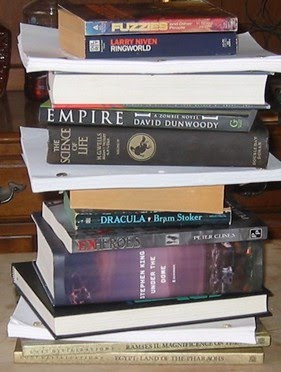

We’re barely into April and I’ve already read sixteen books–more than one a week. I’ve read classic novels like Dracula and shiny-new ones like Under The Dome. I read The Terror by Dan Simmons and then followed it up with an actual history of the Franklin expedition. I’ve read books on ancient Egyptian history and early 20th century spiritualism. I’ve read an end-of-the-world story by Dave Dunwoody that was really fun and another one by Dean Koontz that really wasn’t.April 9, 2010 / 4 Comments
RIF
We’re barely into April and I’ve already read sixteen books–more than one a week. I’ve read classic novels like Dracula and shiny-new ones like Under The Dome. I read The Terror by Dan Simmons and then followed it up with an actual history of the Franklin expedition. I’ve read books on ancient Egyptian history and early 20th century spiritualism. I’ve read an end-of-the-world story by Dave Dunwoody that was really fun and another one by Dean Koontz that really wasn’t.April 1, 2010 / 2 Comments
Baby Steps
So, as some of you may have picked up along the way, I used to work full-time as a crewperson on various films and television shows. On one level, this sounds very exciting and cool. People like hearing stories about blowing stuff up, getting to film in cool locations, and that Reiko Aylesworth is about fifty times more stunning in person than will ever, ever come across on film. I mean, she is just gorgeous. And funny. And a pool shark. Yes, to some extent, working in the film industry really is that cool.
On one out of twenty days. Maybe one out of fifteen, depending on the project.
The rest of the time, it’s dull as hell. Honest. No one’s that interested in the long days, the idiots in charge, or the screw up from another department that delayed everything for an hour. In this respect, the film industry isn’t that different from most other jobs, which is why a lot of people’s eyes glaze over when you try to tell them about it.
Which isn’t that surprising, if you think about it. It’s a job. It’s real life. And real life, for the most part, is pretty boring. Even in the movie industry.
Real life meanders. Sometimes it wanders aimlessly. It involves people learning the same lessons everyone else had to learn–or sometimes not learning them and screwing up more. The dialogue in real life sucks. Have you ever read an actual transcription? I do it all the time. Most people sound like idiots, trust me, and I include myself in there. We stutter, we second guess and repeat ourselves.
As such, it’s always baffling when people think they’ve done something amazing by writing a story about real life. With real characters. And real dialogue. In a sense, it’s like bragging about the peanut butter and jelly sandwich you made for lunch. The only thing more embarrassing is when you try to convince people the PB&J is something bold, daring, and new. Check it out. Bread on both sides. You’ll see I spread the peanut butter across the entire surface of the bread rather than leave it as a large glob in the middle. Also notice, please, that the jelly is between the slices of bread– I came up with that bit myself.
(If it helps, picture Chef Gordon Ramsey staring at me with that stunned look he seems to do so often… and then his next five or six words getting bleeped out.)
Let’s stop and consider for a moment. This is an accomplishment? It’s like congratulating someone for getting pregnant at the prom–so many people do it that it’s almost not worth talking about.
Now, one of the earmarks of this type of writing is when a character has an epiphany. A supposedly real world-altering revelation about their life. I say supposedly because most of them are the sort of simple life lessons most people have figured out by age twenty or so. You know, that it’s better to be loved than to be cool. That drugs are bad. That their destructive behavior is hurting the people around them. Those sort of things. While it’d be tough to prove, I can’t help but think a lot of these moments get put in because it’s something the writer experienced and they don’t grasp that everybody has these moments.
My friend Ace has a neat term for this, developed after years and years of reading for different screenplay contests. To quote: “It’s the moment when a baby discovers their own feet. It may be the coolest thing ever in the life of the baby, but for the rest of us it’s pretty dull and mundane.”
When a real character figures out it’s better to enjoy life than spend time at work, they’re discovering their own feet. When someone realizes they should cherish and spend time with the people that matter to them, it’s their own toes they’re staring at. If someone comes to the jaw-dropping conclusion that they’ve messed up a life that was clearly messed up on page one–OH MY GOD! The toes wiggle when I think about wiggling them!!!!
Part of why this rubs people the wrong way is that it’s plain condescending. As I mentioned before, a lot of these lessons are things we figured out in high school, even if maybe we didn’t take them to heart at the time.
Y’see, Timmy, when people talk about something great and say “It’s so real,” they’re making an implied statement. And that statement is (in full) “It’s so real, but I know it actually isn’t. But, wow, if it was real I bet it would be just like this.”
No one likes real life. If they did, there wouldn’t be any market for even the thinnest veneer of escapism. No one would read books or go to the movies. Reality rarely makes good stories, and the few times it does it’s often too outlandish to be believable. Anyone remember me talking about Vesna?
We want quasi-life. We want life +1. We want the good guy to win. We want the villain to get his or her comeuppance. We want the cute couple to overcome obstacles both physical and emotional so they can be together. We want cyborg ninjas from the future programmed by elder gods from the past and million to one odds that pay off and nymphomaniac heiresses who look just like Reiko Aylesworth.
Okay, maybe that last part’s just me…
Of course, that’s also key. We want all that, but we want it to be believable, too. I mean, if the hero beats the cyborg ninjas and beats the odds three times in a row and finds nympho-Reiko… well, that’s just silly.
So, we want life +1–maybe as much as life+3– but it has to be realistic. At least enough that we can believe in it.
Sound tough? It is, believe me. That’s why most people can’t cut it as writers. They don’t have the ability to pull it off or the patience to figure out how to do it.
A lot of them, instead, write these real stories. Gritty, depressing stories. Stories with broken, unlikable character who fail at everything and lead miserable, pathetic lives. That’s art, my friends. The sure sign it’s art–no one wants to pay to see it because they don’t understand it. No, seriously. That’s the definition of art. Just ask any failed artist and odd are they’ll tell you the problem is everyone else, not them.
At the end of the day, if you’ve decided to tell a real story, you’ve just made a peanut butter and jelly sandwich. You’ve done something that’s common, available everywhere, and didn’t take much effort. It may be the greatest PB&J ever, but it’s still nothing compared to a fairly nice filet mignon. Or even a just-adequate slice of cheesecake. Heck a McDonalds 79-cent hamburger beats a peanut butter and jelly sandwich.
Next week, I’ve got something I’d like you to read.
Until then, go write.
March 26, 2010 / 3 Comments
Thyme to Bored You’re Fight
Today’s ranty blog takes us to the land of imagination. To be exact, the airport of imagination. Say you’re a passenger on the new supersonic jumbo jet I designed. I call it the OmniTurboTron 3000. It’s going to make the Concorde obsolete. And you’re here to ride on one of the very first flights, the maiden voyage. The rest of the passengers are on board, the luggage is packed below, and the flight crew goes to close the door.
Oh, but there’s a problem. The door’s not quite the right shape for the frame. It’s built to all the specs, but it doesn’t seem to fit. That’s odd.
The crew wrestles with it for a while and finally figure out if they use some crowbars to lift it a bit on the hinges it mostly fits into place. They just need to whack it with a sledge a once or thrice and it sits almost perfectly. Well, maybe with a few blankets pushed into that crack on the bottom.
The question for you is… are you going to stay on this plane?
Heck, if I’m supposed to be an engineer and I messed up something as simple as the door, what else is wrong? Is this cabin airtight? Are the windows safe? It seems like I didn’t run any kind of tests or double-check anything–maybe the wings are going to come off in mid-flight!
Believe it or not, the same logic and conclusions are true of writing. If a reader hits something which shows I didn’t check any of this or don’t even know what something does, why should they risk going any farther? If I don’t even know how to spell or use an apostrophe, who knows what kind of plot holes were left behind when I declared this “done” and put it out for people to see. Why would any editor (let alone any reader) risk their time with something like this when there are signs of shoddy workmanship right up front?
Y’see, Timmy, if I skim the page and see Wakko is playing a few cords to compliment the music the band is perforating over their, do I really need to read anything else? That’s four failures in one sentence.
Yes, four. If you can’t see them, pick up a dictionary.
No, not spell check. Not the internet, either. A real dictionary.
I know I’ve gone on about this again and again. Spelling is the number one thing I tell people to work on here. Just look how many links the keyword “spelling” has over there on the right. You cannot succeed at this until you learn what words mean and how to spell them. Not more or less what they mean. Not close enough with the spelling so people will know what you mean. You have to know and you have to be right.
I also know I push owning a dictionary a lot, which seems a bit pointless in our wonderful space age world, but there’s a rhyme to my reason. A dictionary and the internet are not the same thing. If you have to look something up in the dictionary, you are the one doing the work. When you do the work, you learn. Once you’ve learned, you rarely need to look it up again. Like any skill set, your writing improves with study and practice. You need both.
When your computer does the work, you become more dependent on your computer. As I’ve pointed out many times now, a computer is the worst writing partner you can choose. It has no idea what word you wanted to use, only what words you’re close to. This is why people who use spell check all the time continue to use it and continue to need it. Same goes for the folks who tend to Google-search for definitions rather than looking them up. They’re not studying how to write–only practicing.
And practice without study is like that idiot guy in the park swinging his katana around and convinced he’s learning to be a ninja.
Yeah, you know that guy…
Now, there’re some great arguments out there that people don’t need to know this stuff anymore because computers do it for them. It’s my firm belief this is why there’ been such a boom in would-be-writers lately.
Thing is, we’re not talking about people. We’re talking about you. And if you’re spending any amount of time here reading the ranty blog, the assumption is you want to be a writer who can actually sell something. As a writer, you must know how to spell and what words mean.
There’s a huge difference between an engineer and someone who owns a copy of The Way Things Work. Just because I’ve got few friends I can call to help with car repair does not qualify me as a mechanic. Taking a health class in high school and owning a first aid book does not make you a doctor. More to the fact, we’d all mercilessly mock (maybe even sue) anyone who tried to call themselves an engineer, a mechanic, or a doctor based on these “abilities.”
Likewise, if you’re going to say you’re a writer because your computer knows all the right words and spellings, don’t expect a lot of people to take you seriously. Because in their eyes, you’re just that guy in the park, wearing a black tee-shirt and swinging your katana…
Next time, I would like to tell you all a 100% true story about a baby discovering her own feet. Really.
Until then, go write.
March 19, 2010 / 3 Comments
Oh, The Humanity!
Historical reference, just to be different. Although awful things with zeppelins isn’t the greatest parallel for what I wanted to talk about. Plus I understand that airship pilots (of which there are ten in the whole world) get really testy if you bring up the Hindenberg…
Anyway, what I’d like to prattle on about this week is balloons. Y’know… those things that get bigger and bigger and finally explode.
It’s not uncommon for a writer to want to take an idea a little further. To turn that short story into a novella, that novella into a full-fledged book, or those two or three clever scenes into a feature-length screenplay. We’re all creative people. It’s what we do.
Plus, let’s be honest. Sometimes it just needs to be longer. We need another 5,000 words to hit a publisher’s minimum or maybe ten more pages to get this producer interested.
Now, the way most people try to expand their stories is by adding words. Sounds kind of obvious, I know, but there’s a catch. These folks mistake adding words for adding substance. Often, the words being added bulk up the manuscript but don’t actually add anything to it. They’re just putting back in all that stuff that was already edited out for being unnecessary.
It’s easy to explain this with a visual aid. Ready?
Picture a large balloon. A good-sized one. Pretend I wrote a short story on this balloon. Got that? Now it’s easy to make the story bigger, yes? Just inflate the balloon until it’s twice as big. We’ve all done something like this at some point, so it’s still easy to picture, yes?
Have I actually made the story bigger, though? It’s just the same ink forming the same story, now spread thin. In fact, since I filled it with… well, hot air, the story’s gotten a bit insubstantial for its size. It’s tough to read because it covers so much space and we can actually see through it at points.
If you’ve got a solid, edited story, you’ve already let all that hot air out. The story on the balloon is compact and dark, if you get my meaning.
Here’s a few quick, easy ways to spot a balloon…
Giving more description is a typical way of ballooning a manuscript. You throw in a few more adjectives or adverbs or a few more clever metaphors about how Phoebe looks like Angelina Jolie’s hot little blonde sister or something. What’s going on here, though, is all those cuts the writer made during editing are being reversed, just like I mentioned above. The unnecessary stuff is getting added back in and… well, that just doesn’t make sense.
Close to this is when the story’s revisiting the same idea again and again. Let’s have another example in the story of how clueless Yakko can be. Or perhaps yet another scene of slackjawed, stammering men which shows us how stunning Dot is. Maybe one more sequence where Wakko demonstrates how awesomely powerful and badass he is. Besides being a variation of the description problem above, belaboring a point like this gets dull fast. Anyone who wants a dull story, raise your hand now.
Then please leave.
Extending action sequences is another way writers sometimes balloon a story. I mentioned a while back that action (in my opinion) shouldn’t take much longer to read than it would take to do or watch. But an easy way to fill space is to decribe the history behind that perfect jodan zuki the ninja throws which connects with Yakko’s jaw. Then I can describe the excruciating pain as one of Yakko’s molars (which he got two fillings in as a boy and almost had pulled but his father insisted he had to keep his teeth as long as possible) gets smashed loose and the coppery taste of blood fills his mouth even as the impact of the strike twists his head around and… well, you get the idea. Does it really take that long to hit someone in the face? Can you imagine if every punch, strike, kick, or gunshot took that long? Dear God, the elevator scene in The Matrix would be longer than Atlas Shrugged.
So, that’s a few easy ways not to expand your story. But how should you?
Well, like so many things in this field, that’s a bit harder to say. A key thing to remember is expanding something often involves changing it. If your 7,500 word story is structured a certain way, the structure will probably have to alter when the story becomes 10,000 words. If it becomes 35,000 words it’ll have to change a lot. If you’re determined to keep the structure exactly the same, you’re probably going to have a lot of trouble making your manuscript bigger.
Another easy rule of thumb– you shouldn’t be adding things that don’t need to be there. So if you want to add a quirky conversation about “the first time,” angel hair pasta, or who got beat up more as a kid, there needs to be a reason for this conversation to take place.
Just to be clear, “boosting the word count” is not a viable reason.
Y’see, Timmy, if you want to expand a story you can’t add hot air–you need to add actual material. You want a bigger balloon, not the same balloon puffed up to look bigger.
Some quick examples…
–Throw an additional character into the mix. It could change relationships, action, pacing, all sorts of stuff. And add to all of these as well.
–Change someone’s motivation. Not everyone walks to the grocery store for the same reason after all. Yeah, maybe Wakko is helping out because he’s a decent guy, but maybe he’s doing it to try to make up for something he did years ago. This could change how he reacts to things, his exact actions, and maybe what’s a desirable ending for him.
–Make a new goal. A short story is generally A to B, maybe even C. So stop trying to cram in A 1/2 or B 3/4. Have your story go on to D, E, and maybe all the way to X.
And then, when you’ve made this change (or these changes), go over your new, larger story and polish it again.
There’s a chance I might miss next week as I rush to meet a bunch of deadlines for Creative Screenwriting. But please check in and perhaps we’ll talk for a spell, as they used to say.
Until then, go write.