
June 15, 2012 / 4 Comments

Patting the Dog

            Oh, get your minds out of the gutter.
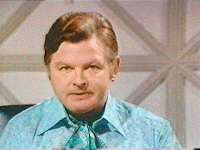
            This week’s topic comes from a comedy sketch done many years ago by British comedian Benny Hill.  He’s best known in America for having lots of scantily clad women dancing around him, while the rest of the world also remembers his ability to rattle off some clever wordplay or jokes.  If I do this right, though, “patting the dog” will become a regular writing phrase and we’ll all get to give him credit for that, too.
            Many years back, Hill did a sketch where he played a foreign film director being interviewed by the press.  When asked about his new film (and I’m paraphrasing a bit here), he explains in broken English that it’s a “deeply emotional tale of love and human kindness.”  When the interviewer prods him a bit, Hill goes into further detail.
            “It’s about a man who tries to leave the mob and sees his friends slaughtered by criminals with machetes.  So he tracks down the villains and kills them all.  Then he finds their boss and kills him in front of the man’s family.  Then he kills the man’s wife, and then his children.  Then he desecrates their bodies and, as he leaves, he sets fire to their home.”
            “I thought it was a deeply emotional tale of love and human kindness?”
            “It is,” insists Hill.  “As he walks out the door, he pats the dog on the head.”
            That got a big laugh from the studio audience.  And from me, even though I was only eleven and really watching the show for the scantily clad women.  It was clever enough to stick with me, even past those distractions.
            See, the studio audience and I both recognized the absurdity of what Hill’s character was suggesting—that one miniscule, token act could balance out, or even override, the atrocities he’d just described.  Patting the dog is a nice thing to do, yes, but in all honesty it’s kind of low on the scale.  Heck, for most of us it’s more of an automatic response than a deliberate act of kindness.  We see a dog and we pat him or her on the head.  That’s all there is to it.  We probably think more about tying our shoes in the morning.
            So the idea that patting the dog would make us completely change our views on this character or this story is… well, laughable.  It’s too little, too late.  It’s the weakest kind of spin job.
            And yet, how often have we seen this sort of thing in books or movies?  We’ll have a completely unlikable person who does nothing we can sympathize with or relate to.  Violent drug dealers, sadistic assassins, abusive spouses, jerk bosses, there’s dozens of characters that could fit this category.  And all too often, the writer will give them some tiny, banal moment that’s supposed to make us suddenly change how we feel about them.  They pat a dog.  They thank the guy who sells them their morning coffee.  They get drunk and confess their awful childhood.  They go to church and say their prayers.
            Y’see, Timmy, if I’m patting the dog, it means I’ve got a character who’s doing some small, token thing that’s supposed to counterbalance a lot of really awful things. And that just doesn’t work.  I can’t spend page after page making the audience feel one way about a character, then expect their views to completely shift because of one minor action.
            Now, at the risk of possible Armageddon, let’s mix dogs and cats
            I’ve mentioned the “save the cat” moment once or thrice.  This is Blake Snyder’s term for when a character does something small and quick early on in the story that gets us on their side.  His example of this is “saving the cat” (which some writers take way, way too literally) but it can be any number of things.  It’s just a simple action that assures us this person is a decent human being.  In my new book 14, the main character’s saving the cat moment is when he decides not to drown a cockroach.
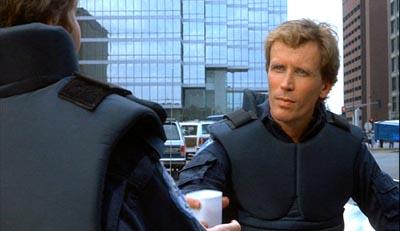
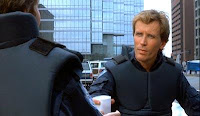
            Here’s a well-known save the cat moment from the movie Robocop.  Remember when we see the still-human Murphy practicing his quick-draw and spinning his pistol into his holster?  He explains that he’s learning the trick for his son, who sees all the great cops on television do it and therefore assumes his dad should also be able to do it (because his dad must be a great cop).  And, Murphy tells his new partner with a grin, it is just kind of cool.  It’s a quick little moment, barely thirty seconds long and only about fifteen minutes into the film, but it establishes Murphy’s a good dad and an overall decent guy.
            Now, the big catch with a save the cat moment is that we’ve never been againstthis character.  Saving the cat has never been about changing our view of a person, it’s about emphasizing our view of them.  It’s just a shortcut to help the reader like them quicker so the writer can move on to more important things.  Like, say, the plot.
            A lot of folks try to have half-assed save the cat moments in their stories, but really they’re just patting the dog.  A couple easy ways to figure out which column my random act of kindness falls in…
–If everything I’ve done up till this point has been to make the character unlikable, then this moment is patting the dog.
–If it comes more than halfway through the story, odds are I’m patting the dog.
–If I’m trying to change the reader’s perception of my character with this moment, I’m just patting the dog.
            This isn’t to say I can’t reverse how my readers see one of my characters, but it’s not going to be a quick fix thing that I can do with one line.  It’s going to take lots of moments and a lot of work.  It’s a long process that can’t be rushed.  Even if I’m doing it with a clever twist, the reader needs to look back and see that the seeds of this change stretch all through my story.
            Because there’s another word for when someone does a sudden reversal like that.  It’s called a betrayal.  And no one likes to be betrayed.  Even if it’s just by characters in something they’re reading.
            Next time, I’d like to run some numbers by you real quick.
            Until then, go write.  And remember to thank Benny Hill.
June 8, 2012 / 2 Comments

Crystal Clear Tone

            The title will become clear further into the rant.  Hopefully.

            Shamefully, some pandering, too.  My new novel, 14, just came out.  It’s there on the sidebar.  Ebook only, at the moment, but this time next week that link should take you to the paperback version.
            As some of you know, I used to write for a fairly popular screenwriting magazine.  It let me talk to lots of professionals about their job, and it also let me see a lot of movies for free.  A lot of movies, sometimes weeks or even months before they came out.  To be honest, the last movie my lovely lady and I paid to see was V for Vendetta.  Before that was probably Batman Begins, which we saw twice—once with our friend Max and once just the two of us.
            But that really doesn’t have anything to do with this week’s topic.
            Or does it?
            Anyway, one day I was in the office and the editor, Amy, asked me about a film she knew I’d seen a few weeks earlier.  One of the other journalists had suggested the idea of doing a big piece on horror-comedies for the September-October issue, and the movie I’d seen (let’s call it Gorefest) was one of the ones that had come up as a potential subject.  Amy wanted to know if I thought Gorefest would fit the article.
            I didn’t think so.  The filmmakers were telling a horror story, and they knew that too many jokes and cheap laughs would shift the tone of the film and knock it into a different category.  Gorefest was a horror movie, and it had several moments of comedy in it, like a lot of modern horror films.  But it wasn’t a horror comedy.  They never crossed that line.
            The other journalist insisted it was, though, and used it anyway.  In the final article, the screenwriter of Gorefestopenly said it wasn’t a horror comedy.  And Amy gave me a little grin the next time I was in the office.
            This is an example of someone being a bit tone deaf.  You’ve probably heard this term applied to both music and writing.  In music, it’s when I don’t realize that a group of notes or chords clashes with another group.  And that’s pretty much what it means in writing, too.  When something doesn’t work in my story, tonally, it means something’s clashing or overpowering something it shouldn’t, to the point that it stands out.  In this particular case, the journalist was projecting emphasis onto those comedy bits that wasn’t there in the script—he was deaf to the actual tone of the film.
            I interviewed Kevin Smith a few years back for one of his movies (Zach and Miri Make a Porno).  One question I asked was about working with Seth Rogen.  After all, Smith notoriously hates ad-libs and Rogen is famous for constantly riffing on lines, coming up with new ideas and variations for almost every take.
            He was quick to correct me, though.  His reputation for hating ad-libs came from his first few films, when he realized he and his cast were too inexperienced to be making big deviations from the script.  So back then, he was very strict about sticking to the page.  And while he’s loosened up a bit, he still favors the script over random interpretations on set.  “So often you’ll get an actor who just starts saying stuff that’s very funny to the crew or me or the other actors, but it’s not germane to the discussion,” he told me.  “It’ll be great on a friggin’ blooper reel, but I can’t fit this into the scene.”
            And, yes, I did clean up Kevin Smith’s quote a bit for those of you reading this at work.  Feel free to swap in the words you think he used.  You’ll be right.
            Just because something’s good in and of itself doesn’t mean something is good in the bigger scheme of things.  I can throw a great slapstick comedy scene into my Somalian pirates script, and it may be some of the greatest slapstick ever written.   But it’s going to stick out like a sore thumb amidst the gunfire, brutal killings, and mounting tension.  I could write some stuff right now that could make most of you reading this cringe or get grossed out.  It’s not really that hard. 
            The thing is, what would be the point of doing it right now?  You’re reading this to learn about writing, not to get nauseous.  It might be some fantastically disgusting imagery, but it just wouldn’t fit here any more than… well, a random discussion about the last couple of movies I paid to see.
            I see this kind of stuff all the time.  Random gore for the sake of gore.  Long monologues in an action film.  Comical sidekicks wedged in for no reason except to be the comical sidekick.  Romance that’s shoehorned in just so there’s a reason for a female character.
            Another quick story, one I’ve mentioned here before.  A friend gave me a horror script to look at a few years back.  It was a basic “cabin in the woods” setup with a clever idea behind it.  My friend knew that sex sells, and he told me before I read it that he’d added a nude scene.  It actually turned out to be a hardcore lesbian sex scene.  Three pages of boobs, some bondage, toys, and insertions.  It was so graphic, in fact, there was nothing to call it except pornographic.  And that’s a major shift in tone right in the middle of a fairly creepy horror story.
            This is one of the harder criticisms to give.  For a lot of people—especially inexperienced people—it’s also one of the harder ones to receive.  It’s very hard for some folks to grasp that something can be good and still not be right
            If I had to guess, I’d probably say part of the reason people have trouble with this concept comes from that reverse-engineering idea I mentioned a few weeks back.  Element X works well in story Y, therefore it stands to reason element X will work in story Z.  There’s also probably a bit of special snowflake mentality—the idea that doing something good should somehow automatically translate to success.  And, for some writers, there’s probably an empathy issue in there as well.
            Y’see, Timmy, tone is about my story as a whole.  Not this particular funny joke or that one creepy description or that strongly-implied (or blatantly shown) sex scene.  Tone is how my entire story feels overall and how it’s going to be viewed.  That’s not to say I can’t have comedy or romance or action in my story.  It’s these little moments of flavor and color that make a story really sing.  The trick is to know how much comedy and how much romance will work in a given story—and maybe accepting that the answer is “none.”  Because things that break the tone generally break the flow, too.
            And if you can’t tell you’re breaking the flow… well, don’t worry.  Your readers will let you know one way or the other.
            Next time, I’d like to talk to you about a wonderful lesson we can all learn from an old Benny Hill skit.
            Until then, go write.
June 2, 2012 / 3 Comments

I Couldn’t Care Less

            Very sorry this is late.  Last Thursday I was up in Seattle for Crypticon.  This Thursday was my birthday and my lovely lady had a very full day planned out for us.  So you’re getting this a bit late, but you’ll still get a new post in a few days.

            Anyway, I had a quick tip for you
            I’ve talked a few times here about mysteries.  A good mystery is when your characters and your audience are looking for the answer to a question.  But there’s an exception to this rule that I haven’t mentioned.  If your characters don’t care about the mystery, there’s a good chance the author and audience shouldn’t either.
            This is pretty much the flipside of an idea I tossed out a few weeks back.  I can’t put the mystery under the spotlight and then expect I don’t have to show it to people.  However, if my characters are content to leave the mystery completely in the dark, odds are my readers will be fine with it, too.
            The Time Traveler’s Wife never bothers to investigate how Henry can travel in time.  We get a loose explanation of genetics and that’s it.  He and Clare just accept it as a given because it’s tied their lives together.  On the sadly-just-cancelled television show Awake, Detective Britten doesn’t care which world is real and which is a dream.  Having both worlds is a win-win for him, so the show was far more procedural than supernatural.  On The Finder, Walter didn’t care how a head injury turned him into a locating-obsessed goofball, and neither did his friends, so the show never pondered on it.
            Y’see, Timmy, my characters should always mirror my audience, and I should write accordingly.  If St. George, Stealth, and Cerberus are excited and interested about something, my story should be structured so my audience is excited and interested as well.  That’s good writing.
            If my characters don’t care about the mystery, though, my story shouldn’t spend page after page shoving it in my readers’ faces.  If my characters have one priority and my audience has another, it’s just not going to work.  That’s badwriting, and it’s going to make things feel forced and unnatural.
            Be clear on what your characters want, and make sure your story wants the same things.  If not, you’re going to create a conflict.  And not the good kind of conflict.
            A quick question for you all, for the future.  Would any of you be interested in interviews with other professional writers?  I’ve got a fair number of novelists and screenwriters in my email address book, plus a good-sized pile of old interviews I did in the past with some name folks.  Would that sort of thing interest anyone here?
            Let me know.
            Speaking of which, next time, I’d like to drop names and talk about something very important that Kevin Smith told me once.
            Until then, go write.
May 18, 2012 / 2 Comments

Textbook Storytelling

            Sorry this is a bit late.  Apartment-and-cat-sitting and I’m losing  a lot of time driving back and forth.

            If you’ve been on the internet lately, especially to any writing-related sites, you’ve probably noticed a lot of what I like to think of as film-school mentality.  It applies to books just as much as movies, but I think it’s a mindset that really began with the spec script boom of the late eighties and early nineties.  The people who display this mentality toss around a lot guru-istic terms and can give you long, exacting lists of why your story doesn’t work, and they make it sound like they really know what they’re talking about.
            Now, I’ve talked a few times (although none recently) about criticism.  A good critic of my work is someone who’s going to be honest about what works and what doesn’t.  Someone who just says “this sucks” isn’t helping me in the slightest. They’re also going to be able to explain why those elements do or don’t work.  But not all of these reasons are going to hold, because sometimes they’re based on a faulty premise.
            Which brings us to reverse-engineering.
            Reverse engineering is when you study how a piece of technology is built, work backwards to its initial phases, then work forward in creating your own. 
            For example, let’s say a UFO crashed in New Mexico back in the ‘50s.  My crack team studies its propulsion system, figures out it works off some kind of magnetic drive, and then eventually figures out how to build their own magnetic drives for monorails and Mk VII Space Shuttles (shhhh, no one’s supposed to know about those).  That’s reverse engineering.
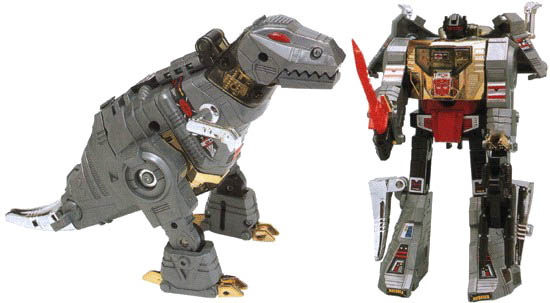
            It can also be something mundane.  I can buy a toy like Grimlock the Dinobot, take him apart, and isolate all the individual components.  Then I just recast those parts, reassemble them, and look at that—I’m making transforming robot dinosaurs that look and work just like the one I studied.
            Now you’ll notice I used two different machines in my examples.  One’s alien-level tech and the other’s a fairly complicated toy, but they’re both mechanical.  There’s a reason for that.  Reverse-engineering is a very mechanical process.  It relies very heavily on the fact that these processes work the same in each direction.  A to B to C, C to B to A, and then A back to B back to C.  I can’t take Grimlock apart, put the components back together again, and somehow end up with a Barbie doll.
            However…
            This isn’t true of stories.  Stories are much more organic.   They depend on a high degree of empathy between the writer and the reader. The elements of a story can go together many different ways, with many different results.  Sometimes, a story just works and no one can tell you why.
            Y’see, Timmy, unlike Grimlock, there’s lots of ways the individual elements of a story can go back together again.  Grimlock’s parts will make a robot dinosaur every time you assemble them, but story elements are fluid and mutable.  They can interact in different ways.  That’s why I can combine a lot of the same characters, plot points, and themes to get a series of radically different stories.  The Forgotten DoorE.T.  Escape to Witch MountainStarmanBrother From Another Planet.  They’re all the same pile of story elements, but these are all very, very different stories.
            Think of it this way… let’s fall back on cooking as a parallel (as I have once or thrice before).  I want to reverse-engineer some waffles.  So if I break the waffles down I’ll find flour, sugar, milk, eggs, and some heat binding them together.  Maybe some chocolate chips, too.  But those ingredients could combine to make more than just waffles.  I could take those same ingredients and make pancakes.  Or muffins.  Or cookies.
            More to the point, these ingredients can also make lukewarm gruel.  Something watery and maybe even a bit slimy that will make you gag.  Just because they went together one way and worked, or even three ways, doesn’t mean we can make a hard fast rule that says all good things to eat have flour, sugar, and eggs in them.  Or that anything with flour, sugar, and eggs in it is good to eat.
            This is why I’m against most gurus and how-to writing books.  You can’t come up with solid rules for how to write a story by reversing the way you analyze them. Using story A to critique story B may work in a classroom, but it won’t work when I try to write a story.  Because we’re all writing different stories and we’re all writing them in our own way for our own chosen audience.  Just because a set of rules can be applied to a novel like To Kill A Mockingbird doesn’t mean a book like Carrie or A Princess of Mars is wrong for not following them.
            I’m sure most of us know someone (or several someones) who’s written a novel, screenplay, or maybe even just a short story that follows all the rules and tips from some guru or how-to writing book.  And these stories tend to be… well, kind of blah.  They’re acceptable stories, they’re just kind of mechanical.  And that’s because these stories weren’t written, they were manufactured.
            Writing just doesn’t work that way.  Analyzing stories does, but analyzing is not the same as writing.  Just because I know how to do one doesn’t mean I know how to do the other. 
            This is why I’m always a little leery when people begin to dissect and critique a story using terms like “turning points” and “redemptive moments” and “inciting incidents,” usually while giving hard page counts for when all these things musthappen in a story.  These are all guru terms that try to pin down very vague, general things that change from story to story.  The more specific those terms are, the less accurate and useful they tend to be, and when people insist on following these inaccurate rules to the letter… well, nothing good comes of it.
            Now, I’m not saying there’s nothing to be learned from studying stories or films.  That’d just be silly.  But I need to understand the difference between  a set of  general guidelines and a hard-fast formula.  I’m sorry to sound repetitive, but there is no formula for writing a good story.  None.
            Bruce Joel Rubin, the Oscar-winning screenwriter of Ghost (and also Deadly Friend) made the keen observation a while back that we experience stories through our gut.  That’s where every good story hits us, on one level or another.  Stories that go through our heads never work, because the minute we start analyzing we’re no longer immersed in the story.
            This works going both ways.  When I write a story, it needs to come from my gut.  It’s not meticulous or precise, it’s raw and emotional and often more organic than logical.  This is why stories that get written to a made-up formula—stories that come out of someone’s head—end up feeling like… well, the product of a formula.
            Next time… well, next time I want to talk about something I couldn’t care less about.
            Until then, put down the how-to books and go write.

Categories