April 18, 2013 / 3 Comments

Stripped Bare

            First, time for the shameless plug. Ex-Patriots, the second book in the Ex-Heroesseries, gets re-released on Tuesday from Broadway Books with a cool new cover.  It’ll be at bookstores, airports, your local PX… pretty much everywhere.  You can pre-order it over there on the side, or go visit your friendly neighborhood bookstore and ask them to get you a copy.

            Now for a quick tip.  Well, quick compared to last week’s ramblings.
            If you’ve been reading this collection of rants for a while, you’ve probably picked up that I’m a bit of a genre fan.  If you’ve read any of my books, it’s probably very clear.  Sci-fi stories, horror stories, fantasy stories… I love this stuff.
            Of course, a big part of loving something is recognizing the flaws in it.  Let’s be honest—there are a lot of horrible genre stories out there.  A real lot.  Depending on who you talk to, some of them are mine…
            Anyway, it struck me the other day that there’s a simple test for good genre stories.  Can I explain my story—and have it make sense—without any of those genre elements?  For example…
–Without the strange force field, Under the Dome is the story of an isolated town falling apart as different characters make different power grabs.
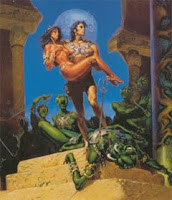
A Princess of Mars becomes a straightforward fish out of water story if you pull out the sci-fi elements.  John Carter could be anyone dumped in a strange, baffling culture where he doesn’t speak the language.
SuperTroopers is still a solid story about police rivalry and budget cuts even without all the comedy.  With the corrupt cops and drug smugglers, you could almost make it a crime drama.  Or a Romeo & Juliet-style love story.
–If you take the undead out of I Am Legend (any version of it), it’s a desert island story.  It’s one man alone (or sometimes with a dog) trying to balance staying alive with staying sane.
Without magic, the Harry Potter books are the story of an unpopular orphan as he grows up, makes friends, finds his way in life, and learns about the parents he never met.
Ghostbusters without comedy becomes a great sci-fi/ horror story about a Sumerian prophesy come to life.  Strip out the sci-fi/ horror and it’s a comedy about a bunch of guys trying to start a bizarre business who suddenly discover they’ve hit a gold mine and everyone wants to hire them.
IT without the horror is just a group of childhood friends who reunite to solve a puzzle from their childhood.
Pitch Black is the story of shipwreck survivors who find themselves dependant on their somewhat-misjudged prisoner to protect them from dangerous predators.
            Now, I’m not saying this as a jab at these books or movies.  The point is not that these tales can be boiled down to much simpler plots.  It’s that they have underlying plots which have nothing to do with their respective sci-fi/fantasy/horror elements.
            Y’see, Timmy, if I strip out the genre components of my story, I should still have a story.  Some writers depend so much on their genre stuff that they don’t grasp they haven’t actually developed any sort of real plot.  They’ve just got a pile of cool elements that doesn’t really add up to anything.  And if they looked at it without the sci-fi/fantasy/horror elements, they’d see that immediately.
           So, get your story out and start stripping.  Pull off all those layers, take a good look at what’s underneath, and… well, make sure you’ve got something worth looking at.
            Next time…
            Okay, I’m going to be honest.  Next time is a week before this new book is due on my editor’s desk, so I’m not going to be here.  I’ll be busy panicking.
            Week after that, though, I’d like to talk with you about the dreaded Scooby Ambiguity.  And I’ll probably be a day early because Thursday morning I head to Dallas for Texas Frightmare.
            Until then, go write.
April 12, 2013

Flash!! Ahhhhhhhhhhh!!

            Pop culture reference.

            You godless heathens.
            So, one thing I’ve heard from a fair number of writing gurus—both for books and screenwriting—is to never, ever use flashbacks.  Which seems a bit odd, because there are plenty of well-known novels and films that use them.  Yet folks keep saying it again and again. Don’t use flashbacks.  Don’t use flashbacks.
            The thing is, it’s actually quite easy to do great, fully functional flashbacks.  The kind that make your readers get a thrill rather than leave them scratching their heads.  It takes a basic understanding of story structure and a bit of thought, but that’s it.  They’re something I wanted to go over in that big structure series I keep promising to revisit, but… well, we’re all here now.
            So… flashbacks.
            And this is kind of big and sprawling, so I apologize now.  But it makes up for missing last week.
            For our purposes, the term flashback can cover a lot of things.  It can be an element within the story like a recalled memory, dream sequence, letter or journal entry.  Sometimes, like in my own Ex-Heroesseries, it’s just part of the way the narrative has been structured.  Whatever the flashback is, however, it’s going to need to follow certain rules in order to work.
            When someone says a flashback doesn’t work, it’s almost always because it inherently has one of four major flaws (I say “almost” because there’s always some bold, daring folks who will find very unique ways to make something not work).  And it’s interesting to note that these four common flaws also pretty much define a successful flashback.  Once I understand the flaws, I’ll understand how to do fantastic flashbacks.
            So, first big helpful hint.  I cannot start a story with a flashback.  Never.  This is the first of those four flaws, and it’s a simple logic/labeling problem so it’s pretty easy to deal with.
            Why is starting with a flashback illogical?  By its very nature, a flashback implies we’re going to a point in time that’s before now.  This means we need a now before we can flash back to anything else.
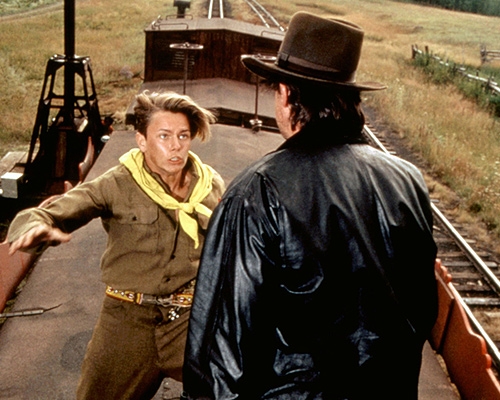
            Indiana Jones and the Last Crusade does not begin with a flashback.  It begins in the “present” of 1912, when Indy’s just a teenage kid trying to stop a group of treasure hunters.  Again, this isn’t a flashback, it’s just a different setting.  The story then moves forward thirty years to a new setting where Indy is an adult and reclaiming that same bit of treasure for his museum.
            Calling this sort of thing a flashback (especially in a screenplay) is just going to get my story labeled on page one as something by a  rookie who doesn’t understand basic structure.  Personally, that’s not a first impression I want to make.
            All clear?
            Okay, moving on…
            Now, I can use a flashback anywhere in my narrative (except at the very start, as I just said), but this switch in the linear structure can’t affect the dramatic structure.  If I’m going to drop linear point D between R and S in my narrative, it has to keep the story moving forward.  D has to keep advancing the plot.  It also needs to keep building tension.  If it doesn’t, there was no point to this flashback.
            A lot of writers use flashbacks as infodumps.  The flashbacks are seen as a chance to show how Wakko met Phoebe, how Phoebe became a ninja, why Wakko hates snakes, and so on.  The mistaken belief is that if I do this in a flashback, I’m not affecting the structure of the present storyline because these events aren’t happening now—they’re happening in the past.   
            When I do this, I’m confusing linear structure with narrative structure.  This is the second major mistake.  As I mentioned above—and have mentioned before—the narrative needs to keep moving forward.  Just like a shark, if the story I’m writing (or reading) stops moving forward, it dies.
            So when I have a flashback, it has to keep moving the story forward.  It has to tell me something new and relevant.  It doesn’t matter where the events fall in the linear structure of the story, but wherever I’m using them they have to fit into the dramatic structure.
            For example…  here’s a flashback failure from a book I read last year.  Some names and situations have been changed to protect those I wanted to pummel senseless a third of the way into the book…
            A man’s family dies when they eat tainted meat (he’s off banging his mistress, so he survives—no guilt there).  The narrative then flashes back a few months and spends three chapters in the boardroom of the meat-packing company’s parent corporation.  They’ve just found out the meat is tainted.  Should they shut down the plant?  Announce the problem?  Should they do a recall?  Realistically, how much would they spend on lawsuits?  Maybe it’s better just to let it go and roll the dice.
            So the plot was put on hold for three chapters (three long, full chapters) so we could see the board reach a decision we already knew they made—to let the meat be sold.  One could make the argument that we find out their exact motivation in these chapters.  Thing is, their motivation is exactly what most of us would expect from a bunch of corporate executives.  In this tainted meat scenario, what’s the most likely reason the executives would decide not to issue a recall?  Money, of course.
            This flashback served no purpose at all.  It gave us a resolution we already knew, with a motivation nine out of ten people automatically assumed.  It did nothing except bring the narrative to a dead halt.  There’s a good argument to be made that it actually made the narrative go backwards.
            Now, the reverse of this problem is also an issue.  It’s the third one, as a matter of fact.  This is when the writer confuses the narrative story with the linear story.  This is very similar to a problem I’ve mentioned before, being clear on the first time something happens in a story.  When this problem arises with flashbacks, instead of destroying all possible tension, as mentioned above, it destroys logic.
            Let’s say I’m telling a murder mystery.  On page 75 of my story, the lead character has no idea who the murderer is.  Then, on page 125, I flash back two weeks to something that happened “off camera” earlier.  Here I reveal that my heroine learned the identity of the killer because of a clue she spotted near the mellonballer.
            In a rough, quick way, this makes sense.  On page 75 she doesn’t know.  On page 125 she does.  Except once I put these story elements in linear order… well, now they don’t make any sense.  While it makes sense that this is a new bit of information for the reader on page 125, it’s not new to my heroine.  She’s known all along.  Which makes her actions and dialogue for the last hundred pages complete nonsense.
            A quick story.  One I’ve told before…
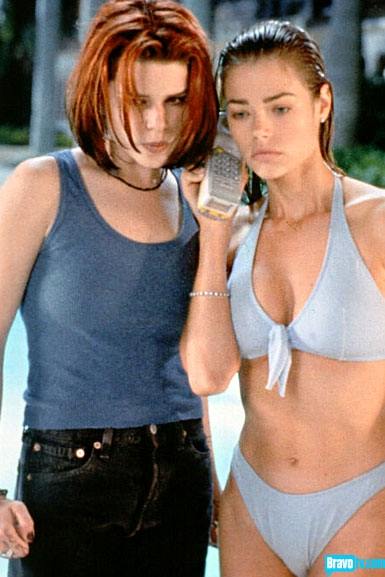
            I worked on the really, really bad sequel to a fairly clever murder mystery film, one which was far more famous for Denise Richards making out with Neve Campbell in a pool then it was for its cleverness.  At the end of the original film, there are a series of flashbacks that show how the various characters were intertwined and involved, and also how the various twists were pulled off.  The film I worked on had these flashbacks at the end, too, but with one major difference…
            When you put these flashbacks in place within the linear story, they didn’t make a bit of sense.  Either they added absolutely nothing to the story or else suddenly people had conflicting motivations, plot points became bizarre twists, and once-clear twists became muddled nonsense.  The writers were simply seeing this as “new information” and not considering that, within the linear structure, it was all actually old information that needed to match up with the rest of the film.
            One of the best ways to test this is to take a narrative apart and put it back together in linear order.  Are motivations still clear?  Do plot twists still make sense?  That’s a good sign the flashback is solid.
            At least, solid in this respect.
            There’s one last way flashbacks tend to frustrate readers.  The fourth way.  By the very nature of a flashback being out of sequence, the readers or audience have effectively seen the future.  If my character is alive at story point S, flashing back to show her in a life threatening situation at D doesn’t really accomplish anything.
            For example…
            Let’s say I’m writing a story where Yakko and Dot are writing up their mission reports at Monster Slayer HQ after killing the Great Vampire.  And then they remember that they still owe a report on the mummy outbreak in Cairo.  So they start scribbling their report and I write a big dramatic flashback scene that ends the chapter with the two of them backed against a wall, outnumbered and surrounded by a dozen mummies and the avatar of a very pissed-off Egyptian god. 
            Thing is… there really isn’t any tension in this cliffhanger, is there?  Because the moment the reader pauses, even for an instant (like, say, at this chapter break), they’ll remember Yakko and Dot are sitting back at HQ writing up this report.  Alive and well.  No missing limbs or sensory organs.  Not even any notable scars.  Heck, we know they’ve gone on another mission since this one (killing the Great Vampire) and survived that one, too.  So in this case, the flashback actually hurts the story because it’s sucking all the tension out and killing forward momentum.
            While it wasn’t really a flashback (because, again, it wasn’t flashing back fromanything), this was one of the huge flaws with the Star Wars prequels.  By peppering the story with characters whose future we already knew, Lucas effectively tied his own hands and sabotaged any attempt at tension.  He could threaten young Obi Wan Kenobi with all sorts of things, but at the end of the day we all know he survives to become old Ben Kenobi.  And old Ben had all his major limbs, all his fingers, both eyes…  He was in great shape.
            So, four basic rules.
            1) A flashback needs to flash back from somewhere.
            2) It needs to work within the dramatic structure.
            3) It needs to work within the linear structure.
            4) It can’t create tension that undermines the present.
            Now, I’m going to suggest a movie to demonstrate a fantastic series of flashbacks, and you may laugh a bit. Resident Evil.  Yep, it’s corny fun and the series has degenerated into near-nonsense that just showcases Milla Jovovich’s figure, but—credit where credit is due—the first film has a fairly tight story and uses flashbacks very, very well.  There are three major flashbacks (each one a slightly more detailed account of a past event as Alice’s memories come back), and they’re a perfect fit for those four rules I just mentioned. Go grab it from Netflix and check it out.
            Next time, I’d like to talk to you about some events from last week…
            No, wait… next time I wanted to talk about good genre stories.
            Until then, go write.

            Pop culture reference.  I have no idea why, but that commercial always made me giggle like a little kid.

            So… I’ve only got a couple of minutes, so let’s talk about right now.  Starting… now.
            When I used to read for a couple of screenplay contests, one of the most common mistakes I’d see would be writers loading the page with information that wasn’t being shown on the screen. 

INT: CAFE
Push in on PHOEBE, sitting at a table, sipping her coffee.  She’s young, blonde, and pretty in that girl-next-door way.  She’s also heartbroken because she just found out her boyfriend’s been sleeping with someone from his office.  They got in a fight when she confronted him and he told her to move out.  She moved here to Seattle to be with him, doesn’t have any nearby family, and has realized that most of her friends were his friends first.  So now she’s sitting here in a cafe, with all her belongings out in her car in the parking lot, trying to figure out what to do with her life.

          Now, in the scene I just scribbled out… what’s happening in the movie right now?  What do we, as the audience, see?  What actions are taking place? 

            Screenwriting is about right now.  Not a year ago, not last week, right now.  Nothing matters except what’s on the screen right now.  If it’s not on screen right now, it’s not important.  If it is important, it’ll come out on screen later (later, at that point, being right now).  If all the words on page one of my screenplay aren’t related to the first minute of my movie, I’m doing something wrong. 

            So, just to clarify, my script should only be talking about what’s happening right now
            Now, there are lots of screenplays out there by some amazing screenwriters that mention a character’s background, past relationships, all that sort of thing.  Thing is, if I really pay attention when I read all those scripts, I’d see that these elements are only brought up when they’re relevant to what’s happening on screen right now.  Because screenwriting is about right now.
            Here’s my quick little common sense analogy for you. Feel free to swap genders or locations as you like…
            If I’m out at a bar talking with Phoebe, she’s what’s important.  If I’m talking to Phoebe but thinking about Dot, it means I’m either A) a jerk or 2) focused on the wrong thing.  Because if I’m talking to Phoebe, I should be focused on Phoebe.  If I’m thinking about my boss, I’m doing something wrong.  If I’m on the phone talking with a friend, I’m doing something wrong.  If I’m thinking about my ex-girlfriend or the woman I met earlier in the evening, there’s something wrong.  And if I’m thinking about where Phoebe and I are going to be two hours from now… yeah, I’m probably still wrong.  Phoebe’s in front of me right now, so I should be focused on her. 
            Right now.
            When next week becomes right now, I think I may talk a bit about flashbacks.
            Until then, go write.
March 21, 2013

F A Q

        The ever-popular Frequently Asked Questions.  I can honestly say I never, ever thought there would be so many people here that I’d need to do something like this.  But here you are.  And much as I love getting to say “hullo” and chatting with folks, it gets really exhausting answering the same questions again and again every other day.
         So, rather than get annoyed with folks for asking the same question I just answered twice on the last status update, I figured I’d just put all the answers to the most common questions in one document and update it every couple of months or so.
                   That way, people can just ignore this.  It’s much more efficient for all of us…

When does Ex-Communication come out?
        Ex-Communication is being released on July 9th, 2013.  I know, finally…  It’s been done for ages, but then got caught up in the whole Crown deal and the usual publishing stuff.  Sorry for the long wait, but I really think it’s going to be worth it.
Is Ex-Communication the last Ex book?
        Nope.  I’m currently finishing up a fourth one which should be out in October of 2013.  I’ve also got very tentative plans for a fifth book, but that would all depend on Broadway Books and how well the series does for them.
        I’ve never really planned it as a trilogy or having a set specific storyline.  I get to leave some threads hanging for later things, and if all goes well I get to pick up those threads in later books.  There are some specific things I know people are hoping to see resolved in Ex-Communication, but there are a few things that may still linger.  The series could go on for a while.
What’s the fourth book going to be about?
        I’d rather not say at the moment.  I don’t like spilling too much in advance because people tend to latch on to a lot of out-of-context stuff and make a lot of judgments about it—despite the fact that it’s a snippet they’re seeing out of context.  I’m kind of like JJ Abrams that way.  Just without the fame, prestige, money, or power.
What’s the fifth book going to be about?
        See above.
Why are you so against people talking about your books? 
        I actually love to think people are talking about my books.  It still stuns me, to be honest.  What I hate are spoilers.  That’s why I always delete it when someone posts revealing information from the back half of a book and why I try to avoid those questions in interviews.  It’s fantastic that someone enjoyed it so much when XX found XXX and realized XXXX, but by talking about it (or posting or whatever) they’re making sure the person they’re telling can’t enjoy it the same way they did.  It’s like explaining how a magician does all his tricks and then taking someone to see the show.  It won’t be as fun, and it’s not how you’re supposed to see a magic show.
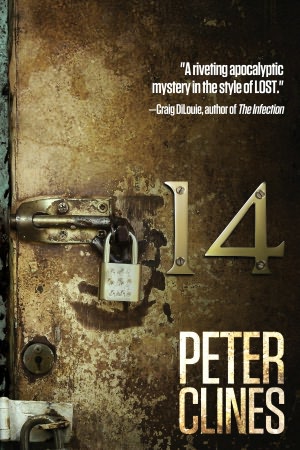
         And, yeah, this is a page for folks who’ve read my books, but not everyone’s read everything.  A lot of folks are here for the Ex-Heroes series, but a lot of people found this page because of 14.  It may be a stupid attitude in the information age, but I don’t want to ruin the experience of these books for anyone if I can avoid it.

Will there be a sequel to 14?

        I don’t really have one planned.  14 was always intended to be a stand-alone book, which was part of the reason I was able to do so much with it, story-wise.  It’d be tough to do anything with it that didn’t feel a bit cheaty or expected (I hate prequels).
        That being said… I have had a few very loose, very faint ideas for a sort of side-quel to it.  Think of it as more of a Next Gen– Deep Space Nine relationship.  But I wouldn’t do anything until I had a good, solid story to tell, so that’s not happening in the foreseeable future (for at least a year or two).
Will there be a sequel to The Junkie Quatrain?
        Probably not.  I think a lot of the fun of The Junkie Quatrain was the interconnected-overlapping nature of the stories, and it would be tough to replicate that without feeling a bit forced and awkward.  I think we’ll probably have to draw our own conclusions about what happened to all those characters.  Well, all the ones that survived anyway…
        However, we may see some of the various characters again.  Quilt has been showing up in my stories, in one guise or another, since my first real attempt at a novel in college (sort of like Stephen King’s Man in Black, Randall Flagg).  If you follow my ranty blog at all, Quilt’s actually a supporting character in The Suffering Map.  I think he’s just a creepy, badass professional in almost every reality.
Do you have any plans to attend XXXX—Con?
        I love attending cons and meeting folks, but it usually burns down to time (I do need to keep writing books) and money (airfare and hotels add up quick).  Driving distance has better odds than flying distance, west coast has better odds than east coast.  I’d love to do more, I just need to figure out ways to make them fit with those two factors.
Will you be my friend on GoodReads?
        Nope.  It’s nothing personal, I just really don’t like Goodreads.  To be honest, I can’t stand the site, I submit nothing there, I post nothing there, and make it a point to spend as little time there as possible (which fortunately works out to “no time” in an average month).  I understand a lot of people love the site and if it works for you, that’s fantastic.  I won’t be there.  No friends, no reviews, no messages, no comments, no nothing.  I’d explain why, but… I’m taking the Thumper approach.
Is there going to be a movie/ TV series/ cartoon/ graphic novel of your books?
          Man, wouldn’t that be cool?  Alas, there’s been a lot of interest (from a few big players), some talks, a few meetings, one lunch where I had a really amazing cheeseburger, but as yet no one’s decided to move forward with anything.  Believe me, if it happens everyone will know.  Everyone.
Are you really working on a remake of The Wraith?  That movie was awful (great car, though).
         Alas, no.  It was just a funny comment to end an interview and some folks latched on to it.  I had a clever idea a while back for how the story could be redone, but I think it’s very, very, very low on Hollywood’s list. 

        And I think that covers most of it. 

Categories