
August 9, 2013

Inside the Bottle

            I’d thought of making an I Dream of Jeannie joke about this post title, but then I heard that actor Michael Ansara had died and it felt like it might be in poor taste.  He was Barbara Eden’s husband for a while, and even played another genie on the show once.  Of course, he’s really famous for playing Commander Kang, arguably the Klingon (sorry, Michael Dorn), on no less than three different Star Trek shows across more than thirty years, starring in countless westerns, a famous Outer Limits episode, and also for being the voice of Mr. Freeze for the animated Batman and Batman Beyond.  In short… he was awesome and it’s sad that he’s gone.
            However…
            By odd coincidence, one of the first places I heard the phrase “bottle show” was when I was researching screenplays for Star Trek.  A bottle show was what they called an episode that used only existing sets and costumes, and often only the regular cast with minimal (if any) guest stars.  The producers loved them because they saved money, which also made them a great way for aspiring writers to get in.  Write a solid bottle show and they’d buy it just so they could have it handy for emergencies, or to help counterbalance two or three expensive episodes in a row.
            And in a way, a lot of the bottle episodes tended to be better stories.  Once the writers didn’t have the distraction of the “alien of the week,” they could focus their efforts on either bringing out new aspects of their cast or weaving a much more elaborate story.  By limiting what could be done with one aspect of the storytelling, it made all the other aspects that much stronger.
            And that kind of makes sense, doesn’t it?  Unlimited situations don’t have any tension.  If my characters have unlimited time to solve a problem, or have unlimited space to get away from it, my story isn’t going to be very interesting
            The thing is, being “in the bottle” could refer to any sort of restriction.  It could be a limited location, yes, like those Star Trek episodes or a good haunted house tale or the classic Campbell story “Who Goes There,” which most of you probably know better as The Thing.  Most of George Romero’s zombie movies are bottle stories, too, with people trapped in a farmhouse, a mall, an underground complex, and so on.
            But it could also be a time limit, that famous ticking clock.  It doesn’t matter what the character does or doesn’t do, the story is ending in two weeks, or two days, or maybe just two hours.  Many of Arthur C. Clarke’s stories involve ticking clocks (often on an astronomical scale, but they’re there)
             Laughable as it may sound, Speed is a bottle story.  The limit is actually the minimum speed the bus could travel.  That’s what created all the tension, because screenwriter Graham Yost came up with a very clever bottle for his story.
            If you’ve having trouble with a story, try sticking it in a bottle.  Rather than trying to make it big and expansive and epic, figure out how it can be tight and restricted and personal.  Slap a limit on it.  Confine your characters to a few locations.  Figure out some way to restrict their time.  Or even just stick to one viewpoint.  If I see and hear everything through Yakko, it means I don’t know what’s going on in Wakko’s head or where Dot was during that blackout.
            As I’ve mentioned before, one of the key elements of any challenge is that it has to be faced.  If I can avoid facing it because of a lack of limits—letting me get away from it, postpone it, or even massively overpower it—then it isn’t really much of a challenge.  And if there isn’t much of a challenge, there isn’t much of a story.
            Next time, I think it’s important that we all admit a few things.

            Until then, go write.

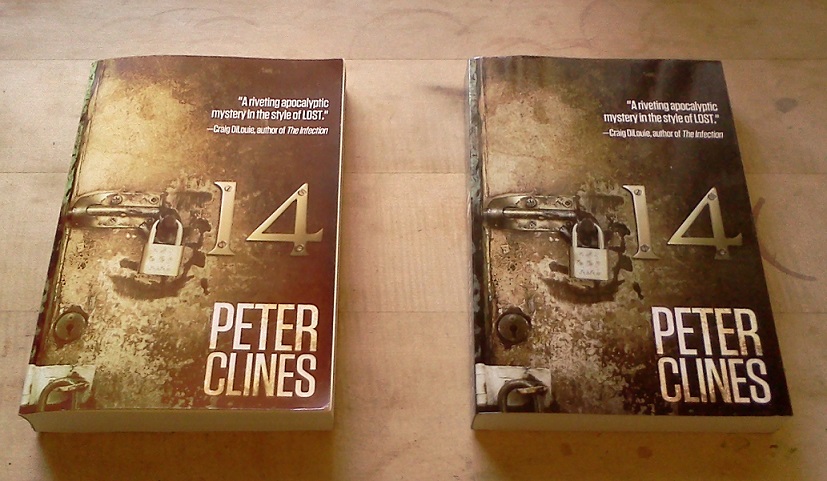
             Two copies of 14.  How are they different…?
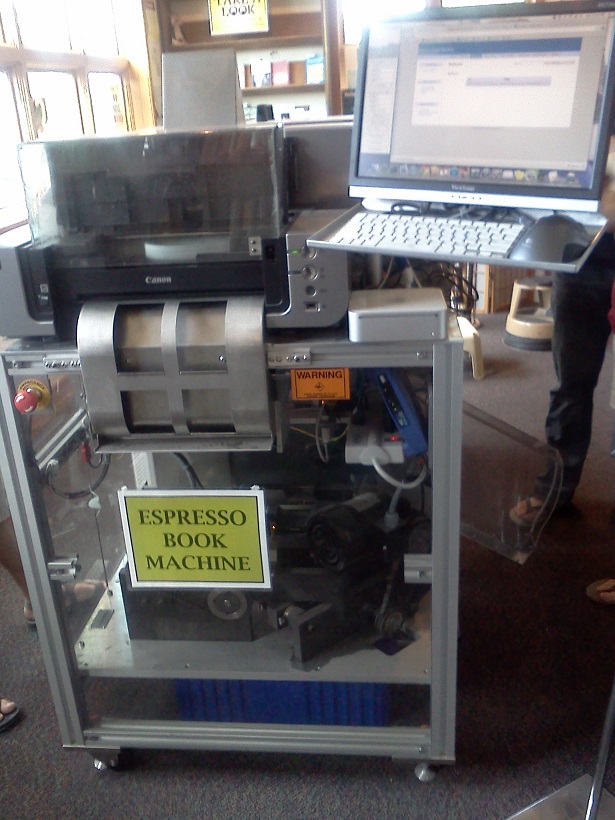
            I’m guessing most of you reading this have heard of the Espresso Machine.  Simply put, it’s an ATM for books.  You select the manuscript you want and the machine prints it up for you right there on the spot.

            In theory, this is cool on a couple levels.  For bookstores, it means they’ve got access to a much larger potential inventory.  I think for most of us, when we go to a bookstore and get told “we can order it for you,” that’s usually the signal to go home and order what we want on Amazon.  With an Espresso Machine, the bookstore gets to say “we don’t have it in stock, but we can print it up for you in fifteen minutes.”

            That’s just a few steps off from replicator technology.
            For writers, especially traditionally published authors, it means paperbacks never need to go out of print.  There are tens of thousands of books out there that aren’t financially viable for a publisher to bring back (last numbers I heard said a book needs to sell over five thousand copies a year to be worth keeping in print), but could still gather random sales.  And sales means income.  Authors with a large back-catalog could suddenly be getting regular checks again when a dozen books sell twenty or thirty copies each.  Not phenomenal money, but definitely better than the nothing the books are making when out of print.
            All pretty nifty, yes?
            Well, about six weeks back I was up at Village Books in Bellingham, Washington, and I got to take their Espresso Machine for a whirl.  Not only that, their resident Espresso expert, Brendan, was willing to talk with me for about half an hour, going over the machine and the whole process from beginning to end.  So I decided to get a copy of 14 through the machine and see what came out.
            The Espresso Machine at Village Books is one of the first ones put out, and thefirst one on the west coast.  It’s about two years old (on a three year, rent-to-own lease), and Brendan’s trying to convince the owners to trade up to the new model in a year when the lease is up.  The newer one has worked out some small bugs and also goes a bit faster (most books are done in closer to ten minutes).  Keep that in mind as you read through this.
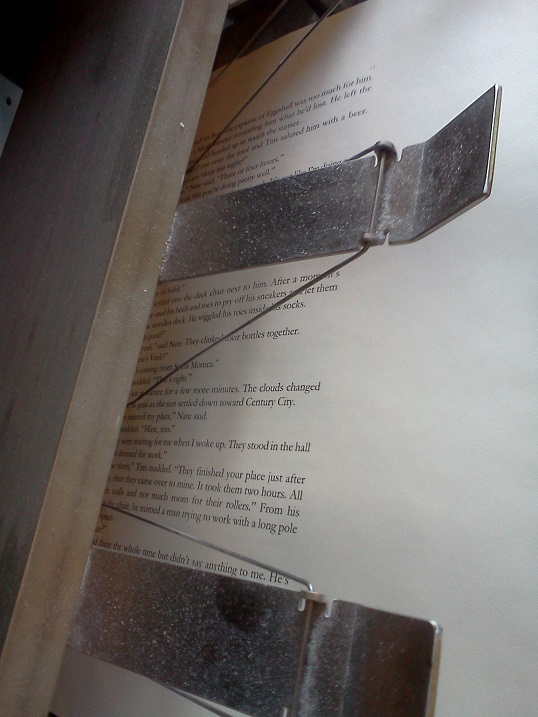
            First off, the machine is a bit more cobbled-together looking than you might expect.  The front is a terminal.  The back looks a lot like an oversized photocopier, the type you’d find in an office or Kinkos.  In between is a glassed-in section with robot clamps, hydraulic blades, and shifting platforms that assemble the book. It’s kind of like a computer and a printer having a threeway with one of the robots from Tony Stark’s workshop.
            So, Brendan ordered a copy of 14 for me.  It’s not a book that’s stored on the machine’s hard drive, so it takes a few minutes just to download that file (they’re kind of big). 
            It’s also worth noting that this download costs almost nine dollars.  This is where pricing comes into play.  The final cost of the book is based off download costs (if any), raw materials (the Espresso machine goes through high-end paper just like a copier, so big books cost more than small books), and the store’s profit margin.  In the case of 14, this actually means the final book ends up costing just shy of $19.00 through the Espresso (four bucks over the publisher’s suggested retail price).  There are lots of public domain books that are inexpensive, though, and it also works well for some of their more direct publishing relationships (local authors, local schools and colleges).
            The cover gets printed first.  It’s usually getting the most color and it’s on glossy paper.  It ends up face down at the bottom of the assembly area.
            Then the machine starts printing pages.  It’s just like watching a copier or high end computer printer.  And, just like these machines, sometimes there are mess-ups.  One page comes out just a little off, as does the next and the next and the next, and suddenly instead of a neat stack of paper there’s a broad fan.  This actually happened on the book the machine was printing right before mine.  Brendan had to pause everything and shuffle things back into place.  He does try to check on the machine while it’s working, but every now and then something sneaks by.
            Once the pages are all printed, the next step is the gluing.  The manuscript is squeezed together and the machine paints a stripe of hot glue along it.  Then the whole thing is pressed down into the cover, which is pressed down into a gap in the floor of the machine (again, all of it shifting and adjusting in a very Iron Man way).  The robot arm presses from above, the gap clamps tight from below, and the pages are glued into the cover.  On rare occasions the machine puts down too much glue and makes a mess of things, and if that does happen it could mean starting over.
            Once the glue’s been given a few minutes to dry, the machine moves on to cutting.  All of this is printed on 8 1/2” x 11” paper, so it needs to be snipped down to size.  The arm spins the book, a new opening appears in the floor of the machine, and a hydraulic blade shears off the excess material.  It’s kind of scary how effortlessly the machine cuts through almost 200 sheets of paper.  The book’s rotated and cut until all the page measurements are correct.
            And that’s it.  The arms carry the book over and drop it out a slot on the right side of the machine.  At the end, it took just shy of fifteen minutes from placing the order until the finished book pops out.
            For the record, the book on the right is one of the regular copies available through Amazon.  The book on the left is the one Brendan printed up for me.  They’re not identical, but they’re pretty close.  It is interesting to note that the cover on the Espresso copy has notably faded, just in the two months since I bought it (originally there was almost no difference).
            Final thoughts…
            The Espresso Machine’s pretty damned impressive, especially when you consider this is a first-gen machine.  It’s not as smooth, simple, and flawless as we were all led to believe, but it’s not far off from that, either.  I’d compare it, technology-wise, to the grocery store self-check out terminals, the ones that at first still needed a clerk standing right there to deal with the issues that kept popping up.  In just a few years, those stations have made some leaps forward, and it’s not hard to believe the Espresso Machine’s going to do the same thing.

Counting down to the announcement of the new Doctor Who.

Or should it be, counting down to the screams of rage and wails of sorrow…? 

July 26, 2013 / 1 Comment

Comic Con Recap

The San Diego Comic-Con was pretty amazing.  My first year going as the guy behind the table—which really changes your view of it, I learned.  I crashed with friends in San Diego for a few days, and then Crown put me up in a hotel by the con for part of it.  
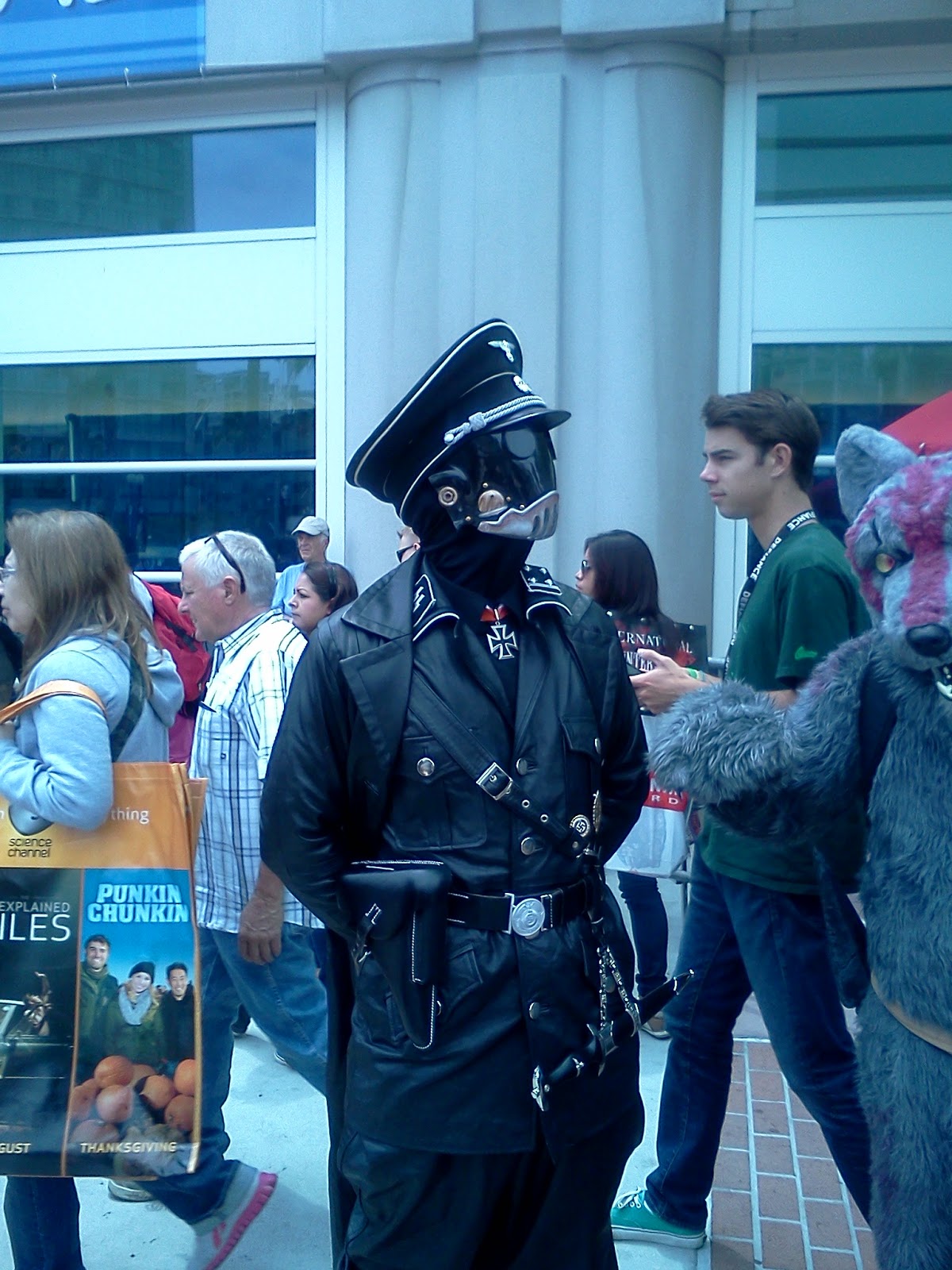
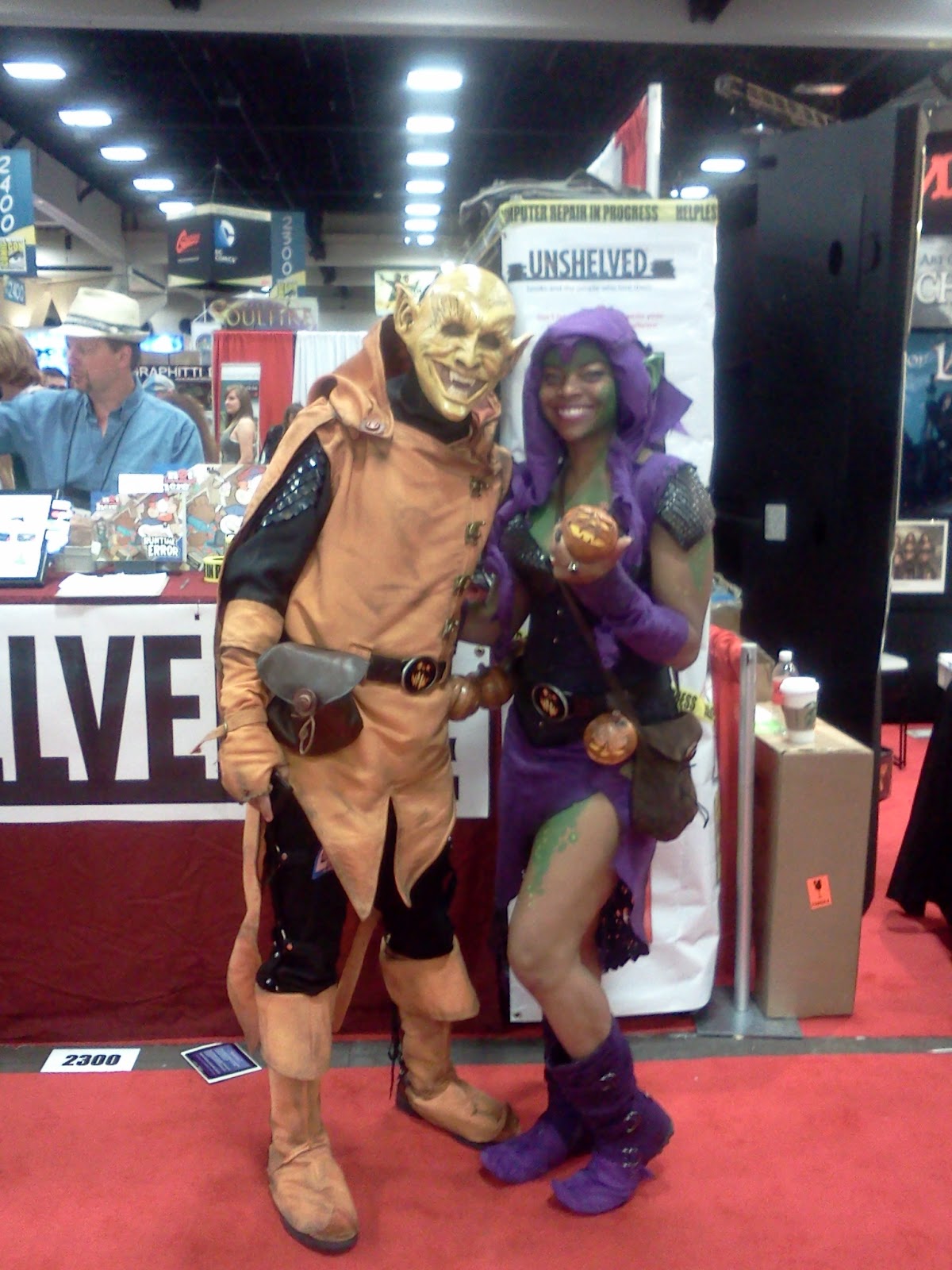
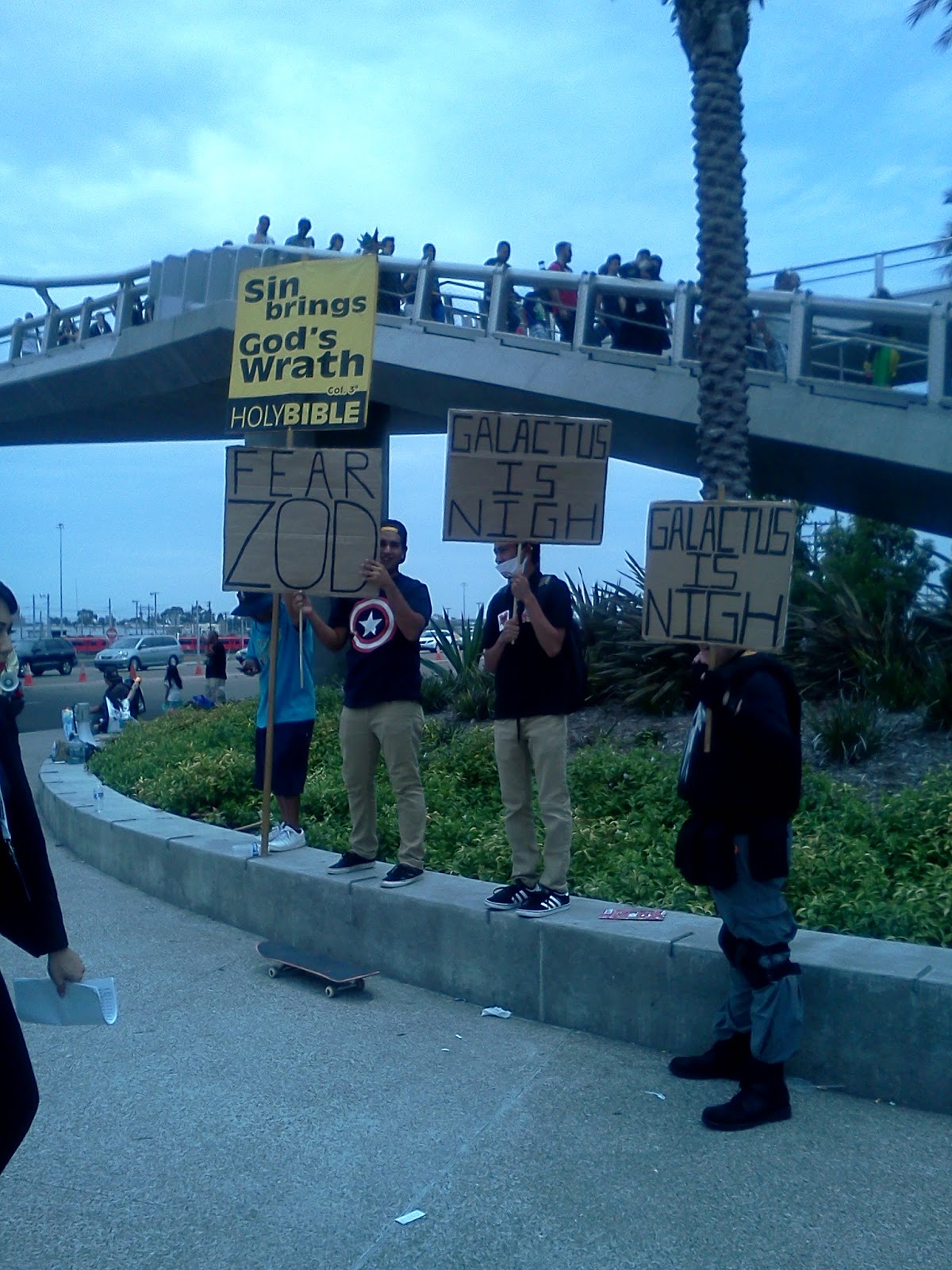
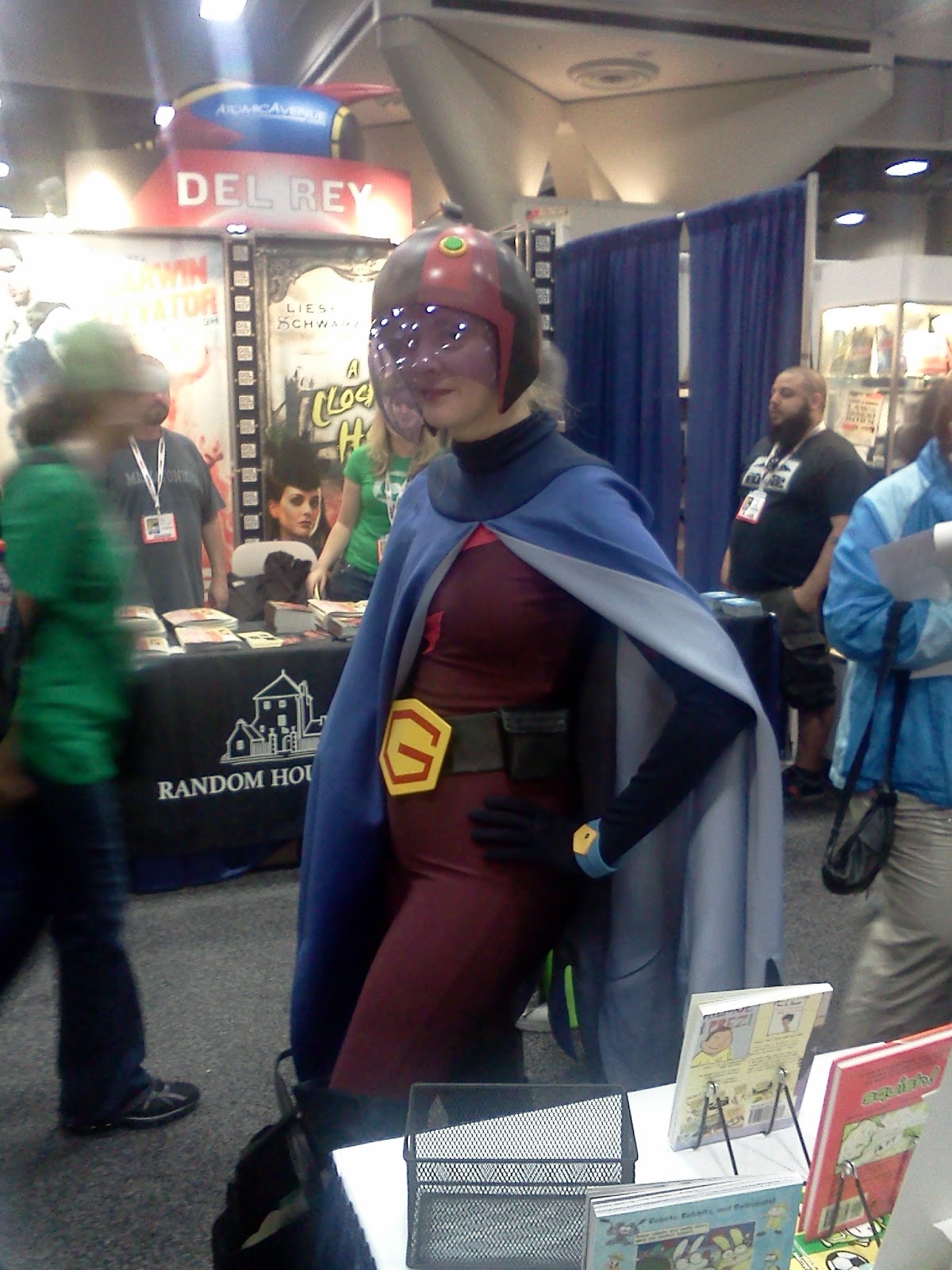
So here are a few of the random high points, as I remember them.  And a couple pictures of random folks/things, too, just so you’ll keep scrolling down.
  
Wednesday – I came down a day early so  there’d be no stress, so I woke up in San Diego.  My friends and I headed over to the convention hall around four to pick up our badges.  Then we killed time at the Spaghetti Factory bar until the doors opened.  I make my first attempt at a Webarella doll for my niece, but on preview night it turns out they’re only selling to people with regular badges—no pros or vendors.  Curse my professional status!  I drown my sorrows in model robots.  Check out Robot4Less—they’re cool.
Stopped by the Random House aisle and the Crown Publishing booth, where I finally met my editor and publicists face to face.  Chatted a bit.  Pre-signed a few books.  Then went back home with my friends to watch Sharknado.
Thursday—The first full day of Comic-Con, and I had free reign for most of it.  I wandered a lot.  Made another run for Webarella, but they’d sold out of their day’s allotment in under an hour.  Doubly frustrating when you saw all the folks walking around with shopping bags full of the dolls.
Checked out lots of booths.  Had lunch with Rick Marson, creator of ZOMS and Katie Cord of Evil Girlfriend Media.  Later in the day I met Bill Barnes who draws the Unshelved comic strip (they did a fun Ex-Heroesreview in comic-strip form a few months back).
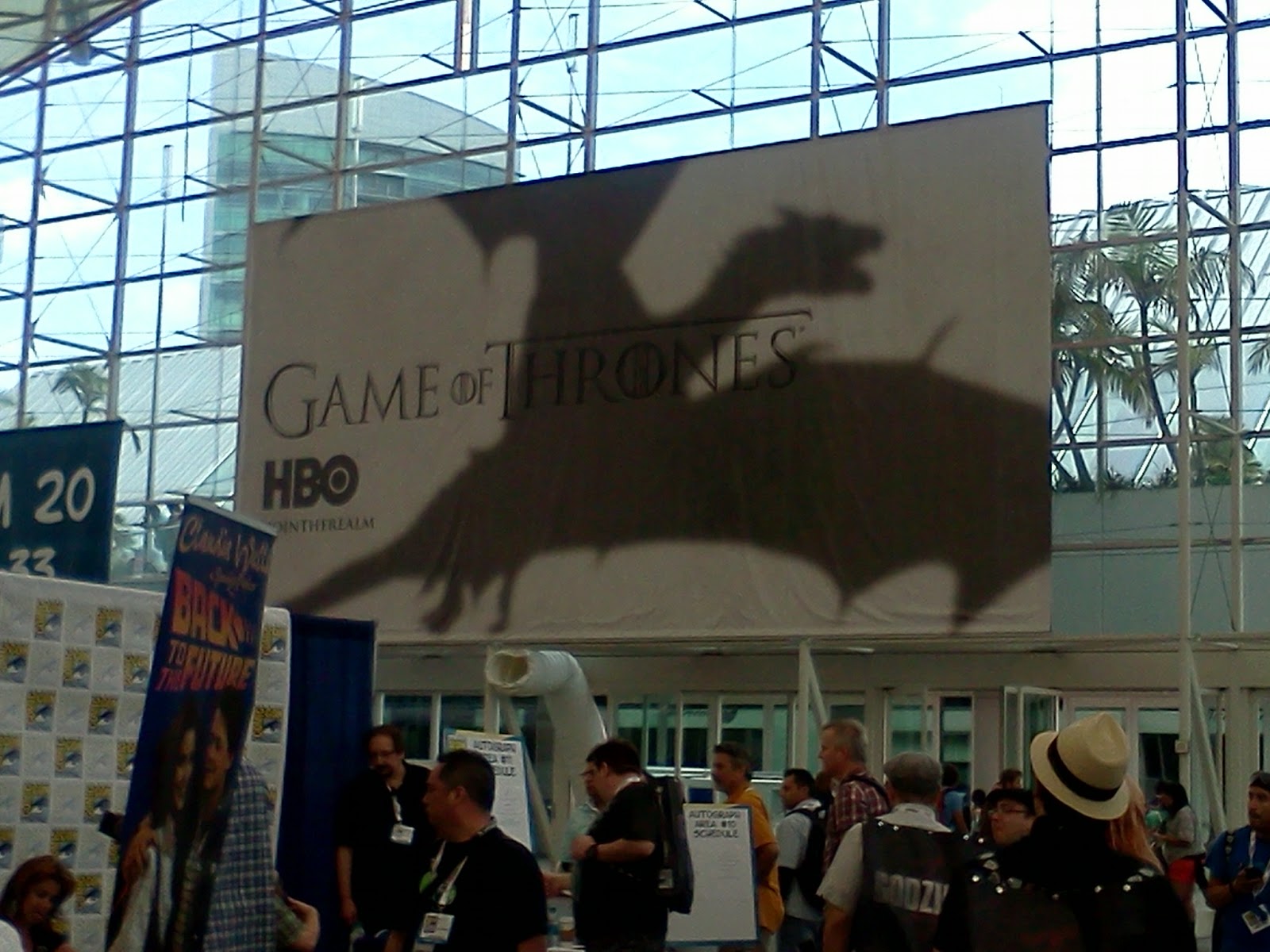
That night was the Random House party.  There’s an embarassing story about me changing for the party in my friends’ car, but it won’t be told here.  Met Peter David,  George R.R. Martin, and also fellow Crown authors Scott Sigler (Pandemic) and Peter Stenson (Fiend).  I also got free drinks served to me by a woman dressed as Daenerys Targaryen (the bar was doing a Game of Thrones theme for Comic Con) while pictures of my book covers (and several other people’s) flashed up on screens around the bar.

Friday – I got to check into my room at the Hyatt.  There are definite perks to being a big press author.  It was also nice to have a place to dump things.  And then I got to go find that Webarella had sold out again.  Saw a jackass offering to sell them at 400% markup right there at the con.
I did a panel with a few other authors, then a signing where I met a few folks.  Talked briefly with Max Brooks (World War Z) at the Crown booth.  Then I moderated a panel with several costume illustrators (who worked on some amazing stuff).  After I dropped off some stuff in my room, it was up to the Top of the Hyatt for drinks with friends while we watched the sunset.  And then down to Seaport Village for dinner with all the Crown folks, including Scott and Peter.  Much smaller than the previous night’s party, and we end up talking about books, publishing, and similar things.  Which led us back to the Top of the Hyatt for more drinks (drinking, you may notice, was a recurring theme). One of the publicists came up with the idea of trading badges so I could get into the hall before it opens and finally get the Webarella doll.  
           

It was very nice to just take an elevator back to the room after all that, kick off my shoes, and scribble a few story notes on my legal pad.

Saturday – My last attempt to get Webarella met in failure.  Con security finally decided to stop other vendors from lining up before the doors open , but they only did a half assed job at it so vendors just lurked in the area.  And then doors opened and Mattel announced they’d changed their criteria, too—no selling to vendors (so my badge is now preventing me from getting the doll).  I slink back to the Crown booth, broken and defeated.
After meeting a few more folks and signing a few more books, I head over to Nerd HQ for lunch and to hang out “off campus” for a while.  Met up with a few folks, had a great turkey sandwich ( I was ready to gripe about the price, but this thing was huge), and missed one die-hard fan (you know who you are) by about ten feet.  Then it was a race back to the Crown booth for my first official signing there.  Met lots of people.  Signed lots of Ex books (I think close to sixty or seventy in a two-hour period) and even a few copies of 14.
Finished up the day having drinks with my agent and editor, talking about future projects.  Then ended up having more drinks at the Top of the Hyatt until… way too late.  Again, thank God the hotel room was right there.
Sunday—One last visit to the Robot4Less booth and then I was back to Crown.  After listening to me grumble every time we ran into each other, Katie from Evil Girlfriend came through with some extra Monster High swag for my niece.  I met a bunch of folks, signed another few dozen books, and the con closed.  Final estimates said over 200 books signed, and both Crown and the nearby Mysterious Galaxy booth both pretty much sold out.  I helped pack up a bit, said my goodbyes to everyone, and then wandered to an undisclosed location downtown, where I was picked up by a man in a dark car…
I was so exhausted that when I got back to my friend’s house I collapsed almost immediately on the couch.  A few of us tried to hang out for a bit, but four days of very little sleep and too much going on finally caught up with me.
Monday –I watched a few countdowns on the Chiller channel with my friend Marc while we talked about geeky stuff, ate lunch, and then I drove home to Los Angeles. There was, thankfully, much less traffic than there was heading down
And now I can’t wait until next year…

Categories