If you’ve been following this ranty blog for any amount of time, you’ve probably heard me mention Shane Black once or thrice. For those who came in late, he’s one of the men behind the million-dollar spec-script boom 20 years ago. You might know him as the writer of films like The Monster Squad, Lethal Weapon, The Last Boy Scout, and The Long Kiss Goodnight.
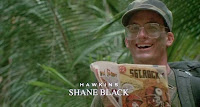
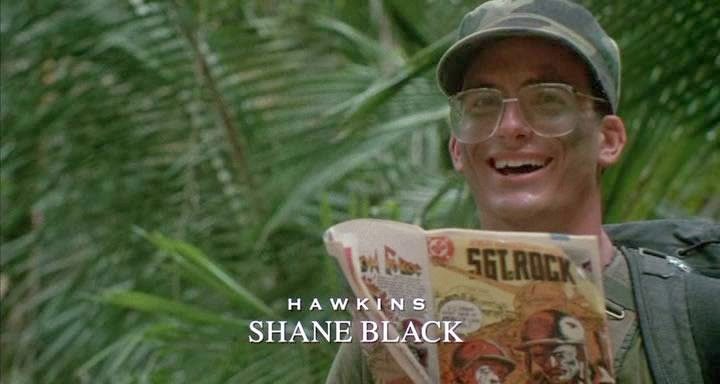
(Supposedly, an unwritten part of his deal for Lethal Weapon was getting to be in an action film, so the studio stuck him in some stupid alien-fighting-bodybuilders-in-the-jungle movie that no one was going to see–never expecting Black would rewrite all his dialogue to become one of the most memorable characters in the film…)
He took some time off from Hollywood and then returned a few years back as the writer-director of the award-winning Kiss Kiss, Bang Bang, which propelled Robert Downey Jr. back into the public eye. Then the two of them got together again for this summer’s Iron Man 3, which Black directed and co-wrote.
Anyway, back when I used to write for Creative Screenwriting, Black was kind of a Hollywood legend as a person and as a writer. So when the editor of CS Weekly asked us for December article ideas, I tossed out doing a general interview with Black. After all, the man’s set almost every movie he’s written at Christmastime—he had to have something to say about it. My editor agreed it would be a neat thing and put out some feelers, and we both kind of forgot about it. We were a very small, niche film magazine, and he was… well, he was Shane Black.
So when Black wrote back in less than a week and said “Sure, let’s grab a coffee or something,” you can imagine the squeals of glee.
Alas, reality hit just as quick. At this point the magazine was starting to struggle financially and my first novel, Ex-Heroes, wasn’t going to see print for another three months. The squeals of glee faded and I suddenly realized I couldn’t afford to grab a coffee. Hell, I wasn’t sure I could afford gas to drive to a Starbucks to meet him. After the shame faded, I wrote back with some lame excuses about sound quality and not wanting to waste his time. We set up a phone interview and I missed my big chance to hang out with Shane Black for an hour.
Fortunately, he was very pleasant and gracious on the phone, and it was one of those conversations where I felt like I learned more about storytelling in forty-odd minutes than I had in some college classes.
A few of the usual points… I’m in bold, asking the questions. Keep in mind a lot of these aren’t the exact, word-for-word questions I asked (which tended to be a bit more organic and conversational), so if the answer seems a bit off, don’t stress out over it. Any links are entirely mine and aren’t meant to imply Mr. Black was specifically endorsing any of the ideas I’ve brought up here on the ranty blog—it’s just me linking from something he’s said to something similar that I’ve said (some of it inspired by this conversation).
By the very nature of this discussion, there will probably be a few small spoilers in here, though not many. Check out some of his movies if you haven’t already seen them. They’re clever, damned fun, and filled with fantastic characters.
Material from this interview was originally used for a “From The Trenches” article that appeared in the December 18th, 2009 issue of CS Weekly.
So, anyway, here’s me talking with Shane Black about Santa, Christmas, storytelling, and Frankenstein in the Wild West.
Happy Holidays.
Were you a big fan of Christmas specials and movies growing up? What are some of your favorites?
Well, it’s interesting. I watch all the old Christmas movies and I like them for odd reasons. Like It’s A Wonderful Life. It’s a Christmas movie, but within it they have a lot of bizarre, Capra-esque touches that are more indicative of just life. The scene where the gym starts to open–the floor starts to pull back and there’s a swimming pool underneath. Someone falls in and then everyone just jumps in the pool. That moment is as fresh today as it was back then. That kind of crazy improv moment where everyone starts laughing and jumping in. Even as a kid I was struck by that. “Wow, that’s a different kind of moment than most movies. That feels like it just happened almost by accident.”
My favorite Christmas film is probably this Spanish Santa Claus movie. It’s called Santa Claus and I even used a bit of it in Kiss Kiss, Bang Bang. Basically, Santa Claus fights the Devil. The Devil tries to stop Christmas. There’s this one scene where he just runs around the room doing gymnastics. You’ve got to see it. You’ve got to pick it up and look at it— The Devil’s this really athletic, slightly gay-looking guy who can blow flames through a phone line. If he calls you on the phone, flames come out the receiver and they singe your ear. That’s probably my favorite. Santa’s really lame and the effects are terrible.
My other favorite was called Santa Claus and the Ice Cream Bunny. There’s no snow. It was filmed in Florida in broad daylight. Santa’s sled is stuck because there’s no snow, and they’re all waiting for the Ice Cream Bunny. While they’re waiting Santa tells all the kids the story of Jack and the Beanstalk, which takes roughly 50 -75 minutes. At the end of which the Ice Cream Bunny shows up and everyone says “now we’re safe.” I can’t believe some of the frauds–even as a child–that were perpetrated on me (chuckles). It’s pretty amazing.
About half your films have been set at Christmas. I know your first script, Shadow Company, was originally set at Halloween, and then you rewrote it as Christmas in a later draft. Why?
Yeah. Christmas for some reason… Even though it’s a worldwide phenomenon I always associate it with a certain kind of American way of life. It’s also sort of a hushed period, during which, for a period of time, we agree to suspend hostility. I’m always fascinated by the almost palpable sense in the air that something’s different at Christmas.
If you look at a tipping point scenario– how many people does it take to start a standing ovation? Just one. And then in five seconds two other people, then three, then four, then 75,000 are clapping. Because the tipping point is as simple as one person pushing in that direction. And it can go ugly just as easily. It can go the other direction. One person starts to get out of hand and then everyone’s out of hand.
So Christmas to me represented the best we have in terms of keeping things on that side of the dial. A period in which, for whatever reason, the tipping point was more likely to bump into someone on the street and have them say “Oh, hey man, my bad,” then to have him say “Fuck you, buddy! Watch where you’re going!” That was remarkable to me.
Also in California, Christmas, if you look at it as a substance almost, as a thing more than an idea, Christmas exists out here in California but in these indescribably beautiful ways to me. You have to dig for it. It’s not a 40 foot Christmas tree on the White House lawn, it’s a little broken, plastic Madonna with a flash bulb inside hanging off a Mexican lunch wagon. It’s a little strand of colored light in some cheap trailer in the blinding sunlight, but it’s still protesting its Christmas-ness. I adore little touches of Christmas that indicate subtly… It’s like talismans. You walk around and these are the magic. These are your touchstones. Little bits of Christmas that remind us that this doesn’t have to be a blinded, blighted, sun-washed, hostile place to live. Christmas has always had that magic ability to me, to exist almost like a magic substance that you find little bit of if you dig carefully enough for it. I know that sounds kind of crazy.
No, I’m intrigued. When did you develop this view? Was Lethal Weapon set at Christmas because of this or did the… the philosophy of Christmas develop along the way?
 Along the way. Well, Lethal Weapon is a Frankenstein story to me. It’s a guy who’s a monster of sorts, who sits in his trailer and watches TV. People despise him, they revile him, because… it’s like a western. They think the west is tame. They think they’re safe and secure in this sedentary little suburbia. This sort of lulling effect that whatever violence and terror are in the world, we’ve managed to secure ourselves from it. But he knows different. Frankenstein in his trailer, he’s been with violence, he’s lived violence. He knows that its still there. The west is not tame, it is not gentrified. When violence, in Lethal Weapon, comes to the suburbs and takes this guy’s daughter and kills cops, they go to Frankenstein and say “Look, we hate you for what we do. We think you’re an anomaly at best and a monster at worst, but now we need you because you’re the only one who understands this. We’ve gotten hypnotized by tranquility. We forgot that violence is still there, and you’re the one who can deal with that, so now we need to let you out of your cage.” That was the idea. Christmas, it seemed to me, was the most pleasant, lulling, hypnotizing atmosphere in which to forget that violence can be so sudden and swift and just invade our private lives.
Did you actually study screenwriting?
Nah. I took theater classes at UCLA. I was studying stagecraft and acting. It was a Mickey Mouse major. y finals often were painting sets, y’know? It was kind of a cakewalk though college. I took all the requirements– I liked theater, I liked movies, but I’d never seen a screenplay and I thought they were impossibly difficult. Coming from back east I just assumed movies were something that floated through the ether and appeared on your TV screen and some magician wrote them, but there was certainly no way I could. Then I read a script and it was so easy. I read another one and said “I can do this. This is really rather simple.” So I never took classes, I just read scriptsI loved.
My style, such as it is, that sometime people comment on, is really cribbed from two sources. One is William Goldman, who has a kind of chummy, folksy, storytelling style. It’s almost as though a guy in a bar is talking to you from his bar stool. And then Walter Hill, who is just completely terse and sparing and has this real spartan prose that’s just punchy and has this wonderful effect of just gut-punching you. I took those two and I slammed them together, and that’s what I use. People say it’s interesting. Mostly it’s a rip-off. It’s Goldman meets Walter Hill.
Did you always write like this or are there some older Shane Black scripts that will never see the light of day?
No, the first scripts I wrote were scripts I wrote after I decided to go out and see what they look like. So I picked up William Goldman, I picked up Walter Hill, and then I wrote Shadow Company, which even on the page, the ’84 version, looks exactly like a Goldman script. Lethal Weapon, it’s pretty much in the style of those two writers. Material aside. Material is different, I’m talking solely about the style on the page and learning the logistics of how to do it. Those two were my mentors. ater mentors were people like James L. Brooks, who taught me an amazing amount, and Joel Silver, of all people, qualifies as a mentor.
How do you generally write? Do you use outlines or notecards or just start cranking it out from page one?
I don’t really use notecards. What I do is I try to figure out what the piece is about and link that to the story arc or the character arc. I always think there’s two things going on in any script–there’s the story and then there’s the plot. The plot is the events. If it’s a heist film, it’s how they get in and out. But the story is why we’re there, why we’re watching the events. It’s what’s going on with the characters. And theme above that. Once I get those things, once I know what the theme is and what it’s about, I can start trying on story beats and plot beats to see if they feel like they’re moving, but they have to relate to the overall theme. If you look at The Dark Knight, you’ll find before those guys wrote a word of script, they knew exactly what their movie was about. All the themes were in place. Sometimes they has to bend the scenes in The Dark Knight to fit the theme they were trying to get across. It’s clear they didn’t write the scenes and then look for what they were about, they clearly knew where they were headed. So thematically I get a sense of what the movie’s gotta be, but I don’t use notecards.
I can juggle a lot in my head. I can’t get more than say, twenty pages, without planning ahead.
How long does it normally take you to get a first draft of something?
I try to keep by studio standards, which is three months. They give you three months from commencement pay to final payment, and I think that’s enough time if you really work at it. We did a draft that I really loved, and it did not make the screen, of Last Action Hero, my partner and I. We did that in six weeks and I was very proud of that. From sitting down with this original screenplay and completely rewriting and retooling it. We were good, we were fast.
You mentioned your partner. I know you worked with Fred Dekker for a while–have you gone back to writing with a partner?
Lately just to facilitate things. It takes me so long to think of ideas and so long to convince myself to get to work, and there’s so much fear involved. Writing to me is a process of just desperately trying, on a daily basis, to concentrate until something becomes more interesting than my fear. Then you’re sucked in and you start doing the work, but up ’till then it’s just horrifying to me. So if I can have help, if someone’s in the sinking boat with me, even if we’re both going to drown, at least there’s a comfort to not being alone. I’ll write the next one solo.
Now, you took time off, came back with a new script you shopped around, and nobody knew who you were. That was Kiss Kiss, Bang Bang, right?
It was. Most people would have nothing to do with it.
Did planning to direct it change how you wrote it?
No, I thought about that. That was when I was dealing with Jim Brooks. He basically said “You don’t need to worry because you direct on paper. You don’t call shots, but you call mood and you call progression and pace and emphasis and just about everything else.” So I may have even done a little more of that on Kiss Kiss, Bang Bang.
Now that you’ve sat in the director’s chair, has it changed how you approach a script?
No, except I’m even more conscious of what will later be shoe leather. The greatest shoemakers in the world supposedly can make a pair of shoes and leave no [extra] leather. They didn’t waste any. I’m very conscious now as a director. If you’ve got two scenes, like a newscaster and a scene before that of a conversation, can’t you have the conversation with the newscaster in the background and do it in one? It’s just shoe leather. No shoe leather.
It’s probably safe to say a lot of people have offbeat movies they watch this time of year, and a bunch of them are probably your movies. Is there anything unusual you like to watch at the holidays?
Oddly enough, every year about this time, for no reason I can fathom, I watch The Exorcist, my favorite movie [chuckles]. Every year I’m reminded of how it doesn’t age, not one single day. It’s as riveting as it ever has been.