September 5, 2016

Writers Coffeehouse

            Hey, everybody…
            Hope you’re enjoying your Labor Day, even if you’re not in southern Califonia.  And if you do happen to be a SoCal resident, I wanted to remind you that this coming Sunday, the 11th, is the second Sunday of the month—which means it’s time for Los Angeles Writer’s Coffeehouse. 
            We’re going to be at Dark Delicacies in Burbank from noon to three (as always).  It’s completely free and it’s open to everyone—writers of all ages and skill levels.  You can be just starting out, halfway through your first project, a seasoned pro, or a complete hack like me. 
            This time around we’re going to be talking about drafts and editing, and also about working with editors in general.  Please feel free to show up with your questions, your own thoughts, and your clever ideas and tips.
            I’m moderating, so it’ll be highly adequate, as always.
            Hope to see you there.
September 2, 2016 / 3 Comments

Let’s Go, Voltron Force!

            Pop culture reference!  Hasn’t been one in ages.  This one’ll make sense in a few minutes.
            I wanted to take a moment to rant about one of my favorite topics—spelling.  Any of you longtime readers know how I feel about misspelled and misused words.  But this week I’d like to approach a specific facet of that problem.
            One thing I see a lot is folks who misuse compound words.  If, for some awful reason you don’t know, a compound word is when you mash two words together and create a new word. And much like the lions that merge into Voltron or the Combaticons combining into Bruticus, sometimes that word is greater than the sum of its parts.
            In fact… sometimes the word is very different from the sum of its parts.  For example, a kneecap is a floating bone in your leg that protects the hinge joint.  But a knee cap is a little hat you wear above your calf.  By extention, kneecapping is the brutal practice of breaking that bone, usually with a bullet, while knee capping is the weird and somewhat creepy habit of putting tiny headgear on other people’s joints.
            Or your own joints, I guess.
            But that almost makes it weirder.
            Want another one?  Whiplash is a condition caused by a sudden thrashing of the neck.  A whip lash can refer to either the leather straps of the whip or the whip’s actual strike.  Like in Pirates of the Carribean,when Davy Jones threatens Will Turner with five whip lashes.
            See the problem here?  The compound word and the phrase refer to two different things. And if my reader has even a faint grasp of vocabulary, they’re going to stumble over my un-compounded word and go back to read it again.  I might know what pissantmeans, but if I come across piss ant… well, is that one of the creepy crawlies from Chuck Wendig’s new book?
            Take a look at a few more of these and see if you stumble on any of them…
straitjacket vs. straight jacket
something vs. some thing
hardcore vs. hard core
breakneck vs. break neck
kingpin vs king pin
connectability vs connect ability
maybe vs. may be
lovesick vs. love sick
sometime vs. some time
            Did you feel it?  That little pause when you were reading?          How many of these did that to you? A few?  Some? If you’re reading this, I’m guessing you’ve got a thing for writing, so maybe a lot of them.
            Y’see, Timmy, once I break the compound word apart, it’s… well, two words. And as long as those two words are spelled correctly… well, that’s all that matters, right?  Most people will get the general meaning from context.
           I think folks do this because they don’t know how to spell the compound word correctly and break it apart to “fix” it.  Maybe my spellchecker kept rejecting straightjacket but once I broke it into two words… oh, well that must be right now.  It’s one of those cases where I’ve assumed the machine is much smarter than I am.
            But that flow-break becomes even worse when people aren’t even using the right words.  I’ve seen people talk about mere cats in Africa and the turn styles in the New York subways.  My spellchecker will accept those, too, just like it will any other misused word.
            Hyphens don’t help the situation.  Most spellcheckers will accept a hyphenated word as correct if the two individual words are correct.  For example, mistake, missed-take, miss-steak, and mist-ache are all spelled correctly.
            The real problem here is that—like any spelling mistake—these sort of mess-ups will break the flow of my story.  If my reader spends just two seconds trying to figure out what liberated bricklayers have to do with an urban fantasy story, they’ve stopped reading in order to analyze.  And once they start analyzing… it’s hard to get them to stop.
            And yeah, a lot of folks will almost immediately figure out that when I said free masons I actually meant the Freemasons—that semi-secretive service organization that so many hack writers use as a fallback source for historical mystery (check out my new book, Paradox Bound, coming out next September). 
            But…
            That pause is still going to happen.  After three or four instances of breaking the flow like that, the reader’s going to set my book aside for something easier to understand.  Like an Overwatch hint guide. Or a rewatch of Stranger Things.
            I need to know how words work. Including compound words. Knowing the two halves doesn’t mean I know the whole, and vice-versa.  I have to know how words work. And what they mean.  And how to spell them.
            In closing, being able to proofread something is a skill every writer needs to develop.  But anyone can proof read… provided the proof is in a language they understand.
            Next time, I want to talk about that guy.  No, no,not him. The other guy.
            And I’ll probably have an update on the whole Amazon review thing, too.
            Until then, go write.
August 25, 2016 / 3 Comments

Sucker Punched

             Grrrrh. Running behind again. Sorry.  Juggling too many things right now.  Honestly, I think I’m thinking about juggling too many things and just being hit with a paralysis by analysis situation…
            Anyway…
            Speaking of things that aren’t immediately apparent, I wanted to talk about a problematic character point for a moment.  It’s one I’ve stumbled across a few times (and fallen victim to once or twice myself), and once I worked out exactly why it was problematic, I thought it was worth mentioning.
            A few quick examples…
            I saw an older movie recently from the dark era of superhero films. You know, that time before Blade when studios (and writers, and directors…) really didn’t believe you could do a serious superhero movie. Well, not without changing everything about it. Play it more for laughs.  Minimize the costume.  Avoid logos. Avoid masks.  Absolutely no capes.
            Really, how could you hope to do a movie about superhero characters who wear masks and capes and get anyone to take it seriously?
            Anyway, this film had a scene where the superhuman hero waded into a minor gang war while wearing his street clothes.  To be clear, at this point, the hero knew the full range of his abilities. Super-strength.  Near-invulnerability. Enhanced reflexes.  So the bad guys were throwing themselves at this skinny guy and ending up with bruises, cracked knuckles, broken limbs, maybe even one or two concussions in there.  By the time they figured out something wasn’t right, the hero’d probably sent a dozen of them to the emergency room.
            Here’s another example from the book side of things.  As usual, names, genders, and genres have been changed to protect the innocent.  Or maybe they haven’t, just to throw you further off the trail…
            A friend of mine had been doing a western horror story recently and asked me to take a look at his current draft.  His main hero, Wakko, was a pretty solid gunslinger/sharpshooter type (yeah, named his lead Wakko—weird coincidence, isn’t it?).  At one point, Wakko and the other heroes find themselves taking refuge in an old frontier fort that’s run by some less-respectable types. Wakko wanders around and finds the local tough guy, and inwardly notes a few things that confirm the guy may have been the best in the fort, but that doesn’t mean he’s particularly good.  To prove it, and make a point, Wakko teases and insults the other guy until he finally leaps up, grabs for his pistol
            And Wakko flicks out his own gun and shoots the guy dead.  Justified, of course.  That guy was trying to draw.  Everyone saw it.
            I made a note that this scene didn’t make Wakko look particularly heroic.  In any sense.
            This sort of thing is a hustle.  A con.  If you’ve ever played pool, nothing annoys people more than to discover the cute “rookie” who tricked them into wagering everything on their third game is actually a pool shark with countless notches on her belt.
           One thing about a hero—in real life or in a literary sense—is that we expect a sense of fairness and general decency from them.  They shouldn’t abuse their power.  They won’t deliberately harm people.  Yeah, they might have to do awful things at some point, and they might not hesitate to do them when they need to, but it won’t be something they want to do.
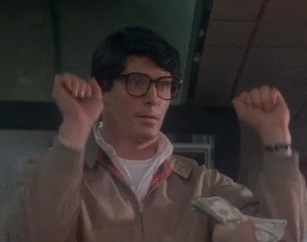
            Y’see, Timmy, a superhero in regular clothes is… well, just a dick.  Yeah, even when it’s Christopher Reeve.  Let’s be honest, that was a cheap move, beating up that guy in the diner.  A green beret who goads people into taking a swing at him is also a dick.  Or a gunslinger who forces somebody into a quickdraw contest.
            Honestly… it’s a bully move.
            Now, when my villain (or just a general antagonist) does something like this, it often works well for my story.  How often have we seen our hero throw a punch or kick or hail of bullets that had no effect?  What appears like a minor obstacle  just became a much more serious challenge for my heroine or hero to deal with. And challenges are great.
            But bullies aren’t.
            Especially when they’re supposed to be my protagonist.
            Next time, I wanted to talk about some thing.
            Until then, go write.
            Hey, a quick bonus post or Writers Coffeehouse folks.  Or any of you who are interested in such things…
            One of our Coffeehouse topics this past weekend was querying agents, and I told the folks there about how I actually got attention from two fairly well-known, high profile agents because I had a good query letter and could talk like a professional in one-on-one meetings. And I thought it might be useful to some folks to have said letter as a rough template.
            Ironically, the book I was querying with was The Suffering Map, my early novel that I use so often here as an example of how not to do things.  Seriously, I use it so often there’s a tag for it.  A big one.  You could figure out a lot of the book  just by reading about all the elements I screwed up in it.
            Anyway…
————————
                                                                          May 15th, 2003
                                                                          My Old Address
                                                                          San Diego CA 92116
Name
Agency
Address
New York NY
Ms. ########,
            If you could travel in an instant to anywhere, or any-when, in the world, where would you go?  Now, what if there was a price?  What if each journey submitted you to a nightmare of pain and torture before you arrive, unharmed, without a mark on you, at your destination.  Getting there is not half the fun.  So why would Rob Fable do it a second time?  Or a third?  And what would happen if he got addicted to it?
My novel, THE SUFFERING MAP,  is a suspense/ horror novel that also involves a great deal of mythology, history, and a sprinkling of pop culture.  It’s set in my home city of San Diego, and the title refers to a mysterious device, found (well, stolen) by Rob, which allows him to travel while submitting him to the whims of a being called Bareback.  It also brings him into contact with Sondra, who develops an unusual bond with the Suffering Map, and Gulliver, who has his own plans for the mechanism….
        Rob comes to realize the financial potential of the device and travels with it more and more.  When he discovers some of the historical results of using the Suffering Map, though, he finds it isn’t that easy to stopusing it.  In the end, Rob must come to terms with his addiction to the ancient machine as his friends try to save him and themselves, for Bareback has his own plans, and the power of history is on his side.
            I would like to send you either the full manuscript of The Suffering Map (approximately 120,000 words), or some sample chapters and a synopsis, at your preference.  Please find a SASE enclosed for your convenience.
                                                                          Sincerely,
                                                                          Peter Clines
———————–
            So, look at what we’ve got here. First off, it’s short and simple–one page only.  I introduce the four major characters and explain the title.  Also notice that while pretty much the whole thing is talking about the story–this could almost be a back of the book/inside flap description,  I also slip in a bit of humor (okay, maybe he didn’t find the Suffering Map…) and some credentials (I’m not just writing about a city I’ve never been to or visited once).
            I wrap it up with a professional closing.  At the time this particular agent hadn’t set out firm guidelines past “query first,” so I suggested some options, each one showing that I have an understanding of the process.  By offering the full manuscript (with a word count) I’m confirming it’s done, and I have an idea how long such a book should be.  Offering a synopsis implies I either have one ready or know how to prepare one.  And all of that helps show that I’ve got an idea how to use words to convey ideas.  Y’know, like a writer…
            One more thing. The little device of asking questions—good, semi-rhetorical questions—encourages people to consider answers.  So even though I address these questions a bit later (to some degree), I’m still leaving room for the agent to wonder about what the answer is. The Suffering Map, as implied, has a mystery element to it, so questions worked well for me. YMMV.
            However… I hear that “asking rhetorical questions” has been getting used in queries a lot lately, and the device is bordering on gimmicky.  Most agents hate gimmicks, because even though it may be new and clever to me, odds are they’ve seen it a hundred times.  This week.  Some might just roll their eyes and keep reading, for others it may be a dealbreaker.  So be cautious with gimmicks.  Or something that may be bordering on gimmick-hood.
            And, again, please don’t forget—this is an example of what worked for me. Your individual query letter needs to reflect your book and your skills as a writer, so copying this and making minor tweaks won’t really help.  This is just a guide, so when you’re talking about your book you’ll have a sense of what to say.
            On our regularly-scheduled Thursday post, I wanted to talk about sucker punches.
            Until then, go write.
            And if you’re at that stage… query.

Categories