November 23, 2016 / 1 Comment

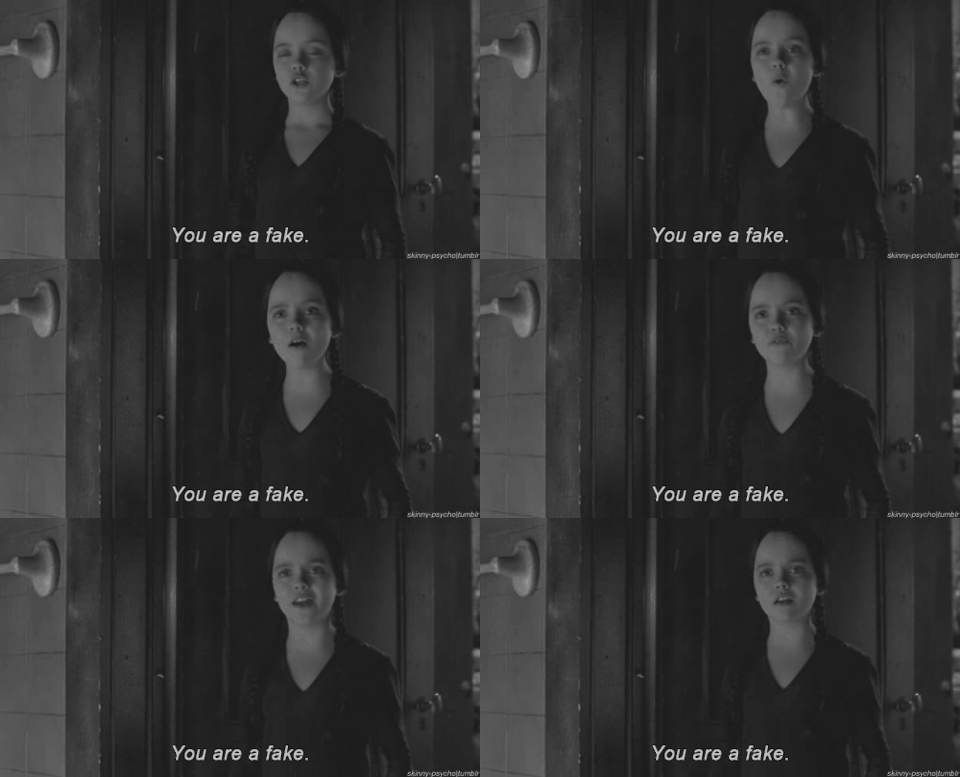
Imposter!

            Look!  We’re a day early because tomorrow I’m going to be cooking and watching a lot of my favorite black-and-white movies.  Joy!
            Well, not all joy…
            I need to get something off my chest.
            I’m a fraud.
            Seriously.
            I would guess, on an average week, this idea runs through my head five or six times (by odd coincidence, I tend to work five or six days a week).  The notion that I’m a complete fake who’s kind of stumbled into this life off sheer luck more than ability.  I re-read my new projects and wonder if they’re good or if I’m just deluding myself.  Maybe I don’t know a tenth of what I think I know—a textbook case of the Dunning-Kruger effect. 
            I sometimes wonder if the next book is going to be the one where my small fanbase gives a big shrug and says “ehhhhh… I guess he’s burned out.  Time to move on.” 
            I fret a lot about whether or not my publisher’s going to dump me as a writer, too. Well, not dump me, but just decide this latest contact will be… well, the last one.  Same with my agent.  He has some much, much bigger clients than me, and it’s not irrational to think he might decide his time and efforts are better spent focused on them.
            You may have heard of people feeling this way before.  It’s called imposter syndrome, and it’s really common.  I get it all the time.  Chuck Wendig gets it.  Victoria Schwab gets it.  Pretty much every writer I’ve ever talked to at length has copped to it. They’re plagued with self-doubt. They question most everything they write.
            (You didn’t think Hemingway drank that much because it was fashionable at the time, did you…?)
            I’m not saying this to freak you out or feed your insecurities.  I’m hoping it reassures you a bit.  We all feel this way sometimes.  Yeah, even those of us so-called-pros who are doing this full time.
            There are two reasons people get hit with imposter syndrome, in my so-called expert opinion.  For what it’s worth.  And they’re kinda related.  It’s almost the same thing, really.
            First is that, once I hit a certain stage in my writing, I start to see certain things.  I can admit to flaws in my work.  Of course, once I admit problems might be there, that also opens me up to imagining and creating problems. 
            As it happens, imagining and creating is what most writers do.  We’re good at it. Sometimes we do it even when we don’t want to…
            Second is fear.  I think imposter syndrome is a lot like writers block.  The act of creation—of pulling something out of my head and setting it down on paper—can be terrifying.  If you think about, it’s really common for people to talk themselves out of doing scary things.  Think of a couple times in your life when you had to do something that scared you.  How often did you end up thinking something along the lines of “ I can’t do this! What was I thinking?  I shouldn’t be here!”
            I can think of three or four times that sort of mantra ran through my head, all long before I became a full time writer.
            There’s a flipside to this, too.  The folks who are utterly, 110% confident their work is perfect, and that they absolutely shouldbe professionals.  The ones who have no doubts at all.
            And yet, for some reason… they’re not.  They don’t make sales. They don’t get deals.  Usually because of gatekeepers or antiquated systems or something.  Definitely not because of them.
            I’ve run into a few folks like this. You probably have, too.
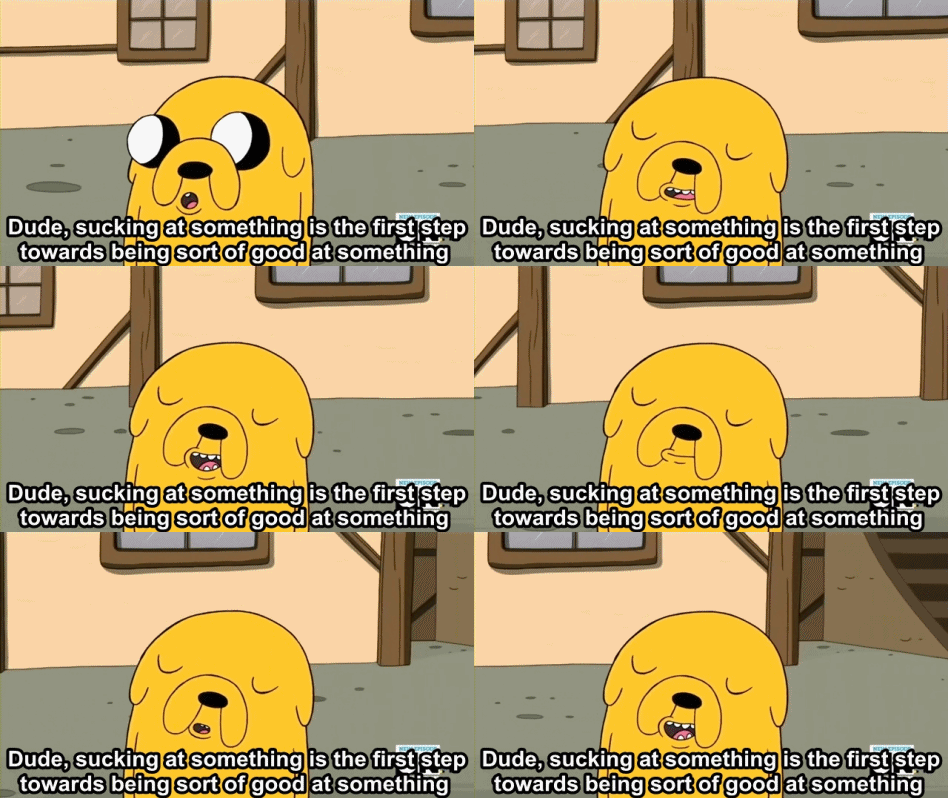
            Y’see, Timmy, I shouldn’t look at imposter syndrome as a problem.  Oh, it sucks, yeah, and it can lead to one or three stressful days or nights. But really it’s a sign of my maturity as a writer. It shows that I’m open to the possibility my work isn’t perfect, which means I’m open to improving it.
            And improving it is the big goal for all of us.
            Next time I might shout at you real quick.

            Until then, go write.

November 17, 2016 / 1 Comment

That Cool Moment When…

            Hey, folks. So very sorry I missed last week.  I had this thing all plotted out and then I somehow ended up in the Mirror Universe. And not the cool part of the Mirror Universe… the bad part.
            Hey, speaking of cool stuff…
            I read a book recently where the characters spent most of their time trying to verbally one-up each other. Every line of dialogue was a cool, badass line.
            Which still wasn’t quite as exhausting as a couple books I’ve read that were just non-stop super-cool action and conflict from page one.
            Although, that was better than the folks who tried to do an uber-cool plot structure of a cool flashback within a cool story within a really cool flashback.
            Saying “cool” that many times is kinda… uncool, isn’t it?
            Now, with that in mind…  I’d like to repeat a little experiment I did for some of you a few years back.  Please pay close attention to the following paragraph.  Don’t write anything down, but try to keep a lot of it in mind.  There’ll be questions afterwards.

            LA LA LA LA LA LA LA LA LA LA LA LA LA LA LA LA LA LA LA LA LA LA LA LA LA LA LA LA LA LA LA LA LA LA LA LA LA LA LA LA LA LA LA LA LA LA LA LA LA LA LA LA LA LA LA LA LA LA LA LA LA LA LA LA LA LA LA LA LA LA LA LA LA LA LA LA LA LA LA LA LA LA LA LA LA LA LA LA LA LA LA LA LA LA LA LA LA LA LA LA LA LA LA LA LA LA LA LA LA LA LA LA LA LA LA LA!!
            So…
            What parts of that stood out to you?  What was the high point?  Did the paragraph hold you from beginning to end?
            Odds are none of it stood out for you.  And the high point was probably when it ended, right?  In fact, I’m willing to bet you got halfway through the first line and just probably skimmed down to the end. 
            Nah, don’t worry, I won’t hold it against you.  Any sane person would’ve done the same thing.  It was just a bunch of LAs.
            Here’s another example. A variation on the theme, you might say.  Have you ever heard a tuning fork?  Tuning forks are perfect, y’know.  If you have a middle-C tuning fork it will hit that note and hold it for ages. 
            That said… have you ever felt compelled to listen to a tuning fork for hours?  No? Why wouldn’t you want to listen to constant perfection?
            Because it’s boring!
            A tuning fork plays one note.  That’s it.  It’s the musical equivalent of LA LA LA LA.  Middle C is great, and any musician from Bach to Pharrell will tell you it’s all but impossible to work without it–but it can’t be the only note.  It’s part of a system of highs and lows that we call music.
            Storytelling works the same way.  A story that’s just all the same thing is the literary equivalent of a tuning fork.  It’s neat for a minute or two… and then it starts to wear on your nerves. 
            I’ve mentioned this idea before, because it applies to several aspects of writing.  Structure.  Dialogue.  Action.  I can’t have a story that’s all action.  I can’t have a script that’s nothing but Oscar moments.  Every line can’t be a cool line.  Because if it’s all at the same level—if it’s all cool—then it’s all monotone.
            Look at Doctor Strange.  Big popular Marvel movie right now, yes?  And, yeah—no spoilers—it has scenes of magical combat and all that skyline-bending we saw in the commercials.  Lots of other cool stuff, too.  But it also has quite a few scenes where Strange just reads medical reports and books.  He listens to music.  At one point he has a conversation with a guy on a basketball court.  He even writes a few emails.
            Y’see, Timmy, it’s the up-and-down, back-and-forth nature that makes for interesting stories.  If you look at any good story, you’ll see that most of its elements swing back and forth between extremes.  Lows and highs.  Calm and frenetic.  Average and unforgettable.
            Because, again, if my story elements don’t have this up and down nature, if it’s all the same, then it’s just a line.  It doesn’t matter how high the line is, even if every point on it scores a perfect ten, even if it all goes to eleven…it’s still just a flat line.
            And you know what “flatline” is another term for, right?
            Dead.
            Next time… well, next Thursday is Thanksgiving here in the states.  But I owe you all one from last week, so I’ll try to get something up the night before.  That way I won’t feel like a total fraud.

            Until then, go write.

November 3, 2016 / 2 Comments

Democracy In Action!

            On this particular Thursday, it seemed like talking about voting could be an interesting idea.
            One thing I did all the time when I was starting out—well, once I’d become brave enough to show my writing to anyone past my mom—was to get as many opinions as possible.  If I had enough, I’d count them up like votes.  And I would do whatever they said.  If someone—anyone—wanted this line or that element changed, I’d change it.  Or remove it.  Or add in something new.  Anyone else’s thoughts were just as valid as mine.
            This happened to me again about thirteen years ago, just before I started doing this full time.  Slightly different direction, though.  Believe it or not, I ghost-wrote an exercise book.  This woman was very smart and savvy about exercise and the specialized niche she wanted to write toward… not so much about writing and publishing. So she hired me to help her out.  Alas, she kept talking about the book with her friends and fellow fitness professionals, showing them half-finished drafts, and taking everyone’s opinion as scientific fact.  So we rewrote the book again.  And again.  And again.  Not drafts, mind you.  Complete, start-from-scratch rewrites.  I think it went through six or seven major revisions before I had to bow out just for time reasons. And she still didn’t have much more than a first draft of her book.
            It was frustrating, but I couldn’t really fault her.  Like I said, I used to do it, too.  I think most people do when we’re starting out and looking for assurance.
            Really, it makes sense to do it that way. It’s what we’ve all been taught, right?  Democracy in action.  Let people vote on something, go with the majority.
            Except…
            Writing is not a democracy.  I’m a benevolent dictator at best.  An angry god at worst.
            Now, before anyone gets too excited about being a dictator…
            I’m not saying I’ll never, ever listen to other opinions.  I have some great beta readers I really trust.  I have a seriously fantastic editor who’s much, much better at spotting flaws than I am.  It doesn’t mean their opinions or suggestions are always right, but I’d be foolish not to at least look at them and consider them.
            At the end of the day, though… what my story needs is up to me.  I’m the one crafting and telling it. Every line of dialogue, every subtle character nuance, every beautiful piece of imagery, every clever plot twist.  It all comes from me.  If a dozen people think I need to get rid of the wine bottle scene but I think it’s vital and memorable, I get the last say.
            And I needto make that decision.  Opinions are great, but as the dictator the final decision is nobody’s but mine.  If I’m going to put things on hold waiting for a consensus or a clear majority… that just makes me a figurehead.
            This also holds for what I’m writing about.  If I just want to write to entertain myself—that’s great.  If I want to fill my story with in-jokes that only ten people on Earth are going to get, that’s also my choice.  I can deliberately focus my book on neo-con, government-hating survivalists or tree-hugging, socialist liberals—and absolutely nobody can say I’m wrong!  This is mystory.  Mine.
            However…
            This doesn’t mean anyone will want to read my story.  Or buy it.  Just because I’m staying true to myself and my vision–only bending where I feel I absolutely must—doesn’t mean my story is going to appeal to anyone else.  And some of those people it may not appeal to are editors.  Under other circumstances, they might be interested and willing to work with me, but if I’m not going to bend at all on that wine bottle scene…  Well, it’s not going to be their fault I didn’t make a sale.
            Plus… Let’s face it, I’m not going to please everyone, no matter what choice I make.  I’ve mentioned before that every story has a limited audience.   Sometimes a very limited one.  That’s the problem with leading—even as a benevolent dictator—the best you can ever hope for is a “greater good” situation.  There will always be people with no interest in the topic or genre, readers who just don’t like it.  Hop over to Amazon and check out well-established American classics like East of Eden or To Kill A Mockingbird.  Look at something newer like The Martian.  Heck, pick your favorite Harry Potter book.  All of these are unquestionably critical and financial successes with, I feel safe saying, hundreds of millions of fans each… but look how many one-star reviews they have.
            Y’see, Timmy, at the end of the day, nobody knows what my story needs but me.  It’s all mine. That’s the art part of it.  There is no democracy.  That’s where I get to be a dictator.
            But once I decide I want to put my writing out there, that I want an audience, that I’d like to get paid… Well, we’re not talking about being a dictator anymore. Now we’re talking about politics. We’re talking about compromises. We’re talking about tweaking my vision to appeal to a greater audience, even when it doesn’t appeal to me quite as much anymore.  Maybe not quite as great a good, but still a “very good” that reaches a lot more people.
            That’s the balancing act.
            Real quick before I wrap up, I’m going to be up in Tacoma, Washington this weekend for the Jet City Comic Show.  If you’re in the area, please stop by, say hi, and tell me how this blog is just a huge waste of time for everyone involved.
            Next time, I want to talk about something cool.
            Until then, go write.
            Historical reference! It’s like a pop culture reference, but it lets you pass tests…
            I’ve talked about different genre issues a few times in the past.  With the upcoming holiday, though, I thought it would be nice to revisit one that’s near and dear to me.  To be more specific, I thought we could talk about the different forms of horror. 
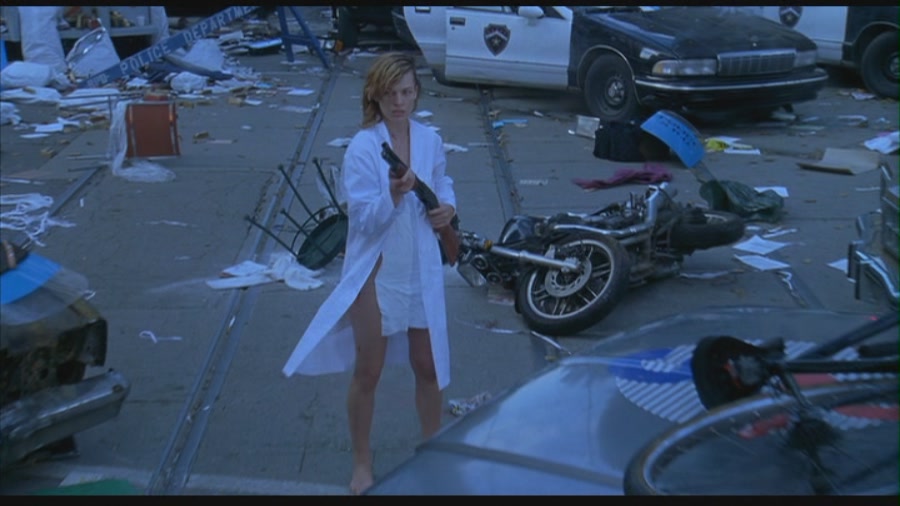
            Anyone who’s dabbled in horror knows that, when we tell folks this is our chosen genre, our work tends to get lumped into this vague slasher/vampire/Satanist category.  Either that or we’re tagged as someone working through a collection of childhood issues.  Most folks don’t realize horror can be broken down into many different sub-genres, just like drama or comedy or war stories.  Just because Resident Evil is under the umbrella (no pun intended) of horror doesn’t mean it’s anything like It Follows, and neither of them resembles Bram Stoker’s Dracula.  Or Stephen King’s Salem’s Lot.  Or Craig DiLouie’s Suffer The Children.
            So, here’s a few different panels of that umbrella.  Some of them are established sub-genres which have already been debated to death.  Others are just things I’ve noticed and named on my own that I feel are worth mentioning.
            Also, you may notice I’m defining a lot of these by how the characters in the story react/interact with the scary things.  That’s deliberate. All stories are about characters, and horror stories hinge on that.  One of the most common complaints we all hear about horror—to the point that it’s almost a joke—is when the characters do something that makes no sense.  So how my characters act and react is going to have a lot of effect on the story I’m telling…
Supernatural stories—This is one of the easiest ones to spot.  It’s your classic ghost story.  The phone lines that fall into the cemetery.  The pale girl out hitchhiking alone in the middle of night.  The foul-smelling thing in the lower berth. 
            There are a few key things you’ll notice about these.  One of the biggies is that the protagonist rarely comes to harm in a supernatural story.  Their underwear will need to go through the wash three or four times and they may not sleep well for years afterwards, but physically, and even mentally, they tend to come out okay.  If anyone suffers in a supernatural story it’s usually the bad guy or some smaller character.  Also, these stories tend not to have explanations– they just are.  There aren’t any cursed objects or ancient histories at play.  Things happen because… well, they happen.
            The Sixth Sense is still a great example of a supernatural story, as is “A Christmas Carol” by that populist hack Charles Dickens.  Even the Pirates of the Caribbean franchise is more supernatural stories than anything else.
Giant Evil stories—These are the grim tales when the universe itself is against my characters.  Every person they meet, everything they encounter–it all serves some greater, awful evil.  H.P. Lovecraft and Robert Howard wrote a lot of giant evil storiesThe Omen is another good (so to speak) story of the universe turning against the protagonist.  Any fan of Sutter Cane will of course remember the reality-twisting film In The Mouth of Madness.  In a way, most post-apocalyptic stories fall here, too—the world belongs to radioactive mutants, the killer virus, or the zombie hordes.
            Personally, I’d toss a lot of haunted house stories in here, because the haunted house (or ship, or insane asylum, or spaceship, or whatever) is essentially the universe of the story.  Not all of them, but a decent number.  The reader or audience doesn’t see anything else and the characters don’t get to interact with anything else.  House on Haunted Hill, The Shining, Event Horizon, and most of the Paranormal Activity films could all be seen as supernatural stories, but their settings really elevate them to giant evil stories.
Thrillers—Thrillers also stand a bit away from the pack because they tend to be the most grounded of horror stories.  Few creatures of the night, no dark entities, far fewer axe-wielding psychopaths.  The key thing to remember is that a thriller is all about right now.  It’s about the clock counting down in front of my heroine, the killer hiding right there in the closet, or the booby trap that’s a razor-width from going off and doing… well, awful things to my characters.  There’s a lot of suspense focused on one or two characters and it stays focused on them for the run of my story.  A thriller keeps the characters (and the reader) on edge almost every minute.

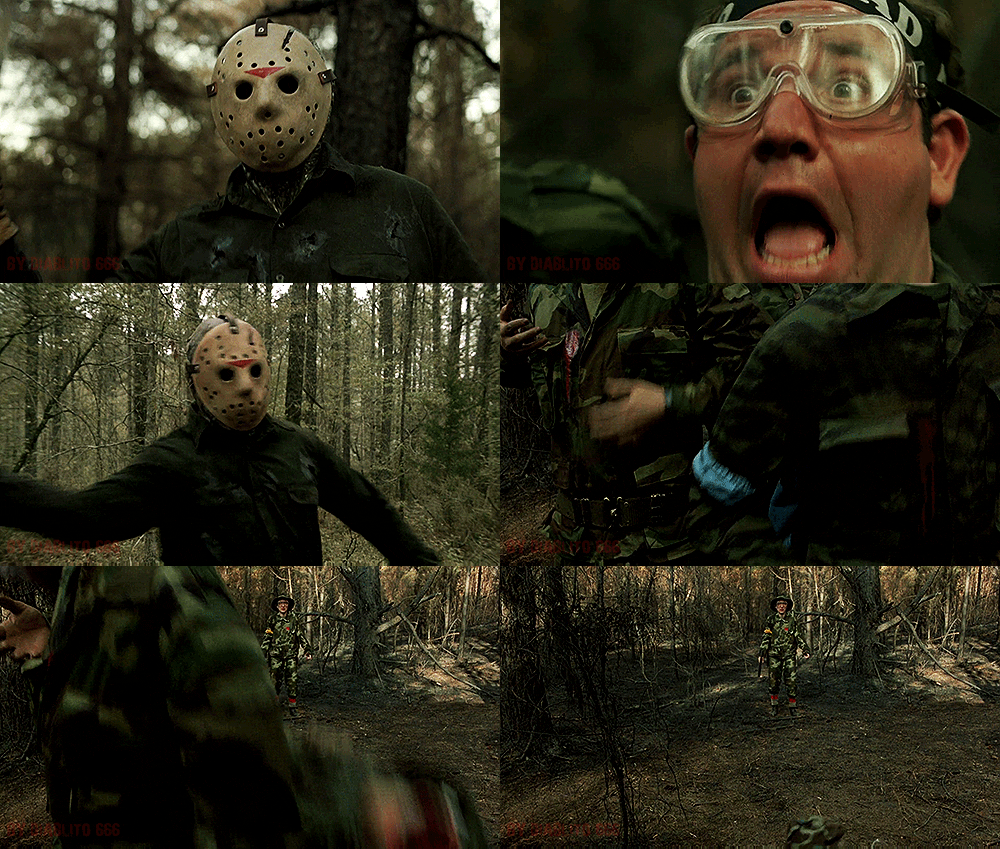
Slasher stories—These are really about one thing, and that’s body count.  How many men, women, and fornicating teens can the killer reduce to cold meat?  Note that there’s a few distinctions between a slasher story and a torture porn story (see below), and one of them is usually the sheer number of people killed.  There’s also often a degree of creativity and violence to the deaths, although it’s important to note it’s rarely deliberate or malicious.  Often it’s just the killer using the most convenient tools at hand for the job—slasher tales are pretty much a parkour of death.  The original Friday the 13th film series has pretty much become the standard for slasher pics, and it’s what most people tend to think of first when you mention the term.

            A lot slasher stories used to have a mystery sub-element to them, and often it was trying to figure out who the killer was.  Then it kind of morphed into being a twist… alas, often not a very well-done one.   Slasher stories also developed a bad habit of falling back on the insanity defense and got stereotyped as “psycho-killer” movies.  Which is a shame because some of them are actually very clever and creepy.

Monster stories—The tales in this little sub-genre tend to be about unstoppable, inescapable things that mean the protagonist harm.  They’re rarely secretive or mysterious, but they do have an alarming habit of tending toward nigh-immortality.   The emphasis here is that nothing my heroes (or the villains, police, military, or the innocent bystanders) do can end this thing’s rampage, and any worthwhile rampage tends to involve people dying.  There may be blood and death, but the focus with a monster isn’t finding it or learning about it– it’s stopping it.  Or at least getting as far away from it as possible.  Of course, how far is far enough with something that doesn’t stop?
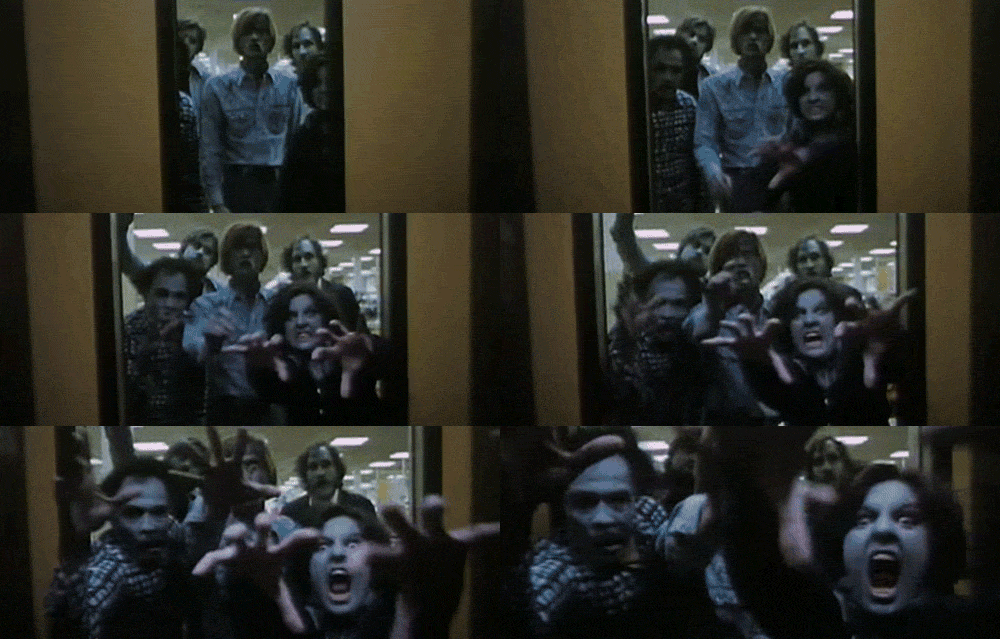
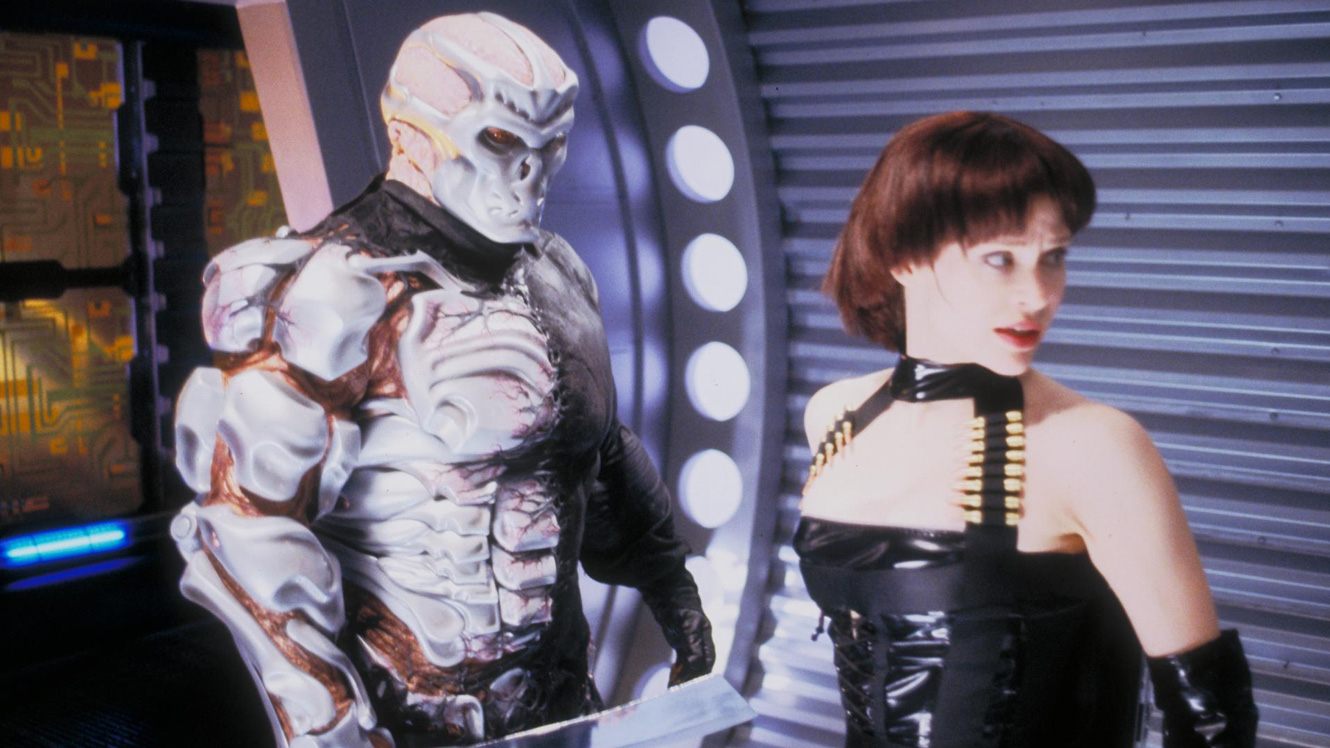
            The original monster story is, of course, FrankensteinGodzilla is a monster, in a very obvious sense, but so are zombies, Samara in The Ring, and even Freddy Kruger.  I still hold that the reason Jason X is so reviled by fans of the franchise is that the filmmakers turned it into a monster movie, not a slasher film like the ones before it.
            My lovely lady also made an interesting observation recently.  In monster stories, you almost always have a moment when the audience feels a twinge of sympathy for the monster.  Look at any of those named above, and you’ll see there’s a point when we empathize with Frankenstein, Godzilla, and yeah… even super-killer cyborg Jason (who seems to settle down once a holodeck dumps him back at a deserted and lonely Camp Crystal Lake and you realize he just wants to be left alone).
Adventure Horror stories—To paraphrase from Hellboy (which would fit quite well in this category), adventure horror is where the good guys bump back.  While they may use a lot of tropes from some of the other subgenres, the key element to these stories is that the heroes are fighting back.  Not in a weak, flailing, shrieking cheerleader way, but in a trained, heavily-armed, we’ve-got-your-numberway.  Oh, it can still go exceptionally bad for them (and often does), but this sub-genre is about protagonists who get to inflict a bit of damage and live to tell the tale.  For a while, anyway.  To quote an even wiser man, even monsters have nightmares.
            The Resident Evil franchise is horror adventure with zombies, just like my own Ex-Heroes.  Jonathan Maberry’s definitely dabbled in it as well, with some of his eerier Joe Ledger books. The Ghostbustersmovies could fit here, too.  There’s long-running shows like Grimm and Supernatural, and some of you may have seen a fun little cable series called Ash vs. Evil Dead
Torture porn—Director Paul Verhoven once commented that the reason Murphy is killed so brutally in the beginning of Robocop was because there wasn’t time at the start of the film to develop him as a character.  So they gave him a horribly gruesome death, knowing it would create instant sympathy for him, and then they’d be able to fill in more details about his life later on in the film.  That’s the general idea behind torture porn.  Minus the filling in more details about the characters later.
            I’m not sure if King himself actually coined the term “torture porn” in his Entertainment Weekly column, but that’s the first place I remember seeing it.  At its simplest, torture porn is about making the reader or the audience squirm.  If you can make them physically ill, power to you.  The victims are usually underdeveloped, unmemorable, and doomed from the moment they’re introduced.  It’s not about characters, it’s about the visceral things being done to the characters.  They’re getting skinned, scalped, boiled, slowly impaled, vivisected… and we’re getting every gory detail of it.  A film industry co-worker once told me “porn is when you show everything,” and this sub-genre really is about leaving nothing to the imagination.  They are the anti-thriller, to put it simply.
            A key element to torture porn is the victim is almost always helpless.  They’re bound, drugged, completely alone, or vastly outnumbered.  Unlike a slasher film– where there’s always that sense that Dot might escape if she just ran a little faster or make a bit less noise– there is no question in these stories that the victim is not going to get away.  That hope isn’t here, because that’s not what these stories are about.
            So there’s seven subgenres we can break horror down into.  And there’s many more.  All fascinating stuff, right?
            Why are we talking about it?
            Y’see, Timmy, when a lot of us start off  as writers, we flail a bit, usually in the attempt to copy stories we don’t quite understand the mechanics of.  As such, we aren’t sure where our own stories fit under the big horror umbrella (or sci-fi, or fantasy, or…).  We’ll begin a tale in one sub-genre, then move into a plot more fitting a different one, wrap up with an ending that belongs on a third, and have the tone of yet another through the whole thing. 
            It’s important to know what I’m writing for two different reasons.  One is so I’ll be true to it and don’t end up with a sprawling story that covers everything and goes nowhere.  I don’t want my thriller to degenerate into a slasher, and if I’m aiming for cosmic-level, Lovecraftian evil it’d be depressing to find all the earmarks of a classic supernatural story.  I also want to be able to market my story, which means I need to know what it is.  If I tell an editor it’s not torture porn when it plainly is, at the best I’m going to get rejected.  At the worst, they’ll remember me as “that idiot” when my next piece crosses their desk.
            In closing, I’ll also toss in the free observation that it’s difficult to merge two of these subgenres because a lot of them contradict each other by their very nature.  Not impossible, mind you, but difficult.  Probably one of the few exceptions I can think of in recent times is The Cabin In The Woods, which does an amazing dancing back and forth between being a monster movie and a giant evil movie.
            So, that’s enough of that.  Feel free to dwell on these points over the weekend while you’re drinking, watching some scary movies, and sneaking Kit Kats out of the candy bowl (seriously—feel ashamed about that. Those are for the kids!)
            Next time… I thought we could talk a little bit about democracy.
            Happy Halloween.  Don’t forget to get some writing done.
Categories