November 13, 2018

My Brush with Greatness

             I’ve been thinking about this all day.  Well, a dozen different versions of this…
            About nine and a half years ago I entered an awful phase.  The small-press, first time author looking for blurbs phase.  It’s when you have no credits to fall back on, no industry clout behind you, but you have to somehow get people with both of these things to read your book and say nice things about it.
            Needless to say, it’s tough.
            Near-impossible.
            I, however, had a plan.
            Since I’d worked in the film industry, and was still writing about it at the time, it occurred to me that rather than go after recognizable authors, I could go after recognizable actors.  Hunt down some of the cult icons that would mesh with a superheroes-fighting-zombies story.  Their names might not carry a ton of weight in the literary world, but they would with the fans I wanted to reach.
            So I called in some favors with people I knew and ended up with a short list of email addresses and phone numbers for certain managers, agents, and small offices.
            Alas, it did not go well.
            I got no response from most of the emails.  My phone calls were stonewalled.  The best response I got was from Bruce Campbell’s manager, who let me give my spiel and then—very pleasantly and politely, without a hint of malice or snark—told me that Bruce was just too busy to be reading anything at the time.
            (Damn you, Burn Notice!  Damn you!!!!!)
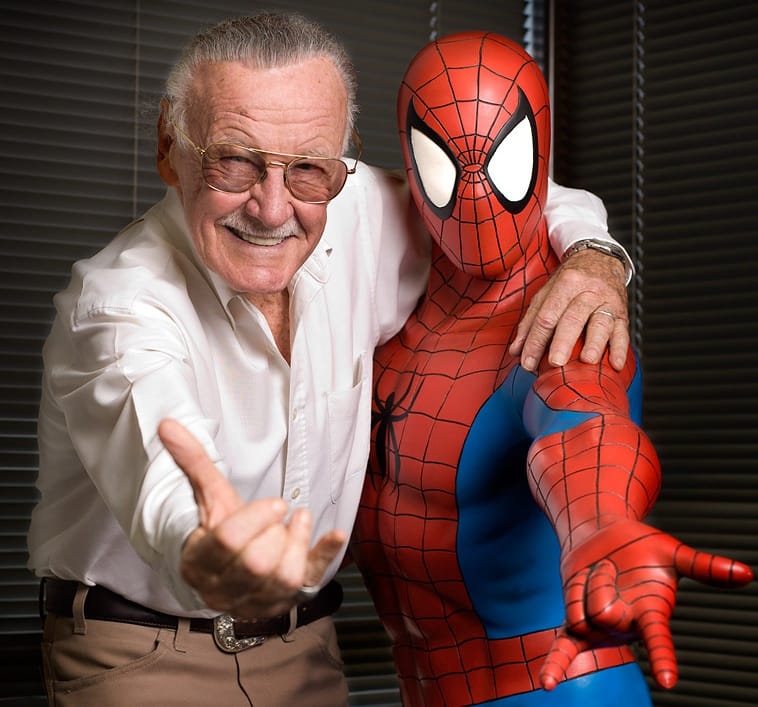
            I hit the bottom of my list pretty quick.  And it was my biggest long shot.  A comic legend who had an office in LA… an office I’d managed to get the phone number for.
            I dialed and ran through the spiel one more time in my head.  The friendly-but-casual-but-confident approach that would get me past the person answering the office phone to the person I needed to speak to, who would then get me to the person I wanted to speak to. Well, I had no illusions about actually speaking to him, but hopefully I could convince that second person to hand off my manuscript to–
            “Hey, it’s Stan.”
            To be fair, true believers, I’m not 100% sure that’s what he said.  By the time he’d reached the second word I’d recognized the voice.  The voice I’d heard in hundreds of interviews.  The voice that had narrated all those episodes of Spider-Man and his Amazing Friends when I was a kid.
            That voice on the phone knocked pretty much every coherent thought I had out of my head.  He was on the phone!  With me!  Right NOW!  I WAS ON THE PHONE WITH STAN LEE!!!
            “Hello?”
            I was still kind of in shock, but I realized I needed to say something or he was going to hang up.  I still couldn’t get my thoughts in gear, though.  Couldn’t adapt, couldn’t stay professional, couldn’t…
            I blurted out my spiel, probably at double time, all in one breath, and ended up asking Stan Lee if I could speak to whoever could get me in touch with Stan Lee.
            There was a pause at the other end of the line, then a little laugh, and then “Yeah, just hang on.”  At which point I heard the phone get muffled, handed off, and found myself speaking to someone else who brusquely assured me Stan was far too busy for whatever my request was and clickthe call was over.
            I’m sure he’d forgotten about it five minutes later, but I’ll never forget the brief moments I found myself talking with one of the most influential people in my life.
            Well, okay…  babbling at him.  And him taking it good naturedly.
            Rest In Peace, Stan.  You were inspirational in so many ways, to so many millions of creators, and I wouldn’t be here today without you.
            Excelsior!
August 30, 2018 / 4 Comments

If I’m Being Honest With Myself…

            Okay, look… there’s a good chance this post will piss you off.
            Two things I ask you to keep in mind, going in.
            First is that this comes from a place of kindness.  If you’re reading this, I want you to succeed.  All of you.  Well, okay, not him, but the rest of you, absolutely.  So I’m saying these things because… well, they need to be said.  And you need to hear them.
            Some of you really need to hear them.
            Second is that everything I’m going to be talking about is something I’ve personally experienced.  Not that I’ve seen another writer doing it—I’ve done it.  I’ve believed it.  I’ve been the person needing that smack in the face.
            And I learned from it.  And got better because of it.
            Writing’s tough.  It’s hard work.  I know this, because I’ve been doing it for a living for over a decade now.  When someone tells me how easy and wonderful and fun writing is, I’m often tempted to point out…
            Well, look.  There was a point when I thought writing was easy and fun.  It was back when I wasn’t taking it seriously.
            My writing ability started making huge leaps when I was finally able to admit a few things to myself.  I think that’s true of most people in most fields—if we can’t be honest about where we are, it’s hard to improve.
            That being said…

My first attempts at writing will suck—This sounds harsh, yeah, but… well…  Too often when we’re starting out, we just can’t get past the idea that something we wrote isn’t good.  I know I couldn’t.  My work was typed.  It was a full page long!  My mom liked it!  Of course it deserved to sell.  It deserved awards!  International awards!

            Seriously, there was soooooo much writing before my “first novel.”  There was Lizard Men from the Center of the Earth (two different versions).  A trope-filled sci-fi novel.  Some Boba Fett and Doctor Who fan fic.  A fantasy novel  fuelled by a sudden influx of hormones during my teen years (enough said about that).  The Werewolf Detective of Newbury Street, The Trinity, The Suffering Map, about half of a novel called Mouth.

            And then…Ex-Heroes. 
            It’s just against human nature to spend hours on something and then tell yourself you just wasted a bunch of time.  Why would I write something I couldn’t sell?  Obviously I wouldn’t, so my latest project must deserve a six-figure advance.
            The problem here is the learning curve.  None of us like to be the inexperienced rookie, but the fact is it’s where everyone starts.  Surgeons, chefs, pilots, astronomers, mechanics… and writers.  Oh, there are a few gifted amateurs out there, yeah—very, very few—but the vast majority of us have to work at something to get good at it.  And we can’t improve until we accept that we need improvement.
My first draft is going to suck—There was a point where I’d fret over my first draft.  I’d spend hours laboring over individual words, each sentence, every paragraph.  I’d get halfway down the page and then go back to try to fix things.  It meant my productivity was slowed to a crawl because I kept worrying about what had happened in my story instead of what was going to happen.
            The freeing moment was when I realized my first draft was always going to suck.  Always.  And that’s okay.  Everyone’s first draft sucks.  Everybody has to go back and rework stuff.  It’s the nature of the beast. 
            With those expectations gone, it became much easier for me to finish a first draft, which is essential if I ever wanted to get to a second draft.  And a third draft.  And maybe even a sale.
            No, needing another draft doesn’t make me a lesser writer in any way.  Every single professional writer I know (and I know a lot of them at this point) does a second draft.  And usually a third and fourth.
My writing needs editing.  Lots of editing—As I mentioned, I’ve been doing this for a while.  Surely by now I’ve hit the point where my stuff rolls onto the page (or screen) pretty much ready to go, yes?  I mean, at this point I must qualify as a good writer and I don’t need to obsess so much over those beginner-things, right?

            Alas, no.  Like I just said, my first draft is going to need work.  We all make the easy first choice now and then.  Things slip past us.  We misjudge how some things are going to be read. I’m fortunate to have a circle of friends and a really good editor at my publisher who all call me out when I make these mistakes or just take the easy route when I’m capable of doing something better.

            As I mentioned above, part of this is the ability to accept these notes and criticisms.  I’m not saying they’re all going to be right (and I’ve been given a few really idiotic notes over the years), but if my default position is that any criticism is wrong then my work is never going to improve past the first draft. 
            Which, as I mentioned above, sucks.
My writing needs cuts—Sticking to the theme, if I believe my writing is perfect, it stands to reason all of it is perfect.  It’s not 90% perfect with those two odd blocks that should be cut.  When I first started to edit, one of my big problems was that everythingneeded to be there.  It was all part of the story.  Each subplot, every action detail and character moment, all of the clever references and in-jokes.
            The Suffering Map was where I first started to realize things needed to be cut.  I’d overwritten—which is fine in a first draft as long as I can admit it in later drafts.  I had too many characters, too much detail, subplots that had grown too big, character arcs that became too complex.  It took a while, but I made huge cuts to the book.  It had to be done.  Heck, I just cut a whole subplot from the book I’m editing right now.  About 2500 words gone, snip-snip, in about five minutes.
            And the book it better for it.
My writing is going to be rejected –Know what I’ve got that most of you reading this will never have?  Rejection letters.  Paper letters that were mailed to me by editors.  I’ve got dozens of them.  Heck, I’ve probably got a dozen from Marvel Comics alone.  And since then I’ve got them from magazines, big publishers, journals, magazines, ezines…
            But when that first rejection from Marvel came… I was crushed.  Devastated.  How could they not like my story?  It was a full page!  I included a colored pencil rendering of what the cover should look like.  Did I mention it was typed?!
            It took me weeks—whole weeks, plural—to work up my courage to try again, and then they shot that one down, too.
            Granted, I was eleven, and those stories were awful.  I mean… really awful.
            Rejection is part of the process.  I still get rejections today.  I expect I’ll be getting then for the foreseeable future.
            Which is a good time to mention…
Rejection does not automatically mean my writing is bad—Getting that email is tough, like a punch to the gut.  It’s easy to let it get under the skin and fester.  Self-doubt feeds on rejections, so it’s important to think of it as “still looking for the right home.”
            Like I said, I’m still getting rejections today, even with the fairly solid list of credits and accolades after my name.  Editors and publishers are people too, and nothing is going to appeal to everyone.  Getting rejected became a lot easier for me when I realized it didn’t show up on my permanent record and it wasn’t a personal attack  It was just a person who didn’t connect with that particular story for some reason.
            Now, there’s a flipside worth mentioning here…
Rejection also doesn’t automatically mean my writing is good—There’s a lot of memes and recurring stories and a few general mindsets that push the idea that if my work gets rejected by an agent or editor it mustbe good, because all those people are idiots.  And it can be a comforting thought.
            It’s also kinda close to conspiracy-theory reasoning, if you think about it.
            Going right back to the beginning of this little rant, there’s a decent chance my work just isn’t good.  No big deal.  Like I said, I had dozens and dozens of rejections before I started to get some sales.
            But if I refuse to back away from the idea that it might be me—if I take dozens of rejections as proof the system is stupid rather than admit the possibility my manuscript wasn’t ready to go out—then I’m never going to improve.
           
            If I can admit these things to myself, it can only make me a better, stronger writer.  It’s not a flaw or a weakness.  In fact, if I look at the above statements and immediately think “Well, yeah, but none of that applies to me…” it’s probably a good sign I’m in denial about some things.
            And that’s not going to help me get anywhere.
            Speaking of getting anywhere, if you’re in the Atlantaarea I’m at Dragon Con this weekend.  Come find me and we can talk about books and writing and is Clark Gregg coming back to Agents of SHIELD or what?
            Next time, I’d like to put a few things in context.
            Until then, go write.

March 13, 2018

Writing Lessons from ROM

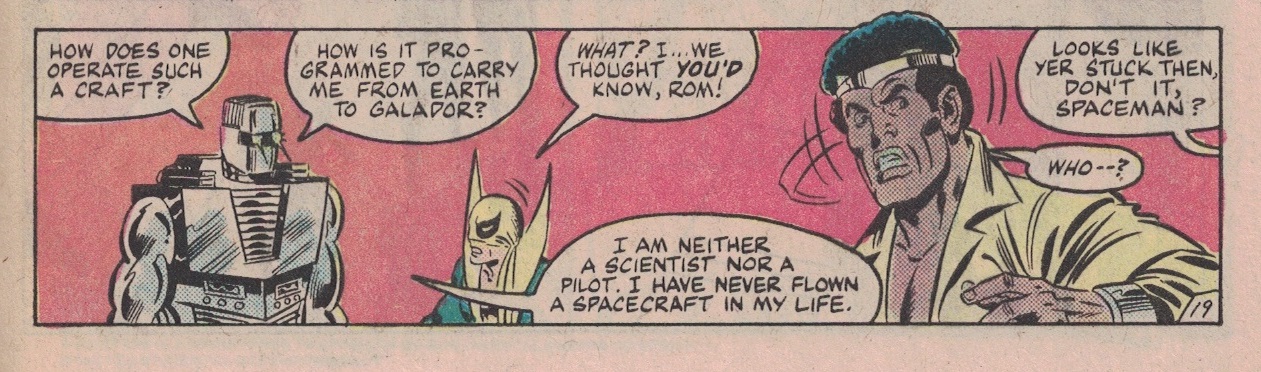
Eight-year old me learned a big lesson about storytelling from this one panel…

November 17, 2016 / 1 Comment

That Cool Moment When…

            Hey, folks. So very sorry I missed last week.  I had this thing all plotted out and then I somehow ended up in the Mirror Universe. And not the cool part of the Mirror Universe… the bad part.
            Hey, speaking of cool stuff…
            I read a book recently where the characters spent most of their time trying to verbally one-up each other. Every line of dialogue was a cool, badass line.
            Which still wasn’t quite as exhausting as a couple books I’ve read that were just non-stop super-cool action and conflict from page one.
            Although, that was better than the folks who tried to do an uber-cool plot structure of a cool flashback within a cool story within a really cool flashback.
            Saying “cool” that many times is kinda… uncool, isn’t it?
            Now, with that in mind…  I’d like to repeat a little experiment I did for some of you a few years back.  Please pay close attention to the following paragraph.  Don’t write anything down, but try to keep a lot of it in mind.  There’ll be questions afterwards.

            LA LA LA LA LA LA LA LA LA LA LA LA LA LA LA LA LA LA LA LA LA LA LA LA LA LA LA LA LA LA LA LA LA LA LA LA LA LA LA LA LA LA LA LA LA LA LA LA LA LA LA LA LA LA LA LA LA LA LA LA LA LA LA LA LA LA LA LA LA LA LA LA LA LA LA LA LA LA LA LA LA LA LA LA LA LA LA LA LA LA LA LA LA LA LA LA LA LA LA LA LA LA LA LA LA LA LA LA LA LA LA LA LA LA LA LA!!
            So…
            What parts of that stood out to you?  What was the high point?  Did the paragraph hold you from beginning to end?
            Odds are none of it stood out for you.  And the high point was probably when it ended, right?  In fact, I’m willing to bet you got halfway through the first line and just probably skimmed down to the end. 
            Nah, don’t worry, I won’t hold it against you.  Any sane person would’ve done the same thing.  It was just a bunch of LAs.
            Here’s another example. A variation on the theme, you might say.  Have you ever heard a tuning fork?  Tuning forks are perfect, y’know.  If you have a middle-C tuning fork it will hit that note and hold it for ages. 
            That said… have you ever felt compelled to listen to a tuning fork for hours?  No? Why wouldn’t you want to listen to constant perfection?
            Because it’s boring!
            A tuning fork plays one note.  That’s it.  It’s the musical equivalent of LA LA LA LA.  Middle C is great, and any musician from Bach to Pharrell will tell you it’s all but impossible to work without it–but it can’t be the only note.  It’s part of a system of highs and lows that we call music.
            Storytelling works the same way.  A story that’s just all the same thing is the literary equivalent of a tuning fork.  It’s neat for a minute or two… and then it starts to wear on your nerves. 
            I’ve mentioned this idea before, because it applies to several aspects of writing.  Structure.  Dialogue.  Action.  I can’t have a story that’s all action.  I can’t have a script that’s nothing but Oscar moments.  Every line can’t be a cool line.  Because if it’s all at the same level—if it’s all cool—then it’s all monotone.
            Look at Doctor Strange.  Big popular Marvel movie right now, yes?  And, yeah—no spoilers—it has scenes of magical combat and all that skyline-bending we saw in the commercials.  Lots of other cool stuff, too.  But it also has quite a few scenes where Strange just reads medical reports and books.  He listens to music.  At one point he has a conversation with a guy on a basketball court.  He even writes a few emails.
            Y’see, Timmy, it’s the up-and-down, back-and-forth nature that makes for interesting stories.  If you look at any good story, you’ll see that most of its elements swing back and forth between extremes.  Lows and highs.  Calm and frenetic.  Average and unforgettable.
            Because, again, if my story elements don’t have this up and down nature, if it’s all the same, then it’s just a line.  It doesn’t matter how high the line is, even if every point on it scores a perfect ten, even if it all goes to eleven…it’s still just a flat line.
            And you know what “flatline” is another term for, right?
            Dead.
            Next time… well, next Thursday is Thanksgiving here in the states.  But I owe you all one from last week, so I’ll try to get something up the night before.  That way I won’t feel like a total fraud.

            Until then, go write.

Categories