
November 1, 2014 / 2 Comments

Bloodsoaked Carnage and Horror 101

            Running late, as usual. In more ways than one.  I was looking back and realized I haven’t done a solid Halloween-related post in ages.  So this is doubly long-overdue.
            Anyway…
            I wanted to revisit something I blabbed on about once a few years back.  I figured it was worth going over again for the holidays and for general purposes.
            When I sit down to write something scary, it helps to know just what I’m trying to accomplish.  “Scary” means a lot of different things to a lot of different people, and some of that depends on context.  Do I want to make hearts race or blood run cold?  Am I trying to make sure someone never walks down a dark hall again, or that from this point on they can never eat chicken and rice without thinking of… well, other things?
            Someone with a sheet draped over them can be funny, creepy, or plain terrifying, but if I don’t know which one I’m aiming for, it’s much harder to accomplish anything.  I mean, I can’t get the desired effect if I don’t know which effect I desire, right?  It’s like playing pool (or billiards, for you continental types).  I can call my shots or I can smash the cue ball into anything on the table.  Either way, there’s a chance of getting a ball in a pocket, but one’s got a much better chance of doing something impressive.
            With that in mind… what kind of scares am I going for?
            There’s a bunch of arguments to be made in several directions, but I think fear, as a storytelling device, generally breaks down into three basic categories.  Stephen King’s said something similar a few times, and I’m kind of expanding on that in my own way.  There’s a couple different names people use for them, but for our purposes today, let’s call them the shocker,the gross out, and dread.  These three form the core elements of most scary stories.  They’re the base ingredients, as it were.
            Let’s review…
            The Shocker This is when something unexpected happens and makes the reader or audience jump.  It’s an immediate fear caused by something happening right at this moment.   When that bear trap snaps shut on someone’s leg or they get a machete in the head, that’s a shock.  Ever seen someone’s eyes bug while they’re reading?  They probably just found a shocker.   A lot of the deaths on Game of Thrones tend to be shockers because—as violent as that world is—we don’t expect to see people we like bite it on such a regular basis.  Individual shocks can be stretched out a bit with chaos and shouting to keep it going—especially on film—but a shocker is really a short-lived thing.
            The shocker is a powerful storytelling tool, don’t get me wrong, but it’s important to remember that it can’t stand on its own for long.  By it’s very nature it’s quick and done.  There can be fallout and aftershocks, but they’re always going to be weaker. I also can’t use shocks one after another.  Repetition bleeds their strength and can even make them lean into comedy or (worse yet)boredom. 
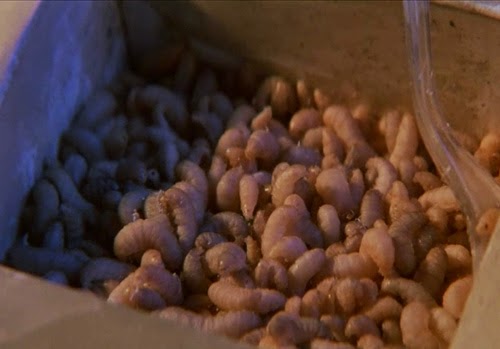
            The Gross-Out As King himself names it.  This is when things are just disgusting.  It’s when I tap into the reader’s sense of revulsion and maybe even induce some nausea.  It’s when we spend six paragraphs going over the exquisite sensation of lifting someone’s still-attached eyeball out of their socket, maybe turning it around to get a view of the room, and then sliding sewing needles into it (maybe even throughit) again and again until it bursts and the warm liquid runs down the optic nerve and drips into the empty socket.  Which then gets packed with salt.  Or maybe it’s just about running a lawnmower over a zombie and describing every color and texture as the half-rotted body sprays out across the grass.

            One of the big differences between the gross out and the shocker is duration.  While a shock loses power the longer I try to prolong it, a gross out can gain strength as it goes on and on (and thus, torture porn was born).  Still, like anything, if it goes on too long or happens too often, my readers will get bored with the gross out, too.

            Another interesting point.  The audience often (but not always) knows the gross out is coming.   Anticipation is part of it.  We don’t have pages and pages of set-up, but it rarely pops up out of nowhere (because if it did, it’d be a shocker).
            Dread This is when something doesn’t happen, but we know it could.  Or maybe it’s something we know ishappening even if we don’t actually see it.  Dread is fear of potential events, if that makes sense, which puts it very close to suspense.  We know any minute now something’s going to crawl out of the shed or reach out from under the bed, and the fact that it hasn’t yet is what gives us the chills.  Dread needs enough space for my readers to realize things aren’t matching up within the story or within their own experiences.  It works well in larger tales because there’s space for back story, but if I’ve got enough experience I can make it function in tighter spaces
            Now, there’s three catches that come with me using dread.  One is that it relies on me having a very solid grasp of how my readers are going to react and what they’re going to know.  If I say you’ve been invited to the Strexcorp company picnic, most of you are going to shrug, put on some sunscreen, and head down to play volleyball.  I have been known to have a bug thing now and then, but I shouldn’t assume everyone will find the sight of a cockroach to be the most awful thing ever.  If the shocker is a sledgehammer, then suspense is the scalpel of fear.
            The second catch is that dread relies on the audience having… well, not to sound elitist, but it depends on a certain level of intelligence and involvement.  If you try explaining climate change to a chimpanzee, you’ll notice they don’t get too worried about it—assuming they sit there for your whole lecture.  The huge reveal about David Warner’s photographs in The Omen doesn’t pack anywhere near the same punch if I come in when they’re done examining the priest’s apartment (see—you should’ve watched The Omen and then this would make sense).  Dread requires an investment and an attention span. 
            Last but not least, dread needs good characters  more than the other two types of horror mentioned above.  My readers need to be able to identify with what a character’s going through.  If they can’t, this isn’t a story, it’s a news report.
            Now, after all that, here’s one more mouthful for you to digest.  Did you notice that each of these types of horror has a different time investment?  The shocker is quick, the gross out needs a few minutes, and dread really takes its time.  Each one is very distinct.  I can’t expect to stretch a shock over two or three pages and I can’t build a sense of dread in a single paragraph.
            Once I know just what I’m trying to do, it’s easy to see how each type of horror should work on the page and also how they can work with each other.  A lot of old ghost stories are little suspense tales that build to a shock.  A lot of  torture porn films start with a bit of dread, but then dive headfirst into gross-outs punctuated by shocks. 
            Y’see, Timmy, when I’m writing horror I need to be aware of the effect I’m trying to create and how much space I need to accomplish that effect.  If I’m trying to build a sense of dread in less than a page, or if I want to make a shock last for just as long, my story’s doomed.  These are things that are very hard to manipulate.
            Of course, it’s possible to do scary things without any of these core elements, just like it’s possible to bake without using flour or sugar.  But I need to be aware that working around these things means a lot of extra effort.  And maybe some really clever thinking.
            Next time, I want to break this bad habit of running late and start over from scratch.
            Until then, go hand out candy.  Oh, and write.
            This week’s blog title is from a future Asylum movie for SyFy.  It’s not in development or anything, as far as I know, but I’m pretty sure just by writing that online I’ve caused it to happen.  It’s the internet butterfly effect.
            And speaking of that geeky reference to a geeky reference…
            What that title really comes from is a note from a friend of mine, the editor at a sci-fi/ science site called Giant Freakin Robot (check it out—it’s fun and educational).  He was explaining what kind of movies and television shows the site covered.  To paraphrase, if the zombies have biochemical or viral origins, GFR will cover them, but not if they’re raised by voodoo spells or curses.
            Over the past few years, a lot of genres have really blended together.  In books and movies, it’s not uncommon to see strong action, drama, or even comedy threads mixing in with sci-fi, fantasy, or horror.  Nowadays it’s just as common for protagonists to fight the undead as it is to run from them, and in doing so writers and readers have created dozens of subgenres.
            Personally, as I’ve mentioned before, I’m a big fan of this.  I think any story that stays too much in one vein tends to get dry pretty quick.  There’s almost always some humor in every situation, even incredibly dark ones.  It’s not uncommon for men and women to have inappropriate thoughts at really inopportune times (or to act on them).  Hey, I grew up on Doctor Who, so in my mind it makes perfect sense for religion-obsessed barbarian tribes to be descended from intergalactic survey teams or for aliens to be controlling the Loch Ness Monster.
            Now, sad but true, there aren’t a lot of firm rules on mixing these things.  Every story is different, so the way mystory blends horror and comedy is going to be different from the way yourstory blends them.  Ten of us can use the same basic plot, but we’re each going to end up with our own unique story.  My characters won’t react the same way as yours, hers will make different decisions than his.
             As such it’s hard for anyone to say which amount is right or wrong without having all the context.  To use one of my frequent cooking analogies, it’s kind of like if I asked “is this too much sugar?”  It’s an impossible question to answer without knowing what I’m cooking, what are the recipe standards, what are my preferences, and what are the preferences of the people who are going to be eating it.  My own skill level in the kitchen matters, too, on whether I should be trying a fried Alaska, death by chocolate, or maybe just a bowl of Captain Crunch.
            However… all that being said…
            I think when these mixed genre stories go bad, a lot of folks tend to look at the small issues and ignore the big ones.  Something isn’t bad because it mixed androids and artificial intelligence with Arthurian legends, or because it introduced a lot of comedy into the Cthulhu mythos.  Those are just the easiest targets, so they get the criticism first. 
            What I’ve come to realize is that most bad genre stuff tends to be bad for the same three reasons.  Granted, there’s always going to be someone who tries to write a sexy mutant cockroach story (or something worse), and there will always be people who just load up on basic mistakes like spelling or flat characters or incoherent plotting. In my experience, though, most genre stuff goes wrong in three basic ways—whether my story is one pure genre or several overlapping ones.
            The firstand often biggest mistake is when authors try to make their stories too fantastic.  If I have an idea, it gets included in the story.  No matter what it is, I’ll cram it in there.  If you’ve ever watched old slasher movies, you know most of them just devolved into creative ways to kill people, and sometimes there are excess characters for no other reason but to allow for more inventive deaths.  Most of us have probably read a sci fi novel that went to great lengths to explain how the weapons, shoes, uniforms, food, transportation, education, and economics are all very different on that other world or in that not-so-distant future.  I read a book recently that had to do with… well, everything.  No, seriously.  Government conspiracies, bio-engineering, super-soldiers, angels and demons, secret identities, zombies, aliens from Neptune, extraterrestrial dragons, thrill-killers, child abuse, sadism, torture porn, regular porn, and lost civilizations in the Amazon.  All of these things were major threads and elements in one average-length novel.  Heck, I’m tempted to say it was even on the shorter side.

            The problem with writing a story like this (book or screenplay) is my audience has nothing to connect with as they’re overwhelmed with all these unfamiliar elements.  The people are different.  The setting is different.  Motivations are different.  I may have created the most amazing post-apocalyptic matriarchal feudal society run by a supercomputer (and its secret android army) that’s ever been seen, but my readers need to be able to understand those characters and that society and relate to it right now while it’s on the page in front of them.

            This is closely related to the second problem—when the writer tries to explain everything.  Bad enough that I felt the need to include the secret android army, but now I’m also going to write about how they were first developed by the Mysteridroid Corporation three hundred years ago, how they see the world, and even how they recharge in various situations.  I think most people reading this have read a story or two that suddenly deviated into exposition like that.  Edgar Rice Burroughs had an awful habit in his Mars books of having his characters stop and explain various aspects of Barsoomian technology (one midnight walk with the Princess famously spun into a discussion of how radium bullets are manufactured and used).  A few recent horror films have gone to great lengths to explain why their antagonist turned out the way he or she did, even though that mystery was part of the character’s strength.
            What this often leads to is stories that feel very exotic and detailed, but very little ever actually happens in them.  Page after page of explanation can add up really fast, and no matter what my chosen format is, there’s only going to be so many pages.  Suddenly a third of my book is just… details.  And while I’m going over those details, my characters are just sitting around twiddling their thumbs, waiting for something to happen again.  This can also lead to a bit of resentment from the reader as I’m spoon-feeding them all this information.
            As it turns out, problem number three is the flipside of two.  It’s when the writer doesn’t explain anything.  I’ve gone through whole chapters of a book trying to figure out which character was KristoMystery Science Theater 3000 once had a running gag about a mystical object (or maybe it was a person…) called “the Sampo.”  We’ve all seen stories where people ride “twyrfels” and we’re left wondering what the hell a twyrfel is (an animal? a vehicle? some kind of transporter beam?).
            There’s also the folks who hide motives and actions to create a sense of mystery.    Characters will appear, make a mysterious statement or three, and then vanish from the story.  Creepy messages will be found on walls, sidewalks, or computer screens and we never learn how they got there.  Disturbing objects are found in the cellar, but never discussed again.  Ever.
            There are two general causes behind this, in my experience.  In the first case it’s when I’ve sunk so far into my fictional world and spent so much time there that I forget the reader isn’t quite so familiar with it.  I can tell you the whole history of the twyrfel as transportation, so I forget that you don’t even know what one looks like.  In the second case, they’re trying to duplicate the tone of books like House of Leaves or shows in the vein of LOST or Person of Interest, but they don’t really understand how those stories achieved that tone.  This is especially frustrating when there’s clearly no real mystery, just a bunch of withheld information.
            So, there’s three big, common mistakes in genre fiction.  Sci-fi, horror, fantasy—we could probably give an example of each failing for each genre.  We could even make a chart.
            Or we could go over a few simple ways to avoid these issues…
            For that firstproblem up above, my story needs to have something my audience can immediately relate to in some way, and it’s best if it’s the main character.  Someone who hates their job, who wants something they can’t have, or maybe who just feels like an outsider.  Simply put, a person with a universal need or desire. 
            I’ve mentioned once or thrice that believable characters make for believable stories, and that’s especially true here in the genres.  Seriously, pick a popular genre story and I’ll bet the main character has a very humble, relatable origin.  Dan Torrance is a nursing home orderly before he’s forced to confront the True Knot.  Katniss Everdeen is just trying to put food on the table when she’s forced to fight for her life in an arena.  John Anderson (a.k.a. Neo) was a cubicle drone who was dragged into a war between humanity and sentient machines.  Dana, Marty, Jules, and their friends were regular college students before they decided to spend their vacation at that old cabin in the woods.  Hell, even in Pacific Rim, one of the most over-the-top movies of the year, our hero Raleigh is working a construction job when we catch up to him in the present, still shaking off the death of his brother.

            If a reader believes in my characters, they’ll believe what’s happening to my characters.  It has to do with willing suspension of disbelief—I can’t believe in the big elements of a story if I don’t believe in the basic building blocks of it.  Once I’m invested in Wakko’s life, then I’ll be more willing to go with it when he finds a lost civilization under the bowling alley or when he finds out the crab people have been running his life since he was born.

            I think there’s two ways to deal with the second problem, too much information.  One is a concept I’ve talked about here in the past—the ignorant stranger.  If things are going to be explained, I should have an actual, in-story reason for that explanation.  Yakko may know all about the secret android army, but Dot doesn’t.  This gives him a valid reason to talk about the Mysteridroid Corporation for a page and a half.  I just need to be sure this really is an ignorant stranger situation and I’m not falling back on the dreaded “as you know…” crutch.

           The other way is, well, for me to just get rid of all that excess information.  Cut it.  I can delete anything that isn’t actually necessary to the story.  This can be tough, because genre stuff tends to involve a lot of new spins on pretty mundane things.  Special pistols, close combat weapons, energy sources, transportation, zombie origins… all that stuff I mentioned up above.

            But is it necessary to the story, or is it just there to help push things deeper into my chosen genre?  It’s cool that my hero has an energy sidearm that uses ultrasonic beams focused through a blue quartz crystal to set up a harmonic vibration in the target’s cells which causes extreme pain and eventual molecular disruption, all powered by a cold-fusion microbattery… but in the long run is this any different than just saying he has a blaster?  Or a pistol?  I may have the most inventive take on teleportation ever, but if there’s no point to teleportation technology in my story except to show off this idea… why bother?  If the plot flows along fine without it, why take up space on the page with it?
            The thirdproblem, not explaining anything, is a little tougher.  On one level, it’s just a matter of skill and practice.  I need to be a good enough writer to know how my plot’s shaping up and to empathize with my audience. 
            A friend of mine gave me a great rule of thumb once—my main character should mirror my audience.  If my main character’s angry about something, the reader should be angry about it.  If my protagonist is puzzled, it means the audience should be puzzled. And if my hero is annoyed because he still doesn’t know what’s going on… well, that’s probably a sign I should have a reveal or two in the immediate future.
            The other way to deal with that third problem is to be sure my story actually has a real mystery, not just the sense of one.  Tying in to what I just mentioned, nothing will aggravate my readers more than to stumble through a story alongside my hero and then discover I’m not revealing a single thread of my mystery.  Or, worse yet, they might realize there isn’t a mystery at all—I was just stringing them along with some nonsense clues.  I need to know what the secret is going to be and work backwards, making sure my characters are smart enough to uncover it or honestly motivated to hide it, depending on which side of the mystery they’re on.
            Are these three the only problems that might crop up in my genre writing?  Not by a long shot.  But these are the ones I see cropping up again and again, so they’re worth looking at and considering.  And fixing.
            Next time, the last post before Christmas, I’d like to share a little holiday conversation I had with the writer-director of Iron Man 3, back when he was just the guy who did Kiss Kiss Bang Bang,
            Until then, go write.
October 24, 2013 / 2 Comments

The Finest Emotion

            Talking about scary stuff, because it’s the season.  Not in the way we usually do, though…
             H.P. Lovecraft once said “The oldest and strongest emotion of mankind is fear, and the oldest and strongest kind of fear is fear of the unknown”  Stephen King said terror is the finest emotion.  And Terror, Inc. once said “My name is my business, and business is good.”
            Okay, that last one’s a bit obscure.
            Anyway…
            I’ll go one step further with this and say that fear is one of the most common emotions.  Most of us live in a state of fear.  I don’t mean that in some socio-political way.  On a regular day, most of us experience fear on some level or another.  Fear of failure.  Fear of rejection.  Fear of injury.  Fear of humiliation.  Maybe even the big ones like fear of helplessness or fear of death.
            In most stories my characters are going to begin things in a state of fear.  Again, maybe not a crippling, hiding-in-the-corner level of fear, but that fear is going to be there. There’s going to be something they don’t want to happen—or something they want to happen—but fear of some kind is going to  keep them from it.  Maybe Yakko wants to ask Phoebe out but is scared she and her friends will laugh at him.  Maybe Dot really wants to make detective, but doesn’t want to risk failing the test for a third time.  Or maybe Wakko just doesn’t want to be torn apart and eaten by a zombie horde.
            Hey, it’s a valid worry.
            Now, I know a lot of people pitch stuff about “strong characters,” and it’s not uncommon for people to misread this to mean characters that are powerful, smart, capable, and confident.  Being afraid of things doesn’t fit into that idea, does it? 
            “Strong characters” isn’t supposed to refer to physical/ mental abilities—it’s about how well they hold up to examination.  Are they believable?  Relatable?  Fleshed out? A strong character can still be nervous about asking Phoebe out in front of her friends.  They can be worried about failure to a point of near-paralysis.  He or she can even be a snivelling coward… as long as they aren’t a shallow, stereotypical snivelling coward. 
            By having my characters begin in a state of fear, I’ve just made them very relatable.  Even better, I’ve automatically set up a challenge for them to overcome.  I’m forcing them to become active and do something.  Better still, my characters have to change internally to overcome fear.  Conquering fear isn’t an exterior challenge (although there can be plenty of those, too).
            Y’see, Timmy, when people are done being scared, they have to be brave.  And that’s when they shine.  Because now that  I’ve forced them to grow and change, they have an arc.  They’ve become better people right in front of us.
            Those characters who aren’t scared?  Well, a few times I’ve mentioned the problem with uber-powerful characters who can deal with anything or who are utterly prepared for everything.  That also ties into this idea of beginning in a state of fear.  It can be summed up best with a joke I heard once…
            A police officer pulls over an elderly lady for a busted tail light.  He’s stunned to see a pair of shotguns and an assault rifle in the back seat, and a pistol strapped to the old woman’s thigh.  She also admits to a pistol in her purse and another one in the glove compartment, as well as a few more rifles and extra ammo in the trunk.  But she has all her permits and everything’s in order. 
            As they’re finishing up, the police officer says, “Ma’am, I have to ask… What are you so afraid of?”
            And the old woman smiles sweetly and says, “I’m not afraid of anything.”
            If my characters don’t have anything to fear, they don’t have anywhere to go from there. They don’t need to grow and change.  They don’t need an arc.  I’ve begun my characters where basic storytelling says they should end.
            So, be afraid.  Be very afraid.  Let your characters be afraid, too.  They should be scared of pain and rejection and failure.  And perhaps also of zombies and werewolves and little alien worms that wiggle into their ears and burrow into their brains.
            Next time… well, I won’t be posting on Halloween for religious reasons, so next time will be in November.  And considering what comes out in theaters around then, I might let somebody else talk about writing movies for Marvel.
            Until then, go write.
April 18, 2013 / 3 Comments

Stripped Bare

            First, time for the shameless plug. Ex-Patriots, the second book in the Ex-Heroesseries, gets re-released on Tuesday from Broadway Books with a cool new cover.  It’ll be at bookstores, airports, your local PX… pretty much everywhere.  You can pre-order it over there on the side, or go visit your friendly neighborhood bookstore and ask them to get you a copy.

            Now for a quick tip.  Well, quick compared to last week’s ramblings.
            If you’ve been reading this collection of rants for a while, you’ve probably picked up that I’m a bit of a genre fan.  If you’ve read any of my books, it’s probably very clear.  Sci-fi stories, horror stories, fantasy stories… I love this stuff.
            Of course, a big part of loving something is recognizing the flaws in it.  Let’s be honest—there are a lot of horrible genre stories out there.  A real lot.  Depending on who you talk to, some of them are mine…
            Anyway, it struck me the other day that there’s a simple test for good genre stories.  Can I explain my story—and have it make sense—without any of those genre elements?  For example…
–Without the strange force field, Under the Dome is the story of an isolated town falling apart as different characters make different power grabs.
A Princess of Mars becomes a straightforward fish out of water story if you pull out the sci-fi elements.  John Carter could be anyone dumped in a strange, baffling culture where he doesn’t speak the language.
SuperTroopers is still a solid story about police rivalry and budget cuts even without all the comedy.  With the corrupt cops and drug smugglers, you could almost make it a crime drama.  Or a Romeo & Juliet-style love story.
–If you take the undead out of I Am Legend (any version of it), it’s a desert island story.  It’s one man alone (or sometimes with a dog) trying to balance staying alive with staying sane.
Without magic, the Harry Potter books are the story of an unpopular orphan as he grows up, makes friends, finds his way in life, and learns about the parents he never met.
Ghostbusters without comedy becomes a great sci-fi/ horror story about a Sumerian prophesy come to life.  Strip out the sci-fi/ horror and it’s a comedy about a bunch of guys trying to start a bizarre business who suddenly discover they’ve hit a gold mine and everyone wants to hire them.
IT without the horror is just a group of childhood friends who reunite to solve a puzzle from their childhood.
Pitch Black is the story of shipwreck survivors who find themselves dependant on their somewhat-misjudged prisoner to protect them from dangerous predators.
            Now, I’m not saying this as a jab at these books or movies.  The point is not that these tales can be boiled down to much simpler plots.  It’s that they have underlying plots which have nothing to do with their respective sci-fi/fantasy/horror elements.
            Y’see, Timmy, if I strip out the genre components of my story, I should still have a story.  Some writers depend so much on their genre stuff that they don’t grasp they haven’t actually developed any sort of real plot.  They’ve just got a pile of cool elements that doesn’t really add up to anything.  And if they looked at it without the sci-fi/fantasy/horror elements, they’d see that immediately.
           So, get your story out and start stripping.  Pull off all those layers, take a good look at what’s underneath, and… well, make sure you’ve got something worth looking at.
            Next time…
            Okay, I’m going to be honest.  Next time is a week before this new book is due on my editor’s desk, so I’m not going to be here.  I’ll be busy panicking.
            Week after that, though, I’d like to talk with you about the dreaded Scooby Ambiguity.  And I’ll probably be a day early because Thursday morning I head to Dallas for Texas Frightmare.
            Until then, go write.

Categories