
May 6, 2011 / 3 Comments

This IS Ceti Alpha Five!

If you get that title reference, you probably feel an equal mix of pride and shame. Just like I do for coming up with it.

For those of you who don’t get it, it’s from a sci fi movie where the characters suddenly discover they aren’t on the planet they thought they were. They (and the audience) had gone along assuming they were on planet A, only to discover they were on planet B instead. It’s a mistake that costs them dearly—they end up getting little parasitic worms stuck in their ears.

Silly as it may sound, a key part of storytelling is knowing the world your story is set in. I can tell the story of a noble knight on a quest to find the Holy Grail, but depending on the world I set it in, he can be a glorious hero (The Once and Future King) or a deranged madman (The Fisher King). We’d all frown if one of the Bourne books had him stopping an alien invasion and we’d shake our heads if Jack Reacher took on a cult of Satanists that had summoned an actual demon.

One of the biggest ways writers mess this up is to take too long to establish what kind of world they’re in. For example, they’re doing a spoof-comedy, but the first thirty pages have been completely straight. Or (on the flipside) they do establish the world and much later in the narrative try to switch that world to something else. I’ll blab on about that in a minute.

For now, consider the movie Predator. The original, with Governor Arnold, Governor Jesse, Secretary of Defense Carl Weathers, and screenwriter Shane Black.
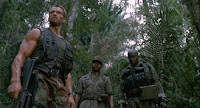
Predator begins with the team landing in Central America and getting briefed on their mission. They head into the jungle, locate the crashed plane, find the enemy camp, and have an awesome gunfight. Then Arnold discovers that Carl set them up and dumped them in the meat grinder. They head back out for the rendezvous… and that’s when they discover there’s something else in the jungle.

We’re, what… half an hour into the film at this point?

Except… that’s not how Predator begins. If you think back, the movie actually begins with an alien spaceship flying past Earth and launching off a small shuttle/ drop pod. We’re told in the first minute of the film that this is, ultimately, a sci-fi story. We may get distracted for a bit by the hail of bullets, but when the title alien shows up it isn’t a surprise… just a bit creepy.

On the other hand, one recent book I read was 100% set in the real world. Everything about it was realistic. The basic idea was two people who had found the last notebook of a dead research scientist who claimed (in his notes) to have discovered a cure for cancer. The cure for cancer. The entire book was about them trying to figure out what the heck they had while half a dozen pharmaceutical companies chased them—all wanting the notebook one way or another. Well, in the end they escape big pharma, sell the notebook to a group of researchers for a couple million dollars, and cancer is cured across the globe.

Yep. We cured cancer everywhere in the last seven pages. Go us.

I also once saw a script that started out as a dramatic comedy sort of thing. Young woman, single mother, trying to make the best of life even though she keeps getting knocked down… we’ve all seen it a few dozen times. That was the first forty odd pages. Then, on page 44, if memory serves (almost 3/4 of an hour into the movie, mind you), we discover that the old man she just helped cross the street is actually the Easter Bunny, who decides to reward the woman with a wish for her random act of Christian charity.

That’s right. A key point in this story is that the Easter Bunny spends his downtime walking among us disguised as an octogenarian. And the Easter Bunny is all about Christian charity because… well, the brown of the chocolate and the brown of the wood of the cross… or something…

Like any other disruption in the flow of a story, it’s very jarring when a story is set up in one world and then veers off into another one. It’s like discovering that one of your main characters has actually been insane all along. It forces the reader to re-examine what’s come before, and not in a good way. In fact, more often than not, these sudden shifts in tone and world force a story into pure comedy. Again, not in a good way.

Consider this. There’s a classic Saturday Night Live skit which claims to be the famous “lost reel” of It’s A Wonderful Life. In this, just as everyone’s sitting around singing and rejoicing, Uncle Billy remembers that he misplaced the money in the newspaper Mr. Potter took. It only takes a few moments for this realization to turn the celebrating friends and family into an ugly mob, and they march to Potter’s house, give the man a mass beating, and burn his home to the ground. The End. The Simpsons did something similar with a lost final reel of Casablanca. Here Ilsa parachutes out of Laszlo’s plane to be with Rick, saving him from (and killing) Adolph Hitler in the process. The happy couple is married shortly afterwards. The End…?

No, seriously. That’s how they “ended” Casablanca, with the ellipse and the question mark. Which, as Bart points out, leaves them open for a sequel.

So just by (hypothetically) shifting the tone/world of the endings, both of these classic, award-winning films become absurdist comedies.

Now here’s a key thing to remember. You can still have a fantastic story set in the real world provided the events of your story don’t change the world. If I wage a secret battle against lizard men from the center of the Earth and at the end of my story no one knows the war happened, then the world hasn’t changed, has it?

Perfect example—Raiders of the Lost Ark. Not only does this story involve a Nazi plot to seize arcane objects across the globe, it has reputable archeologist Henry “Indiana” Jones finding hardcore evidence that God is real. Think about the repercussions that information would have. If someone went public in the 1930s with absolute, undeniable proof of God’s existence, what kind of world would we be living in today? What kind of story would you be telling?
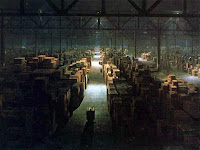
Which is why that evidence never goes public. We’re left with the distinct impression no more than a dozen people know what Dr. Jones recovered from that island, and that he’s been well-paid not to talk about it. And the Ark… well, we all know what happens to the Ark, don’t we?

I really, really hate to use this analogy, but it is perfect. If you want to set an amazing story in the real world, you need to use conspiracy theory logic. Yep, the same reasoning used by the birthers, moon-landing deniers, and “9-11 was staged” folks is what makes for a good fiction story. How sad is that?

By conspiracy-theory logic, the lack of evidence for X is the proof that X is true. Any facts that disprove X are manufactured by the powers that be, thus further proving X is true. And if you stumble across a few coincidences that imply X is true, well, that of course is solid proof that X is true.

Y’see, Timmy, by this chain of reasoning, the untouched real world is undeniable proof the imaginary world of your story is true. Only the BPRD knows what really happened to Adolph Hitler after the Occult Wars, so it’s understandable that most of us only know the publicized version of events. There are a dozen enchantments that keep the magical world of Hogwarts and Diagon Alley separate from the real world, thus the fact that no Muggle has ever seen Hogwarts pushes the idea that the stories about it are true. Only a worthy mortal can lift the hammer of Thor (bonus points if you remember its name—offer not good after Friday), but we all know we’re not 100% worthy so we accept that we’ve never had the chance to lift it. The fantasy world doesn’t change the real world, so that fantasy world is more believable.

So do amazing things in amazing worlds. Just make sure no one finds out about it.

Next time, I wanted to rant a bit about sounding like a professional.

Until then, go write.
April 30, 2011 / 5 Comments

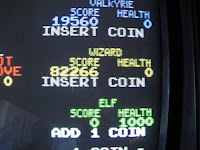
Wizard Needs Food

Extra bonus points if you get that pop-culture reference.

Sorry for the delay, too. Working out some final kinks in the new computer.
In my car, in that little bin they all have under the cupholder, is a blue and yellow card. It’s from a board game called Goosebumps, based off the book series by R. L. Stein. Many, many years back, when I was living in another city altogether, I was heading out to work and discovered someone had thrown away said game but missed the dumpster. The wind and backwash from other cars had blown pieces every which way. Plastered to the driver’s side window of my car, right by the door latch, was one of the game cards.

MAGIC RING
save this to fight
the headless ghost
Not being a fool, I saved it
Seriously, it’s out in my car right now. I kid you not. Yeah, you’re smirking, but we’ll see who’s laughing when that headless ghost shows up.
This is funny for a couple of reasons, not the least of which is a grown man driving around with parts of the Goosebumps game in his car. Plus, we’re all about 99.99% sure a headless ghost isn’t going to show up anytime in the foreseeable future. I didn’t save the card for its spirit-fighting abilities, just because it makes for an interesting conversation piece.
Okay… maybe I saved it just in case…
The card’s also funny because we can probably all agree most magic rings wouldn’t have an inscription that says save this to fight the headless ghost. Heck, in The Lord of the Rings Frodo’s ring was covered with writing, but nowhere did it say wear me to turn invisible and become a megalomaniac. Imagine how silly it would be if a character in a story decided to go hiking one morning, opened the fridge, and there was a raw steak labeled bring this to distract the mountain lion. The only thing more silly, in fact, would be if that character just randomly decided to bring a steak on their hike for no reason. And then a mountain lion showed up.
Wow. Lucky break there.
More than a few times—enough that I feel justified ranting about it—I’ve seen manuscripts or screenplays where characters randomly decide to do something. They’ll decide to go visit Mom’s grave in the country where they haven’t been in years. They’ll toss a first aid kit and some cans of soup in the back seat of their car for no real reason. Or maybe, for no apparent reason, they’ll decide to make a bomb shelter in their back yard.
Lo and behold. Ten pages later it turns out this was precisely the right thing to do. The character’s random, unmotivated decision was the right one to make. That bizarre object they decided to lug around is exactly what they need.

In my opinion, this kind of mentality grows out of videogames. Not the newer, sleeker ones, but the older ones. The game would only have ten or twelve things to pick up, so when you ran across one of them you knew it was going to be important and you grabbed it. This wasn’t really a fault of the games, mind you. It’s just that there wasn’t that much processing power or memory.
No metaphor there…
There’s two problems here, and they kind of build off each other.
First is that once a writer starts falling back on these sort of coincidences it removes any sense of challenge. We can’t be worried when Yakko is facing the living incarnation of the Babylonian goddess-dragon when he has the silver sword of Marduk that was specifically prophesied to kill her. If Dot is given an all-access passkey, getting locked in the sub-basement isn’t that big a deal. When I reveal my villain’s weakness is romantic poetry and a few pages later we learn the hero had a minor in Byron… well, personally I can’t get too invested in that.
Second is that it’s just shoddy writing. Depending on nothing but coincidence to drive the plot forward is like winning a game using loaded dice. I get to say I wrote a book and Wakko gets to say he won the game, but did either of us actually accomplish anything? Did either of us demonstrate any actual skill or ability? Heck, we weren’t even depending on luck. We handed the character A and then constructed a challenge that would be solved with A.
Sounds a lot like cheating, doesn’t it? On a number of levels.
Yes, William Goldman did precisely this in The Princess Bride with the holocaust cloak and the wheelbarrow. But he’s William Goldman and he did it perfectly. And I’ll save you some more effort—Phillip K. Dick already used the idea in a time travel story, and it was already adapted into a passable movie (both named Paycheck). Not to mention the fantastic Doctor Who episode “Blink” with the Weeping Angels. So give up any thought of doing something clever… unless you can do something incredibly clever.
The very nature of good writing is that the characters aren’t going to do everything right and everything is not going to work out for them. People need to face challenges and they need to overcome them.
Because we all know somebody who got everything handed to them in life. Thanks to TMZ and People magazine, we probably know a couple. And how did they turn out? Were they someone you wanted to follow and keep tabs on? Or someone you couldn’t wait to be done with?
Next time I’d like to talk about this world we live in. Most of us, anyway.

Until then, go write.
April 22, 2011

Beware the Bellboy

You’ll have to excuse me for running a bit late. My old laptop came to an unexpected end on Monday night and I lost the first draft of this post. Believe me, it was far more witty and insightful than what you’re about to read.

That being said…
As the story goes, there once was a young carpenter here in Hollywood who wanted to be an actor. He had trouble getting parts. The problem, according to his agent, was that the young actor sank too deep into his roles and never got noticed. He’d gotten a small supporting role as a bellboy and just vanished into the background. The agent pointed out that one of Tony Curtis’s first roles was playing a grocery store clerk, but he dominated the scene. “You looked at that guy and you knew he was supposed to be the star,” said the agent.
“I thought the point was you were supposed to think he was a grocery clerk,” said the frustrated actor.
And that young bellboy grew up to be Harrison Ford.
Who, let’s all be glad, also had enough sense to stop making Indiana Jones movies after Last Crusade.
(la la la la la la la la not listening la la la la la la la)
Anyway…
This fun observation by Mr. Ford hammers home a problem I’ve seen with a few narratives. It’s not uncommon for fledgling writers to center the narrative around a character and then tell a story that’s far beyond the scope of said character. nailing down the perspective a story is being told from is tough, and picking the wrong one can leave the story painted into one corner after another. This comes up most often in two forms—a first person person story and an epistolary story.
To recap…
In a first person story the reader gets everything through the eyes and thoughts of one of the characters. On the plus side, we get to know and see everything this character knows and sees. On the down side, we only get to know and see what this character knows and sees. First person is a very limited viewpoint. We don’t get the suspense of us knowing something’s happening that the character doesn’t know about. This also means we can’t be privy to extra detail, nor can we have any doubt if something did or didn’t register with the main character. To Kill A Mockingbird is a phenomenal first person novel, as are Moby Dick, A Princess of Mars, and Stephen King’s novella “Rita Hayworth and Shawshank Redemption.”
(Yeah, there’s no the in the original title. Seriously. Check it out.)
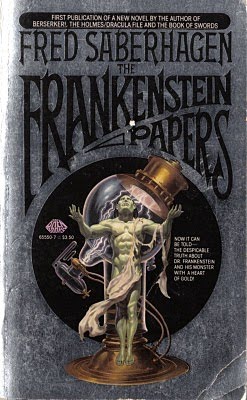
An epistolary novel is told through “existing” documents. As the name implies, it was originally letters, but it can also include journals, police reports, newspaper articles, and even blogs or tweets or social network updates. By its nature, a lot of epistolary writing comes across as first person, but there’s a notable difference. This form is very episodic. There are gaps in it where the “writer(s)” didn’t have time or inclination to put things down on paper. Dracula is an epistolary novel, as is Fred Saberhagen’s The Frankenstein Papers, and Mr. King did a rather horrific epistolary short story some of you may remember called “Survivor Type.”
Now the catch for both of these forms is that once a writer chooses to use them, they’ve just put themselves into what can be a very limiting viewpoint. If Wakko’s my main character, I can’t see, hear, or understand anything if he doesn’t. His limitations are mine. If he doesn’t know what happened out on Highway 10 that night, I don’t get to know.
More to the point, it’s going to make Wakko crumble as a character if he’s constantly stepping out of his boundaries. When he does know what happened out on Highway 10, as a reader I end up puzzling over how and when he found that out. If he suddenly reveals on page 120 that he studied Goju-ryu karate in Okinawa for twenty years, I’m going to wonder why this never came up before. Since I’m inside his consciousness, inconsistencies stand out like flares and each one means I’m going to believe in him less and less.
I recently read a book where the narrator goes to great lengths to tell us she has no writing ability. Oh, like anyone who graduated high school she knows the bare mechanics of how to write, but she’s not at that level that she’d consider herself a writer. Why, not counting work memos, this is probably the longest document she’s ever committed to paper (or computer memory). So hopefully we, the readers, will go easy on her as she tries to record the events of the past few days.
Said narrator then launches into a flourish of vivid metaphors, purple prose, elaborate sentence structure, and parallel constructions. This went on for the entire book. The vocabulary was the kind of stuff you might hear tossed around by Harvard alumns trying to outdo each other at literary conferences.
She did not come across as someone who never expressed themselves through writing.
Definitely didn’t sound like a grocery clerk.
Just as a quick note—some writers have managed to pull off stories where a first person character who should be ignorant of certain facts manages to convey enough information for the audience to understand what’s really going on. Perhaps he or she has some knowledge that goes against the character we’ve seen so far. We’ve all seen stuff like this. The illiterate guy who manages to describe a stop sign, the Neanderthal girl who explains a pistol, or the bellboy who it turns out has a degree in chemical engineering so he can help thwart a terrorist attack. You can get away with this once or twice, but it’s a device that wears thin fast so you shouldn’t be depending on it for an entire book.
Now, there’s a somewhat-related problem that tends to crop up in epistolary work. Some writers litter the journals and letters there creating with typos and misused words. The idea here is this makes the documents (and thus, the characters behind them) seem more real because they contain the kind of errors that real people make, especially folks who aren’t usually writing for an audience. And, let’s face it, it also spares those writers from learning how to spell or bothering to do any sort of editing.
The catch here is that any typo is going to knock a reader out of the story. It’s going to be an even bigger hit if the reader stops to figure out if this was a deliberate mistake or just… well, a mistake. Like up above when I used there when it should’ve been they’re. All of you stumbled on it, and a few of you probably stumbled even more as you paused to figure it out if, being the sneaky bastard I am, I was doing it for a deliberate effect. And I was. And you still stumbled and paused.
A great example of doing this correctly is the book Flowers for Algernon by Daniel Keyes. It’s the epistolary story of a man named Charlie who’s mentally challenged. If you felt cruel, you could call him severely retarded. The book, in theory, is a journal his doctors have asked him to start writing. It’s painful to read. Charlie can barely spell, has only the barest understanding of grammar, and no real idea how to express himself.
His doctors are giving him a series of treatments and surgeries, though, and as the book progresses the journal entries become clearer and more elaborate. At one point they actually get close to going the other way—Charlie has become so smart he’s taken over the enhanced intelligence project and is using his journal for research notes and brainstorming. Now the journal’s almost unreadable because it’s so advanced! The language he uses becomes one of the elements Keyes uses to show the reader how much Charlie is changing.
So one of the big tricks with these two formats is to create a character who’s believable and relatable, but still has the abilities, intelligence, and experience to deal with whatever challenges the plot may throw at them. A cheerleader may be great for figuring out who ruined homecoming, but not as much for an assassination plot. A Nobel-prize winning physicist isn’t going to be much help at harvest time. The trans-warp drive on a starship is probably going to be out of the range of the guys who work at Jiffy Lube.
Choose your character wisely.
Next time, I was going to blather on about the world we live in. Or, at least, the one we thought we were living in.
Until then, go write.
April 14, 2011

Jenga!

For those who never played it, Jenga involves making a tower out of long wooden blocks. Then multiple players take turns sliding the blocks out without toppling the tower. Eventually, though, someone will pull out one block too many and it begins to sway. It might stabilize. It might not. In the next turn or two that tower’s going to come crashing down into a pile of wooden blocks.

More on that in a minute…

I’ve mentioned the idea of withheld information once or thrice before, and it struck me that I’ve never quite explained what it is and why it should be avoided

So, hey… no time like the present.

Withheld information is when the writer or characters hold back facts from the audience for no other reason than to drive the plot forward. It’s the clumsy, unskilled version of mystery and suspense. I usually see it employed by novice writers who don’t have a mystery but are trying to create the illusion of one.

If you think of it in terms of Jenga, withheld information is when you know the next block is going to make the tower collapse… so you pass your turn to Wakko. Who in turn passes his turn to Phoebe. Who passes it to Yakko. Who passes it back to you. Yes, the game is still going on, but it’s only continuing because it’s stopped moving forward. And has become very boring in the process.

Like Jenga, information in a story can hit a certain tipping point. There comes a time when you have to tell the reader everything because it’s foolish not to. I can have the mystery, I can have the characters discover the answer… and then I need to let the audience know the answer.

At some time or another, most of us have been in a position where we have a vested interest in not answering a given question. Or taking as long to answer it as possible. A few such questions are….

“How old are you?”

“Do these jeans make me look fat?”

“Are you claiming this as a deduction?”

“Did you eat the last piece of cheesecake?”

“Is that lipstick on your collar?”

Now, by the same token, there are questions that should take no time at all to answer. When life and limb are at stake–or when nothing at all is at stake–nobody beats around the bush. These are the times you have to seriously wonder why someone isn’t answering a question–and they’d better have a damn good reason for not answering. I loved LOST. Absolutely loved it. But it did suffer when Ben became a regular part of the cast because we all knew that he knew stuff he wasn’t telling us. While there were still lots of cool mysteries on the island… well, there were also lots of things where it was just Ben sitting there with his lips pressed together in that creepy flat line.

There’s a sci-fi show on right now that suffers from this. I won’t name names, but a third of the show is the government trying to figure out what a group of humanoid aliens are up to, a third of it is one lone character trying to find out the alien secrets that are keeping him from his girlfriend, and one third of the show is the aliens themselves. And the aliens tend to talk in very vague, general terms, like they think every room and car they’re in is loaded with listening devices.

You can probably see how the writers have put themselves in a corner. If the aliens talk freely, it kills the mystery for the other two-thirds of the show. If they don’t, a third of the show becomes obtuse for no reason except to keep the other two-thirds going.

Now, there is a point when the pendulum swings even farther. Sometimes the information has been revealed, but people keep acting and insisting it hasn’t. So the audience is left drumming their fingers while they wait for the characters to learn something that’s already known.

I read a book recently that suffered from this twice-over. First, much like my own Ex-Heroes, it switched styles and viewpoints now and then. Every second or third chapter was done in epistolary form, a series of 16th century letters between a spy and his master, encoded with an elaborate, almost unbreakable cipher. Sounds kind of interesting, yes?

Thing is, most of the other chapters were about a search for the key that would let the modern-day characters read those letters. They’d go on and on about how important it was to decode them and learn the secrets contained within, etcetera, etcetera. So the motivation for a big chunk of the plot–maybe a third to half of the book–was deciphering some letters that had already been deciphered for the audience.

In the same book, though (twice-over, remember), one of the characters also had a secret. I felt there were a few too many clues, but overall it was passably hidden (I guessed it a third of the way in). At the halfway point, two different characters (solving different halves of the secret) came together and realized their halves met to form a whole. I felt clever. The characters didn’t realize what they’d discovered. The “secret” went on and on and was finally “revealed” in one of the final chapters.

In other words, for most of the book the reader is waiting for the characters to catch up.

To keep up our Jenga metaphor, this is when the tower has collapsed but your host is insisting you keep playing. So everyone’s sitting there picking up little wooden blocks off of the tabletop and telling themselves it’s a fun game of skill.

Now, I’d also like to point out that there are times when the audience does know things the characters don’t. That’s where we get suspense, and suspense is great… if it’s real suspense. Y’see, Timmy, one of the keys of suspense is that the characters don’t know they’re lacking this information, but it’s very important they learn it. Life-threateningly important. In suspense the stakes are high and they’re almost always personal. It may not be my life that’s in danger, but maybe the life of my girlfriend, my brother and his family, or even my cats. It’s tough to have good suspense without high stakes that matter to me. And the thing about high stakes is that they eventually have to pay off.

Hitchcock spoke of the bomb under the table (or was it under a chair? Or under the car…?). Wakko doesn’t know it’s there. The audience does. We can see the countdown timer and we know Wakko’s life is in danger. But if the bomb never goes off or Wakko never finds it, that bomb is just as frustrating as the pile of wooden blocks.

So, to recap, here are three great story elements that are not withheld information.

A mystery is when the main character and the audience are aware that a piece of information has been hidden from them, and the story usually involves the search for that unknown fact. At it’s simplest, a mystery is a question someone in your story is asking and trying to find the answer to.

Suspense is when there’s an important piece of information the audience knows and the characters don’t. The key here is that the characters don’t know that they need to know this vital fact. The bomb under the table. Wandering off with the murderer. These are common suspense situations.

A twist is when a piece of information is revealed that your characters and the audience didn’t know was being kept from them. They don’t even suspect those facts are out there, waiting to affect the story. When a twist appears, it comes from out of nowhere and changes a lot of perceptions for the characters and the audience. We’ve all made the natural assumption that Luke Skywalker’s father is dead, so when we learn that Vader is his father, it’s a bombshell that alters our view of everything.

If you’re trying to use one of these devices, make sure you’re using them correctly. Don’t just withhold information from your audience. Your characters should be just as smart and clever as your audience, and if they aren’t talking, make sure there’s a real reason why.

Next time, a wonderful story about Harrison Ford and a bellboy.

Until then go… you know. Do that thing. The thing we were just talking about. That.

Categories