
September 8, 2011 / 12 Comments

An Ode to OED

No, don’t worry. There will be no poetry.

There will, however, be mocking. And some shameless plugging.

Ex-Patriots is now out in both paper and ebook formats, available pretty much anywhere fine books are sold. Mysterious Galaxy, Barnes and Noble, Amazon, Bord… well, okay, not Borders. But I got to see Ex-Heroes there a few times, at least. Please feel free to pick up a copy.

Anyway, let’s talk about the Oxford English Dictionary. Or Webster’s, if you prefer. I’m actually a dictionary traitor. One of my college professors was on the OED board and I have a huge Webster’s dictionary on my desk.

But I digress… again.

Remember last week’s little rant about tools? Those folks who insist on carrying their tools around one at a time even though it makes the job take ten times as long? Well as bad as it is to be the person showing up on the jobsite with only one tool at a time, imagine if someone showed up with a basic tool they didn’t know how to use?

Seriously–what would you do if you were the foreman and one of your workers–someone who claimed they were a skilled, professional carpenter–admitted they had no idea how to use a hammer? Their excuse? “Well, y’know… I always work with Wakko, and he does all the hammering. So, really, I don’t need to know how to use one.”

Would this guy still have a job at the end of the day?

And yet, it’s stunning how many would-be-writers—people trying to convince publishers that they’re skilled professionals—don’t know how to spell. Their excuse? They’ve got a spellchecker on their computer. It already knows how to spell, so why should they learn how?

Words are our tools, and knowing what they are and how to use them is the most basic skill any of us has to have if we want people to take us seriously as writers. If you don’t know how to use them it is painfully obvious to someone who does.

Let’s go over a little list of words and see how many definitions you can get.

pour, poor, and pore – only one of these means to read intently

confirm and conform – one of these means to become similar

faze and phase – only one of these deals with a blow to the head

role and roll – only one of these is a list of names

further and farther – one of these usually refers to physical distance

glutton and gluten – only one of these words is a person

desert and dessert – only one of these comes after supper

barely and barley – one of these is a food source… almost

satin and satan – one of these is a silky fabric

lightning and lightening – only one of these is an atmospheric event

conscience and conscious – one means being awake

Done with the list? Good.

Now, I’m sure two or three of these made you laugh. Satan and satin? Really? I mean, they’re so obviously different words only a complete idiot would mess them up, right?

Bad news, everyone.

Your spellcheck program is a complete idiot. It’s the worst writing partner you could possibly ask to have. As far as it knows, your main character is supposed to be making a gluten of himself by shoving barely down his throat for desert.

Y’see, Timmy, whenever I make these lists they’re from words I’ve seen misspelled in manuscripts or screenplays I’ve been given to read. Not once or twice in a hundred pages but consistently. These are all mistakes made by people who were trying to convince me (or, through me, someone higher up) that they know how to write. People claiming to be professionals.

One story I recently read had someone trying to resist the temptations of Satin all the way through it (which makes it sound like a very different story, believe me). The power of Satin, get behind me Satin, resisting the will of Satin, all that. If the writer hadn’t asked an idiot to check the whole thing for them, they wouldn’t’ve had that problem. And my opinion of the story wouldn’t’ve dropped every single time I came across it.

I’ve said many times before that people need to buy a dictionary, and more than once I’ve gotten a chuckle from folks over it. After all, the computer does that sort of thing for us, right? Silly dinosaur, telling people to resort to books. Modern writers don’t need such antiquated tools.

As the above list proves, though… a sizeable percentage do.

Using a dictionary doesn’t just mean looking up how a word is spelled. It also means you’re going to look up what the word means. These two things are inherently bound together in a dictionary and they’re not in a spellcheck program. I look up barely and realize it’s not a grain, it’s an adverb. I also just learned that baresark is another form of berserker, which I can probably file away and use sometime later.

But the spellchecker? It looks at barely, grins, and gives you a big thumbs up. “Looks cool—send it off to a publisher.”

Plus, when you use a dictionary, odds are you’ll learn something and not need the dictionary next time. My mechanic’s worked on my car a few times, but I didn’t learn anything about auto repair because I wasn’t the one doing the actual work. I’ve also gone out to eat several times, but having someone else cook for me didn’t teach me anything about cooking. If your writing partner’s doing all that vocabulary work–idiot or not–how do you expect to learn anything?

I’m about to start my fifth novel. Not my fifth attempt at a novel. Not my fifth manuscript to sit in a drawer. My fifth already-got-a-contract-and-deposited-a-nice-advance novel. And I still reach for the dictionary at least once a day to make sure I’m spelling a word correctly or that I’m using it correctly. Using the dictionary doesn’t make me a lesser writer. It makes me a better writer. I’m the guy who shows up at the jobsite with all his tools and who knows how to use them. I don’t need anyone else to do the work for me. Which is why I’m the guy the foreman hires again and again.

If the foreman didn’t hire you… maybe it’s because you’ve got an idiot for a partner.

Not sure what I’m going to rant on about next week. I’ve got a half-formed post of random screenwriting tips. Also got one on villains. And the bare bones of one about motivations…

Any of those sound interesting? Let me know.

Until then, go write.
September 2, 2011

The Sonic Screwdriver

First off, my apologies for running late. Lots of work on the new book.

Second off, a bit of shameful self-promotion. If you haven’t picked up my “debut novel” Ex-Heroes, the publisher’s put the ebook version on a fantastic sale right now. $2.99 for the next week (starting today). Kindle, Nook, Kobo, whatever. If you haven’t grabbed it, now’s a great chance. If you’ve been pushing a friend to get it, tell them about it now. Or just buy it for them. After all, the sequel’s out in about four weeks.

And now, with that ugly bit of capitalism out of the way…

If you’re a big fan of Doctor Who (like me), you know the sonic screwdriver is about the most useful tool ever invented. It opens and closes locks, takes readings, repairs barbed wire, gives phones universal roaming, acts as a TARDIS remote control, and hundreds of other things. Put simply, it’s the greatest all-in-one tool that has ever existed.

Alas, most of us just have to buy a whole tool box worth of stuff. Hammers. Wrenches. Pliers. Tape measures. And of course, screwdrivers. But it’s not enough to have all this stuff. You can only really work on something if those tools are handy.

For example…

Let’s say your significant other comes home from the market and says “Hey, the flux capacitor on the car isn’t fluxxing. You might want to check it out.”

So you go out to the car and see you need a screwdriver to open the housing on the flux capacitor. So you go back inside, dig your toolbox out of the cabinet under the sink, and get a screwdriver out. Then you go back out to the garage and discover you needed a Phillips head screwdriver, not a flathead. Head back in, grab a Phillips, back out to the garage.

You get the housing open on the flux

I’m sure you can all see what’s going wrong here. It’s not that we’re trying to fix the plutonium intake when the problem’s clearly in the flux dispersal array. The problem is that we’re attacking this project piecemeal, trying to solve it a single element at a time, and in doing so things are dragging out far longer than they need to. Unless you’ve actually got a sonic screwdriver, you can’t grab one tool out of your toolbox and go see what the problem is. You also don’t go check the problem, walk back, and grab the next item you need at this particular stage.

No, you take the whole toolbox. You bring everything. Because it’s worth the little extra effort to have it all handy and there to work with if you need it. Yeah, you’re not going to use every single tool you brought out there, but the amount of time you save is worth that initial extra effort.

For the record, my friend Laura got me a sonic screwdriver for my birthday.

But that’s not important right now.

How many of you have figured out the point of this little scenario…?

A lot of people take forever when they write. Years and years. Sometimes it’s basic procrastination, yes, but sometimes it’s just that they’re trying to get every single element right before they put it down on paper (so to speak). They won’t write one word unless they know it’s the word they’re going to have in the final draft. So each sentence takes hours and each chapter can take weeks.

Now, there’s nothing wrong with wanting to get things right. That’s the whole point of feedback and editing and doing multiple drafts. Thing is, you can’t do a second draft until you have a first one. Which means the entire process is really at a dead halt until that first draft is done.

When I sat down with my new project, -14-, I spewed out pages and pages of stuff over three months, and soooooooo much of it got cut in later drafts. A lot of it got reworded and some of it got completely rewritten. But I was able to keep working because I had stuff to work with.

Y’see, Timmy, it’s always better to have something to work with than to have nothing to work with. Don’t be scared to put everything in your first draft. Bring it all. Don’t hold back because you think you might not need something or it might not work. Write bits you know you’re going to cut and characters you know are going to be trimmed out. Because you can’t edit or rewrite a paragraph that doesn’t exist.

Next week, unless I get a really cool request or suggestion, a little free verse love poem about the Oxford English Dictionary.

Until then, go write.

August 19, 2011 / 1 Comment

Stop Me If You’ve Heard This One…

My apologies for not posting anything last week and being late this week. To be honest, I was so wrapped up in the new draft of this book I forgot what day it was. Soon the fall season will start back up and I’ll be able to tell where we are in the week by episodes of Fringe and Castle.

Anyway, there was a suggestion for a topic and it got me thinking about something funny…

A joke is a great diagram for a story, because all good stories have a setup and a punchline. Not in the sense of evoking laughter, but in the sense of that one beat near the end that strikes a chord and gives you a little rush. In jokes and stories, you have a setup and a payoff. For example…

A nun, a priest, and a rabbi walk into a bar. The bartender looks up and says “What is this, a joke?”

It’s very short, but it does the job. It’s just setup, payoff, done. That first sentence is the setup. To be exact, it’s a type of setup we’ve all heard a dozen or more times, which is what makes the second sentence (the payoff) funny. Adding in other elements would just slow the story—the joke—and probably detract from the punchline.

Now, let’s take this a step further. Has someone ever told you a longer joke, maybe one that took a minute or three to tell? If they knew how to tell it, odds are you chuckled a couple times during the setup, yes?

In this case it’s not just the A-B of that first joke. We’ve got A-B-C-D and then the payoff of E at the end (E is for end, after all). There’s enough space to work with for B and C to be a bit funny themselves and get that extra chuckle before the punchline.

Here’s the thing to keep in mind, though. B and C are still serving the greater payoff of E—the greater good, if you will. They aren’t filler or random asides. Even though they get a laugh of their own, they’re necessary steps on the way to the punchline.

This is a lot like your standard short story. Most of them really just have one big payoff and that’s it. Think of some of the collected stories in Isaac Asimov’s I, Robot or most of the classic Sherlock Holmes tales by Arthur Conan Doyle. The characters set out to accomplish goal A and by the end of the story they’ve done it. Or, in a few rare cases— “Evidence” and “A Scandal in Bohemia” come to mind—they admit they haven’t.

Even though they’re two hours long, most feature-length scripts tend to have more in common with short stories than books. In fact, if you talk to lots of screenwriters, they’ll tell you it’s always easier to adapt a short story than a novel. Most of us have read a short story and thought it would be fun to see more of him or learn about her backstory and maybe get a better sense of what happened there. That’s the stuff which is great to expand on in a screenplay. If you look at most films, you’ll see that they’re still a pretty straight line from A to E (or maybe up to J with the expansion). You may have heard some guru-types calling this the through-line. It’s how you make way through a story (or a joke) without any odd segues.

Look at the first Pirates of the Caribbean movie. There’s one main story—catch the Black Pearl, stop Barbossa—which is made up of two side-by-side stories (arguably three). Despite this, though, each one of these elements has a very simple and clean A-B-C-D story. Will just wants to rescue Elizabeth, and all of his scenes reflect that. Jack just wants to reclaim the Black Pearl and sail free, and all his scenes reflect that.

Also, as I mentioned above, adding in unnecessary clutter would just slow the story—either the individual element or the film as a whole—so there isn’t any. Will never has a segue where he rescues puppies from a burning building or decides he needs to learn karate to rescue Elizabeth. Jack seems very scattered at first, but as the movie goes on it becomes clear how sharp and how focused he really is. Every scene in the film, no matter which thread it’s part of, is leading us to the same big payoff.

Let’s go another order of magnitude bigger and consider novels. The average novel’s going to be six or eight times the word count of most screenplays. It’s where the writer’s got time and space to go all out. We’ve now got A through Z. Maybe it’s even looping around to something like A through AF or something. The writer has a little more space to wander down those paths or maybe take the scenic route to their destination.

Good analogy, that one. Remember that when you take the scenic route, as a writer, you still need to get where you’re going. When you go down a random road for no reason it doesn’t matter how pretty the foliage is at this time of year. If there was no purpose to it you weren’t on the scenic route—you were lost. It’s cool that you enjoyed being lost and you got some nice pictures, but not everyone’s going to feel that way. A lot of folks are just going to see four hours of driving time they lost.

So even in a book, with all that extra space for plot and characters, you need to be aiming for that big punchline. Each of those smaller elements that got a chuckle are expected to get a full laugh on their own now, but they’re also still expected to serve the greater good. Remember, you don’t want to drop 4-5-6 in the middle of H-I-J-K-L.

Here’s another tip. Have you ever heard the term “episodic” used to describe something. Yes, television, of course, but there’s a reason for that. When something is episodic, the setups and payoffs come one after another. A is the setup for B, C is the setup for D, E is the setup for F, and so on. Think of older videogames where you’d move from one level to the next. New problem, solved, next problem. You rarely got a sense of the big story because nothing carried over. That’s what episodic writing does–it presents challenges that are immediately dealt with, so the story feels more like individual episodes than a coherent whole. To use our joke analogy, it’s the difference between a two hour stand-up routine and a two hour comedy movie.

If your story involves multiple setups and payoffs, take a second look at where they fall. Make sure they’re spread out, and make sure they’re all leading somewhere. Hopefully the same somewhere.

Finally, here’s a little exercise for you. Yep, there’s homework. I’m sure at some point in your life you’ve had to listen to someone who didn’t know how to tell a joke. So ask yourself—what did they do wrong? Was it their pacing? Did they give away the punchline to soon? ‘Cause the real trick to telling a good joke is being able to tell a good story. If you don’t know why they did it wrong… are you sure you aren’t?

Next week, why you should never carry just a screwdriver.

Unless you’re the Doctor, of course…

Until then, go write.

August 4, 2011 / 4 Comments

Simpsons Did It!

A pop culture reference that’s so spot-on it’s not even funny.

Okay, it’s a little funny…

(General Disarray, go get the minions before they get lost…)

One of the big worries with creativity is wondering if you really are being creative. Is that clever new idea of yours something you came up with all on your own, or is it something you unwittingly borrowed from someone else? Maybe you skimmed over the back copy of a paperback in your local neighborhood bookstore or read a few spoiler-filled reviews on Amazon and your brain just filed it away. Worse yet, what if your clever story gets out there and then you discover five other people already had similar ideas. Now you just look like some hack plagiarist.

I’ve been involved in a bunch of discussions about stuff like this in the past few weeks. Has anyone crossed X with Y before? Have you ever seen this element used in that genre? What about that plot but in this setting?

The answer to all of these, alas, is yes.

Some guru-types like to drawl on about how there are only seven stories (or nine, or thirteen, depending on who’s selling what this week). While I think this is an oversimplification, it does point out an obvious truth. Most stories have things in common with other stories. That’s just the way of it. The same type of characters show up. The same situations arise. The same relationships form.

Here’s a random observation for you. When was the last time you met someone who didn’t remind you of someone else? Think about it for a minute. When we were little everything was new and fresh but as we got older we started to see patterns and similarities. A guy I met at a birthday party last weekend reminded me of a guy who lived across the hall from me in college. When I first met her, I thought my girlfriend looked a lot like one of my next-door neighbors. A production assistant I used to work with looks kind of like a sound mixer I know in San Diego. Another one reminded me of my cousin Chrissie crossed with a bit of Angelina Jolie (a very good mix, I have to say).

But those are all first impressions. As I delve deeper, I start to see the uniqueness of each person. The better I got to know them, the more Leo, Colleen, Russ, and Sarah became individuals and those superficial similarities dropped away.

Still, those initial generalities can be a bit bothersome. If there’s something else out there that’s similar to your work, should you worry about it?

Probably not.

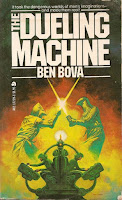
Submitted for your approval is The Dueling Machine. It’s a 1969 sci-fi novel by multiple-Hugo-award winner Ben Bova. In the far, far future, a brilliant scientist has created a machine to help reduce hostility. It’s “a combination of electroencephalograph and autocomputer” which lets two or more people connect their minds through the machine and interact in an imaginary dream world that they create inside the machine. The story comes about when someone is killed during one of these “simulated” duels—is it possible that dying in the imaginary world could make someone die in the real world?

Hopefully this premise sounds a bit familiar to you. It should because it’s a big chunk of the plot to The Matrix movies. And The 13th Floor. Also the Lawnmower Man films. Plus there’s a few books like Cybernetic Samurai and Snow Crash and Giant’s Star. And that television show VR5 that was on for a while. And about a hundred Star Trek episodes where people get trapped on the now-deadly holodeck, because the holodeck safety systems are apparently made of cobwebs and wet tissue paper. Heck, you’ve all probably got a dozen more at your fingertips, don’t you?

For the record, there are also dozens of books and movies and television shows featuring vampires in space (one’s actually called The Space Vampires—it was the basis for the movie LifeForce). And zombies in the old west. And new takes on time travel, space travel, politics, Jekyll and Hyde, all that stuff.

Now, this doesn’t mean that most stories copy other stories. We all draw from a lot of the same sources, so our thoughts are going to follow a lot of the same paths. But even on those paths we’re all going to march to the beat of our own drummer, so to speak. We’re also going to dress differently, bring different things with us, ask different people to come along, and we’re all probably heading down that given path for different reasons.

Y’see, Timmy, we put our own stamp on everything we do. If I did a modern version of Dracula and you did a modern version of Dracula, neither of us would end up writing Salem’s Lot, which was Stephen King’s modern version of Dracula. You might stick with Europe, but I’m probably going to set mine in southern California. We’d have our own ideas and notions and way of looking at it, just like Mr. King did.

Now, there’s a downside to this apprehension, too, and it’s kind of similar to the people who won’t write anything because they’re too busy learning how to write. Sometimes we—yes we—get so caught up in worrying if something is original that we grind to a halt trying to prove it isn’t. This desperate need to avoid being a copycat brings things to a dead halt.

True story —I was working on a book a few years back (right before I was inspired to start Ex-Heroes, in fact) called Mouth. As I was typing away, I suddenly came up with the coolest way to explain teleportation ever. I mean, this was Stephen Hawking-level brilliant. It was, if you’ll pardon the phrase, sheer elegance in its simplicity. I typed up a quick scene where Character A explained it this way to Character B, read through it, and realized it was even cleverer than that.

Too clever, in fact, for a guy like me to come up with it. It was too clean. Too perfect.

In a panic, I wracked my brain trying to figure out where I’d heard it before. Because I must’ve seen this somewhere. Online? In a comic book? All I was reading at the time was Amazing Spider-Man and that was all packed full of “Civil War” nonsense. Maybe a television show? What had we gotten from Netflix in the past few months?

I asked my girlfriend to read it. I figured she might recall whatever this source was, because I kept drawing a blank. She went through the chapter, got to the questionable explanation, and loved it. When I asked her where she’d seen it before, she couldn’t remember ever seeing it. After I pressed her for a bit and she re-read it again, she admitted it was vaguely like the explanation of “tessering” in Madeline L’Engle’s classic A Wrinkle In Time, but only in that it took what was plainly a very complex idea and boiled it down to an extremely simple explanation.

In other words, it was all mine. But I wasted a week worrying over whether or not I’d copied it.

Do a quick look at your chosen field. Make sure no one’s done something exactly like your idea. Then just write. Your own style and vocabulary and characters will give it a flavor all its own.

Like the Buddha says, don’t sweat the small stuff.

Next time, if I don’t get any suggestions, I may have to fall back on spelling.

Until then, like I just said, go write.

Categories