
September 21, 2012

One Step Ahead

            First off, if you want it, there’s kind of a bonus post this week.  Go check out Ebon Shores, a great little horror site from down under, where I was asked to prattle on for their “Wednesday Writer” column.  Actually, page through some of the past ones, too.  There’s a lot of really good stuff there.
            Speaking of horror…
            By nature of my chosen career, I tend to read and see a lot of horror stuff.  Specifically, post-apocalyptic stuff, usually with some form of zombie in it.  And there’s a certain recurring flaw that always gnaws at me. 
            It’s when characters do or say things that experience says they shouldn’t.  The kind of things that common sense tells you they should’ve figured out not to do or say ages ago.  How often do you see zombie hunters in t-shirts, even when they know one scratch could mean death?  Or that one guy who sets his gun down and walks a few yards away from it?  Or, knowing there could be zombies in the area, they reach into the dark room and start feeling around for a light switch with their one, ungloved hand…
            Or sometimes it’s what characters don’t do.  They’ll find a door and talk about how it might be locked, how it could be dead bolted, or how there may have been a cave in that’s blocking it from the other side.  The one thing none of them will do is actually attempt to open the door.  And if they did and it didn’t open, it’d never occur to them to try that key they found on the floor down the hallway.  Even though they know there’s a zombie apocalypse going on, they’ll forget to barricade windows.
            Simply put, it’s when the readers can see one step ahead and the characters can’t.  It’s when the audience can foresee the consequences of an action (or inaction), but the people in the story don’t.  And if the reader stops to think about that sort of thing, then I’m doing something wrong as a writer.  It means my characters’ choices or actions are breaking the flow of the story.
            There’s a very, very bad sequel to a very, very good classic World War Two movie.  Early in the film, our heroes arrive in Germany in a stolen plane.  The plan is to pose as German soldiers and officers, sneak away, and then begin their mission behind enemy lines.  It’s only after the four hour flight, as the plane is taxiing to a stop at the end of the landing strip, that the mission commander realize the one flaw in their plan.  One of the team members is a black man!  How will they pass him off as a Nazi?
            The resolution was kind of clever in that quick-fix sort of way, but it didn’t change the fact that the whole situation was stupid as hell.  The one question everyone asks at this point is “Why the hell did no one think of this before?”
           Y’see, like most readers and movie watchers, I have a tendency to think about what I’d do in a given situation.  I’d punch that guy.  I’d lean in and kiss the girl.  I’d make sure my shotgun was loaded beforeI stepped out into the zombie-filled hallway.  And nothing frustrates me more as a reader than when I see an immediate, obvious flaw in a character’s motivations or actions.

            That’s not to say every character should react like me (or you, or that guy).  If the writer’s got any sense of empathy, though, I should at least be able to see why characters make the choices they do.  I might’ve punched that guy, but Jack Reacher might be biding his time or just trying to keep a low profile and not to stir up too much trouble.  Many of us might’ve leaned in to kiss Elizabeth Swann, but we all understand why Will Turner feels bound by duty, honor, and social mores to let that opportune moment slip by. 

            Y’see, Timmy, one of the best things I can do as a storyteller is think one step ahead.  For the most part, the audience shouldn’t be able to think of something I didn’t already think of.  Oh, there’s always going to be that five or six percent who shriek about “totally obvious” things, but forget them.  I don’t need to cover everything, I just need to answer the immediate questions.
            “Hanging a lantern on it” is a great example of being one step ahead.  I know this odd coincidence is going to bother the reader, so I’ll have one of my characters point out how odd and coincidental it is
            LOSTdid this a lot to help take the edge off some of the oddities of the island and the plot devices they needed to further the story.  Hurley questions why there’s a brand new washer and dryer set in the otherwise very retro underground station called The Swan.  Kate and Sun wonder what kind of person travels with a pregnancy test.  Ben questions the odds of a spinal surgeon literally dropping out of the sky just a few weeks after he learns he’s got a tumor on his spine.
            Looking ahead can also be a good gauge for exposition and figuring out how much is too much.  In a couple of my books and novellas I have scenes of scientific jargon and techno-speak.  But I don’t need to explain things out in full and exacting detail.  I just need to be one step ahead and address enough points that my story doesn’t get hung up on my lack of explanation. 
            In Ex-Patriots I explain that the military’s been “training” zombies to follow simple orders.  But I don’t leave it at that.  In the same chapter I introduce the idea of the Nest—a NEural STimulator—which sends electricity to parts of a zombie’s brain in order to reactivate it.  I don’t need to explain what parts of the brain, how much voltage or amperage, or how they first tested it.
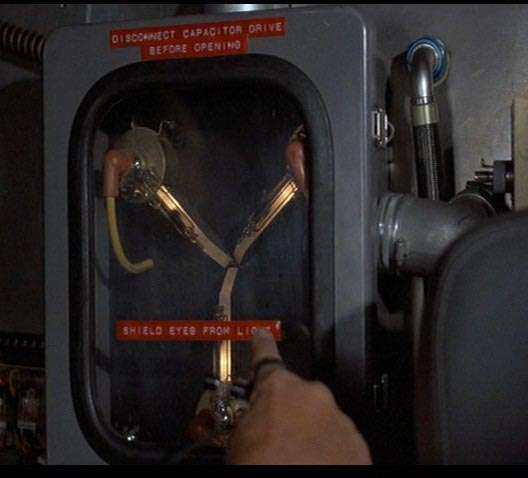
            A famous example of this is in Back to the Future, when Doctor Emmet Brown tells us he’s made a time machine out of a DeLorean.  Even as we’re processing this, though, part of us wondering… well, how?  How does someone turn a sports car into a time machine?  It’s kind of goofy and ludicrous all at the same time.  And then Doc shows us the flux capacitor and tells Marty (and the audience), “this is what makes time travel possible.”  And it’s glowy and it buzzes and, well… yeah, okay, that makes sense. A DeLorean on its own couldn’t travel through time, but a DeLorean with a flux capacitor channeling 1.21 gigawatts of electricity…
             Doc’s addressed our question before we even got to ask it out loud. So the story never pauses and we get carried along into the next bit.  And the DeLorean goes down in history (no pun intended) as probably one of the top three fictional time machines.
            Sometimes all staying ahead takes is being aware of where the characters are in the story.  If I’m confusing the first time I’m showing something to the reader with the first time the characters have seen it, that’s going to lead to problems.  There are mistakes and screw ups that we’ll accept from amateurs in any field, but not from people who’ve supposedly been doing this for a while (whatever this is).  If my plot point depends on a Master Sergeant in the Army not knowing how to load a pistol or the head chef at a restaurant not being able to tell salt from sugar… well, there better be a damned good reason for it.
            Stay one step ahead of the reader.  Know where they’re going to go, be there waiting for them, and guide them back to the path you want them on.  Not the path where they growl in frustration and shout “Why the heck did they…?”  And then toss your manuscript in that big pile on the left
            Next time, by request, I wanted to talk about how you can use plot and story to develop an idea.
            Until then, go write.
September 15, 2012 / 4 Comments

This AND That

            Sorry for the delay.  I was out of town all of yesterday and a lot of today’s been spent playing catch up.  Of course, if I’d been thinking ahead, that wouldn’t’ve happened. And I’d have that post about thinking ahead done.

            Instead, let me give you a quick tip.  This one’s inspired by a book I just finished reading.  It frustrated me on several levels…
            One of the joys of being an author is finding clever ways to influence the reader.  When I know I’ve guided the reader down one path of assumptions—or maybe away from the correct set—that’s a great feeling.  There’s a lot of ways we can do this, but the most common one is formatting.  After all, the way the words sit on the page affects how the reader takes them in, and if I’ve got a good grasp of how said reader will interpret that layout, it lets me manipulate them a little more.
            The catch here is that I can’t use the same formatting trick for multiple things.  If we were watching a movie and I told you all the people dressed in red were robots, and then the movie introduced a dozen characters in red who were aliens, there’d be some serious problems with my interpretation of the movie.  If I establish that every scene with blurry edges is a flashback, I can’t also use blurry edges to mean a character is having a clairvoyant vision.
            For example…
            In Ex-Heroes the character of Zzzap always speaks in italics without quotation marks.  Like I mentioned above, it’s a visual trick to show that, in his energy form, he doesn’t sound or talk quite like a normal person.  His voice has a buzz, an edge, that separates it from normal dialogue.
            The catch is that it means I have to be very, very careful about using italics anywhere else.  A lot of authors use them to indicate a character’s thoughts, but that was right out for me.  It’d get too confusing—especially in any scenes Zzzap was in.  And confusion is one of those things that breaks the flow of a story.
            The same with emphasis.  It’s common to use italics when you really want to accent something.  But I had to be careful using them in Ex-Heroesbecause if I led off a sentence with italics it’d look like Zzzap was speaking.   And if that causes a moment or two of confusion, well… there goes the flow again.
            In the book I just finished, the author used quotes for dialogue, but he also used them for character’s thoughts.  So more than once there were paragraphs like this…
            “Okay, nobody move!” shouted Phoebe.  “The shock of me yelling should keep them off guard for a few moments,” she thought.  “Put your hands behind your heads and get on your knees,” she continued out loud.
            See the problem there?  There were maybe a dozen points in the book that shook me for a moment, and at least half a dozen where it broke the narrative and I had to look back to figure out if that last bit had been spoken or thought.  That’s almost twenty chances for me to put the book down in frustration.
             If I want to do something different in your manuscript, format-wise, that’s fantastic.  Hell, Cormac McCarthy has pretty much built a career of it.  But I need to be consistent.  I can’t say that all dialogue will be in quotes and also have thoughts in quotes.  I can’t tell you that writing in all caps means text messages but also have it indicate telepathy two pages later.
            Make sense?
            “Make sense?”
            MAKE SENSE!?!?
            Thinking ahead to next time, I’ll have that post about keeping ahead done by then.
            Until then, go write something.
            And be consistent about it.
September 7, 2012 / 6 Comments

The Deadly Triangle

            You know who likes triangles?

            Pirates and ninjas. 
            Just saying.
            However, since no one here (to the best of my knowledge) is either a pirate or a ninja, I should probably just talk about how writers deal with triangles.
            Triangles are a form of conflict we’ve all come across.  Probably one of the easiest a writer can create.  It’s when a character (A) has to choose between two options (B and C).  A is pursuing B, but it’s clear C should be the priority.  Making the decision between B and C provides the conflict, the drama, and maybe even some comedy depending on how it’s done.
            We’ve all heard of romantic triangles.  It’s one of the most common ones out there.  Phoebe is dating Wakko, but then comes to realize her best friend Yakko is her real soulmate.  Bob is engaged to a bridezilla, but can’t help falling for the caterer.  The standard in most romantic triangles is that B is very clearly not the right person for A, while C is so blatantly right it’s almost frustrating.
            Another triangle most of us have probably seen is the “work vs. family” one.  Will Doug choose to spend the weekend with his family or working on the Hammond account?  Mary’s training so hard with the team that her relationship with her boyfriend is starting to suffer.  There are a few versions of this.  Sometimes it’s friends instead of family.  It’s usually work on the other leg, but it could be any sort of mild obsession or compulsion.  Am I choosing my best friend or this treasure map?  My pets or my new apartment?
             Triangles are great because it’s a very simple plot and framework that we can all immediately relate to and understand.  They make for easy subplots in novels, and for short stories and screenplays they can almost be the entire story.  This is one of the reasons we keep seeing them again and again and again.
            However…
            Just because something’s easy and common doesn’t mean it doesn’t get messed up.  I’ve seen a lot of scripts and stories where the writer messed up the triangle.  Heck, I’ve seen a few films that messed it up.  I don’t think it’s a coincidence that none of these films did well at the box office.  Or on Netflix…
            How can I mess up a triangle, you ask?
            Well, the whole reason we have a triangle is because there’s A, B, and C.  If I eliminate one of these—let’s say B—then all I’ve got left is a straight line between A and C.  This means there’s no choice.  It’s just process of elimination.
            Let me give an example…
            I saw one film a few years back where a young man decides to travel cross country to lose his virginity with a young woman he met online (she’s his soul mate, after all).  Along for the ride is his longtime best friend, the ugly-pretty girl from next door (played, as usual, by a Victoria’s Secret model wearing slouchy clothes and a pair of glasses), who we all sense is a better match for our hero than this mystery online woman.  In fact, his good friend points out if all this is just about having sex, they could just lose their virginity to each other—at least then it’d be with someone they each care about rather than a stranger.
            Our young protagonist is determined, though, and it turns out our mystery woman is an honest-to-god psychopath.  Some third act hijinks take place, our heroes get away, and a few nights later they settle in down on the basement couch to finish up their unfinished business.  The film ends with the happy couple together. 
            Or how about this one—not a specific story in this case, but we’ve all still seen before… 
            Phoebe is so obsessed with getting her next promotion that she misses her son’s baseball game, her daughter’s violin recital, and the anniversary party her husband arranged for them.  But she keeps at it because this promotion will put her in a key position for the nextpromotion, and that’s the one that’s going to put her on top and change their lives. 
            The stress of all this is too much, though, and Phoebe snaps.  She screws up an account and yells at a client.  When she’s called on it, she even yells at her boss.  The end result is that she’s fired.  But after a week at home with her kids and her husband, she realizes this is where she was supposed to be all along, with her family.  They may not be filthy rich, but the film ends with the happy family together.
            Did both of those feel a little hollow to you?  A little lacking?
            What happened in both of these examples is that character A never really made a choice.  Once B was eliminated, there wasn’t anything to do except go with C.  Character A didn’t do anything active, they just went with what was left.  Which isn’t terribly satisfying for C, one would think.  Or the readers.
            Y’see, Timmy, A has to realize C is the right choice before things go bad with B.  If not, getting C isn’t a triumph.  It’s just a consolation prize.
            If my story has a triangle, it has to keep that triangle up until the moment of resolution.  B can still be a poor choice, but A has to actively realize that and then make the choice to go with C instead.  Once that’s happened, I can get B out of the picture, but not until then.
            Make sense?
            By the way, if anyone’s got any particular topics they’d like me to address or revisit in my weekly prattlings, feel free to toss something in the comments.  In the meantime, I’m going to try to stay one step ahead of the readership here.
            Starting next week.
            Until then, go write.
             Running behind this week.  Sorry.  I’ve just gotten too relaxed after Ex-Communicationand the success of 14.  And I got zombie Legos, which have taken up far more of my time than a grown man should probably admit to…

            Bonus points if you know when Batman blackmailed someone with that title line.  Yeah, Batman.  Hiding a bomb somewhere in Gotham to stop his opponent.
            Anyway… on a related note.
            The late, great Alfred Hitchcock had a famous example about suspense that you’ve probably heard before.  To paraphrase, suspense is when two people are having breakfast and they don’t know there’s a bomb under the table.  If the bomb goes off, it’s a shock, absolutely, but the longer they sit there and the bomb doesn’t go off… well, the tension’s going up a few notches every minute.
            Now there’s a few conditions that have to be met for this to work.  It doesn’t matter if I’m writing a short story, a novel, or a screenplay.  Suspense needs certain elements to be effective.
            Firstoff is that there has to be a real threat.  A can of whipped cream under the table just doesn’t equate to four pounds of plastique.  Neither does four pounds of liquid negathilium with a dynochrome timer, because none of us have the slightest clue what that is (for all we know it might be tastier than the whipped cream).  The bomb under the table has to be something the readers immediately understand is a horrible thing.
            Second, the reader or audience needs to know about the threat, even though the character doesn’t.  We have to be cringing every time they bang a glass on the table or pound their fist for emphasis.  If one of them is checking their watch, it should make us tremble every time we see those hands tick forward another minute.
            Thirdis that the characters need to be smart enough to recognize that threat—if they knew about it.  This is where it gets tricky, because this requirement has to be carefully balanced with the first two. 
            Let me toss out a trio of quick examples.  Names have been changed to protect the innocent.
            A while back I watched a movie where the main character’s friend was… well, psycho.  Not quietly, in-the-background psycho, mind you.  She was brutally-kill-your-pet, attack-and-mutilate your next best-friend, constantly-check-up-on-you, stare-at-you-longingly while you sleep psycho.  There were so many warning signs that she was unstable.  How could everyone not catch all those pointed glances and wild eyes and trembling hands.
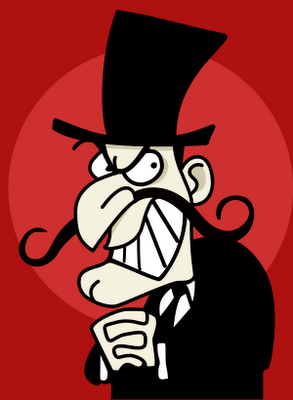
            My lovely lady was reading a script a while back where a naive country boy moved to Manhattan and was taken advantage of again and again.  And again.  And then one more time after that.  And every time it was made painfully obvious that the woman/ man/ indeterminate the main character was dealing with was screwing him over.  It was like reading a cartoon script where nobody recognizes Snidely Whiplash as the villain, even with his black cape, twirling mustache, and bad habit of ending every sentence with an evil cackle.
            Finally, there was a fairly popular sci-fi prequel this summer.  It featured, in one scene, a hissing alien which seemed to be a cross between an cobra, a python, and a gigantic, albino leech.  One of the human characters, you may remember, kept trying to pat it on the head.
            In each of these cases, the writers were so desperate to meet one or both of the first two requirements (establishing the threat and letting the reader know about that threat) that the third requirement suffered for it.  This is a recurring mistake I see when people try to create suspense.  My characters aren’t supposed to know about the bomb (to keep using our main example), so they just don’t see it.  No matter how much evidence there is that a high explosive device has been activated under the breakfast table, no one reacts.  Because if they reacted, there wouldn’t be any suspense.  So the attempt to create tension just creates a ridiculous blind spot instead.
            Y’see, Timmy, there’s a corollary lesson to be learned here.  If there’s a bomb under the table and my characters don’t know it, that could be considered suspense, yes. 
            However, if the bomb has a bright red flasher, ticks louder than Big Ben, and the characters still don’t know about it, that isn’t suspense. 
            It just means my characters are idiots.
            And it’s tough for any of us to relate to characters who are idiots.  I’ve mentioned a few times now that my characters should always be as smart as my audience.  If they’re not, everyone’s just going to get frustrated.  So when I’m building suspense and tension, I have to make sure it’s in a way that makes my characters look smart while still informing my readers.
            No, it isn’t easy.  If it was, everybody would be doing it.
            Next time, I want to talk about triangles.  They’re dangerous, pointy things.
            Until then, go write.

Categories