
February 8, 2013

The End of Houdini

            My apologies for missing last week.  There’s just a whirlwind of stuff going on with the re-release of Ex-Heroes coming up in a few weeks (pre-order a copy at your favorite bookstore now).
            Anyway, an odd title this time, I know, but it’ll make sense in a few minutes.
            But before then, if you don’t mind, I’d like to brag a bit.
            Most of you reading this know I worked in the film industry for many yearsbefore I started writing full time.  That’s pretty cool, right?  I got to hang out with a lot of actors and actresses you’ve heard of.  I had lunch and dinner with several of them, grabbed drinks at the hotel bar with some of them, even played pool with one or two of them.
            In fact, if I may brag a bit more, I fooled around with one of them.  An actress you’ve probably heard of who made it pretty big shortly after our little liaison.  We got drunk at a wrap party that was being held in her hotel.  It was nothing too serious, and we didn’t speak of it afterwards.  I wouldn’t be surprised if she’d written it off or forgotten it entirely, but it’s a small point of pride for me. 
            Wow, you’re thinking.  Good show, Pete.
            Honestly, though, this isn’t much of a story at all, is it?  It’s not like we dated for any amount of time or ever hooked up again.  If I were writing the story of my life, it’d be a minor detail at most.  Barely even a plot point
            And, of course, you figure that over the past fifty years there’s probably been a thousand actors and actresses in Hollywood who could claim that kind of status—someone you’ve heard of who’s undeniably attractive.  And if any of them had vaguely normal sex lives and appetites, they could probably claim that level of physical interaction with at least a dozen people (probably a lot more in the ‘60s and ‘70s).  That’s somewhere around twelve thousand people who could tell the same story as me.
            So it really happened.  But it’s not that interesting.  And it happened to a lot of other people, too.
            Now I said all this to remind you about Harry Houdini. 
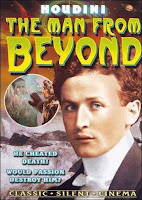
            I saw ads for that Cirque de Soleil movie around Christmas and I thought, wow, some production company did not learn from Harry Houdini.  The man’s career tanked with films, because on film anybody can do anything.  At the end of the day, the fact that Houdini was actually doing elaborate escapes on film didn’t matter.  Even in those early days, audiences had realized that people in Hollywood could do amazing things on screen.  They could shoot somebody with a rifle, set buildings on fire, even turn a man into a monster.  Getting out of a pair of handcuffs was nothing.  It was commonplace.
            Y’see, Timmy, if my story is depending on the fact that it’s real and true to make it interesting… well, that’s just not going to cut it. The moment we get caught up in a good story and believe in the characters and the events around them–even just for a moment–they’re real.  So no matter how powerful it may be to me personally, a truestory has to match that level of interest. A real character needs to compete with fictional ones.
            The movie Argois a great example of what I’m talking about.  I remember first reading about the events that inspired the film years ago, and I was blown away by them then.  It’s a heist story wrapped in a con game wrapped in a political tale.  That sounds fantastic, doesn’t it?  And in the hands of a storyteller who knows how to structure his narrative, it’s an absolutely amazing story.
            Who cares if it’s true or not?  It’s just a great story.
             In both books and movies, James Bond is really and truly a secret agent.  So is Jason Bourne.  Chuck Bartowski’s a secret agent, too.  John Carter of Virginia actually traveled to Mars.  The Avengers fought Loki and a bunch of aliens in Manhattan last summer.  I remember it like I was there. 
            If my stories are worth reading, whether they’re true or not is irrelevant.  They need to hit the same levels as these fictional stories.  They don’t need to be action-packed, non –stop thrills, or tons of gratuitous sex and nudity, but they need to have something original and compelling about them that’s going to be interesting to more than a few dozen people.  I’m not talking about universal appeal, but maybe at least… y’know, solar-system appeal.
            More appeal than there was between me and that actress, that’s for sure.
            Next time, on a related note, I thought I’d talk a bit about love.  It’s that time of year, after all.
            Until then, go write.
January 24, 2013 / 6 Comments

His But Looks Like an Asterisk

Bonus points if you get that reference…

Something quick for you.  I’m trying to finish some rewrites.

I’ve mentioned conflict once or thrice. Usually I prefer the term challenge, which has also shown up here a few times. Challenges are what make a story. When my character deals with problems, obstacles, and unexpected twists, that’s what makes them interesting and keeps the audience engaged.

Yeah, there are a few character-heavy stories out there that manage to have no challenges at all and still be interesting. Believe me when I say that they are very, very few and far between. Much, much rarer than some of our college writing instructors and chosen gurus would have us believe.

And really, at the end of the day, readers want to see challenges. They want to read about characters who are doing something active—physically, emotionally, spiritually. Ninety-nine times out of a hundred, characters who never face any sort of challenge are boring as hell.

And that hundredth time is a coin toss.

So here’s a simple test to see if my story has any kind of challenge in it.

Back when I was talking about expanding ideas, I mentioned that I should be using a lot of conjunctions when I explain my plot to someone. If you look back at the example I gave (the first half of Raiders of the Lost Ark) you’ll notice that but accounted for almost half the conjunctions I used. This is because but represents conflicts and setbacks. Indy finds the Ark of the Covenant, but Belloq and the Nazis steal it out from under him. I would’ve had a great time at the party, but my ex was there. Congress says they want to accomplish a lot, but the House and Senate never agree on anything.

Take your novel, screenplay, or short story. Try to summarize it one page. This isn’t a sales-pitch summary like you’d find on the inside flap of the dust jacket or on the back of the DVD. Write up an honest summary from beginning to end with all the beats and plot points. Don’t hold back, include as much as you can, but keep it at one page.

Now let’s take a look at it. How many times did you end up using but as a conjunction? You can count however if it shows up, and maybe though, as well.

If I can summarize my whole story without using the word but, I have a problem. Because but is where my challenges are. No but means no conflicts, and no conflicts means my characters aren’t doing anything worthwhile.

And that means they’re boring as hell.

Hopefully you see my point. But I’m sure some folks won’t.

Next time… hmmmm, not really sure what I’ll do next time. Open to suggestions as always. If none appear… well, I’m sure I’ll think of something really interesting.

Until then, go write.

January 18, 2013 / 3 Comments

The Magical Mystery Tour

             Yes, the Beatles also gave writing advice.

            Is there nothing they couldn’t do…?
            Back when I was in college, I submitted a story to a magazine.  It was loosely based on the myth of the Wandering Jew, and I’d had a character passing through time at a couple key events in history.  I later incorporated it into my college novel, The Trinity, which none of you have ever read.  For good reason.
            The story was rejected.  Not really a surprise, in retrospect, but the editor did send back a personalized response.  He congratulated me on my language, my characters, my dialogue, and my descriptions.  “However,” he said (paraphrasing a bit), “there isn’t much of a story here.  It’s a really neat magical mystery tour, but that’s it.”
            That term threw me a bit at first.  Wasn’t much of a story?  I’d written about an immortal passing down through the ages.  He was there for the Crucifixion.  The fall of Rome.  Magellan’s voyage around the world.  The Boston Tea Party.  How could this editor say there wasn’t a story?  Well, college-age me grumbled a bit and moved on, but I eventually figured out what that editor was talking about.
            Let me give you a few quick examples…
            (and these are just titles to get the point across—don’t read too much into them)
            Sometimes the tour might be the Non-Stop Laughs Roadshow.  We’ve all read these stories or seen these films, where every single line pushes for another laugh.  There’s never a pause to breathe, not even a moment.  Sight gags, puns, fart jokes, awkward pauses, absurd segues, funny voices.  Characters, plot, tone—nothing matters but getting the next laugh.
            Another version could be Merlin’s Wondrous Mobile Fae Emporium.  Every page has something else magical or supernatural to remind us what a magical and supernatural world this is.  I introduce the reader to ancient gods, spirits, supernatural creatures, and arcane mailmen.  Magical weapons, armor, jewelry, and household utensils.  Everything is magical.  Everything is from the dawn of recorded history. Except maybe the bathmat.
            No, sorry, the bathmat was woven on the loom of Fate with the silk of astral spiders.  But the washcloth is pretty mundane.
            The High-Tech Pan-Galactic Tour is sci-fi for the sake of sci-fi.  Because in the future or alien world that I’ve created, everything is different.  People wear clothes for different reasons.  They have robots that aren’t reallyrobots.  Things are powered in an entirely different way.  Transportation, food, the internet, entertainment… it’s all very alien and unrelatable.  Don’t even ask about sex.  In the future it’s so different you wouldn’t’ believe it.
            We could also call the tour, say, Captain Spaulding’s Traveling Horror Show.  It’s when people die one after another in horrible ways, usually after witnessing the gruesome death of the last poor bastard.  There’s blood and gore and some really nauseating dietary choices and a few nightmarish torture scenes.  Running someone feet-first through a meat grinder is tame compared to what happens in the horror show.
            In my case, it was the Historical Talent Show and Social Mixer.  If my story is set in the 1960s, my character will run into every single person you’ve ever heard of from that decade.  Fidel Castro, Andy Warhol, the Apollo 11 crew, the cast of Star Trek, Ed Sullivan, Harper Lee, Kurt Vonnegut, Kennedy, Nixon, Hendrix, Elvis, and (of course) the Beatles.  Most of them won’t do anything, but they’ll pass through and offer a few words here and there.  Maybe one of them will offer a helpful tip, but odds are they’re just there to get recognized.
            Y’see, Timmy, the mistake I made—one I still see lots of people make—is the assumption that a pile of plot points is the same thing as a story.  This is kind of like saying a pile of lumber is the same thing as a house, or there’s no difference between a palette of oil paints and the Mona Lisa.
            A lot of the time these stories will end up with a very episodic feel to them.  In the case of comedies, it’ll be a constant stream of setup-joke-setup-joke-setup-joke.  In horror stories, it’s victim-death-victim-death-victim-death.  The magical mystery tour almost always feels episodic because I’m using it to show you one thing after another with very little connection between them.  Oh, look, it’s the Crucifixion.  Oh, look, it’s Magellan.  Oh, look, it’s Paul Revere.
            All of these things I’ve listed above are great elements, no question about it.  If they’re not doing anything to advance the plot or the story, though, they’re just distractions.  There’s a point that this kind of thing is rich detail and there’s a point that it’s just padding.  And that’s the kind of detail that just slows down my story.
            Assuming I’ve even got a story.
            Any time you feel the need to drop a detail like this into your manuscript, stop for a minute and think.  This may absolutely be the greatest take on werewolves anyone’s ever put on paper, but if the werewolf’s only in the story to show this take… maybe I should save it for something else.  I may have scribbled the most elaborate death scene ever, but if absolutely nothing changes in the story when I swap out those six pages with “And then Phoebe killed Wakko,” maybe I should reconsider those six pages.
            And if I can just pull them out altogether without changing the story…  Well, I’ve got to wonder what they were doing there in the first place.
            Next time, I want to talk about your but for a little bit.  Especially yours.
            Yours… not quite so much.
            Until then, go write.
January 11, 2013 / 6 Comments

Guns. Lots of Guns.

            This is my rifle, this is my gun.  One is for killing, the other’s for fun.

            A while back there was a discussion on a page I browse semi-regularly.  A few folks were moaning about the overzealous use of firearms terminology in some stories.  It can get frustrating and distracting, I admit.  There are writers who feel a need to show off their knowledge by naming every single weapon, component and accessory their protagonist or villain is using.  Every time they’re seen.
            The term I’ve heard for this, which I have to admit I love, is gun porn.
            The real question, of course, would be… is this a bad thing or not? 
            The answer is one of those gray areas of writing.  It depends a bit on what the author’s trying to do.  It depends on the character.  Honestly, it’s a simple issue, but because firearms tend to be a very divisive subject—where some folks love and worship them to an almost obsessive degree and other folks hate and revile then to an equally obsessive degree—they get brushed into their own special category sometimes in writing, even though they don’t need it.
            See, a pistol or rifle is really just like any other object in my story.  It’s a name, and there’s a time for proper names and a time for pronouns.  To paraphrase the song, if every time Rufus Xavier Sarsaparilla walks into a room, Rufus Xavier Sarsaparilla makes a point of patting the holster of Rufus Xavier Sarsaparilla’s Sig Sauer Pro2340 pistol and considers that now maybe it’s time for Rufus Xavier Sarsaparilla to draw his Sig Sauer Pro2340 pistol…
            Well, Peter William Clines will be putting that manuscript down pretty fast.  Peter William Clines can tell you that much for sure.
            We’d all much rather read that when Rufus walks into a room he makes a point of patting the holster of his pistol and considers that now maybe it’s time for him to draw it. 
            Sometimes.
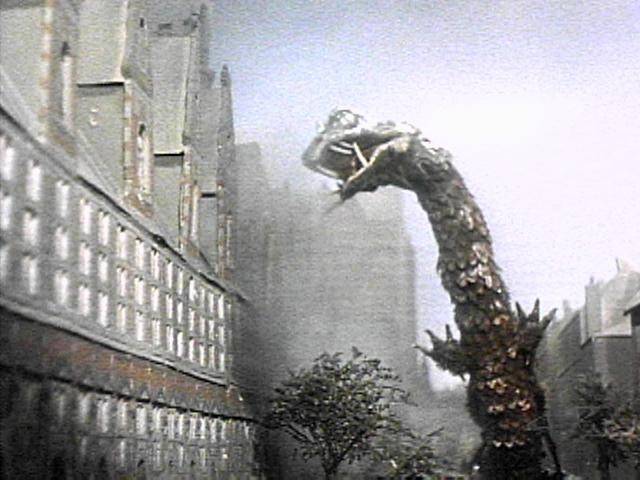
            On the flipside, I was watching an old giant monster movie the other day.  Not one of the classy ones from Japan, but a western attempt to cash in on the  craze.  At one point, the characters are gathered in the war room looking at a map of the city, trying to figure out if they’ll be able to stop the monster or not.  And the three-star general stabs his finger down on the map and says “We’ve got to get it out in the open so we can throw all our stuff at it!”
            All our stuff…?
            Y’see, Timmy, just like some characters, there’s going to be times it makes perfect sense to write out the full name of a pistol, and some when it’s perfectly fine to just call it “her pistol” or “his rifle.”  There will be times when the full name of a weapon is going to be a distraction more than anything else, but also times that it’s going to seem silly and out of character not to use it.  It’s important for me to remember that it isn’t always about what I know or what’s right—it’s about what the character knowsand thinks is right.  A trained assassin might see a Heckler & Koch G36, but a schoolteacher’s probably just going to see a big, scary-looking machine gun.
            In my own book, Ex-Patriots, Stealth is a deductive genius and a walking Wikipedia.  She’s Sherlock Holmes in spandex and body armor.  Early in the book, when she first encounters the soldiers from Project Krypton, she immediately identifies the exact model of rifles they’re using and realizes the unusual way the weapons are being used.  Yet in that same moment, it’s clear St. George—a former maintenance guy—has no clue what kind of rifles the soldiers are using.
            Watch The Matrix sometime.  Is that a love letter to gun culture or what?  And not a single weapon is named in the movie.  Not one.  The closest they get is when they talk about the EMP they use against the Sentinel robots.
            I just finished reading one of the Harry Dresden books by Jim Butcher, and at one point Harry and his friends end up with a few pistols and shotguns.  And that’s what they’ve got—a few pistols and shotguns.  Harry identifies one of the pistols as a 9mm when he gets it, but that’s all the explanation we ever get.
            Ash may have his double-barreled Remington 12 gauge, but most of us just think of it as his boomstick.  And that name really fits with a guy who’s not too bright and making a lot of stuff up as he goes.
            We all know Chekhov has a rifle hanging above the mantle, and we accept that as sage bit of writing wisdom.  Yet who among us has stopped to question what kind of rifle it is?  I’d bet a ton of money that nobody here has, because it’s just not important.
            As a small side note, I mentioned a ways back that this is a good rule of thumb for screenplays.  Unless it is life-or-death important to the plot that the bad guy is carrying a Glock 34 9mm with a custom rubber grip—I mean, the plot will collapse if he doesn’t have this specific weapon—then I’m not going to waste my words naming weapons.  When the movie gets made, there are going to be prop masters and armorers who know much more about this stuff than me, and they’re going to make good choices so we all look good.  Until then, my characters can just have pistols, shotguns, machine guns, and so on.
            And on another somewhat related note… a common criticism I see is folks shrieking, “They’re called magazines, not clips!”  This is kind of the same issue as above.  Sometimes I need to make sure that the weapons are loaded with magazines, but there are just as many times it makes more sense to call them clips—even though it’s inaccurate.  Yes, many folks who knows their weapons knows the difference.  If my characters don’t, though, then it wouldn’t be that surprising for them to call that thing holding bullets a clip.  It’s been a common mistake for almost eighty years, after all.  In fact, it’d come across a bit odd and fake if every non-soldier and non-gun-enthusiast in my story used precise firearms terminology.
            So here’s a little suggestion I’ll toss out for you.  Maybe this’ll work for you, maybe it won’t.  The next time one of your character pulls his pistol or swings up her rifle, ask yourself this…
            Would you be as specific and descriptive with the weapon’s name if it was a bow?
            There are lots of different types of bows, with many strings, grips, pulls, models, extra add-ons, and so forth.  That’s not even counting the arrows themselves, and the different shaft lengths, fletching, heads, and notching.  Professional archers are very specific about what they will and won’t use.  So at this moment in your story, if someone aimed their bow at your character… how much detail would you feel compelled to use?
            If the answer is “not much,” maybe that’s a sign to rethink how much detail’s going into that firearm.
            Next time, courtesy of the Beatles, we’re going to take a little trip.  Odds are you won’t enjoy it.
            Until then, go write.

Categories