
July 11, 2025

Nothing At All…

Okay, so last time I talked about using said. Just plain, basic said. It’s the workhorse that makes all those other dialogue tags special and not just static on the page.

This time I kind of wanted to go the other way and talk about not using said.

In fact, let’s talk about using nothing at all.

One thing about dialogue is it’s almost always between two people. A binary system, if you will. Ninety-something percent of the time, it just goes between me and you and back to me and back to you.

Think of it like playing pickleball. Too hip? Okay, think of it like playing tennis. Except we’re just lobbing the ball back and forth and back and forth. And the ball (our dialogue) can only ever be between two players, right? Even if there’s four people on the court, right now it’s only going between me and you and me and you.

Now because of this back and forth aspect of dialogue, there’s a lot of times I can skip tags altogether. If I know it’s me then you then me then you, well, you know who speaks next, right? And who speaks after that? And then the next logical person is…? Honestly if it’s just the two of us and I speak first, there’s only one other person who can be speaking.

Tell you what. Here’s a little peek at the first chapter of God’s Junk Drawer

———————–
Kyle moved toward the front of the bus. “Why’d you even sign up for this if you’re dumping him?”

Olivia let out a long sigh. Let her shoulders slump. “It was a surprise. He signed us both up without telling me. And I’m not dumping him.”

“Yeah?”

“No.” She finally stood up. Slung her coat into her armpit. “Dumping implies we’re in a relationship.”

“Aren’t you?”

“No.”

“He thinks you are.”

“Having sex a couple times a week isn’t a relationship. It’s just having a workout buddy you see naked sometimes.”

“So it’s not working out anymore, I guess?”
—————————

Barely any dialogue tags there at all. But it’s still pretty easy to follow, right? Back and forth, back and forth. When you got to the end, was there any confusion who got in the last word?

Even if I’ve got a bit with more than two characters in it, it’s pretty much always me to you to me to you. If someone else chimes in (or, to keep our metaphor, I knock the ball to someone else)? Then it’s me to you to me to her to me to her. Back and forth. Back and forth. Always a binary.

Sticking with our tennis metaphor just a bit longer, here’s an easy rule of thumb. If I’m sending the ball back to the same character who just sent it to me, I probably don’t need to identify them. I can skip the dialogue tag. But if someone new hits the ball, I should say who they are.

Here– let me give you one more bit from that same chapter of God’s Junk Drawer

—————————
Olivia adjusted the backpack’s strap on her shoulder. “We should probably get going.”

Logan jerked his head at the far side of the parking lot. “I think I might hit the bathroom.”

“Better be quick,” she told him, “or we’ll have to leave you here.”

“We’re not in a rush.” Kyle shook his head. “So fucking dumb.”

Logan shot him a look. “Seriously, stop saying dumb.”

“Whatever. You both know we don’t need to be there exactly at sunset. It’s not like the universe is going anywhere.”

Olivia shrugged. “Maybe the part he wants to show us is.”
—————————

Three people talking, but when you hit that line starting with “Whatever” were you confused?

Now I’m not going to lie. This is a bit tougher to pull off. I’ve got to have a good ear for dialogue and my characters need to have a strong voice. I also need to have a good sense of timing—how long can I keep that ball in the air before I need to address who just hit it? We’ve all had that moment, right? We’re reading a long stretch of dialogue with minimal or no tags, and then there’s suddenly that jarring moment of “Wait… he’s saying this?!?” And then we work backwards up the page trying to figure out where the rhythm broke and we lost track of who was saying what.

And I won’t lie. It’s not unusual for me to get a note or two from editors or copy editors as they go through a manuscript, just checking if we need to clarify who’s speaking at a given point. It’s worth pointing out, though, that one time when they were asking for this clarification it was because they’d deleted a line of dialogue… and now the rhythm was broken. It was back and forth and back and back and forth and back. Of course it seemed confusing now.

We don’t need that many tags. Again, this isn’t true 100% of the time. Not much is when you’re writing. There’ll be times when people are arguing—maybe lots of people—and shouting over each other and I want to use more dialogue tags. Just to be safe. But these are going to be the exceptions.

So trust your tennis game. Or writing game. And see how often you don’t need to use dialogue tags.

Next time, I’d like to talk to you a bit about, well, how to deal with things. One specific thing.

Until then, go write,

June 30, 2025

June ’25 Newsletter

As I have in the past, I’ll remind you that you could subscribe and get this newsletter delivered right to your inbox, rather than waiting two weeks or so for it to show up here on the ranty blog. And that timeliness might be helpful in the next few months.

Just sayin’…
>>>>>>>>>>>>>>>>>>>>>

Sorry this is a bit late. Can’t imagine what’s going on that would have everyone feeling overwhelmed. Or exhausted. Or scared. Or filled with an overwhelming need to doomscroll…

I don’t think there’s anything new I can say about the shape the United States is in, domestically and internationally. Over a century of power and influence, decades of financial power, all destroyed in less than six months. Brownshirts running unchecked in the streets. And the whole country basically defenseless against the next natural disaster to strike, be it climate-related or disease.

And we’ve still got three and a half years to go.

Ha ha ha ha haaaaaaaaa…

Anyway, let me try to distract you (and me) from all that for ten or fifteen minutes.

As I’m writing this, I just finished up one last rewrite of TOS last night and set it off to my agent this morning. I’d thought the last draft was pretty solid, but he read it and made one little suggestion that just… I mean, it was a little thing, but it was absolutely perfect. A little thing that was a big thing. Honestly, I was kicking myself that I hadn’t thought of it to start with. So I spent, well, the past month rewriting TOS to include this change (and all its necessary ripples throughout the manuscript) and the book is very seriously better for it.

I know some folks like to complain about agents for, well, a bunch of reasons (and some of of them are kind of nonsense), but the truth is I have a really good working relationship with my agent. I mean, there’s the obvious plus of having a business partner who’s all about the business side of this career (freeing me up to just think about the art side of it). But it’s also good to have someone who looks at my ideas and manuscripts from that point of view, thinking about what might help something sell and what might hurt its chances. I mean, that’s the whole point of having an agent, right? To help you sell stuff. Sometimes we agree. Sometimes we disagree and we talk about it for an hour or so.

And yeah… sometimes he drops a really cool idea in my lap.

Let’s talk about God’s Junk Drawer!

As I was writing this newsletter (like, rewriting that last big paragraph) I got an email showing off the cover for the ARC (advance reader copy, if you didn’t know). Those are getting printed up and will be going out to folks very soon. And we may even have two or three at a certain upcoming comic-centered convention in San Diego (more on that in a bit).

We also had a big meeting about publicity/ marketing stuff and… yeah, I’m doing it. Big west coast signing tour! New England signing tour! Driving home across the country signing tour! Exact dates still need to be nailed down, but we’re looking at starting in San Diego on November 11th, release day, and then driving all the way up to Seattle (stopping several times) and all the way back. Then flying out to New England the first week of December for five or six signings throughout the area. And then driving back to San Diego and stopping at a few places along the way (including but not limited to Albany, St. Louis, Tulsa, Amarillo, Phoenix…). And then I get home and sleep until Christmas morning. We’re hoping to have it all nailed down by August soooo… two newsletters from now? As always, you’ll probably be the first to know

I’m also probably going to do a little preorder bonus right around then, most likely just for those of you reading this newsletter. That’ll keep it from getting too overwhelming. Show me proof of preorder and I’ll send you <<REDACTED FOR NOW>>. And since we’ll know all about the book tour by then, you can preorder at your friendly local bookery. They win, you win, we all win!

Speaking of preorders… a while back I mentioned Dread Coast: SoCal Horror Tales. It’s a charity anthology and a big chunk of the proceeds go to help with recovery from the California Wildfires at the start of the year (yeah, that was this year. Barely five months ago). It’s got a story from me called “Flesh Trade” which, up until now, has only been available in my audiobook-only collection Dead Men Can’t Complain. So you can also preorder that now from your favorite bookologist.

And looking not-as-far into the future… San Diego Comic-Con is next month! Maybe I’ll see you there? I know the final schedule hasn’t been released, but I think it’s okay to tell you I’m going to be there and doing panels on Thursday and Friday, and a few signings those days as well. Plus wandering around looking at toys and saying “hi” to folks I know. I should have the locked schedule soon, and it’ll be on my website and maybe a quick bonus newsletter?

What else could I blab on about…?

Cool Stuff I’ve Been Watching
Well, was kind of crushed by the season finale of Doctor Who, but I won’t say anything in case you haven’t seen it and have avoided spoilers.. Absolutely loving Murderbot. We’ve also ducked back to watch the last season of The Dragon Prince and it got me wondering… is this the longest running Netflix show? Seven seasons. I know there’s a lot of series there, but I mean, shows made by Netflix for Netflix. And I think Ironheart starts next week. I’ll probably give it a try.

Cool Stuff I’ve Been Reading
I feel like I’ve just gotten to read SO much good stuff lately. Overgrowth by Mira Grant a.k.a. Seanan McGuire is simply fantastic, and probably my favorite thing she’s ever written. Chuck Wendig’s The Staircase in the Woods is amazing. I also got to read an early copy of Robert Brockway’s I Will Kill Your Imaginary Friend For $200 and despite that title it’s skin-crawlingly creepy and just plain wonderful.

Cool New Toys
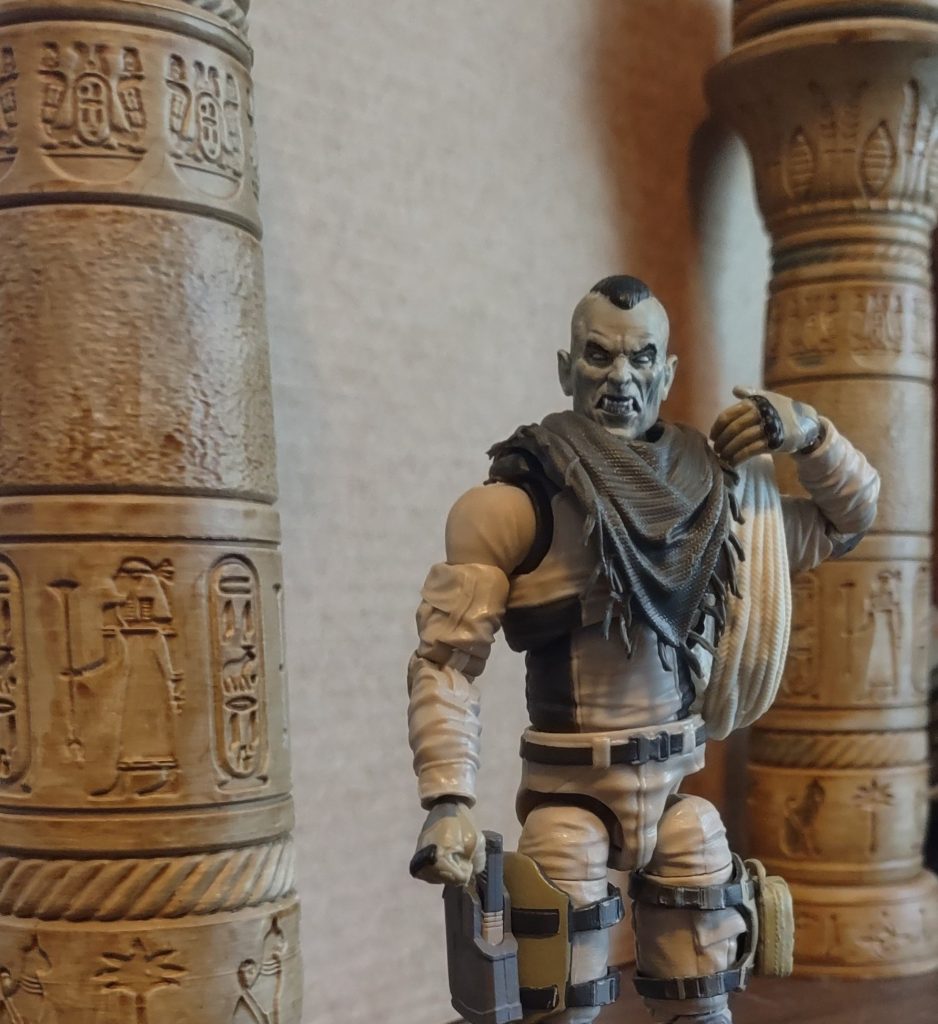
I finally took my Rom figure out of the package and took some fun photos with him. Also, for my birthday, my beloved got me this fantastic Gladiator Hulk figure, based off how he looked in Thor: Ragnarok. It’s simply massive and wonderful.

And I think that’s all I’ve got for you right now. Many thanks, as always, thanks for reading. See you again in mid-July (just before SDCC).

Okay, quick-ish.

I’ve mentioned before that I started writing very young, and at some point—maybe late high school or college—I finally understood that the key to being a successful writer was all about vocabulary. Not using common words and only using extraordinary ones! The thesaurus was my best friend. Using a rare word just showed what a good writer I was, and using an obscure word… well… clearly the money and awards were going to be rolling in. Once I finished something.

One of the places I… okay, wait, let’s just be honest. This is a horrible way to approach writing. Just awful. I shouldn’t be trying to make my writing hard to understand or read. If people need to pause on every sentence and try to work out a word’s meaning from context… that’s not great.

That said, one of the places where I did this a lot was dialogue. Somehow I got it in my head that only losers used the same dialogue tags on the same page. There were thousands of better words out there, and I was going to use every. Single. One of them.

As I’ve mentioned before, the first time I got to sit down with an editor to talk about my writing, his opening words to me were not “this is amazing, let me give you twenty bazillion dollars” they were, in fact, to just use said. Stop with all the muttering, mumbling, grumbling, stating, shouting, hollering, whispering, gasping, declaring, ejaculating (oh yes), exclaiming, and calling out and just use said. Said, he told me, is invisible.

There are a lot of folks out there who will try to convince you said is pedestrian or boring or flat. That it’s what lesser writers use because they can’t think of anything else. I mean, there’s dozens of lists on the internet—many from writing teachers!—of “better” dialogue tags to use.

But the truth is, said doesn’t slow writing down. It doesn’t trip people up. It’s what most professional writers use. It’s a solid workhorse that lets me save those other dialogue tags for when they’ll actually matter, when it’s important that readers hear that mutter or shout or exclamation.

Plus…

Okay, let’s have another moment of brutal honesty. When we start out as writers, a lot of our dialogue is… not good. It’s awkward and on the nose and kind of flat on the page. Mine definitely was. So I think sometimes we latch onto those other dialogue tags because they help us get the point across. They’re sort of like an adverb or adjective for the whole sentence, in the sense that they’re not inherently wrong, but I also probably wouldn’t need them if my dialogue was stronger

So some people are a bit… shall we say, reluctant to let go of the idea they should always use much, much more than said.

Don’t worry about them. Just use said most of the time. I can use the other ones too, sure, but I try to think of them like exclamation points. The more I use them, the less powerful they become.

And I want my writing to be powerful.

Now, just to be contrary, next time I’d like to talk about not using said.

Until then, go write.

Okay, I’ve fallen waaaaaay behind in ranty blog posts over the past two months, so let me take a few minutes and try to make it up to you

As it happens, I wanted to talk about redemption stories. You know, where our hero has done something awful in their past and is now seeking to balance the scales one way or another. Maybe by actively trying to make up for it or by punishing themselves for it.

Right up front, if I want to write about redemption a key thing is empathy. A good redemption story depends on me knowing how my readers will respond to various incidents and actions. If I don’t have a good sense how something will go over, it’ll be easy for my redemption tale to seem pointless, silly, confusing, melodramatic… or, y’know, all of the above.

And, as usual, none of this is ironclad, heavily researched and sourced literary theory that I rigorously defended for my thesis or anything like that. It’s just observations from many, many years of reading and watching stories. Your mileage may vary.

That said… a redemption tale could either be the main thrust of my story or it just part of a single character’s personal arc. Either way, I think my story has to hit a couple of key points. Not in an “introduce the first conflict by page 23,” way, but more in a general “let’s talk about the characters and the story” way. If I don’t have these points in mind, there’s a good chance that my “redemption” story may end up a little lacking

1) Does my character need to be redeemed?
This is one of those “obvious” things that I’ve seen a fair number of folks mess up. If I’m going to tell a redemption story about Wakko, he needs to have actually done something that requires redemption. It’s really cool that Wakko wants to sacrifice himself to make up for his past sins, but if he doesn’t have any past sins… well… That’s not redemption, it’s just a pointless sacrifice. Wakko needs to have something in his past (or do something very early in my story) for which some form of redemption is required. For this post, let’s call it his key event.

This is my first big empathy moment as a writer. If I can’t predict what actions (or lack of actions) my audience will see as needing redemption, my story can get silly pretty quick. There are some things—even things we’d all agree are bad things—that just don’t tip the scales into that “I need redemption for this” territory. Accidentally kicking my cat is bad, but it’s probably not worth a novel of me trying to make up for it Wakko should not be going on a ten year penitent crusade around the world as penance for putting a red sock in the wash (unless comedy is my goal). If he’s really guilt-ridden about that nickel he picked up off the sidewalk when he was six… again, I’d better be writing a comedy.

Also, please note I’ve been referring to the key event as something in the past. That’s going to come up again.

So what was Wakko’s key event? Did he knowingly write a bad check? Peek in someone’s bedroom window when he was fourteen? Sabotage a relationship? Steal a car? Blackmail someone? Maybe… kill someone?

This leads nicely into…

2) Can my character be redeemed?
Somewhat related to the first point. Much like the key event needs to cross a certain threshold to be redemption-worthy, I think we can all agree that there’s another threshold where it’s going to be a lot harder for someone to balance the scales. Maybe impossible. That’s true in pretty much any society, past, present, or future. Sometimes people do things that are beyond redemption. It’s really tough to imagine anything a serial child rapist could do to make up for what they’ve done.

I’m sure some of you immediately thought “well, they could die,” but that’s not redemption, is it? It’s just death. Possibly revenge, but that’s a whole different animal.

So when I’m writing Wakko’s redemption tale, I need to really think about what he’s done. Again, this is going to be an empathy issue. Will my readers think his key event is a redeemable act? Or is it so extreme nothing could ever make up for it.

3) Does my character want to be redeemed?
This may sound obvious, but I can’t force redemption on someone. That’s not how it works, despite everything the Inquisition tried to teach us. Wakko needs to want it.

And… maybe he doesn’t. Maybe he doesn’t feel like he did anything wrong. Perhaps he paid his fine or wrote his apology letter or served his time and considers the matter closed. Or it could be he knows it was wrong and just doesn’t care. Maybe he feels he’s beyond your petty ideas of right and wrong. Some people are like that. If that’s the kind of character I’ve written Wakko as, it’s going to be tough to do a convincing redemption story about him.

4) Why hasn’t my character done it before?
Okay, for this one, I want to toss out what I personally think is a pretty solid rule of thumb… Feel free to agree or disagree down below.

In a good redemption story, a notable amount of time needs to pass between the key event and the redemption for that event.

Y’see, Timmy, in my opinion one of the main elements of redemption (from a story point of view) is guilt. If I don’t feel guilty about the key event, why would I want redemption?

With that in mind, if I’m taking care of things immediately after the key event, this isn’t so much redemption as it is… well, cleaning up. Wakko may feel awful about having to clean up the mess he made, but does he really feel guilty? If I hit someone with my car, it’s the difference between calling 911 and sitting with them until the ambulance comes… or switching my headlights off and speeding away. I may feel bad in both situations, but they’re two very different situations.

So what made Wakko run from his key event? Why didn’t he clean up his mess right then? What’s kept him from admitting it or doing anything about it until now? Denial? Fear?

And this one leads nicely to a sort of two in one, Watsonian-Doylistic point…

5A) Why is my character doing it now?
If I accept that Wakko’s tried to hide that key event for weeks or months or years… why is he looking for redemption now? What’s changed for him as a character that he’s decided to acknowledge this and make amends, starting today? What’s his (and I hate myself for saying this) inciting incident?

This is yet another empathy moment for me, the writer, because this is a big decision for any character. It’s a major change of course. They’re going against what they’ve done up until this point in their lives. If this isn’t a believable change of heart, my whole story could fall apart.

5B) Why is my character doing it now?
Looking at this as the writer, from a story point of view, why is this happening now? Odds are Wakko’s going to start thinking about redemption in this story, because I write about active characters who actually do things. So why have I included this? Am I just looking to give him some flavor and round him out a bit as a person? Is it the main plot of my whole novel? No matter why I’m doing it, this decision and the repercussions from it need to fit into the structure of my story and into Wakko’s arc as a character.

6) Does it balance the scales?
At the end of the day, every redemption story comes down to this. Has Wakko made up for what he did? Does he believe he did? Do other character think things are even now? Are my readers going to think he’s redeemed himself, or is it going to come across a little thin or forced?

I mentioned death up above—well, you thought about it, I mentioned it—so it’s probably worth talking about that. A lot of folks try to use death as the ultimate balancing agent. A life for a life, redemption achieved, and so on. I mean, sure, Wakko robbed, raped, and murdered his way across the country, leaving hundreds of people physically and/ or emotionally scarred, but in the end he died saving that little kid from getting hit by a bus And that makes it all okay, right?

No, of course it doesn’t. In fact, if not handled just right, death can come across as cowardice or a “he got off easy” situation. It can even look like laziness or a cop-out on the writer’s part. I mean, I don’t have to deal with all these complex emotions and repercussions if Wakko just gets a bus in the face. But it still counts as a strong resolution, right?

Right?

And there you have it. This is the kind of stuff I think about when I’m trying to do a redemption arc story. And if I don’t have good answers for most of these points, well, maybe I need to look again at how I’ve set up my story. Or my character.

Because there’s a decent chance they’re not on the road to redemption.

Next time I’d like to say something about said

Until then, go write.

Categories